SRS Account Sep 2026: How the Fed Rate Hike Affects Your Fixed Income Options
Published September 2026 · CPF & SRS Investing · The Kopi Notes
Your SRS account gives you a powerful tax-deferred space for fixed income investments — and the Fed’s rate hike in September 2026 is about to reshape your best options. With 6-month T-bill yields projected to rise from 3.50% to 3.80% post-hike, SRS holders who act before the next cut cycle could lock in meaningfully higher returns on the money they’ve already shielded from tax.
Not financial advice. All figures are for educational reference only. Data as at September 2026 unless noted.
- The September 2026 FOMC rate hike pushes Singapore T-bill yields higher — SRS investors benefit directly from this.
- T-bills remain the highest-yielding low-risk SRS option at ~3.50–3.80% post-hike; SSB trails at 2.32%.
- S-REIT ETFs within SRS offer 5–6% yield potential but come with price volatility — rate hikes create short-term pressure.
Table of Contents
Jump to Section
- What Is the SRS Account?
- The September 2026 Fed Rate Hike — What Happened
- T-Bills Inside Your SRS: Before and After the Hike
- Singapore Savings Bonds in SRS
- Endowment Plans and Fixed Deposits in SRS
- S-REIT ETFs in SRS: Higher Yield, More Volatility
- SRS Fixed Income Comparison Table (Sep 2026)
- Your SRS Action Plan for Q4 2026
- Frequently Asked Questions
What Is the SRS Account?
The Supplementary Retirement Scheme (SRS) is a voluntary savings programme under the Ministry of Finance. It lets you contribute pre-tax income up to S$15,300 per year (S$35,700 for self-employed), reducing your taxable income dollar-for-dollar.
At withdrawal — from age 62 onwards — only 50% of withdrawals are taxable. That means if you withdraw S$40,000 in a year, only S$20,000 counts as income. For many retirees, the effective tax rate on SRS money ends up close to zero.
But here’s the part many people overlook: SRS money can be invested. Leaving it in your SRS account earns just 0.05% per year — essentially nothing. You can invest in T-bills, Singapore Savings Bonds, unit trusts, shares, ETFs, and endowment plans instead. This is where the September 2026 Fed rate hike matters.
For a deeper primer on how to grow your CPF and SRS together, see our guide on CPF investment strategy Singapore.
The September 2026 Fed Rate Hike — What It Means for Singapore
The US Federal Open Market Committee (FOMC) met in September 2026 and raised the federal funds rate target. Futures markets had been pricing in a hike rather than a cut in the weeks leading up to the decision — a reversal from the easing cycle that many expected earlier in 2026.
Singapore doesn’t set rates based on the Fed directly. MAS manages the Singapore dollar through the exchange rate policy, not an interest rate target. But in practice, Singapore’s T-bill yields, fixed deposit rates, and SSB coupon rates all track global rate movements — especially US Treasuries — closely.
When the Fed hikes, two things tend to happen in Singapore:
- T-bill cut-off yields rise — the 6-month MAS T-bill tends to price higher as investors demand more return to park SGD in short-term paper.
- S-REIT prices face short-term headwinds — higher rates make the spread between REIT yields and the risk-free rate look less attractive, leading to price pressure (even though underlying rents and DPUs may hold up).
Both effects matter if you’re managing a SRS portfolio. The good news: the first effect benefits fixed income SRS holders. The second creates opportunity for patient REIT investors willing to wait it out.
T-Bills Inside Your SRS: Before and After the Rate Hike
Six-month Singapore T-bills are one of the most SRS-friendly instruments available. They are backed by the Singapore government (AAA-rated), they mature in just 6 months, and they can be purchased using your SRS funds through your bank’s investment platform — OCBC, DBS, and UOB all support T-bill subscriptions from SRS accounts.
Before the September 2026 hike, the cut-off yield on the 6-month T-bill was hovering around 3.50%. Post-hike, analysts and auction history suggest yields could rise to the 3.70–3.90% range on subsequent auctions — particularly if the Fed signals further tightening.
For an SRS investor, this is significant. Unlike CPF contributions (which are locked until 55 or retirement), SRS funds can be deployed at each T-bill auction every two weeks. You can roll your position regularly — and each roll benefits from the higher rate environment as long as the hiking cycle continues.
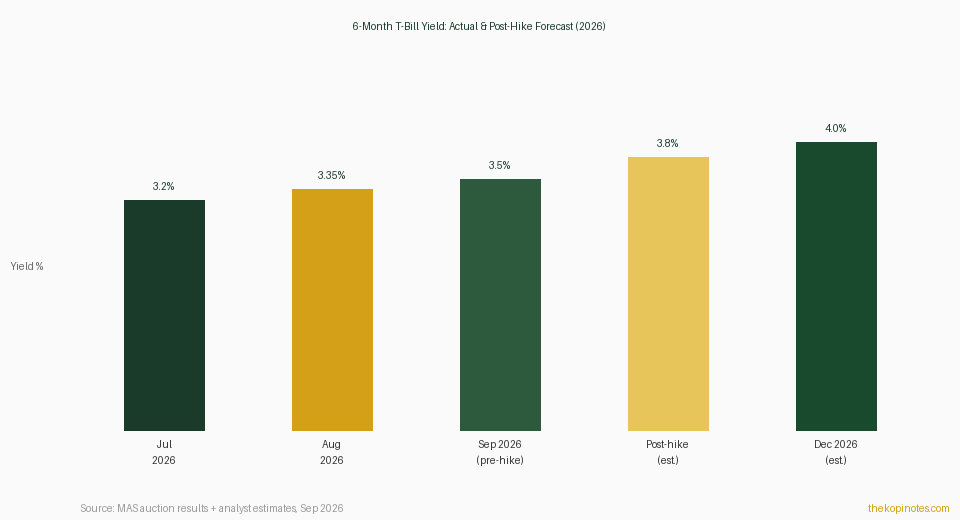
Estimated T-bill yield trajectory (Jul–Dec 2026). Actual auction outcomes may vary. Source: TKN analysis based on MAS auction data and FOMC projections.
For more context on how T-bill auctions work and how to apply via SRS, see our full Singapore T-bills 2026 guide.
Singapore Savings Bonds in SRS: Lower Yield, More Flexibility
Singapore Savings Bonds (SSBs) are also available for SRS investment. The October 2026 SSB offers a 10-year average return of approximately 2.32%. This is lower than the current T-bill yield, but SSBs have one important advantage: you can redeem them any month without penalty.
For SRS investors who want a stable parking spot for funds they might need to shuffle around, SSBs offer peace of mind. But from a pure yield perspective, the T-bill is ahead — and after a rate hike, the gap may widen further.
You can check the latest SSB rates on the MAS website. New SSB tranches are announced each month.
For a complete comparison between SSBs and T-bills for SRS, see our Singapore Savings Bonds guide.
Endowment Plans in SRS: Steady but Illiquid
Insurance endowment plans purchased with SRS funds can offer guaranteed yields in the 2.5–3.2% range for 5–10 year tenures. These are typically sold through insurers like Prudential, Great Eastern, AIA, and Manulife.
The trade-off is illiquidity: you typically cannot exit an endowment plan early without penalties. For SRS investors who are still decades from retirement age, this can make sense — you’re locking in a known yield for money you won’t need for years. But if you think the rate environment will keep improving, locking into today’s endowment rate may not be the best move right now.
The general rule of thumb: use T-bills for SRS funds you want flexibility with, and endowment plans for SRS funds you know you won’t need for 5+ years.
S-REIT ETFs in SRS: Higher Yield Potential, With Rate Hike Headwinds
The highest-yielding option for SRS investors is the S-REIT space — particularly through ETFs like the NikkoAM-StraitsTrading Asia Ex Japan REIT ETF (CFA) or the Lion-Phillip S-REIT ETF (CLR). These distribute dividends quarterly, with trailing yields in the 5–6% range as at mid-2026.
Here’s the catch: a rate hike puts short-term pressure on REIT prices. When risk-free yields rise, investors demand higher REIT yields too — which means REIT unit prices have to fall to adjust the yield upward. This can cause your SRS portfolio to show paper losses in the near term, even if the underlying distributions remain healthy.
For long-term SRS investors (10+ years from drawdown), this is likely a buying opportunity rather than a reason to avoid REITs. You’re buying more units at a lower price, and the distributions keep flowing into your tax-sheltered SRS account.
For shorter-horizon SRS investors (5 years or less from drawdown), the fixed income options — T-bills and SSBs — offer more certainty at a reasonable yield.
For a full breakdown of S-REIT ETF options in Singapore, see our Singapore REIT ETF guide.
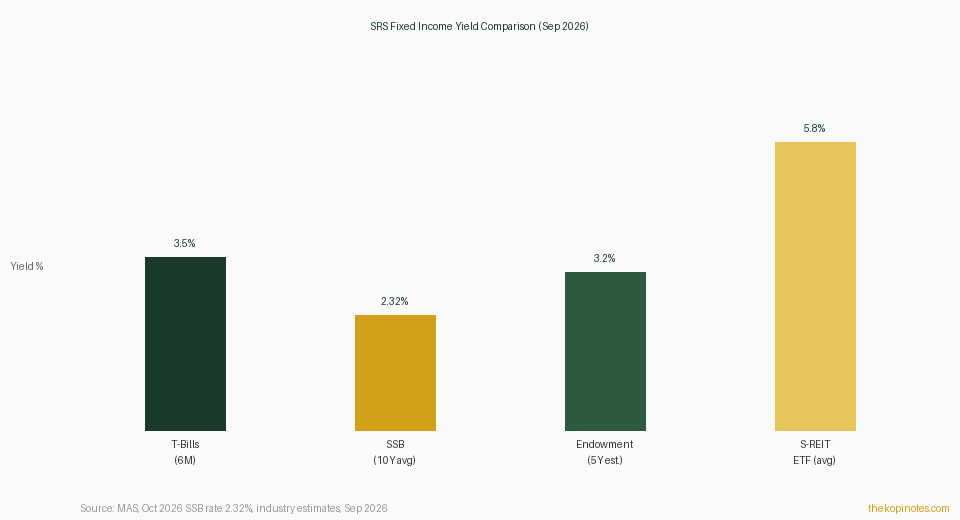
SRS fixed income yield comparison (Sep 2026). T-bill yield post-hike is an estimate. S-REIT ETF yield is trailing 12-month distribution. Source: TKN analysis.
SRS Fixed Income Comparison Table (Sep 2026)
| Instrument | Yield (Sep 2026) | Liquidity | Rate Hike Impact | SRS-Compatible? |
|---|---|---|---|---|
| 6-Month T-bill | ~3.50–3.80% | 6 months (rollable) | Yield rises ✅ | Yes |
| Singapore Savings Bond | ~2.32% (10yr avg) | Monthly redemption | Lagging uplift | Yes |
| Endowment Plan | ~2.50–3.20% (guaranteed) | Illiquid (5–10yr) | Locked rate, no change | Yes |
| S-REIT ETF (e.g. CLR) | ~5.50–6.00% (trailing) | Daily (exchange traded) | Price pressure short-term | Yes |
Source: TKN analysis, MAS data, SGX, insurer product sheets (Sep 2026). T-bill yield post-hike is an estimate. Not financial advice.
Your SRS Action Plan for Q4 2026
Here’s how to think about your SRS portfolio given the September 2026 rate hike:
If you’re 10+ years from retirement age (62): Consider holding a split between T-bills (for yield) and S-REIT ETFs (for long-term distribution growth). A rate hike creates an entry point for REITs. You have time to ride out price volatility. Check out the Singapore retirement planning calculator to model your SRS drawdown.
If you’re 5–10 years from retirement: Lean heavier on T-bills. The 3.50–3.80% yield is meaningful with no credit risk. Roll your T-bill position at each auction to capture any further rate increases. Avoid locking into long-tenure endowment plans if you think the rate cycle still has room to run.
If you’re within 5 years of drawdown: Capital preservation matters more. T-bills and SSBs should dominate. SSBs are particularly useful here — you can hold them while the rate environment evolves, and redeem monthly if you need to shift to higher-yielding T-bills.
For SRS account investment platforms, you can invest in T-bills, SSBs, and ETFs through DBS, OCBC, or UOB’s SRS investment portals. You can also invest in S-REIT ETFs through a brokerage linked to your SRS account via Syfe referral code (for Syfe’s managed portfolios) or FSMOne referral code (for self-directed ETF buying).
If you’re still building your SRS corpus, don’t forget to check whether you’ve maximised your contribution limit for 2026 — remember, every dollar contributed saves you your marginal tax rate upfront.
Frequently Asked Questions
Can I buy T-bills using my SRS account?
Does the Fed rate hike directly affect Singapore T-bill yields?
Is it better to hold SSBs or T-bills in my SRS during a rate hike?
Should I shift my SRS out of S-REIT ETFs because of the rate hike?
What is the maximum SRS contribution limit for 2026?
Can I invest my SRS in both T-bills and S-REIT ETFs at the same time?
Are SRS withdrawals taxed?
This article was researched with the help of AI. While we strive to keep all information accurate and up to date, there may be errors. If you notice any discrepancies, please contact us.