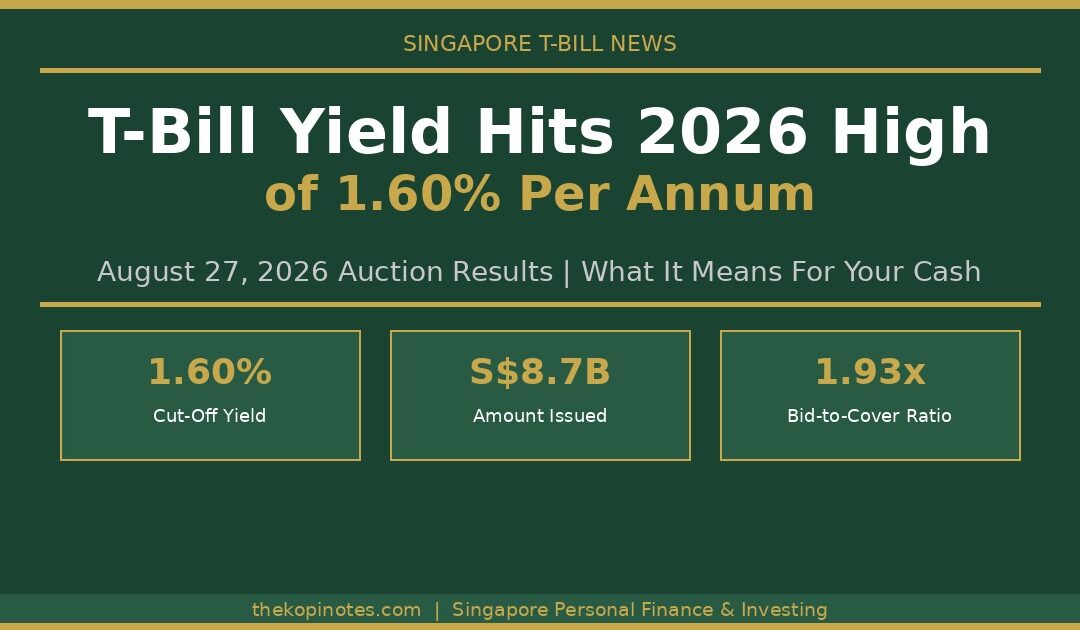
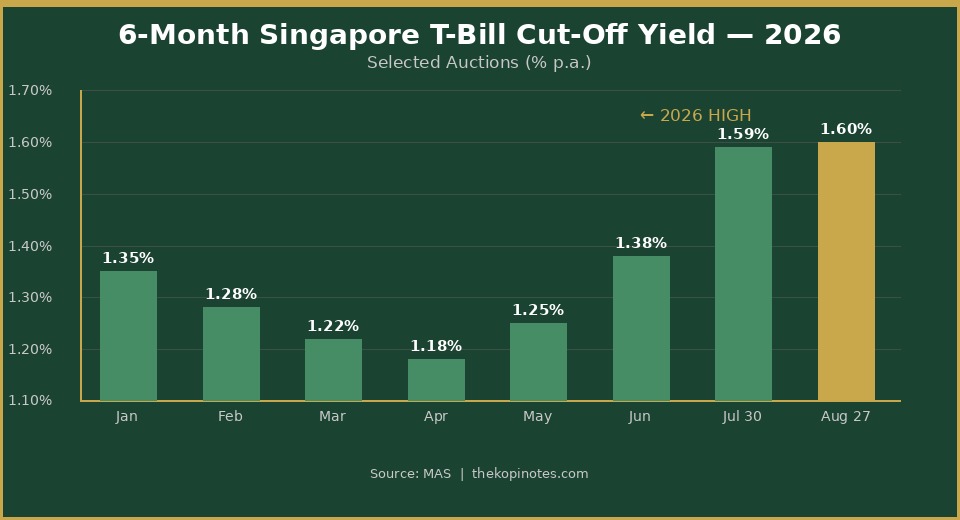
Singapore’s 6-month T-bill cut-off yield hit 1.6% at the 27 August 2026 auction — the highest reading of 2026 so far. Demand dipped slightly, pushing the cut-off above July’s 1.59% high, while S$8.7 billion was issued against S$16.8 billion in applications. Here’s what the rising yield means for your cash strategy and how it stacks up against the alternatives.
This is an editorial analysis. Not financial advice. Data verified as at 29 August 2026.
What Just Happened? The 27 August T-Bill Auction
The results are in for Singapore’s latest 6-month Treasury bill auction (issue code: BS26117A), and it has grabbed the attention of the local investing community for a good reason: the cut-off yield climbed to 1.6% per annum — the highest it has been all year.
Here’s the full breakdown from the Monetary Authority of Singapore (MAS):
| Metric | Result |
|---|---|
| Issue Code | BS26117A |
| Tenor | 6 months |
| Auction Date | 27 August 2026 |
| Issue Date | 1 September 2026 |
| Cut-off Yield | 1.60% p.a. |
| Median Yield | 1.55% p.a. |
| Average Yield | 1.48% p.a. |
| Total Applications | S$16.8 billion |
| Amount Issued | S$8.7 billion |
| Bid-to-Cover Ratio | 1.93x |
| Previous 2026 High | 1.59% (30 July 2026) |
The cut-off yield of 1.6% means that only bids submitted at this yield or lower were fully allotted. Investors who bid above 1.6% received nothing, while those who bid exactly 1.6% may have received a partial allotment.
For a deeper read on how T-bill auctions work in Singapore, see our complete guide to Singapore T-bills in 2026.
Why Is the T-Bill Yield Rising?
The 1.6% cut-off yield doesn’t exist in isolation — it reflects where short-term interest rates are moving in Singapore and globally.
Demand dipped, pushing the cut-off up. Total applications fell to S$16.8 billion, while the amount on offer stayed constant. When demand drops relative to supply, investors need to be offered a higher yield — which is exactly what happened. A bid-to-cover ratio of 1.93x confirms competitive but moderating demand.
Global rate environment staying elevated. The US Federal Reserve has maintained a data-dependent approach through mid-2026, keeping USD rates elevated. Singapore short-term rates tend to track US rates with a lag, particularly for short-duration instruments like T-bills, which has supported yields staying above 1.5%.
MAS maintaining tight policy stance. Singapore’s inflation remained sticky at 1.5–1.8% in early 2026, prompting MAS to hold its monetary policy settings. MAS published its July 2026 Monetary Policy Statement confirming an unchanged stance. When inflation stays above target, short-term rate incentives to hold SGD assets remain relatively attractive.
Track T-bill auction results and upcoming auction dates in our Singapore T-bill 2026 auction results tracker.
How Does 1.6% Compare to Your Alternatives?
The real question for most retail investors isn’t just “what’s the T-bill yield?” — it’s “can I do better with my cash?” Here’s the August 2026 picture:
| Product | Best Rate (Aug 2026) | Conditions / Lock-In | Min. Amount |
|---|---|---|---|
| 6-Month T-Bill (BS26117A) | 1.60% p.a. | 6-month lock-in; no spending or salary conditions | S$1,000 |
| SSB Sep 2026 (Year 1) | 1.52% p.a. | Flexible — redeem monthly with no penalty | S$500 |
| SSB Sep 2026 (10-Yr Avg) | 2.25% p.a. | Must hold for 10 years for maximum return | S$500 |
| Best FD (Major Banks, Aug 2026) | ~1.65–2.00% p.a. | 1–12 month lock-in; varies by bank/tenure | S$1,000+ |
| UOB One Account | Up to 3.40% p.a. | Salary credit + card spend required | Varies |
| OCBC 360 Account | Up to 4.70% p.a. | Salary + save + spend + insure/invest | Varies |
| CPF Ordinary Account | 2.5% p.a. (guaranteed) | Withdrawal restrictions; retirement use | N/A |
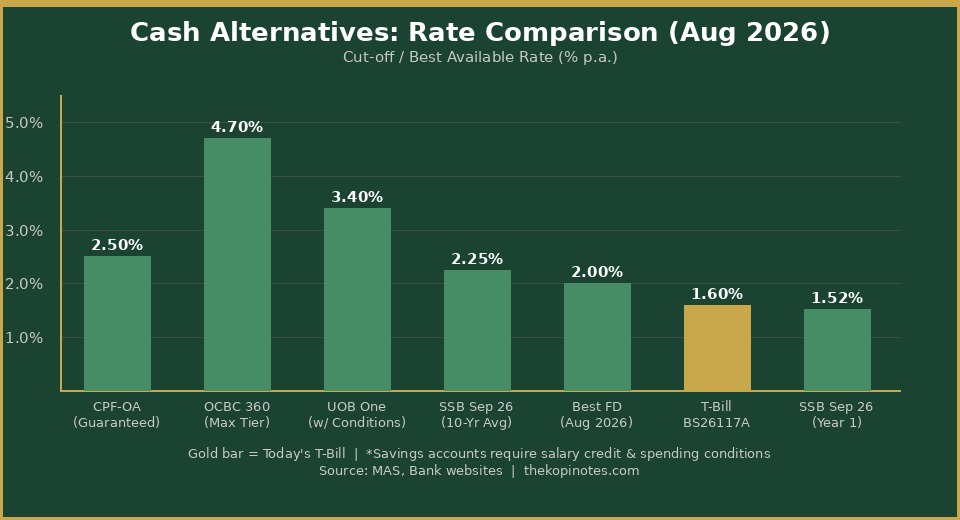
At face value, 1.6% trails the top savings account rates. But context matters enormously:
- No conditions required. T-bills ask nothing of you — no salary crediting, no minimum card spend, no insurance requirements. You park S$10,000, earn 1.6% for 6 months, done.
- Risk-free government backing. T-bills are direct obligations of the Singapore Government, making them as safe as it gets in SGD-denominated assets.
- Works with CPF-OA and SRS. You can use CPF Ordinary Account funds via the CPF Investment Scheme (CPFIS), though note that your OA stops earning the 2.5% guaranteed rate while funds are in T-bills.
For those who qualify for top savings account bonus tiers, the 3–4.7% rates clearly beat T-bills. But for investors parking “excess” cash beyond what their salary accounts hold, T-bills remain a clean, no-friction option — particularly for retirees, self-employed individuals, or those who don’t want to chase conditions. Read our full breakdown of Singapore’s best high-interest savings accounts in 2026.
T-Bill vs. Singapore Savings Bond — Which Is Better Right Now?
The comparison between T-bills and SSBs is a perennial question for conservative Singapore investors. The September 2026 SSB offers a first-year rate of 1.52% p.a. and a 10-year average yield of 2.25% p.a. (if held to maturity), confirmed via the MAS SSB interest rate table.
The August 2026 SSB had a lower 10-year average of 2.06%, making September’s a meaningful step up. For full details, see our article on the Singapore Savings Bond August 2026 and use our SSB interest calculator to model your actual returns.
Here’s the decision framework:
- Choose T-bill if you’re parking cash for exactly 6 months, want the highest short-term risk-free yield with zero conditions, and don’t need early access.
- Choose SSB if you want flexibility (redeemable monthly with no penalty), are comfortable with a slightly lower Year 1 rate, or plan to hold for multiple years.
What About the 10-Year SGS Bond?
For investors thinking longer-term, the 10-year Singapore Government Securities (SGS) bond yield also rose to 2.30% p.a. at the 27 August 2026 auction. This matters as a benchmark for long-duration fixed income portfolios, REIT cap rate expectations, and property market sentiment. When the 10-year risk-free rate rises, S-REIT valuations typically face pressure as the required yield spread must expand to attract investors.
When Is the Next T-Bill Auction?
Based on the MAS Auctions and Issuance Calendar, the next 6-month T-bill auction is expected in mid-September 2026. Apply via ATM or internet banking at DBS/POSB, OCBC, or UOB, or through CPF/SRS operators. Watch our T-bill auction results tracker — we update it after every auction.
Bottom Line for SG Investors
The 1.6% T-bill yield is the best short-term risk-free return available in Singapore for no-conditions cash parking as of August 2026. It beats the SSB Year 1 rate and most major bank FD rates. The decision framework is simple:
- If your salary account earns 3%+ (e.g. UOB One with salary credit + card spend): stick with your savings account — it wins.
- If you have excess cash beyond those accounts: T-bills at 1.6% are a clean, low-effort option for 6 months.
- If you need liquidity within 6 months: Go with SSBs — redeemable monthly with no penalty.
- If you’re considering CPF-OA funds: The T-bill at 1.6% loses to the guaranteed CPF-OA 2.5% rate — generally not advantageous unless you expect rates to rise significantly.
Short-term rates in Singapore are holding up better than many expected through 2026. This is an environment that rewards those who actively compare options rather than letting cash sit idle.
Frequently Asked Questions
What was the 6-month T-bill cut-off yield on 27 August 2026?
The cut-off yield for the 6-month Singapore T-bill (BS26117A) at the 27 August 2026 auction was 1.60% per annum — the highest of the year so far, per MAS auction data.
Is 1.6% a good T-bill yield by Singapore standards?
It is the highest 6-month cut-off yield in 2026, surpassing the previous high of 1.59% set on 30 July 2026. By recent historical standards it is a solid short-term risk-free return, though it remains below the 3%+ yields seen in 2023–2024.
How does the T-bill compare to the SSB in August 2026?
The T-bill offers a higher short-term return at 1.6% for 6 months vs. the SSB September 2026 Year 1 rate of 1.52%. However, SSBs offer full flexibility (no lock-in), and a much better 10-year average return of 2.25% if held to maturity.
Can I use CPF to buy Singapore T-bills?
Yes. You can use CPF Ordinary Account (OA) funds via the CPF Investment Scheme (CPFIS). However, OA funds stop earning the guaranteed 2.5% p.a. while invested in T-bills. At 1.6%, the T-bill yields less than the CPF-OA rate, so this is generally not advantageous unless you expect rates to rise significantly.
What is the minimum amount to buy a Singapore T-bill?
The minimum is S$1,000, in multiples of S$1,000.
When is the next Singapore T-bill auction?
The next 6-month T-bill auction is expected around mid-September 2026. Results are published on the MAS website on the auction date. We update our T-bill auction results tracker as soon as results are released.
What was the bid-to-cover ratio for the 27 August 2026 T-bill?
The bid-to-cover ratio was 1.93x, with S$16.8 billion in total bids against S$8.7 billion issued. A ratio above 1.5x indicates healthy demand, though somewhat softer than recent auctions.
This article was researched with the help of AI. While we strive to keep all information accurate and up to date, there may be errors. If you notice any discrepancies, please contact us.