Best Integrated Shield Plans in Singapore (2026): Ranked After the April Rider Overhaul
All 7 insurers rebuilt their riders under MOH’s new rules. Here’s how AIA, Great Eastern, Prudential, Income, Singlife, HSBC Life and Raffles Health Insurance stack up now.
The best Integrated Shield Plan for most Singaporeans in 2026 is still AIA HealthShield Gold Max or Great Eastern GREAT SupremeHealth for private hospital cover, and Income’s Enhanced IncomeShield Preferred for public hospital cover. But the real story in 2026 is the rider, not the base plan: every insurer relaunched its rider from 1 April 2026 with a $6,000 co-payment cap and no deductible cover, cutting rider premiums by 23% to 84%.
Not financial advice. All figures are for educational reference only. Data verified as at 22 August 2026 against MOH and insurer sources unless otherwise noted.
- Since 1 April 2026, new Integrated Shield Plan (ISP) riders no longer cover your deductible, and the minimum co-payment cap has doubled from $3,000 to $6,000 a year.
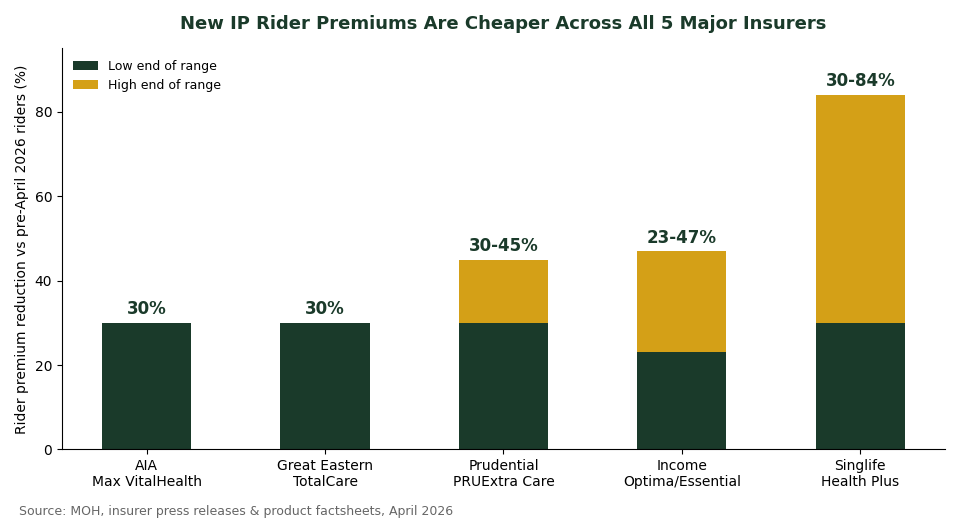
- In exchange, riders are cheaper — AIA and Great Eastern cut premiums by about 30%, Income by 23-47%, Prudential by 30-45%, and Singlife by 30-84% depending on the tier.
- Your best plan depends on whether you want maximum private hospital access (AIA, Great Eastern), the lowest new rider cost (Income, Singlife), or public hospital value (Income, NTUC-linked plans).
Table of Contents
What Changed for Every Insurer in April 2026
You’ve probably heard your agent mention “rider changes” this year. Here’s what actually happened. The Ministry of Health (MOH) announced new design rules for Integrated Shield Plan riders in November 2025. They took effect on 1 April 2026, and they apply to every rider sold from that date onward.
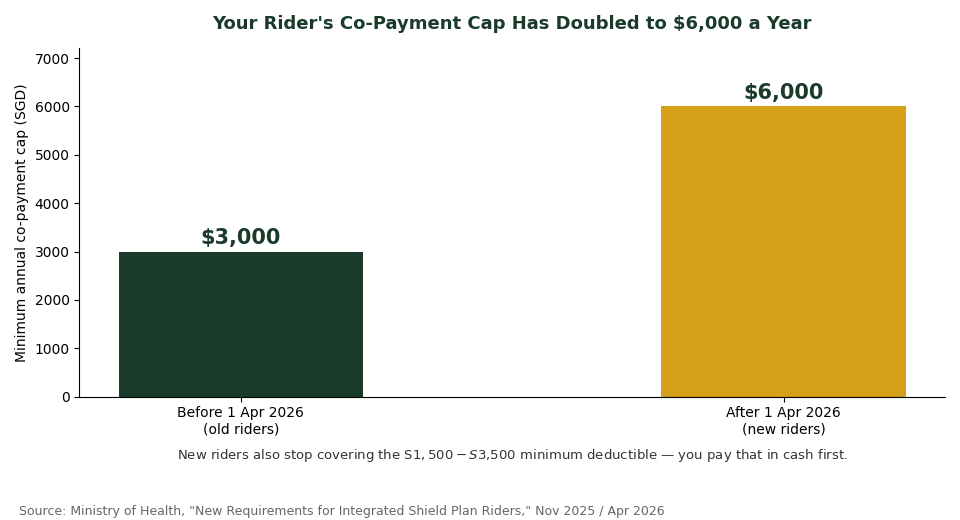
Two things changed. First, new riders can no longer cover your policy’s minimum deductible — that’s the S$1,500 to S$3,500 you must pay yourself before your Integrated Shield Plan (IP) starts paying out, depending on your ward class. Second, the minimum annual co-payment cap doubled from $3,000 to $6,000. You still pay at least 5% of each bill yourself, capped at this new higher amount.
Why did MOH do this? According to MOH, private hospital IP rider premiums had been rising by an average of 17.2% a year between 2021 and 2024. Riders that covered “as-charged” costs with almost no co-payment removed any incentive to question a hospital bill. The new rules force you to have some skin in the game — and in return, insurers cut rider premiums.
Best Integrated Shield Plans, Ranked by Category
There’s no single “best” Integrated Shield Plan — it depends on what you’re optimising for. Here’s how we’d rank the main plans across the categories that actually matter to a Singapore policyholder in 2026.
For a ward-by-ward walkthrough of every insurer’s claims process and full plan details, see our companion complete guide to the best Integrated Shield Plan in Singapore — this article focuses on ranking plans by use case instead.
| Category | Winner | Why |
|---|---|---|
| Best overall private hospital cover | AIA HealthShield Gold Max A | Largest private hospital and specialist panel, high annual claim limit |
| Best panel network | Great Eastern GREAT SupremeHealth P Plus | Broad specialist panel plus GREAT TotalCare rider options |
| Cheapest new rider (as % cut) | Singlife Health Plus | Premiums down 30-84% depending on tier and age band |
| Best value for public hospital (B1) | Income Enhanced IncomeShield Preferred | Competitive B1 premiums with the new Optima Care rider |
| Best for pre-existing conditions cover | Prudential PRUShield + PRUExtra Care | PRUExtra Care series adds critical illness and retrenchment benefits on top of the base rider |
| Simplest to understand | Income Enhanced IncomeShield Basic | Fewer tiers, MediSave-friendly premiums, clear co-payment structure |
Source: The Kopi Notes editorial assessment based on insurer product factsheets and MOH rider requirements, as at April-August 2026.
These rankings assume you’re a healthy adult buying fresh cover. If you already have a pre-existing condition, medical underwriting outcomes will vary by insurer regardless of how a plan ranks here — always get a formal quote before switching.
New Rider Premium Cuts, Compared
Every insurer had to redesign its rider from scratch. That means every rider name changed too — so if you’re comparing quotes, make sure you’re looking at the new (post-April 2026) versions, not legacy riders still shown on some comparison sites.
| Insurer | New Rider Name | Premium vs Old Rider | Notes |
|---|---|---|---|
| AIA | Max VitalHealth | ~30% lower | A mid-aged Gold Max A policyholder saves roughly $500-$800 a year on rider premiums alone |
| Great Eastern | GREAT TotalCare / TotalCare Plus | ~30% lower | P Plus deductible rises to $3,500 max out-of-pocket before co-payment applies |
| Prudential | PRUExtra Care series | 30-45% lower | PRUExtra Preferred Care (panel hospitals) is the cheapest of the three new tiers |
| Income | Optima Care / Essential Care | 23-47% lower | 6 legacy riders withdrawn for new sign-ups from 1 April 2026 |
| Singlife | Health Plus Private / Public | 30-84% lower | New Care Collab Recovery Support benefit adds up to $20,000 for home nursing and rehab |
| HSBC Life / Raffles Health Insurance | Insurer-specific new riders | Lower, exact % not separately disclosed | Smaller panels — check current quotes directly with the insurer |
Source: MOH newsroom (Nov 2025 / Apr 2026), AIA, Great Eastern, Prudential and Income Insurance product announcements and factsheets, April 2026.
Notice the spread. Singlife’s headline “up to 84% lower” applies to its cheapest new tier for younger, healthier buyers — not every age band. Always ask for a like-for-like quote at your own age and ward class before comparing headline percentages across insurers.
Why Your Co-Payment Cap Doubled to $6,000
Here’s the part that surprises most people. A $6,000 cap sounds worse than the old $3,000 cap — and for a single large bill, it is. If you’re hospitalised for a major procedure at a private hospital, you could now be on the hook for up to $6,000 in co-payment, on top of the deductible your rider no longer covers.
But context matters. MOH’s own data showed private hospital bill sizes have grown substantially since the old $3,000 cap was set. Raising the cap to $6,000 keeps the co-payment proportional to actual bill sizes today, rather than letting riders absorb an ever-growing share of the bill with zero cost discipline.
For a Singapore resident with a $30,000 private hospital bill, here’s the rough maths under the new rules: you pay the deductible (say $3,500) plus 5% co-payment on the remainder, capped at $6,000. In the worst case, your total out-of-pocket could be close to $9,500 — up from roughly $4,500-$6,000 under the old rider structure.
How to Choose the Right Plan for You
Don’t just chase the lowest premium. Match the plan to how you’d actually use it.
Pick a private hospital plan (AIA Gold Max A, Great Eastern P Plus, Prudential PRUShield Premier) if you want choice of doctor and private hospital access, and you can comfortably absorb the new $6,000 co-payment cap plus deductible in cash or MediSave.
Pick a public hospital B1 plan (Income Preferred, most insurers’ equivalent tier) if you’re cost-conscious and comfortable with restructured hospitals like SGH, NUH or Tan Tock Seng — premiums and co-payments are meaningfully lower.
Consider skipping the rider entirely if you have at least 6 months of expenses in an emergency fund and would rather pay lower premiums now in exchange for bearing the deductible and co-payment yourself. This is a reasonable strategy for younger, healthier buyers who want to keep overall insurance costs down — see our retirement planning in Singapore guide for how to size that emergency buffer alongside your other goals.
If you’re investing your savings alongside managing insurance costs, tools like the Singapore retirement planning calculator help you see how a lower insurance premium today could be redirected into long-term investing instead.
What If You Already Have a Rider?
If you bought your rider before 27 November 2025, MOH has not forced you onto the new structure yet. Insurers must transition existing policyholders no later than their first renewal after 1 April 2028. That gives most people a two-year runway.
Should you switch early? Usually not, unless your existing rider premium has become unaffordable. Older riders with full deductible coverage and a lower co-payment cap are generally more generous than the new versions — you’d be trading better coverage for a lower premium. Speak to a licensed financial adviser before making the switch, since underwriting rules mean you may not get the same coverage back if your health has changed.
For a full walkthrough of the April 2026 changes themselves, see our dedicated guide on the Integrated Shield Plan rider changes in 2026, and our side-by-side comparison of all 7 Singapore Integrated Shield Plan insurers.
Frequently Asked Questions
What is the best Integrated Shield Plan in Singapore right now?
There’s no single best plan for everyone. AIA HealthShield Gold Max and Great Eastern GREAT SupremeHealth tend to rank highest for private hospital access and panel size, while Income’s Enhanced IncomeShield offers strong value for public hospital (B1) cover. Your best choice depends on your budget, health status and preferred hospital type.
Why did Integrated Shield Plan rider premiums change in April 2026?
MOH introduced new rider design rules from 1 April 2026 to slow rising healthcare costs. New riders can no longer cover your policy’s minimum deductible, and the minimum co-payment cap doubled from $3,000 to $6,000 a year. In exchange, rider premiums dropped by roughly 23% to 84% depending on the insurer and tier.
Do I have to switch to the new rider if I already have one?
Not immediately. If you bought your rider before 27 November 2025, insurers must transition you to a new-style rider no later than your first renewal after 1 April 2028. Until then, you can generally keep your existing rider, which may offer more generous coverage than the new versions.
Can I use MediSave to pay for my Integrated Shield Plan rider?
No. You can use MediSave to pay the base MediShield Life-linked Integrated Shield Plan premium, up to the Additional Withdrawal Limit. Riders, however, must be paid entirely in cash — this has not changed under the April 2026 rules.
How much will I pay out of pocket now if I'm hospitalised?
Under a new rider, you’ll typically pay your plan’s minimum deductible (S$1,500 to S$3,500, depending on ward class) plus 5% co-payment on the remaining bill, capped at $6,000 a year. For a large private hospital bill, your total out-of-pocket could reach roughly $9,500 in the worst case.
Is it worth buying a rider at all after the April 2026 changes?
For most people with a private hospital plan, yes — a rider still caps your worst-case out-of-pocket cost at a predictable amount. But if you have a large emergency fund and want to lower your overall insurance spend, going without a rider (or choosing a public hospital B1 plan) is a reasonable alternative worth discussing with a financial adviser.
Compare More Integrated Shield Plans
See how all 7 insurers compare side by side, or plan your finances around your new premium costs.
Get Free Insurance Advice
Speak with a licensed insurance advisor. No obligation, no cost.
By submitting this form, you agree to our Privacy Policy.
This article was researched with the help of AI. While we strive to keep all information accurate and up to date, there may be errors. If you notice any discrepancies, please contact us.