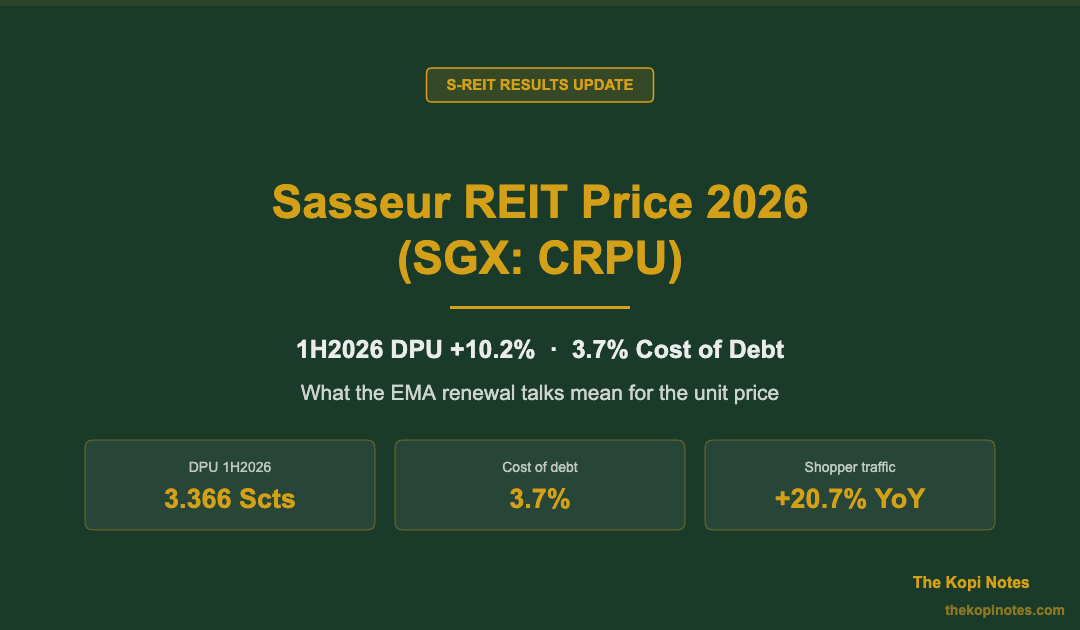
Sasseur REIT Price 2026 (SGX: CRPU): 1H2026 DPU +10.2%, 3.7% Cost of Debt & the EMA Renewal Question
What the 14 August 2026 results actually changed for the unit price — and the one thing that matters more than sales growth.
Sasseur REIT (SGX: CRPU) traded at S$0.68 as at 20 August 2026, after 1H2026 results lifted distribution per unit 10.2% to 3.366 Singapore cents. A record-low 3.7% cost of debt and 20.7% higher shopper traffic did most of the work. The bigger swing factor for the price is the EMA rental framework, which expires in March 2028 and is now in formal renewal talks.
Not financial advice. All figures are for educational reference only. Data as at August 2026 unless noted.
- 1H2026 DPU came in at 3.366 Singapore cents, up 10.2% year-on-year. Outlet sales grew 7.4% and finance costs fell.
- The unit trades around 0.9x book value with a forward distribution yield near 9% — one of the highest in the S-REIT market, and priced that way for a reason.
- The Entrusted Management Agreement expires in March 2028. Renewal terms, not sales growth, are the single biggest thing that can re-rate or de-rate this price.
Table of Contents
Contents — Click to expand
- Sasseur REIT Price Snapshot (August 2026)
- What the 1H2026 Results Actually Showed
- Why the 3.7% Cost of Debt Matters More Than the DPU
- How the EMA Rental Model Works
- The EMA Renewal Talks: The Real Swing Factor
- Valuation: 0.9x Book and a 9% Forward Yield
- Risks to Weigh Before You Buy
- How to Buy Sasseur REIT in Singapore
- Frequently Asked Questions
Sasseur REIT Price Snapshot (August 2026)
Sasseur REIT is a Singapore-listed retail outlet mall REIT. It owns four outlet malls in China — in Chongqing, Chongqing Bishan, Hefei and Kunming. The units trade on SGX under the ticker CRPU.
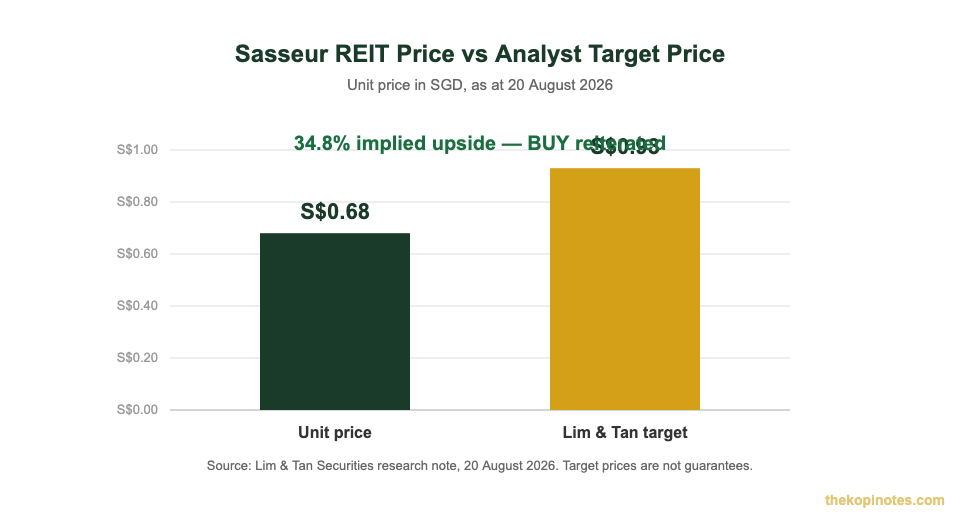
As at 20 August 2026, the unit price was S$0.68. That is roughly 0.9x book value, which means the market values the trust about 10% below the accounting value of its properties. For context, most S-REITs with China exposure have traded at similar or wider discounts through 2026.
Here is the thing that makes this REIT unusual. The price does not really move on rental renewals the way an office or industrial REIT does. It moves on two things: how much shoppers spend at the four malls, and what the sponsor agrees to pay the trust under the entrusted management model.
The 14 August 2026 results release moved the first lever in the right direction. The second one is still open. If you want to sanity-check what a 9% headline yield actually pays on your own position size, our Singapore REITs dividend yield calculator does the arithmetic for you.
What the 1H2026 Results Actually Showed
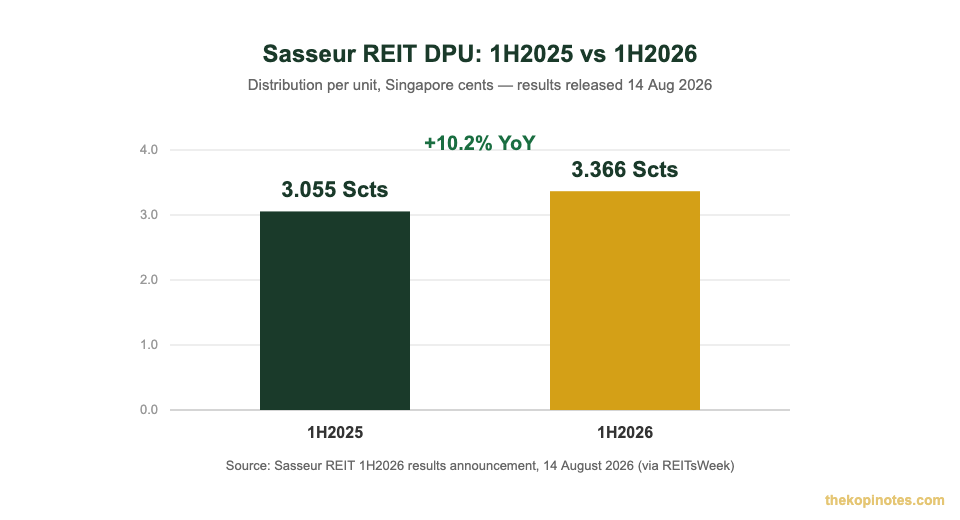
Sasseur REIT released results for the six months to 30 June 2026 on 14 August 2026. Distribution per unit — DPU, meaning the cash each unit pays you — came in at 3.366 Singapore cents. That is up 10.2% from 3.055 Singapore cents a year earlier.
The manager put the increase down to two things: stronger outlet sales, and lower finance costs. Portfolio sales grew 7.4% over the half. Shopper traffic grew much faster, at 20.7% year-on-year.
That gap between traffic growth and sales growth is worth pausing on. More people are walking through the malls, but each visit converts to less spending than before. In practice, that is what a value-conscious Chinese consumer looks like. It is not a disaster, but it does cap how fast rental income can compound.
The soft spot was occupancy, which eased over the half. At the 1Q2026 update, portfolio occupancy stood at 98.5%. It slipped from there. The manager has been reworking the tenant mix, so some of this is deliberate churn rather than tenants simply walking away.
| Metric | 1H2026 reading | What it tells you |
|---|---|---|
| DPU | 3.366 Scts (1H2025: 3.055 Scts) | +10.2% YoY |
| Portfolio outlet sales | +7.4% YoY | Top-line demand still growing |
| Shopper traffic | +20.7% YoY | Footfall running ahead of spend |
| Weighted average cost of debt | 3.7% (record low) | Early refinancing done |
| Portfolio occupancy | Eased from 1Q2026’s 98.5% | The one soft spot |
| EMA framework expiry | March 2028 | Formal renewal talks confirmed |
Source: Sasseur REIT 1H2026 results announcement, 14 August 2026; Lim & Tan Securities research note, 20 August 2026.
Why the 3.7% Cost of Debt Matters More Than the DPU
The headline everyone quoted was the 10.2% DPU jump. The number that actually de-risks the price is the cost of debt.
Sasseur REIT’s weighted average cost of debt fell to 3.7% in 1H2026. That is a record low for the trust. It got there by refinancing loans early rather than waiting for maturity.
Here is why that matters to you as a unitholder. A REIT’s distribution is what is left after interest is paid. When borrowing costs fall, the same rental income produces a bigger distribution. No new malls, no new tenants, no extra shopper spending required.
Compare that with 1Q2026, when the cost of debt was 3.9%. Shaving 20 basis points off in a single quarter is meaningful for a trust of this size. It also means the 2026 refinancing risk that hung over many S-REITs is largely behind this one.
Sasseur REIT has also run one of the lower gearing levels in the S-REIT universe. Gearing — the ratio of total borrowings to total assets — is capped at 50% under MAS rules for Singapore REITs, with an interest coverage requirement attached. Trusts operating well below the cap have more room to borrow for acquisitions and less risk of a forced equity raise. If you want to compare this against other S-REITs you hold, run the numbers through our S-REIT gearing ratio and ICR calculator.
The caveat: a low cost of debt is a one-time gain, not a growth engine. You cannot refinance your way to 10% DPU growth every year. Once the refinancing benefit is fully in the base, growth has to come from sales and rent again.
How the EMA Rental Model Works
Most S-REITs collect rent directly from tenants. Sasseur REIT does not. It uses an Entrusted Management Agreement, or EMA, with its sponsor, Sasseur Cayman Holding.
Under the EMA, the sponsor’s operating companies run the malls day to day. They handle leasing, tenant mix, marketing and mall operations. In return, the trust receives an EMA rental income made up of two parts.
The first part is a fixed component. It steps up by a set percentage each year regardless of how the malls perform. This is the floor under your distribution.
The second part is a variable component. It is calculated as a percentage of the malls’ total sales. When shoppers spend more, the trust earns more. When they spend less, this part shrinks.
So when you read that portfolio sales rose 7.4%, that is not a vanity metric. It feeds directly into the variable rent the trust collects. That structure is why sales figures get more attention here than occupancy or rental reversion.
The trade-off is dependence. The trust’s income depends on an agreement with its own sponsor rather than on hundreds of independent leases. That concentration is exactly why the market applies a discount — and exactly why the renewal question below is the one to watch.
The EMA Renewal Talks: The Real Swing Factor
The current EMA framework expires in March 2028. At the 1H2026 results, the manager confirmed that formal renewal talks with the sponsor are underway.
That confirmation is genuinely new information. Until now, the March 2028 expiry sat on the horizon as an unpriced unknown. Investors could not model what happens after it. Formal talks do not settle the terms, but they do put a process around the question.
Why does this dominate the price? Because the EMA is the income. Change the fixed step-up rate, change the variable percentage, or change the length of the term, and you change the distribution stream that the whole valuation rests on.
Think about three broad outcomes. In the good case, the EMA renews on similar or better terms with a long tenure. The overhang lifts and the discount to book value should narrow. In the neutral case, it renews with slightly weaker economics — mildly negative for DPU, but the uncertainty is gone. In the bad case, terms deteriorate materially or talks drag toward the expiry date without resolution.
Markets hate the third scenario most. A REIT trading at a 9% yield is already telling you investors are demanding compensation for structural risk, not just China consumption risk. Resolution — in almost any direction — usually compresses that risk premium.
Practically, this means the next 12 to 18 months of announcements on SGXNET filings for CRPU matter more than any single quarter’s sales number.
Valuation: 0.9x Book and a 9% Forward Yield
At S$0.68, Sasseur REIT trades at roughly 0.9x price-to-book. Price-to-book, or P/NAV, compares the unit price to the net asset value per unit — the accounting value of the properties minus debt. Below 1.0x means you are paying less than book value.
The forward distribution yield sits near 9%. That is well above the typical S-REIT and comfortably above what Singapore Savings Bonds or six-month T-bills pay in 2026.
Following the results, Lim & Tan Securities reiterated a BUY call on 20 August 2026 and raised its target price to S$0.93 from S$0.91. That implies 34.8% upside from S$0.68.
Treat that number with the usual care. It is one broker’s view, not a consensus, and target prices are estimates rather than promises. What it does tell you is that a sell-side analyst reading the same 1H2026 numbers concluded the results beat expectations.
| Measure | Reading | Note |
|---|---|---|
| Unit price | S$0.68 | As at 20 August 2026 |
| Price-to-book (P/NAV) | ~0.9x | About a 10% discount to book value |
| Forward distribution yield | ~9.0% | Among the highest in the S-REIT market |
| FY2025 DPU (full year) | 6.138 Scts | Prior full-year base |
| Lim & Tan target price | S$0.93 (raised from S$0.91) | 34.8% implied upside |
| Broker call | BUY, reiterated | Single-broker view, not consensus |
Source: Lim & Tan Securities research note, 20 August 2026; Sasseur REIT FY2025 results, February 2026.
A 9% yield at a discount to book is not a free lunch. It is the market pricing in China consumption risk, currency risk and the EMA structure all at once. Whether that discount is too wide is the actual investment question. Our S-REIT P/NAV calculator lets you test what happens to the implied discount at different entry prices.
Risks to Weigh Before You Buy
Sponsor and EMA concentration. Your income depends on one agreement with one counterparty. If the sponsor runs into trouble, or renewal terms worsen, there is no diversified tenant base to fall back on.
China consumer softness. Traffic grew 20.7% while sales grew 7.4%. Shoppers are showing up but spending more carefully. If that gap widens, the variable rent component takes the hit.
Currency risk. The malls earn renminbi. Your distributions arrive in Singapore dollars. A weaker RMB against the SGD reduces what lands in your account even if mall performance is unchanged.
Occupancy drift. Occupancy eased in 1H2026 from the 98.5% seen at 1Q2026. Some of that is deliberate tenant-mix rework. Watch whether it stabilises in the next update.
Liquidity and index exclusion. Smaller S-REITs trade thinly. Bid-ask spreads widen when sentiment turns, and exiting a large position quickly can cost you.
Single-country exposure. All four malls sit in China. There is no geographic hedge inside this trust. If you want that, you need it at the portfolio level — our guide to the best S-REITs in Singapore for 2026 covers how the different sectors and geographies stack up.
None of these are reasons to avoid the REIT outright. They are reasons the yield is 9% and not 5%. Size your position accordingly.
How to Buy Sasseur REIT in Singapore
Sasseur REIT trades on SGX under CRPU. You buy it like any other Singapore-listed counter, in board lots of 100 units. At S$0.68, one lot costs about S$68 before fees — one of the lower entry points in the S-REIT market.
You will need a brokerage account with SGX access. Most Singapore brokers cover it. The differences that matter are minimum commission, custody arrangement and whether the units are held in your own CDP account or in a custodian account.
CDP-linked accounts put the units under your name at the Central Depository. Custodian accounts are usually cheaper per trade but hold the units in the broker’s name on your behalf. For long-term income holdings, many Singapore investors prefer CDP for the direct ownership and the dividend statements that come with it.
If you are comparing platforms, the FSMOne referral code page covers their SGX commission structure, and the Syfe referral code and sign-up bonus page covers Syfe Brokerage — sign up with code SRPRFFFCD if you go that route. Both waive or reduce minimum commissions on small SGX trades, which matters when a lot costs S$68.
One practical note. Sasseur REIT distributes twice a year, not quarterly. Check the ex-distribution date before you buy if you are trying to catch a payout, and remember that buying on or after the ex-date means you miss that distribution.
Full corporate filings, results presentations and distribution announcements are published on the Sasseur REIT investor relations site. Gearing limits and interest coverage requirements for all Singapore REITs are set out by the Monetary Authority of Singapore.
Not financial advice. This article is for educational reference only and does not consider your personal circumstances. All data as at August 2026 unless otherwise stated. Do your own research before investing.
Frequently Asked Questions
What is the Sasseur REIT price today and is it cheap?
Sasseur REIT (SGX: CRPU) traded at S$0.68 as at 20 August 2026, which is about 0.9x book value with a forward distribution yield near 9%. On paper that is cheap versus the wider S-REIT market. The discount reflects real risks: China consumer softness, renminbi exposure, and dependence on the entrusted management agreement with its sponsor. Cheap and risky are not opposites here.
Why did Sasseur REIT DPU rise 10.2% in 1H2026?
Distribution per unit rose to 3.366 Singapore cents in 1H2026 from 3.055 cents a year earlier. Two drivers did the work. Portfolio outlet sales grew 7.4%, which lifts the variable portion of the trust’s rental income. Separately, the weighted average cost of debt fell to a record-low 3.7% after the manager refinanced loans early, leaving more cash available to distribute.
What is the EMA in Sasseur REIT and why does it matter?
EMA stands for Entrusted Management Agreement. Instead of collecting rent directly from tenants, Sasseur REIT receives income from its sponsor’s operating companies, who run the four malls. The payment has a fixed component that steps up annually and a variable component tied to mall sales. It matters because that agreement is effectively the trust’s entire income stream, and it expires in March 2028.
What happens to Sasseur REIT after the EMA expires in March 2028?
The manager confirmed at the 1H2026 results that formal renewal talks with the sponsor are underway. Nothing has been agreed. A renewal on similar or better terms would likely narrow the discount to book value. Weaker terms, or talks dragging on without resolution, would keep the risk premium elevated. This is the single biggest swing factor for the unit price over the next two years.
Can I buy Sasseur REIT with my CPF or SRS funds?
Supplementary Retirement Scheme funds can generally be used to buy SGX-listed REITs through an SRS-linked brokerage account, so Sasseur REIT is usually accessible that way. CPF Investment Scheme eligibility is narrower and depends on the specific counter and your CPF agent bank. Check directly with your broker and CPF agent bank before assuming eligibility, as the approved lists change over time.
How often does Sasseur REIT pay distributions?
Sasseur REIT distributes twice a year rather than quarterly, covering the first and second halves of each financial year. The 1H2026 distribution was 3.366 Singapore cents per unit. If you are buying specifically to receive a payout, check the ex-distribution date first — buying on or after that date means the distribution goes to the previous holder.
Work Out What This Yield Is Really Worth
A 9% headline yield means little until you compare it against the risk-free alternative and your own retirement target.
This article was researched with the help of AI. While we strive to keep all information accurate and up to date, there may be errors. If you notice any discrepancies, please contact us.