Bond ETF Singapore Guide 2026: Best Fixed Income ETFs as Rates Fall
SGX and London-listed bond ETFs compared — real TER, yield and CPF/SRS data for Singapore investors.
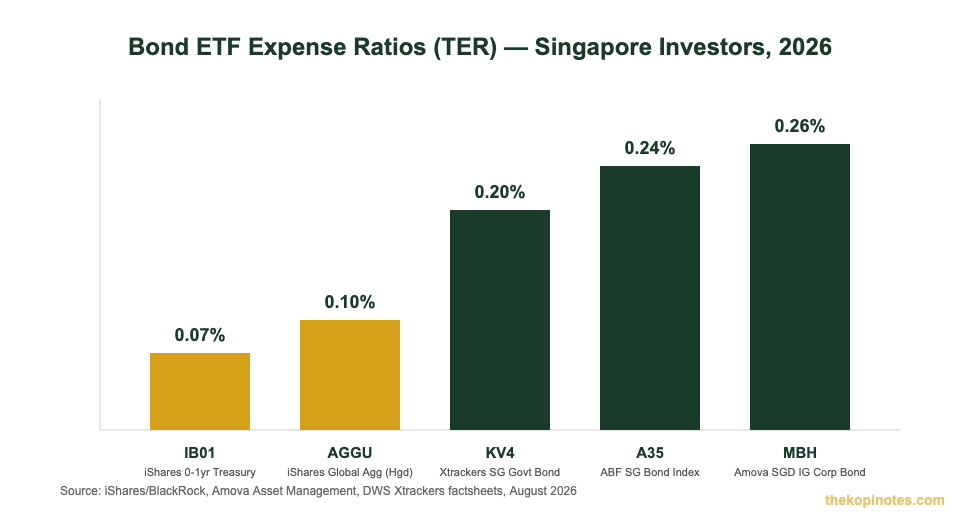
A bond ETF lets you buy a basket of government or corporate bonds through a single SGX or London-listed fund, from as little as one unit. Singapore options range from the CPFIS-approved ABF Singapore Bond Index Fund (A35, 0.24% TER) to globally diversified UCITS funds like AGGU (0.10% TER). With the US Federal Reserve widely expected to cut rates in September 2026, bond ETFs are back in focus for income-seeking investors.
Not financial advice. All figures are for educational reference only. Data verified as at 21 August 2026 unless noted.
- Bond ETFs give you diversified fixed income exposure from one unit — no SGD 1,000+ minimum lot size like buying individual bonds.
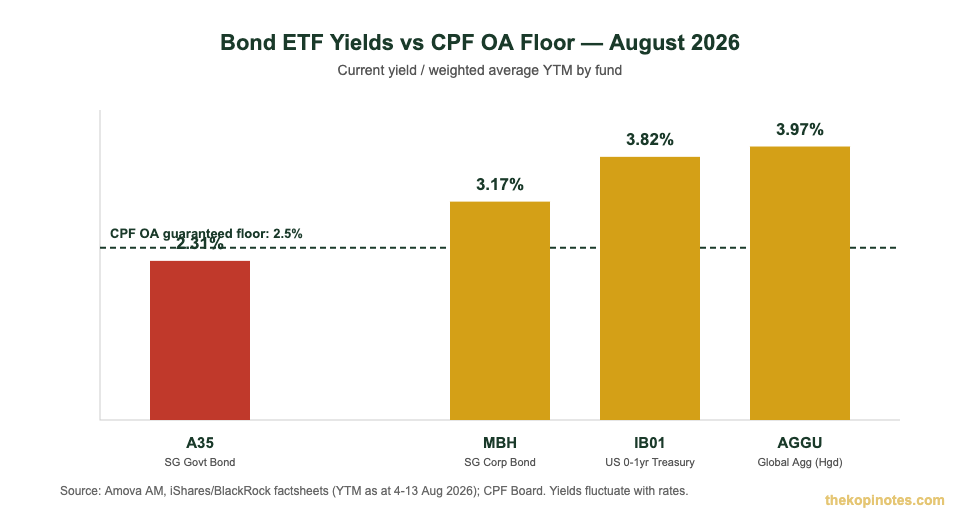
- A35 (SGX) is CPFIS-OA and SRS approved, but its 2.31% yield currently sits below the CPF Ordinary Account’s guaranteed 2.5% floor.
- Lower-cost UCITS options like AGGU (0.10% TER) and IB01 (0.07% TER) currently yield more (~3.8-4.0%) but carry USD/SGD currency risk.
What Are Bond ETFs?
A bond ETF pools money from many investors to buy a portfolio of bonds — government, corporate, or a mix of both. You buy one unit on an exchange like SGX or the London Stock Exchange (LSE), and that unit gives you a proportional slice of every bond the fund holds.
This matters because individual bonds are hard to access directly. Singapore Government Securities (SGS) and most corporate bonds trade in minimum lot sizes of SGD 1,000 to SGD 250,000. A bond ETF collapses that barrier. You can start with a single unit costing well under SGD 200.
Bond ETFs also pay you interest income (called a coupon, passed through as a distribution) on a regular schedule — usually quarterly or semi-annually — and their unit price moves inversely with interest rates. When rates fall, existing bond prices rise. That’s the mechanic driving renewed interest in 2026.
Why Bond ETFs Are Trending in 2026
Three things are converging to put bond ETFs back on Singapore investors’ radar this year.
First, the Fed is expected to cut. Market pricing as at August 2026 implies roughly an 85% probability of a 25 basis point rate cut at the US Federal Reserve’s September 2026 meeting. Falling US rates tend to lift the price of existing bonds, including SGD and USD bond ETFs held by Singapore investors.
Second, “risk-free” yields at home are sliding. We’ve flagged this before with Singapore T-bills: the latest 6-month T-bill cut-off yield has dipped to around 1.56%, now sitting below the CPF Ordinary Account’s guaranteed 2.5% floor. The 10-year Singapore Savings Bond (SSB) average return sat at roughly 2.25% in the August 2026 tranche. Cash-park options are simply paying less than they did a year ago.
Third, the Singapore 10-year government bond yield has been volatile — closing around 2.36% on 19 August 2026, off its multi-year lows but still well below levels seen in 2023-2024. For income-focused investors, that combination — falling T-bill and SSB yields, plus a live rate-cut catalyst — is why bond ETFs are getting a second look.
Best Bond ETFs for Singapore Investors
There’s no single “best” bond ETF — it depends on whether you want SGD-denominated safety, higher-yielding SGD credit, or globally diversified USD exposure via a London-listed UCITS fund. Here’s how the five most relevant options compare as at August 2026.
| ETF | Ticker / Exchange | TER | Domicile | Focus | Yield / YTM |
|---|---|---|---|---|---|
| ABF Singapore Bond Index Fund | A35 / SGX | 0.24% | Singapore | SGD govt & quasi-govt bonds | 2.31% (Jun 2026) |
| Amova (Nikko AM) SGD IG Corp Bond ETF | MBH / SGX | 0.26% | Singapore | SGD investment-grade corporate bonds | ~3.17% (2026) |
| Xtrackers II Singapore Govt Bond UCITS ETF | KV4 / SGX | 0.20% | Luxembourg | SGD govt bonds (FTSE SG Govt Bond Index) | ~in line with SGS 10Y (2.36%) |
| iShares Core Global Aggregate Bond UCITS ETF (USD Hedged) | AGGU / LSE | 0.10% | Ireland | Global investment-grade bonds, USD-hedged | 3.97% YTM (Aug 2026) |
| iShares $ Treasury Bond 0-1yr UCITS ETF | IB01 / LSE | 0.07% | Ireland | Ultra-short USD Treasuries | 3.82% YTM (Aug 2026) |
Source: Amova Asset Management, iShares/BlackRock and DWS Xtrackers factsheets; Trading Economics (SGS 10Y); data as at 4-19 August 2026. Yields and YTM fluctuate with interest rates.
A35 is the closest thing Singapore has to a “default” bond ETF — it’s been around since 2005, tracks the iBoxx ABF Singapore Bond Index, and is CPFIS-Ordinary Account and SRS approved, which none of the London-listed options are. MBH holds SGD-denominated investment-grade corporate bonds rated AAA to BBB, so it pays a higher yield than A35 but carries more credit risk. KV4 is a smaller, Luxembourg-domiciled alternative tracking the same broad government bond space, though its AUM (roughly €83 million) is modest.
On the London-listed side, Singapore investors already buy equity UCITS ETFs like CSPX and VWRA on the LSE for the tax advantages — the same domicile logic applies to bond ETFs. AGGU and IB01 are both Ireland-domiciled, UCITS-compliant, and benefit from the same 15% (rather than 30%) US withholding tax treaty rate on US-sourced income, plus no US estate tax exposure since the fund itself — not the underlying US Treasuries — is what you hold.
The CPF OA Yield Gap — A Worked Example
Here’s a calculation worth doing before you buy: for a SGD 50,000 allocation, A35’s 2.31% yield pays approximately SGD 1,155 a year. The same amount in MBH at ~3.17% pays roughly SGD 1,585 a year — a SGD 430 difference, though you’re taking on corporate credit risk instead of near-pure government risk to get there.
But here’s the part most guides miss: A35’s 2.31% yield currently sits below the CPF Ordinary Account’s guaranteed 2.5% floor. If the SGD 50,000 in question is CPF OA cash and not SRS or cash savings, you’d be earning less by moving it into A35 than by simply leaving it in your OA. This is the same dynamic we’ve flagged with Singapore T-bills dipping below the OA floor — read our CPF investment strategy breakdown for how to think about when CPFIS investing actually beats the OA floor.
The calculus is different for SRS funds, where there’s no guaranteed floor to compare against — A35 and MBH both remain reasonable low-volatility options for SRS balances you don’t want fully in equities.
How to Buy Bond ETFs in Singapore
SGX-listed bond ETFs (A35, MBH, KV4) trade like any other Singapore stock. Open a brokerage account, fund it in SGD, search the ticker, and place a normal buy order during SGX trading hours. Syfe’s brokerage platform and most local brokers support all three without extra paperwork.
London-listed UCITS bond ETFs (AGGU, IB01) require a broker with LSE access — Interactive Brokers (IBKR), Saxo Markets, and some FSMOne accounts all support this. You’ll typically fund the trade in USD or GBP, so factor in the FX spread your broker charges on top of the ETF’s own TER.
For CPF Ordinary Account money: only A35 is CPFIS-OA approved among the funds compared here. You’ll need a CPFIS Investment Account (via a CPFIS-approved bank) to buy it with OA funds — SRS purchases can go through your regular SRS brokerage account instead.
Minimum outlay: SGX board lots are usually 100 units, so A35 at roughly SGD 1.11 a unit means a starting position of around SGD 111. LSE-listed UCITS ETFs typically trade in single units, so IB01 or AGGU can be bought for the price of one share plus your broker’s minimum commission.
Broker Access & CPF/SRS Eligibility
| ETF | Exchange | Trade Currency | CPFIS-OA | SRS | Approx. Min Outlay |
|---|---|---|---|---|---|
| A35 | SGX | SGD | Yes | Yes | ~SGD 111 (100-unit lot) |
| MBH | SGX | SGD | Platform-dependent | Yes | ~SGD 100 (100-unit lot) |
| KV4 | SGX | SGD | No | No | Varies by broker lot size |
| AGGU | LSE | USD | No | Broker-dependent | 1 unit + broker commission |
| IB01 | LSE | USD | No | Broker-dependent | 1 unit + broker commission |
Source: CPF Board CPFIS fund list, SGX, broker platform data as at August 2026. SRS/CPFIS eligibility for MBH and UCITS funds via SRS varies by broker — confirm with your platform before investing.
Risks to Consider
Bond ETFs are lower-volatility than equities, but they’re not risk-free. Four things to weigh before buying:
Interest rate risk. Bond ETF prices move opposite to yields. If the Fed’s September 2026 cut doesn’t materialise, or inflation forces a pause, bond prices can fall even while you collect the coupon. Longer-duration funds like AGGU feel this more than short-duration ones like IB01.
Credit risk. MBH holds corporate bonds rated as low as BBB — investment grade, but not risk-free. In a recession, corporate bond spreads widen and prices fall more than government bonds like A35 or KV4.
Currency risk. AGGU and IB01 are USD-denominated. Even though AGGU is currency-hedged at the bond level against its global holdings, your SGD-to-USD conversion when you buy and sell still carries FX risk that A35 and MBH — both SGD-denominated — don’t have.
Liquidity risk. KV4 has a relatively small AUM (roughly €83 million). Thinly-traded ETFs can have wider bid-ask spreads, which eats into returns on smaller trades.
None of this makes bond ETFs unsuitable — it just means they’re a diversifier, not a guaranteed-return product. Singapore T-bills and the Singapore Savings Bonds (SSB) remain the closer-to-risk-free options if capital preservation matters more than yield to you.
Sources & Further Reading
For live fund data, check the official factsheets: iShares Core Global Aggregate Bond UCITS ETF (AGGU) factsheet, iShares $ Treasury Bond 0-1yr UCITS ETF (IB01) factsheet, and ABF Singapore Bond Index Fund (A35) factsheet. For CPFIS scheme rules, see the CPF Board’s CPFIS guidance. Fed rate expectations are tracked via the CME FedWatch Tool.
Not sure whether bonds or equities fit your goals better? Our US Estate Tax guide for Singapore investors covers the same LSE/UCITS domicile logic in more depth, applied to equity ETFs.
Frequently Asked Questions
What is a bond ETF and how does it work for Singapore investors?
A bond ETF is a fund that holds a basket of bonds and trades on an exchange like a stock. Singapore investors can buy SGX-listed options like A35 or MBH through any local broker, or London-listed UCITS bond ETFs like AGGU or IB01 through a broker with LSE access. You earn periodic interest distributions plus any change in the ETF’s unit price.
Is A35 or MBH better for a Singapore bond portfolio?
A35 holds mostly government and quasi-government SGD bonds and yields around 2.31%, with lower credit risk. MBH holds investment-grade SGD corporate bonds and yields more, around 3.17%, but carries higher credit risk. A35 also has the advantage of CPFIS-OA and SRS approval, which MBH’s inclusion varies by broker platform — check before committing CPF funds.
Can I buy bond ETFs using my CPF or SRS funds?
Yes for A35 — it’s approved under CPFIS-Ordinary Account (classified Low to Medium Risk) and is SRS-eligible. You’ll need a CPFIS Investment Account through a CPFIS-approved bank to use OA funds. London-listed UCITS bond ETFs like AGGU and IB01 are not CPF-investable but can typically be bought through an SRS brokerage account if your broker supports LSE trading.
Are UCITS bond ETFs like IB01 or AGGU better than SGX-listed ones?
Not universally better — they’re different tools. IB01 and AGGU have lower TERs (0.07% and 0.10%) and currently yield more than A35, plus they benefit from Ireland’s UCITS structure and the lower 15% US withholding tax treaty rate. But they add USD currency exposure and aren’t CPF-investable. If you want SGD stability and CPF eligibility, A35 remains the more straightforward choice.
What happens to bond ETFs if the Fed doesn't cut rates in September 2026?
Bond ETF prices would likely stay flat or dip slightly, since current prices already reflect the roughly 85% market-implied probability of a cut. You’d still collect the underlying yield (coupon income), but wouldn’t see the capital appreciation that a confirmed rate cut typically brings to bond prices. This is the interest rate risk inherent to any bond fund.
How much do I need to start investing in bond ETFs in Singapore?
For SGX-listed bond ETFs, a board lot of 100 units of A35 costs roughly SGD 111 at current prices. London-listed UCITS bond ETFs like IB01 or AGGU can usually be bought in single-unit amounts, so your starting outlay is essentially the unit price plus your broker’s minimum commission — often under USD 100.
Ready to Diversify Into Fixed Income?
Open a brokerage account and add bond ETFs to your portfolio for income diversification alongside equities and REITs.
This article was researched with the help of AI. While we strive to keep all information accurate and up to date, there may be errors. If you notice any discrepancies, please contact us.