Yes. CPF lets you use a spouse’s, parent’s, child’s, grandparent’s or sibling’s MediSave to pay your Integrated Shield Plan (ISP) premium, and vice versa. MediShield Life is fully payable by MediSave, but the private insurance component is capped by the Additional Withdrawal Limit (AWL) — $300, $600 or $900 a year depending on age. Anything above that comes out of cash.
Not financial advice. All figures are for educational reference only. Data verified against CPF Board as at 21 August 2026.
- You can use your own MediSave, or your spouse’s, parents’, children’s, grandparents’ or siblings’ MediSave, to pay your Integrated Shield Plan premium — and there’s no limit on how many relatives you can help.
- MediSave only covers the private insurance portion up to the Additional Withdrawal Limit (AWL): $300 if you’re 40 and below, $600 if you’re 41–70, and $900 if you’re 71 and above.
- Rider premiums must always be paid in cash — MediSave can’t touch them, no matter whose account it is.
- How MediSave pays for your Integrated Shield Plan premium
- Who counts as “family” for MediSave purposes
- The Additional Withdrawal Limit (AWL), by age
- Why you’d use a family member’s MediSave instead of your own
- How many family members can you help?
- How to set it up
- What MediSave can’t cover
- A worked example
- FAQ
How MediSave Pays for Your Integrated Shield Plan Premium
Your Integrated Shield Plan premium has two parts. The first is your MediShield Life (MSHL) premium — the base national layer everyone gets. The second is the private insurance component that your insurer (AIA, Great Eastern, Prudential, Singlife or NTUC Income) adds on top.
Here’s why that split matters. MSHL premiums can be paid fully with MediSave. There’s no cap. But the private insurance component is different — MediSave can only cover it up to a yearly ceiling called the Additional Withdrawal Limit (AWL). Once you hit that ceiling, your insurer collects the rest from you in cash.
If you already know how this works for your own MediSave, you may want to start with our guide to using your own MediSave withdrawal limits for an Integrated Shield Plan. This article covers the part most people miss: you don’t have to rely on your own account at all.
Who Counts as “Family” for MediSave Purposes
CPF Board’s rule is broader than most people expect. According to CPF, you can use your MediSave for yourself or your family members — and that includes your spouse, children, parents, grandparents, or siblings.
There’s one condition. Your spouse, children and parents can be of any nationality. But your grandparents and siblings must be Singapore Citizens or Permanent Residents for this to apply.
This works both ways. You can use their MediSave to pay your premium, or they can use yours to pay theirs. CPF confirms this directly for Integrated Shield Plans: you can use your MediSave to pay IP premiums for your spouse, parents, children, grandparents and siblings.
The Additional Withdrawal Limit (AWL), by Age
The AWL is banded by “age next birthday” — meaning the age you’re turning this year, not your current age. Here’s the table straight from CPF Board.
| Age Next Birthday | Additional Withdrawal Limit (per year) |
|---|---|
| 1 – 40 | $300 |
| 41 – 70 | $600 |
| 71 and above | $900 |
Source: CPF Board, Additional Withdrawal Limits for Integrated Shield Plan (IP) premiums, verified 21 August 2026.
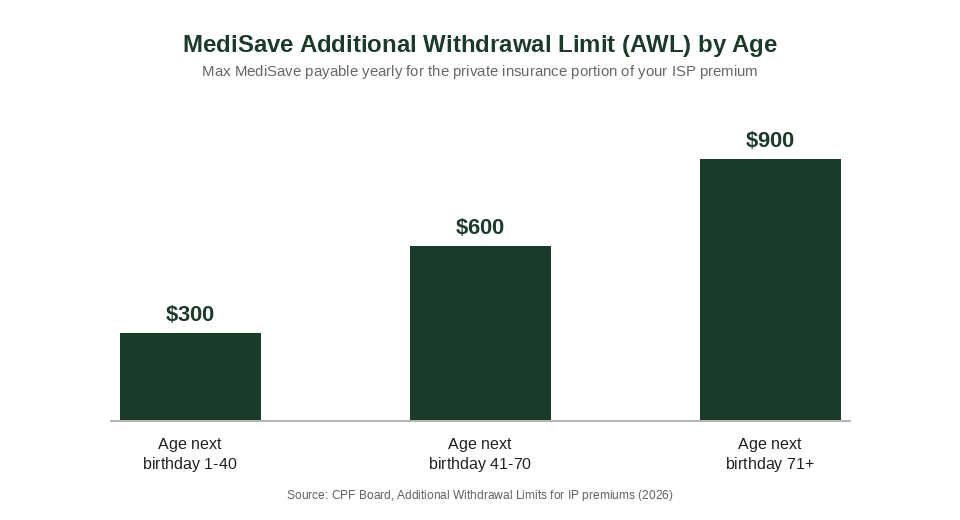
This limit applies per insured person, per year — not per MediSave account. So if you’re 45 and helping pay your father’s ISP premium, the ceiling that applies is his age band, not yours. If he’s 75, the private component of his premium can draw up to $900 a year from your MediSave, regardless of how old you are.
Why You’d Use a Family Member’s MediSave Instead of Your Own
Two situations come up most often.
Retirees with thin MediSave balances. Premiums climb steeply with age — the private insurance component alone can be several times higher in your 70s than in your 30s. But your MediSave contributions stop once you retire, so your balance isn’t growing to match. An adult child with a healthy MediSave balance can step in, up to their own AWL for the parent’s policy.
Children and non-working spouses. A young child or a spouse who isn’t working has little or no MediSave of their own. Parents commonly use their own MediSave to pay a child’s ISP premium instead.
For a fuller picture of how your MediSave balance grows and what it’s meant to cover over your lifetime, see our complete guide to how MediSave works. It’s also worth checking your retirement healthcare cost projections before committing a family member’s MediSave to an ongoing premium — rising ISP premiums are a multi-decade cost, not a one-off.
How Many Family Members Can You Help?
There’s no cap. CPF Board is explicit about this: there is no limit to the number of family members you can use your MediSave to pay Integrated Shield Plan premiums for.
That said, CPF also flags the trade-off directly — you should weigh the long-term affordability of your family members’ premiums against whether you’ll have enough MediSave left for your own healthcare needs in retirement. Helping three or four relatives sounds generous until your own Basic Healthcare Sum runs thin at 70. If you want the fuller mechanics of how your BHS interacts with withdrawals, our Basic Healthcare Sum guide walks through it.
How to Set It Up
In practice, this isn’t something you configure yourself online. Here’s the usual process:
- Check the AWL that applies. It’s based on the insured person’s age next birthday, not the account holder’s.
- Inform the insurer. When you or your family member applies for (or renews) the ISP, tell the insurer which MediSave account should be debited — yours or theirs.
- Get the account holder’s consent. If you’re using a family member’s MediSave, they’ll need to authorise it. Insurers typically require their signature or an online authorisation through the insurer’s portal.
- The insurer handles the deduction. Your insurer submits the claim to CPF Board directly each year at renewal — you don’t manually transfer MediSave funds yourself.
- Cash tops up the gap. If the private component exceeds the AWL, the insurer will bill the difference to the policyholder’s registered payment method in cash.
If you’re topping up a family member’s MediSave first so they have enough to cover their own AWL, our guide on how to top up MediSave in Singapore covers the tax relief and mechanics.
What MediSave Can’t Cover
MediSave — yours or a family member’s — can’t be used for everything tied to your ISP. Two things are always cash-only:
Riders are the optional add-ons that reduce your deductible and co-insurance. They’re not covered by MediSave at all, from any account, at any age. That’s unchanged by the MOH rider reforms that took effect on 1 April 2026 — if anything, it matters more now, since new riders sold after that date carry a higher minimum co-payment cap of $6,000 and no longer cover the deductible.
The second thing cash-only: any part of your private insurance premium above the AWL, once you’ve exhausted your annual ceiling. To see how MediShield Life itself and the various insurers’ plans fit together before you compare riders or upgrade a ward class, our Shield Plan Singapore overview is a useful starting point.
A Worked Example
CPF Board publishes its own indicative premium table to illustrate how this plays out at different life stages. The figures below are CPF’s own worked example (premiums indicative as of April 2023, reproduced by CPF as a teaching illustration) — but the AWL cap itself is current for 2026 and hasn’t changed.
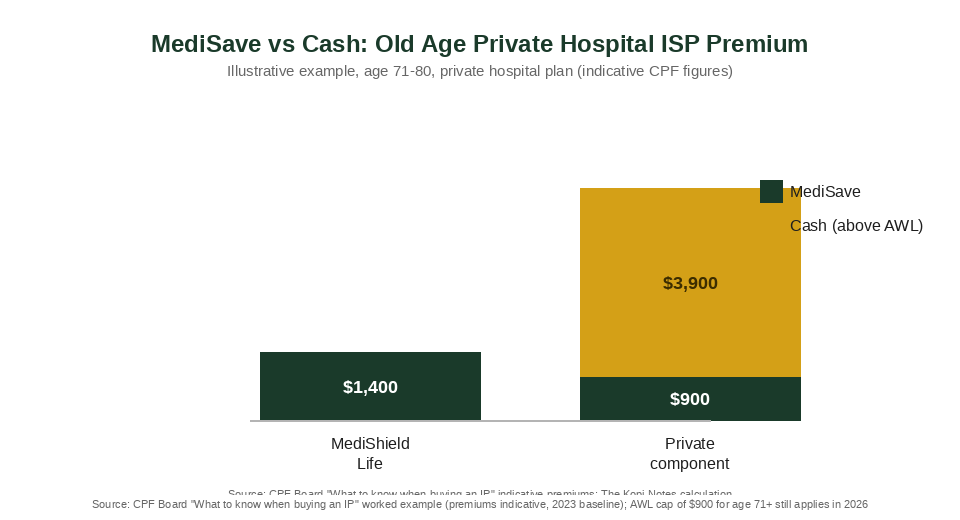
Take a policyholder aged 71–80 with a private hospital ISP. In CPF’s illustration, the MediShield Life premium (roughly $1,200–$1,600) is fully covered by MediSave. But the private insurance component can run from roughly $2,900 to $8,000 a year — and MediSave only ever covers $900 of that, capped by the AWL. Everything past $900 is cash.
Now imagine this policyholder’s own MediSave balance is running low in retirement. Their 45-year-old child, still working and contributing to MediSave every month, can be nominated to cover that same $900 AWL slice instead — freeing up the parent’s own MediSave for other healthcare costs, like hospitalisation bills or outpatient treatment.
| Who Can Pay | MediShield Life Portion | Private Component (up to AWL) | Excess Above AWL |
|---|---|---|---|
| Your own MediSave | Full amount | Yes, up to your age band’s AWL | Cash |
| A family member’s MediSave | Full amount | Yes, up to the insured person’s age band AWL | Cash |
| Rider premium (any account) | Not applicable | Not covered by MediSave | Always cash |
Source: CPF Board, “What to know when buying an Integrated Shield Plan (IP)” and AWL FAQ, verified 21 August 2026.
FAQ: Family MediSave and Integrated Shield Plan Premiums
Yes. CPF Board allows you to use a parent’s MediSave to pay your ISP premium, subject to the Additional Withdrawal Limit for the private insurance portion. Your parent will need to authorise this with the insurer.
No. CPF Board has confirmed there’s no limit to the number of family members you can use your MediSave to pay Integrated Shield Plan premiums for. The trade-off is your own long-term MediSave adequacy, not a hard rule.
No. Rider premiums must always be paid fully in cash, whether you use your own MediSave or a family member’s. This hasn’t changed under the April 2026 MOH rider reforms.
Your insurer collects the difference in cash. MediSave — yours or a family member’s — never covers more than the AWL for the private insurance component, though it always covers the full MediShield Life portion.
Yes. Your spouse, children and parents can be of any nationality, but grandparents and siblings must be Singapore Citizens or Permanent Residents for MediSave family use to apply.
Yes, if you’re the one whose MediSave is debited. Every dollar used for a family member’s premium is a dollar that no longer earns interest toward your own future healthcare needs. That’s why CPF explicitly recommends weighing affordability before committing to it long-term.
Get Free Insurance Advice
Speak with a licensed insurance advisor. No obligation, no cost.
By submitting this form, you agree to our Privacy Policy.
This article was researched with the help of AI. While we strive to keep all information accurate and up to date, there may be errors. If you notice any discrepancies, please contact us.