What Happens When MediSave Can’t Cover Your Integrated Shield Plan Bill? (2026)
MediSave withdrawal limits, the new IP rider co-payment rules, and exactly what covers the gap when there’s a shortfall.
MediSave has fixed withdrawal limits, not unlimited access, even if your account balance is healthy. When your Integrated Shield Plan bill goes past these limits, or your rider’s deductible and co-payment add up, you’re left with a gap. Since 1 April 2026, new riders also carry a mandatory 5% co-payment. Here’s exactly what MediSave covers, what your rider pays, and your options when there’s still a shortfall.
Not financial advice. All figures are for educational reference only, sourced from CPF Board and Ministry of Health publications. Data verified as at August 2026 unless otherwise noted.
- MediSave has fixed withdrawal limits per day and per procedure â not a blank cheque, even with a large account balance.
- From 1 April 2026, new IP riders can’t cover your deductible, and every rider must charge at least 5% co-payment, capped at a minimum of $6,000 a year for panel or pre-authorised claims only.
- If MediSave and your rider still don’t cover everything, you can tap a family member’s MediSave, ask for a 0% instalment plan, or apply for MediFund as a last resort.
Table of Contents
Contents â Click to expand
- What “MediSave Running Out” Actually Means
- MediSave Withdrawal Limits for Hospitalisation and Surgery (2026)
- How the New IP Rider Rules Change What You Owe (From 1 April 2026)
- Two Real MOH Case Studies: How Much MediSave Actually Covers
- What Happens When MediSave and Your Rider Still Don’t Cover Everything
- How to Avoid a MediSave Shortfall Before You’re Hospitalised
- Frequently Asked Questions
What “MediSave Running Out” Actually Means
When people say MediSave “runs out” mid-treatment, they usually mean one of two different things. The first is hitting a withdrawal limit â a fixed cap on how much you can use per day or per procedure, regardless of how much is sitting in your account. The second is your actual MediSave balance being too low, which is less common but does happen to younger workers or those who’ve made large withdrawals earlier in the year.
Withdrawal limits exist on purpose. As CPF Board explains, they’re there to stop your MediSave from being depleted prematurely, since your savings need to last your whole life. CPF is upfront that these limits “are generally sufficient” to cover bills in Class B2 or C wards at a public hospital. Notice what’s missing from that sentence: private hospitals and Class A wards, where bills run much higher.
Your MediSave also sits inside a bigger cap â the Basic Healthcare Sum, which limits how much can build up in your Medisave Account. And because you’re also using MediSave to fund your Integrated Shield Plan premiums each year, a bad year of claims can eat into savings you were counting on for something else.
MediSave Withdrawal Limits for Hospitalisation and Surgery (2026)
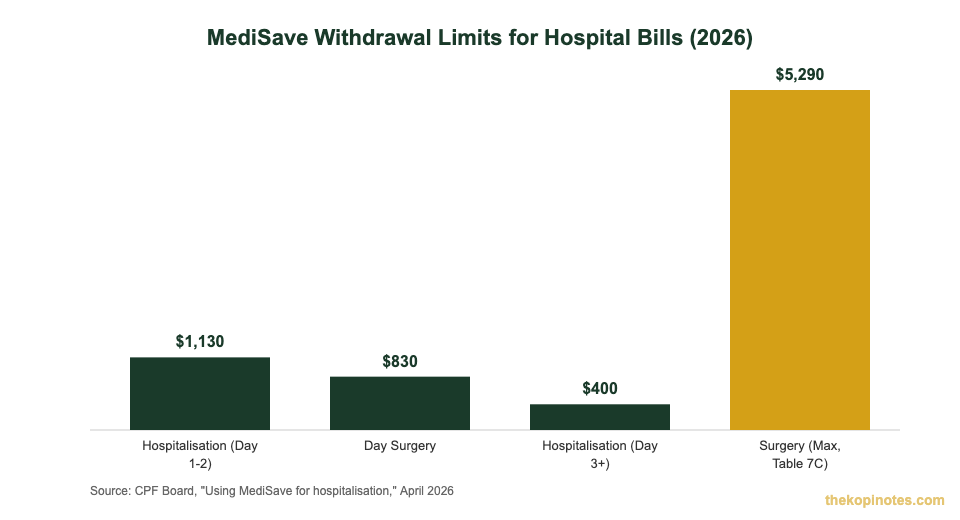
Here’s the part most people never check until they’re staring at a bill. MediSave pays out according to fixed schedules, not “whatever’s left in your account.” These are the current limits, based on official CPF Board figures.
| Treatment Type | MediSave Withdrawal Limit |
|---|---|
| Hospitalisation (general ward) | $1,130/day for the first 2 days, $400/day after |
| Psychiatric treatment | $1,130/day for the first 2 days, $230/day after |
| Day surgery | Up to $830/day |
| Surgery (Table of Surgical Procedures) | $240 to $5,290, by procedure complexity |
| Delivery (MediSave Maternity Package) | $1,120 natural, $2,380â$2,440 caesarean |
Source: CPF Board, “Using MediSave for hospitalisation,” last updated April 2026.
Here’s why this matters for your Shield Plan bill: MediSave pays first, up to these caps. Your MediShield Life or Integrated Shield Plan claim then covers the insured portion. Anything past that â including the combined MediSave limit by age for your specific claim â has to come from somewhere else. For a bigger private hospital bill, it’s entirely possible for your deductible and co-payment to exceed what MediSave is allowed to release that day, even if your account has plenty of savings in it.
How the New IP Rider Rules Change What You Owe (From 1 April 2026)
MOH reformed rider design because riders were driving up costs across the board. Policyholders with a rider are 1.4 times more likely to make a claim, and their average claim is 1.4 times larger than someone without one. That over-consumption pushes up premiums for everyone, so MOH stepped in.
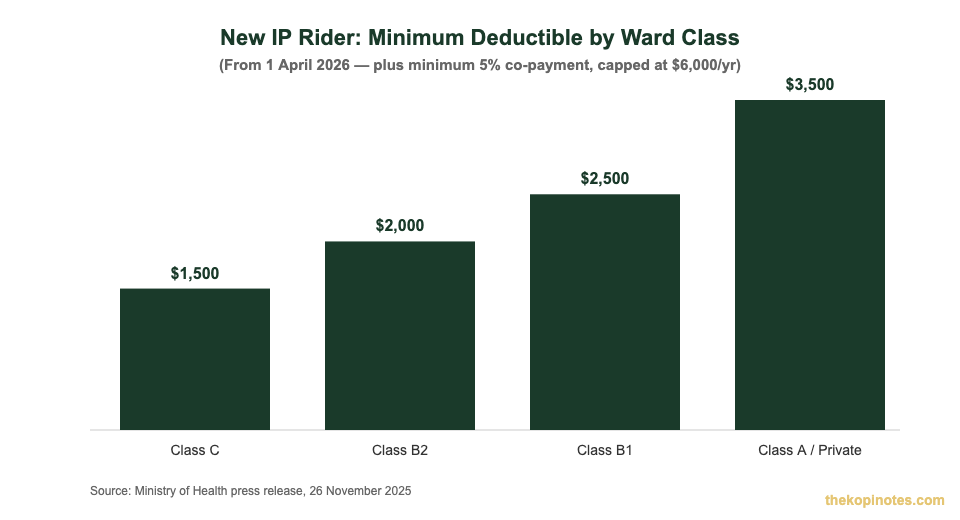
From 1 April 2026, new riders sold can no longer cover your minimum IP deductible â you pay that part yourself. The minimum co-payment stays at 5%, but the co-payment cap has been raised from $3,000 a year (set back in 2018) to at least $6,000 a year. That cap applies only to the co-payment, not the deductible, and â this is the detail most people miss â it only applies if you see a panel doctor or get pre-authorisation. Go outside the panel without pre-authorisation, and there’s no cap at all.
| Ward Class | Minimum IP Deductible (From 1 Apr 2026) |
|---|---|
| Class A / Private | $3,500 |
| Class B1 | $2,500 |
| Class B2 | $2,000 |
| Class C | $1,500 |
| Day Surgery (non-subsidised / subsidised) | $2,000 / $1,500 |
Source: Ministry of Health press release, 26 November 2025.
Both the deductible and the co-payment can be paid with MediSave, but â back to the earlier point â only up to the withdrawal limits that apply to your treatment. If your combined deductible and co-payment fit within those limits, MediSave can carry the whole thing. If it doesn’t, you’re paying cash for the difference.
If you bought your rider before 27 November 2025, your insurer decides how and when you move to the new design. If you bought on or after that date, you’ll transition to a compliant rider by your next renewal after 1 April 2028.
Two Real MOH Case Studies: How Much MediSave Actually Covers
MOH published worked examples alongside the rider reform. They’re useful because they show both outcomes â one where MediSave covers everything, and one where it doesn’t.
Mr A, 60, knee replacement (private hospital): His bill came to $56,900. Under the new rider, he pays the $3,500 deductible plus 5% of the remaining bill, totalling $6,170. That entire amount was covered by MediSave, based on the applicable withdrawal limits for his ward class and procedure.
Mrs B, 40, ACL reconstruction (private hospital): Her bill was $38,700. Her deductible and co-payment came to $5,260, but MediSave could only cover $3,900 of it. She had to pay the remaining $1,360 in cash â even though she had both insurance and MediSave working for her.
The difference isn’t really about the size of the bill. It comes down to whether the deductible-plus-co-payment amount sits inside MediSave’s withdrawal limits for that specific treatment. Two similar-sized bills can land very differently, which is exactly why it’s worth checking which insurer leaves you paying the least cash out of pocket before you’re the one signing the admission form.
What Happens When MediSave and Your Rider Still Don’t Cover Everything
Pay the Balance in Cash
This is CPF Board’s own answer: if any part of the bill isn’t covered, you pay it in cash. There’s no automatic fallback. It’s the reason a shortfall catches people off guard â MediSave and insurance feel comprehensive right up until the point they aren’t.
Use an Approved Family Member’s MediSave
You’re not limited to your own account. Approved dependants include your spouse, parents, and children of any nationality, plus grandparents and siblings if they’re Singapore Citizens or Permanent Residents. You’ll need their consent to authorise the withdrawal, and the same treatment-specific limits still apply.
Ask for Hospital Financial Counselling and a 0% Instalment Plan
Most Singapore hospitals have a financial counselling or medical social work office. In practice, they can arrange interest-free instalment plans for the outstanding balance, and sometimes point you towards additional hospital grants you didn’t know existed. Ask before you leave the hospital, not after the bill arrives in the mail.
Apply for MediFund (Last Resort, Means-Tested)
MediFund is the government’s payer of last resort, but it’s narrow. It only applies to Class B2 or C wards at public hospitals, and only after you’ve exhausted subsidies, insurance, and MediSave. A medical social worker assesses your household finances and decides case by case â there’s no guaranteed payout, and it isn’t available for private hospital bills.
How to Avoid a MediSave Shortfall Before You’re Hospitalised
For planned or elective procedures, you have room to prepare. A few things genuinely move the needle:
Ask your hospital for a bill estimate and get pre-authorisation from your insurer before admission â this is also what unlocks the co-payment cap under the new rider rules. Check whether your existing rider has already been switched to the post-April-2026 design, since that changes what you’ll owe. If your MediSave balance is thin, consider a top-up ahead of a planned admission rather than during one. And when comparing riders, don’t just look at the premium â look at which rider design suits you best after MOH’s 2026 reform, since the cheapest option isn’t always the one with the smallest cash gap.
Frequently Asked Questions
What happens if MediSave can't cover my full hospital bill?
MediSave withdrawal limits cap how much you can use per day or per procedure, regardless of your account balance. Once you hit that cap, you’ll need to pay the remaining balance in cash, unless your Integrated Shield Plan claim or a family member’s MediSave can cover it.
Can I use my family member's MediSave for my Integrated Shield Plan bill?
Yes. Approved dependants include your spouse, parents, and children of any nationality, plus grandparents and siblings who are Singapore Citizens or Permanent Residents. You’ll need their consent to authorise the withdrawal.
Do I still have to pay cash if I have an 'as charged' rider?
From 1 April 2026, new IP riders must include a minimum 5% co-payment, so even “as charged” plans aren’t fully cashless anymore. The minimum $6,000-a-year co-payment cap only applies if you use a panel doctor or get pre-authorisation; otherwise there’s no cap.
What is MediFund and can I apply for it?
MediFund is a means-tested government safety net for Singapore Citizens who still can’t afford their bill after subsidies, insurance, and MediSave. It only covers Class B2 or C wards at public hospitals and is granted case by case by a medical social worker â never guaranteed.
What's the MediSave withdrawal limit for surgery in 2026?
Surgical withdrawal limits range from $240 to $5,290, based on the Table of Surgical Procedures (TOSP), which ranks operations by complexity from Table 1 to Table 7.
Will the new IP rider rules from April 2026 affect my existing policy?
If you bought your rider before 27 November 2025, your insurer decides its own transition approach. If you bought on or after that date, you’ll move to a compliant rider by your next renewal after 1 April 2028.
Disclaimer: This article is for educational purposes only and does not constitute financial or insurance advice. Figures are sourced from CPF Board and Ministry of Health publications and are accurate as at August 2026, but MediSave withdrawal limits, deductibles, and rider rules may be revised over time â check CPF Board and MOH directly before making decisions.
Get Free Insurance Advice
Speak with a licensed insurance advisor. No obligation, no cost.
By submitting this form, you agree to our Privacy Policy.
This article was researched with the help of AI. While we strive to keep all information accurate and up to date, there may be errors. If you notice any discrepancies, please contact us.