MediSave Cash Outlay Compared: Which Integrated Shield Plan Costs You Least in 2026?
We compare the actual cash top-up you pay after MediSave and the Additional Withdrawal Limit, across Prudential, Great Eastern, Singlife and NTUC Income’s top-tier private hospital plans.
MediSave covers your MediShield Life premium in full, but the private component of your Integrated Shield Plan is capped by the Additional Withdrawal Limit (AWL) of $300 to $900 a year. Once you apply that cap to each insurer’s official 2026 premium table, NTUC Income’s Enhanced IncomeShield Preferred leaves you with the smallest cash bill at both age 40 and age 60, while Great Eastern’s GREAT SupremeHealth P Plus leaves you with the largest.
Not financial advice. All figures are for educational reference only and drawn from each insurer’s own published premium tables. Data verified as at 17 August 2026 against Prudential, Great Eastern, Singlife, Income and CPF Board sources.
- The AWL is the same for everyone at a given age ($300 under 41, $600 from 41-70, $900 from 71) — but your cash outlay still depends entirely on which insurer and plan you pick
- At age 40, NTUC Income’s Enhanced IncomeShield Preferred costs just $129 a year in cash, versus $380 for Great Eastern’s GREAT SupremeHealth P Plus — nearly 3x more
- The gap widens sharply with age: by 60, the difference between the cheapest and priciest plan compared here grows to over $750 a year in cash
Table of Contents
Contents - Click to expand
- Why “Cash Outlay” Matters More Than the Sticker Premium
- How We Compared: Same Tier, Same Age, Same Math
- MediSave Cash Outlay at Age 40, By Insurer
- MediSave Cash Outlay at Age 60, By Insurer
- Why the Gap Is So Wide Between Insurers
- What About AIA HealthShield Gold Max?
- What This Means for Your MediSave Planning
- Frequently Asked Questions
Why “Cash Outlay” Matters More Than the Sticker Premium
When you compare Integrated Shield Plans, it’s easy to focus on the headline annual premium. But that number isn’t what actually leaves your bank account. Once MediSave pays your MediShield Life portion in full, and covers as much of your private component as your Additional Withdrawal Limit allows, what’s left over is your real cash outlay.
Two insurers can have similar total premiums but very different cash outlays, simply because of how each insurer prices its private component relative to the AWL. That’s the number that actually matters for your monthly budget, and it’s the number most comparison articles skip.
This guide isolates that single figure, cash outlay, and lines it up side by side across four insurers’ top-tier private hospital plans, at two ages: 40 and 60.
How We Compared: Same Tier, Same Age, Same Math
To keep this comparison fair, we used each insurer’s own published premium tables for a Singapore Citizen or Permanent Resident, no smoking or health loadings, at the private hospital or Class A ward tier, which is each insurer’s flagship plan:
- Prudential PRUShield Premier — rates effective 1 April 2026, per Prudential’s official premium rate table
- Great Eastern GREAT SupremeHealth P Plus — rates effective 1 April 2026, per Great Eastern’s benefit schedule and premium rates
- Singlife Shield Plan 1 — rates effective 1 April 2026, per Singlife’s revised premium rates
- NTUC Income Enhanced IncomeShield Preferred — rates effective 1 October 2025 (the schedule still in force at the time of writing), per Income’s standard premium table
Every insurer’s table already does the AWL math for you: it shows the MediShield Life premium (fully MediSave-payable), the private component premium, the AWL that applies at that age, and the resulting cash outlay. We pulled those columns directly rather than recalculating them ourselves, to avoid introducing rounding errors. The AWL amounts themselves are set by CPF Board.
One important caveat: these four plans are broadly comparable in tier, but not identical in benefits. Claim limits, panel networks, and rider add-ons differ between insurers. This comparison is about cost, specifically MediSave cash outlay, not a ranking of overall plan quality. Check each insurer’s own benefit schedule before switching.
MediSave Cash Outlay at Age 40, By Insurer
At age 40 (age next birthday), you’re still in the $300 AWL band. Here’s how much cash each insurer’s flagship private plan actually costs you once MediSave has paid what it can.
| Insurer & Plan | MediShield Life (MediSave) | Private Component Premium | AWL | Cash Outlay |
|---|---|---|---|---|
| NTUC Income Enhanced IncomeShield Preferred | $503 | $429 | $300 | $129 |
| Singlife Shield Plan 1 | $503 | $432 | $300 | $132 |
| Prudential PRUShield Premier | $503 | $516 | $300 | $216 |
| Great Eastern GREAT SupremeHealth P Plus | $503 | $680.16 | $300 | $380.16 |
Source: Prudential PRUShield Premium Table (1 Apr 2026), Great Eastern GREAT SupremeHealth Benefit Schedule and Premium Rates (1 Apr 2026), Singlife Shield Revised Premium Rates (1 Apr 2026), Income Standard Premiums for Enhanced IncomeShield (1 Oct 2025). All figures for Age Next Birthday 40, Singapore Citizens/PRs.
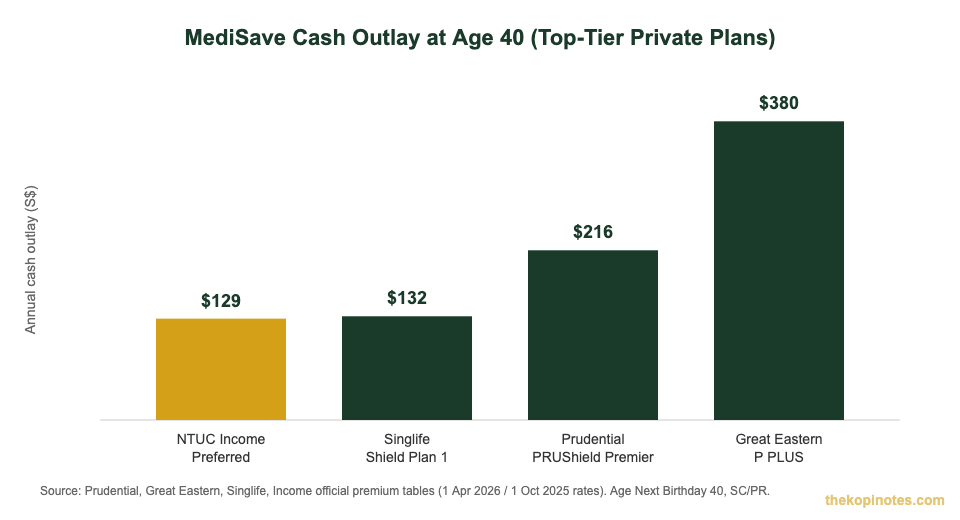
At this age, the gap is already meaningful. Income’s Preferred plan costs $129 a year in cash. Great Eastern’s P Plus costs $380.16 — almost three times as much, for a plan in the same private hospital tier. Over a decade, that’s roughly an extra $2,500 in cash out of pocket, before any rider is added on top.
MediSave Cash Outlay at Age 60, By Insurer
By age 60, you’ve moved into the $600 AWL band, but private component premiums have grown much faster than the AWL itself. Cash outlay jumps sharply across every insurer.
| Insurer & Plan | MediShield Life (MediSave) | Private Component Premium | AWL | Cash Outlay |
|---|---|---|---|---|
| NTUC Income Enhanced IncomeShield Preferred | $903 | $1,940 | $600 | $1,340 |
| Singlife Shield Plan 1 | $903 | $2,084 | $600 | $1,484 |
| Prudential PRUShield Premier | $903 | $2,258 | $600 | $1,658 |
| Great Eastern GREAT SupremeHealth P Plus | $903 | $2,698.84 | $600 | $2,098.84 |
Source: Prudential PRUShield Premium Table (1 Apr 2026), Great Eastern GREAT SupremeHealth Benefit Schedule and Premium Rates (1 Apr 2026), Singlife Shield Revised Premium Rates (1 Apr 2026), Income Standard Premiums for Enhanced IncomeShield (1 Oct 2025). All figures for Age Next Birthday 60, Singapore Citizens/PRs.
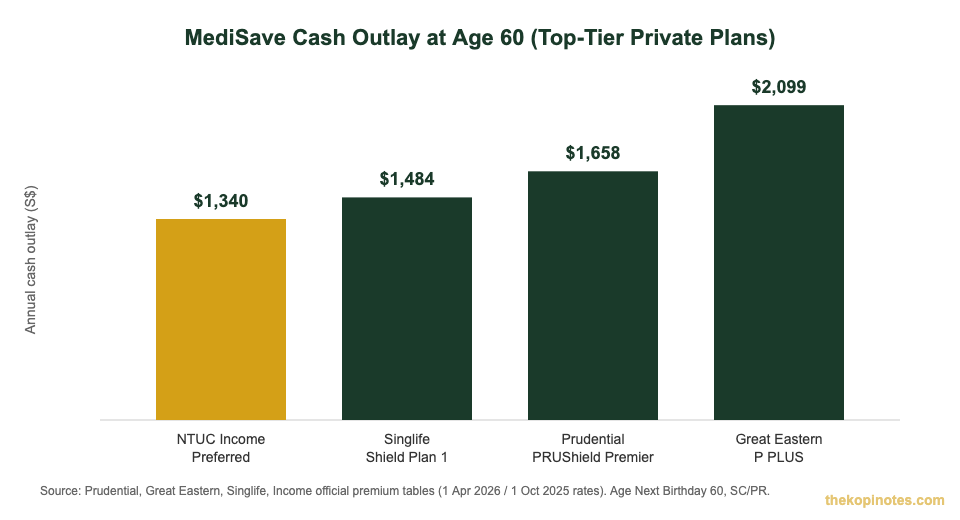
That’s the difference between Income’s Preferred ($1,340) and Great Eastern’s P Plus ($2,098.84). The AWL is identical for both policyholders at $600. Every extra dollar of that gap comes purely from how each insurer prices its private component.
Why the Gap Is So Wide Between Insurers
The AWL is a flat government-set cap, so it can’t explain the difference in cash outlay. What explains it is how each insurer prices its top-tier plan relative to that cap. A few factors typically drive this:
Claim limits and panel structure. Plans with higher annual claim limits, broader “as charged” coverage, or wider specialist panels tend to carry higher base premiums, which pushes more of the bill above the AWL and into cash.
Underlying claims experience. Insurers price premiums based partly on how much they’ve historically paid out for that plan tier. An insurer with a larger, older, or higher-claiming pool for its top-tier plan will generally charge more.
Rider bundling and reform timing. Since MOH’s April 2026 rider reform, insurers have redesigned riders at different paces, and some plan premiums reflect newer, cheaper rider structures faster than others.
None of this means the cheapest cash outlay is automatically the “best” plan. Great Eastern’s P Plus and Prudential’s Premier, for example, are priced as premium private hospital plans with correspondingly broad benefit schedules. If you want the full benefit-by-benefit picture rather than just the cost angle, see our dedicated guides: the Prudential PRUShield premium guide, the Great Eastern SupremeHealth P Plus premium table, the Singlife Shield Plan premium table, and the NTUC Income Enhanced IncomeShield review.
What About AIA HealthShield Gold Max?
We left AIA HealthShield Gold Max out of the headline comparison tables above because we couldn’t independently re-verify AIA’s current official premium table against a live source at the time of writing, and this article’s fact-check standard requires that for every figure we publish. AIA’s Plan A is a comparable top-tier private hospital plan, and its own AWL treatment works exactly the same way described here. For AIA-specific numbers, see our separate AIA HealthShield Gold Max premium table guide, and check AIA’s own published rate tables directly before making a decision.
What This Means for Your MediSave Planning
A few practical takeaways if you’re comparing plans or budgeting for your next renewal:
Ask for the cash outlay, not just the premium. When comparing quotes, ask your insurer or adviser to state the cash outlay explicitly, not just the total annual premium. It’s the number that actually affects your monthly budget.
The gap compounds with age. A $250 cash difference at age 40 becomes a $750-plus difference at age 60 for the plans compared here. If you’re choosing a plan in your 30s or 40s, model out what that gap could look like by the time you’re in your 60s, not just today’s number.
Cost isn’t the only factor. A lower cash outlay is worth less if the plan’s claim limits or panel network don’t fit your needs. Weigh cash outlay alongside coverage, not instead of it, and read our full AWL breakdown if you want to understand exactly how the cap is calculated at every age band.
Budget the cash portion separately. Since this money doesn’t come from MediSave, many Singaporeans set it aside in a separate high-yield account earmarked for insurance renewals, so it’s not competing with other short-term savings goals. Our retirement planning calculator can help you see how a rising cash outlay fits into your broader retirement number as you age.
Frequently Asked Questions
Does MediSave cover my full Integrated Shield Plan premium, or just part of it?
Just part of it. MediSave pays your MediShield Life component in full. The private insurance component on top is capped by the Additional Withdrawal Limit (AWL), which is $300 to $900 a year depending on your age. Anything above that cap is billed to you in cash by your insurer.
Which insurer has the lowest cash outlay for its top-tier private hospital plan?
Based on official premium tables compared in this article, NTUC Income’s Enhanced IncomeShield Preferred has the lowest cash outlay at both age 40 ($129 a year) and age 60 ($1,340 a year), among the four insurers compared: Prudential, Great Eastern, Singlife and NTUC Income.
Why is Great Eastern's cash outlay higher than the others if the AWL is the same for everyone?
The AWL is a flat, government-set cap that doesn’t vary by insurer. The difference comes entirely from how each insurer prices its private component premium. Great Eastern’s GREAT SupremeHealth P Plus carries a higher private component premium than the other three plans compared here, so more of that premium falls above the AWL and has to be paid in cash.
Does a lower cash outlay mean a better plan?
Not necessarily. Cash outlay only measures cost, not coverage. Plans with higher premiums often come with higher claim limits or broader panel networks. Compare cash outlay alongside each plan’s actual benefit schedule before deciding, rather than choosing on price alone.
Are AIA's premiums included in this comparison?
No. We excluded AIA HealthShield Gold Max from the quantitative comparison because we could not independently re-verify AIA’s current official premium table at the time of writing. See our separate AIA HealthShield Gold Max premium table guide for AIA-specific figures, and confirm directly with AIA before deciding.
How often do these premium tables change?
Insurers typically revise Integrated Shield Plan premiums annually, and sometimes more often following regulatory changes like MOH’s April 2026 rider reform. The figures in this article reflect each insurer’s most recently published table as at 17 August 2026; always check the insurer’s current rate table before applying, since rates are non-guaranteed and subject to revision.
Compare Your MediSave Options Before You Renew
See exactly how much cash your current plan costs you, and what the alternatives look like.
Get Free Insurance Advice
Speak with a licensed insurance advisor. No obligation, no cost.
By submitting this form, you agree to our Privacy Policy.
This article was researched with the help of AI. While we strive to keep all information accurate and up to date, there may be errors. If you notice any discrepancies, please contact us.