Retirement Calculator Singapore: How Much You Actually Need to Retire (2026)
A step-by-step guide to working out your real retirement number — with CPF LIFE payouts, savings gaps, and a free calculator.
Free download: The Singapore Money Playbook — 7 money mindset shifts written for Singapore, with the CPF-adjusted retirement number most guides get wrong (PDF + Notion).
Most Singapore retirement calculators only tell you your CPF LIFE payout. Your real number is CPF LIFE plus whatever gap you need to close with cash savings, SRS, or investments — and that gap is usually bigger than people expect. At the Full Retirement Sum (FRS) of $220,400, CPF LIFE pays roughly $1,780 a month. If you want $3,500 a month in retirement, you need to fund the other $1,720 yourself.
Not financial advice. All figures are for educational reference only. CPF figures are for the 2026 cohort and are correct as at August 2026 unless otherwise stated.
- CPF LIFE at FRS pays about $1,780/month — that’s your retirement income floor, not the full picture
- Work out your target monthly spend first, then subtract CPF LIFE to find your real savings gap
- Use our free calculator below to plug in your own numbers in under 2 minutes
What’s In This Guide
How much do you actually need to retire in Singapore?
The 3 building blocks of your retirement income
CPF LIFE payouts at BRS, FRS and ERS
How to use the retirement calculator
Worked example: closing a $1,720/month gap
Retirement age, re-employment and timing
Common mistakes when calculating your number
How Much Do You Actually Need to Retire in Singapore?
There’s no single “magic number” for retirement in Singapore. It depends on your target monthly spend, how long you expect to live off your savings, and how much of that spend CPF LIFE already covers.
Here’s the simplest way to think about it. Start with your target monthly spend in retirement. Subtract your expected CPF LIFE payout. What’s left is the monthly gap you need to fund from savings, SRS, investments, or rental income.
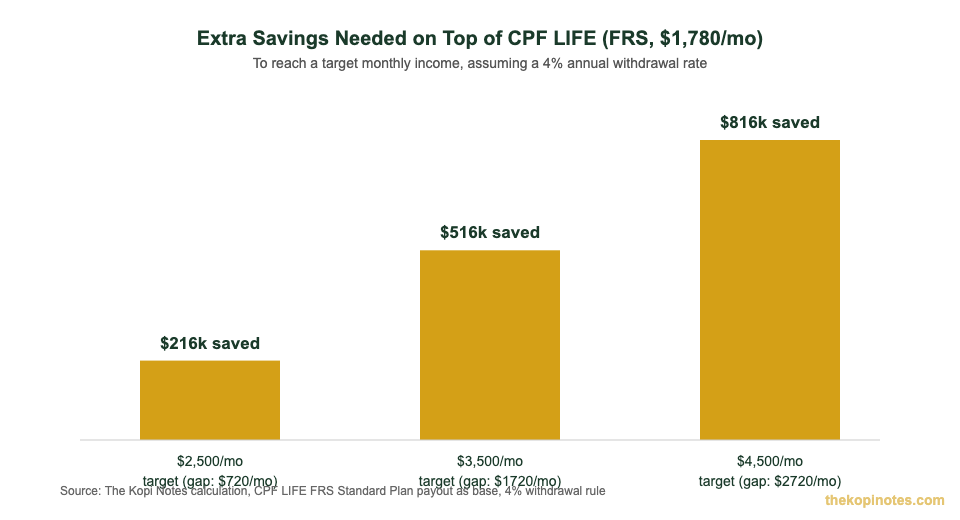
For example, if you want $3,500 a month and you’re on the FRS with CPF LIFE Standard Plan, you’re getting about $1,780 a month from CPF LIFE. That leaves a $1,720 monthly gap. Using a 4% annual withdrawal rate (a common rule of thumb for how much you can safely draw down each year), you’d need roughly $516,000 in savings and investments to fund that gap for a 20 to 25-year retirement.
That number can feel intimidating. But you don’t have to hit it all through cash savings — SRS, CPF investment returns, and dividend-paying assets like S-REITs and ETFs can all contribute. The point of a proper retirement calculator is to turn a vague worry into a specific number you can actually plan against.
The 3 Building Blocks of Your Retirement Income
Most Singaporeans end up combining three sources of retirement income. Understanding each one helps you see where your calculator inputs should come from.
1. CPF LIFE — your guaranteed floor
CPF LIFE gives you a monthly payout for life, starting at your payout eligibility age (currently 65). It’s not means-tested and it doesn’t run out, which makes it the most reliable part of your plan. The amount depends on which Retirement Sum you hit and which plan (Standard, Basic, or Escalating) you pick.
2. Personal savings and investments
This covers your SRS account, brokerage investments, and cash savings outside CPF. It’s the flexible part of your plan — you control when and how much you withdraw, but you also carry the risk of running out if you draw down too fast.
3. Other income — rental, part-time work, or a paid-up policy
Some retirees keep a rental property, do consulting or part-time work into their late 60s under re-employment rules, or hold an endowment or annuity that pays out separately from CPF LIFE. This is the most variable piece and shouldn’t be relied on as your core plan.
CPF LIFE Payouts at BRS, FRS and ERS (2026 Cohort)
Your CPF LIFE payout depends on which Retirement Sum your Retirement Account hits at age 55 (or later top-ups). Here are the 2026 cohort figures on the Standard Plan, payout starting at age 65.
| Retirement Sum | Amount Set Aside | Est. Monthly Payout (Standard Plan) |
|---|---|---|
| Basic Retirement Sum (BRS) | $110,200 | ~$950 |
| Full Retirement Sum (FRS) | $220,400 | ~$1,780 |
| Enhanced Retirement Sum (ERS) | $440,800 | ~$3,440 |
Source: CPF Board, CPF LIFE Standard Plan payout estimates, 2026 cohort.
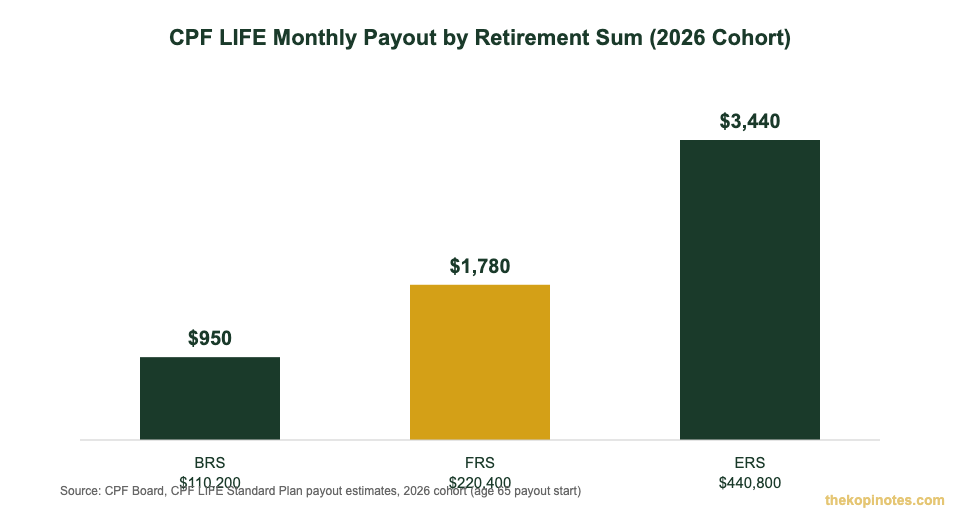
BRS gives you the smallest payout but leaves your CPF Life Savings scheme flexibility if you have a property with sufficient charge or pledge. FRS is the default and requires no property pledge. ERS gives the highest payout but locks in the most cash at age 55.
How to Use the Retirement Calculator
Our free Retirement Planning Calculator takes the maths above and does it for you. Here’s how to get an accurate result in under two minutes.
First, enter your current age and target retirement age. Second, enter your target monthly spend in retirement — be realistic, base it on your current spending rather than a round number. Third, enter your CPF Retirement Account balance or projected balance at 55. The calculator estimates your CPF LIFE payout and shows the monthly gap you need to close with other savings.
Worked Example: Closing a $1,720/Month Gap
Let’s say you’re 45 now, plan to retire at 65, and want $3,500 a month in retirement. You’re on track for the FRS, so CPF LIFE covers about $1,780. That leaves a $1,720 monthly gap, or $20,640 a year.
Using a 4% withdrawal rate, you’d want roughly $516,000 in savings and investments by age 65 to sustainably fund that gap. That sounds like a lot, but spread over 20 years of saving, it’s about $1,700 a month in regular contributions and investment growth — achievable if you start early and invest the difference rather than leaving it in a savings account.
| Target Monthly Income | Monthly Gap Above CPF LIFE (FRS) | Savings Needed (4% Rule) |
|---|---|---|
| $2,500 | $720 | ~$216,000 |
| $3,500 | $1,720 | ~$516,000 |
| $4,500 | $2,720 | ~$816,000 |
Source: The Kopi Notes calculation, CPF LIFE FRS Standard Plan payout as base, 4% withdrawal rule.
Instead of parking that gap in a savings account earning little interest, many Singaporeans channel part of it into passive income assets like dividend-paying S-REITs, or use a robo-advisor through their Endowus referral code or Syfe referral code to automate the investing.
Retirement Age, Re-Employment and Why Timing Matters
Singapore’s statutory retirement age is 65, and employers can re-employ eligible staff up to age 69. That extra window matters for your calculator inputs — working two or three years longer means more CPF contributions, a bigger Retirement Account, and fewer years your savings need to stretch.
Delaying your CPF LIFE payout start date past 65 also increases your monthly payout by up to 7% a year, up to age 70. If you can afford to wait, it’s one of the few “guaranteed returns” left in retirement planning.
Common Mistakes When Calculating Your Retirement Number
Three mistakes come up again and again. First, using today’s spending as the target without adjusting for inflation over 20 to 30 years. Second, forgetting that CPF LIFE payouts are nominal and don’t automatically keep pace with inflation unless you pick the Escalating Plan. Third, ignoring healthcare costs — CPF investment strategy and MediSave planning should sit alongside your income calculation, not be an afterthought.
A useful habit is to re-run your retirement calculator every one to two years, especially after a salary change, a new CPF policy update, or a big life event like buying a home. Your target spend and CPF projections will shift over time, and treating the calculator as a one-time exercise is one of the biggest planning mistakes you can make. Revisiting it regularly keeps your number realistic instead of stale.
Frequently Asked Questions
How much do I need to retire comfortably in Singapore?
Is CPF LIFE enough to retire on?
What's the difference between BRS, FRS and ERS?
How accurate is a retirement calculator?
Should I delay my CPF LIFE payout past age 65?
What should I do if my calculator shows a large savings gap?
Related reading: best S-REITs in Singapore 2026 · Singapore REIT ETF guide · FSMOne referral code
This article was researched with the help of AI. While we strive to keep all information accurate and up to date, there may be errors. If you notice any discrepancies, please contact us.