Can Self-Employed or Unemployed Singaporeans Use MediSave for Their Integrated Shield Plan Premium?
The 2026 AWL rules apply the same way whether you draw a salary or not — here’s exactly how the cash gap works if you’re a freelancer, business owner, or between jobs.
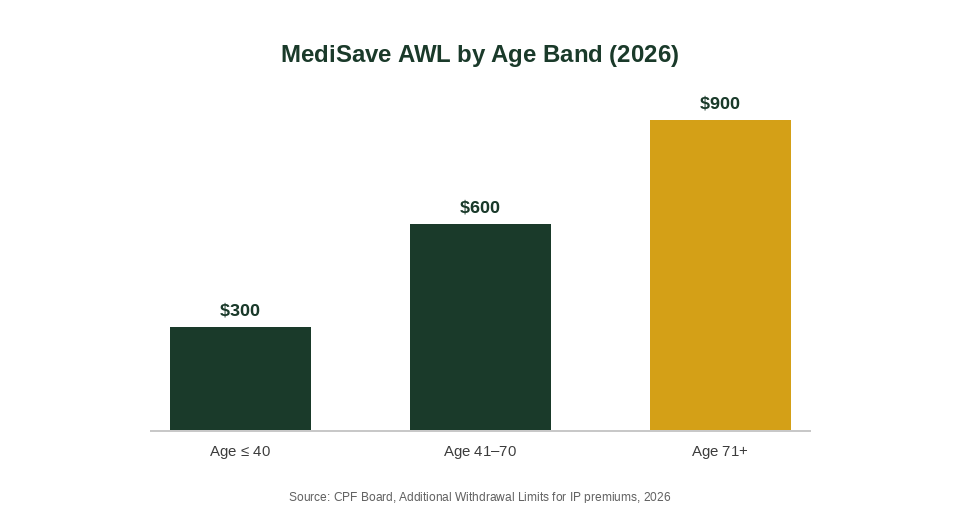
Yes. MediSave works the same way for self-employed and unemployed Singaporeans as it does for salaried employees. Your MediShield Life premium is fully MediSave-payable, and the private insurance portion of your Integrated Shield Plan (ISP) is capped by the Additional Withdrawal Limit (AWL): S$300/year if you’re 40 and below, S$600 for ages 41 to 70, and S$900 for age 71 and above. The catch isn’t the rule — it’s whether you have enough MediSave savings sitting in your account to use.
Not financial advice. All figures are for educational reference only. Data verified as at 14 August 2026 against official CPF Board and MOH sources unless otherwise noted.
- The MediSave AWL rules don’t care about your employment status. Self-employed, unemployed, retired — the same age-based caps apply to everyone.
- Your real risk isn’t the rule, it’s your MediSave balance. Employees get automatic monthly top-ups from CPF contributions; self-employed people only top up MediSave once a year (or voluntarily); unemployed people get none at all unless they top up themselves.
- If your MediSave account is thin, budget for the cash gap now — don’t wait for the premium bill to find out.
Table of Contents
Contents — Click to expand
- Does Employment Status Change the MediSave Rules?
- The AWL Applies to Everyone the Same Way
- How Self-Employed Persons Fund MediSave for ISP Premiums
- What Happens If You’re Unemployed With No Income
- Worked Example: Cash Gap by Employment Status
- Riders Are Still Cash-Only for Everyone
- What to Do If Your MediSave Balance Is Too Low
- Frequently Asked Questions
Does Employment Status Change the MediSave Rules?
No. This surprises a lot of people. CPF Board doesn’t run a different set of rules for salaried staff versus freelancers, hawkers, private-hire drivers, or people currently out of work. MediSave belongs to you as an individual, not to your employer. Whether you’re on a payroll, running your own business, or between jobs, the same withdrawal rules apply to your Integrated Shield Plan (ISP) premium.
Your ISP premium is really two premiums bundled together. The MediShield Life (MSL) portion — the compulsory national layer everyone holds — is fully payable from MediSave, no matter your income situation. The private insurance portion, sold by insurers like AIA, Prudential, Great Eastern, NTUC Income, or Singlife, is capped by the Additional Withdrawal Limit (AWL), the same annual cap for everyone in your age band.
For the full breakdown of how the AWL works and what counts toward it, see our complete guide to using MediSave for your ISP premium.
The AWL Applies to Everyone the Same Way
The Additional Withdrawal Limit is banded by “age next birthday” — your age at your next birthday, not your current age. These bands have not changed since MediShield Life launched in 2015, and they apply identically regardless of how you earn (or don’t earn) income.
| Age Next Birthday | Additional Withdrawal Limit (AWL) |
|---|---|
| 1 – 40 | S$300 per year |
| 41 – 70 | S$600 per year |
| 71 and above | S$900 per year |
Source: CPF Board, Additional Withdrawal Limits for IP premiums, 2026.
Your Basic Healthcare Sum (BHS) — the ceiling on how much MediSave you’re expected to hold for basic healthcare needs — is a separate figure, set at S$79,000 for CPF members below 65 in 2026, up from S$75,500, according to the CPF Board’s 2026 BHS announcement. The AWL isn’t deducted from your BHS — it’s simply the annual spending cap for ISP premiums, on top of whatever else you’re allowed to withdraw for hospitalisation.
How Self-Employed Persons Fund MediSave for ISP Premiums
Here’s where things genuinely differ — not the rule, but the plumbing behind it. If you’re an employee, your MediSave account gets a top-up every single month automatically, as part of your CPF contribution. That steady drip means there’s usually fresh MediSave sitting in your account when your ISP premium comes due.
If you’re self-employed, CPF contributions don’t work the same way. According to CPF Board’s guidance for self-employed persons, your MediSave contribution is based on your Net Trade Income (NTI) as declared to IRAS. Once IRAS finishes assessing your income for the year, CPF Board issues a Notice of CPF Contributions telling you what you owe, due 30 days from that notice — usually once a year, not monthly like an employee’s automatic contributions. That means your MediSave balance can sit flat for long stretches, then jump once a year (unless you opt into the Contribute-As-You-Earn scheme, which spreads contributions out as you get paid).
If your ISP premium falls due before your annual MediSave contribution lands, you could technically be within your AWL on paper but short on actual MediSave dollars to use. The fix is planning ahead: check your premium renewal date against your MediSave contribution cycle, and top up voluntarily if there’s a gap. You can read more in our complete guide to CPF MediSave contributions and top-ups.
What Happens If You’re Unemployed With No Income
If you’re not working at all — between jobs, caring for family, or taking a career break — you don’t make any new CPF contributions. But you still have a MediSave account, and whatever balance is already sitting there from your working years remains fully usable for your ISP premium, up to your AWL.
The risk here is depletion, not eligibility. If you’ve been unemployed for a while and have already used MediSave for hospital bills, dental work, or other approved purposes, your balance could be too low to cover even the AWL-capped portion of your premium. In that case, the shortfall comes out of your own pocket in cash — the same as it would for anyone whose MediSave account runs low.
One option many people overlook: a family member can top up your MediSave account, or in some cases pay your ISP premium using their own MediSave for an immediate family member’s plan. We cover the mechanics of that in our guide on using MediSave to pay for a family member’s ISP premium.
Worked Example: Cash Gap by Employment Status
Take a 45-year-old (age band 41–70, AWL S$600/year) paying a S$2,500 annual ISP premium for a private hospital plan. The AWL cap is identical no matter how they earn a living — but whether they can actually use it depends on their MediSave balance.
| Employment Status | Premium | MediSave Cap (AWL) | Cash You Pay |
|---|---|---|---|
| Employee (monthly CPF top-ups) | S$2,500 | S$600 | S$1,900 |
| Self-employed (annual top-up, timing matters) | S$2,500 | Up to S$600, if balance available | S$1,900, or more if MediSave is short |
| Unemployed (existing balance only) | S$2,500 | Up to S$600, if balance available | S$1,900, or more if MediSave is depleted |
Illustrative example. Actual premiums vary by insurer, plan tier, and ward class — see our Best Integrated Shield Plan Singapore 2026 guide for current premium tables.
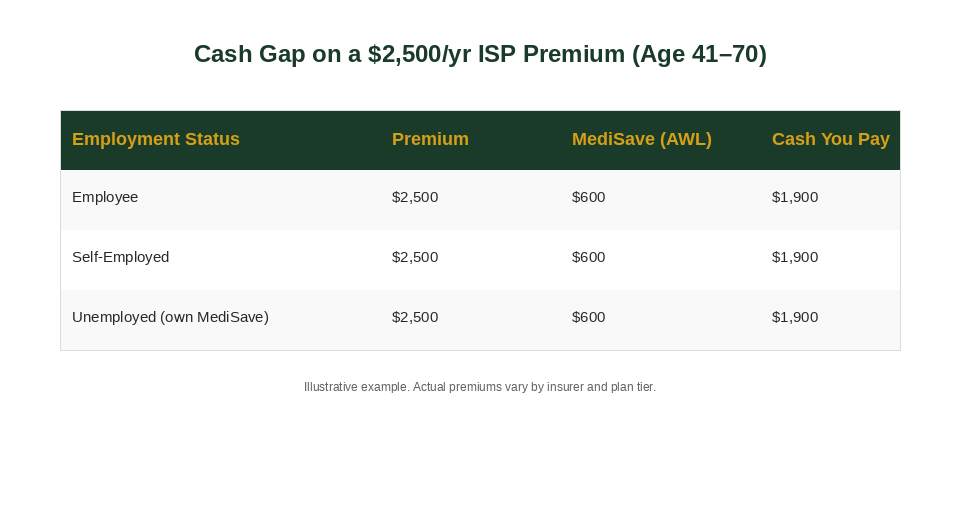
Notice the AWL cap — S$600 in this example — is the same across all three rows. What changes is whether that MediSave is actually there to draw on. This is why timing your voluntary top-ups matters more if you’re self-employed or unemployed than if you’re a salaried employee with automatic monthly contributions.
Riders Are Still Cash-Only for Everyone
No matter your employment status, rider premiums cannot be paid from MediSave at all. This has been the rule since MOH’s 2021 rider reform, and it wasn’t changed by the additional rider design updates that took effect on 1 April 2026, which reworked how riders cover deductibles and co-payments. If you hold a rider on top of your base ISP plan, budget for that premium entirely in cash.
The April 2026 changes raised the minimum co-payment cap on new riders to S$6,000 and stopped new riders from covering the deductible — the portion of a hospital bill you pay before insurance kicks in. MOH expects these changes to make new riders roughly 30% cheaper on average, which helps the cash-flow picture, but the deductible itself still has to be paid in cash or from your regular hospitalisation MediSave withdrawal limits when you actually claim, not from the AWL used for premiums. For the full picture, see our guide on the Integrated Shield Plan rider switch deadline for 2026 to 2028.
What to Do If Your MediSave Balance Is Too Low
If you’re self-employed or unemployed and worried your MediSave won’t stretch to cover even the AWL portion of your premium, you have a few practical options.
First, check your premium renewal date against your CPF contribution or top-up schedule. If you’re self-employed, consider making a voluntary MediSave contribution ahead of your policy renewal instead of waiting for the annual compulsory one. Second, ask a family member to help — CPF Board allows top-ups to a family member’s MediSave account, and in some cases the family member’s own MediSave can be used to pay your premium directly. Third, if the cash gap is a recurring problem, it may be worth reviewing whether your current plan tier matches your budget — our Best Integrated Shield Plan Singapore 2026 guide compares premiums across insurers and ward classes.
Finally, run your numbers through our Singapore retirement planning calculator to see how consistent MediSave top-ups now affect your healthcare buffer later in life — this matters more if you don’t have an employer topping up your account every month.
Frequently Asked Questions
Can self-employed Singaporeans use MediSave to pay their ISP premium?
Yes. The same MediSave rules apply to self-employed persons as to employees. Your MediShield Life premium is fully MediSave-payable, and the private insurance portion is capped by your Additional Withdrawal Limit (AWL), based on your age. The difference is that self-employed MediSave contributions are usually made once a year after tax filing, not monthly, so your balance may not always be topped up when your premium falls due.
Can unemployed people use MediSave for their Integrated Shield Plan premium?
Yes, as long as they have a MediSave balance to draw from. Unemployment doesn’t remove your access to your existing MediSave savings — the AWL rules apply the same way. The risk is that without new CPF contributions coming in, your balance can run low if it’s been used for other healthcare expenses.
What is the MediSave Additional Withdrawal Limit (AWL) in 2026?
The AWL in 2026 is S$300 per year for those aged 40 and below (age next birthday), S$600 per year for ages 41 to 70, and S$900 per year for age 71 and above. These bands have been unchanged since MediShield Life launched in 2015 and apply to everyone regardless of employment status.
Do self-employed persons have to contribute to MediSave?
Yes. Once you declare your Net Trade Income (NTI) to IRAS, CPF Board assesses your MediSave contribution and issues a Notice of CPF Contributions, which is due 30 days from issuance. This is typically once a year, unlike the monthly contributions employees receive automatically — unless you opt into CPF Board’s Contribute-As-You-Earn (CAYE) scheme.
Can a family member's MediSave help pay my ISP premium if I'm unemployed?
In certain cases, yes. CPF Board allows MediSave to be used for an immediate family member’s approved healthcare expenses, including ISP premiums, subject to the same AWL caps. See our dedicated guide on using MediSave to pay for a family member’s Integrated Shield Plan premium for the exact eligibility rules.
Can MediSave pay for my Integrated Shield Plan rider if I'm self-employed or unemployed?
No. Rider premiums must always be paid in cash, regardless of your employment status or age. This rule has applied since MOH’s 2021 rider reform and was not changed by the April 2026 rider design updates.
Get Free Insurance Advice
Speak with a licensed insurance advisor. No obligation, no cost.
By submitting this form, you agree to our Privacy Policy.
This article was researched with the help of AI. While we strive to keep all information accurate and up to date, there may be errors. If you notice any discrepancies, please contact us.