Starhill Global REIT FY2026 Results: DPU Rises to 3.68 Cents as Occupancy Hits 97.2% (SGX: P40U)
Full-year results ended 30 June 2026 — DPU growth, portfolio occupancy recovery, and what it means for Singapore income investors.
Starhill Global REIT (SGX: P40U) reported FY2026 full-year distribution per unit (DPU) of 3.68 cents, up 0.8% year-on-year, for the 12 months ended 30 June 2026. Gross revenue rose 0.2% to S$192.5 million and committed portfolio occupancy improved to 97.2%, driven by full occupancy at Wisma Atria and Ngee Ann City and a strong recovery in Australia. Gearing held steady at 35.8%.
Not financial advice. All figures are for educational reference only. Data as at August 2026 based on Starhill Global REIT’s FY2026 results announcement.
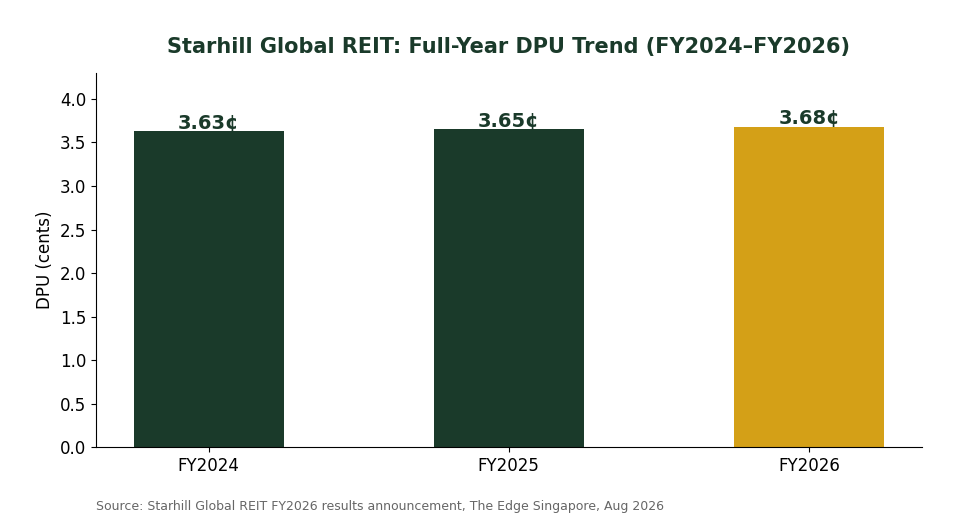
- FY2026 DPU came in at 3.68 cents, up 0.8% from FY2025’s 3.65 cents — modest but consistent growth, not a blowout.
- Occupancy jumped to 97.2% from 94.6% a year earlier, mostly thanks to Australia’s Myer Centre Adelaide recovering from a big tenant exit.
- Gearing is stable at 35.8% with 80% of debt on fixed rates, so the REIT isn’t taking on fresh balance sheet risk to grow.
Table of Contents
FY2026 Results at a Glance
Starhill Global REIT owns a small but well-located portfolio anchored by Wisma Atria and Ngee Ann City on Orchard Road, plus retail and office assets in Australia, Malaysia, China and Japan. For the year ended 30 June 2026, the REIT delivered steady, unspectacular growth — exactly the kind of result you’d expect from a mature, income-focused REIT rather than a growth story.
| Metric | FY2026 | FY2025 | Change |
|---|---|---|---|
| DPU | 3.68 cents | 3.65 cents | +0.8% |
| Gross Revenue | S$192.5 million | S$192.1 million (approx.) | +0.2% |
| Net Property Income (NPI) | S$150.3 million | S$150.2 million (approx.) | +0.1% |
| Income Available for Distribution | S$89.3 million | S$87.8 million (approx.) | +1.7% |
| Committed Occupancy | 97.2% | 94.6% | +2.6 pp |
| WALE (by NLA) | 7.0 years | — | — |
| Gearing | 35.8% | 35.8% (broadly stable) | Flat |
Source: Starhill Global REIT FY2026 results announcement, The Edge Singapore, August 2026. FY2025 comparatives approximated from reported y-o-y percentage changes where exact prior-year figures were not separately disclosed.
DPU and Income Breakdown
You get paid twice a year with Starhill Global REIT. The REIT distributes DPU in two halves, and the split tells you something the headline number doesn’t.
1H FY2026 DPU came in at 1.80 cents — flat versus 1H FY2025. All of the year’s growth showed up in the second half: 2H FY2026 DPU was 1.88 cents, up from 1.85 cents in 2H FY2025. That means the improvement in occupancy and income only really kicked in from January 2026 onwards, not evenly across the year.
Income available for distribution grew faster than revenue and NPI — up 1.7% versus roughly flat top-line growth. Management attributed this to higher contributions from Ngee Ann City and Lot 10 (Kuala Lumpur), plus a currency tailwind from the Malaysian ringgit and Australian dollar strengthening against the Singapore dollar. That currency benefit is worth flagging: it can reverse just as easily if SGD strengthens again, so don’t assume this pace of income growth is guaranteed going forward.
Occupancy: The Australia Recovery Story
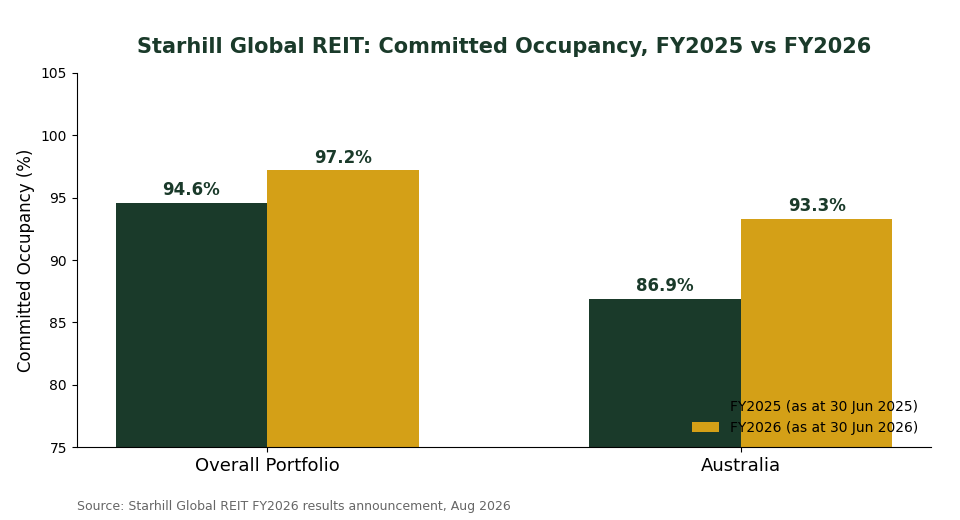
The real story in this results release isn’t Singapore — it’s Australia. Portfolio-wide committed occupancy climbed to 97.2%, from 94.6% a year earlier. That 2.6 percentage-point jump is almost entirely explained by one property: Myer Centre Adelaide.
Myer Centre Adelaide’s occupancy had dragged on the whole portfolio after a single large office tenant terminated its lease. As at 30 June 2026, Australia’s occupancy recovered to 93.3%, up sharply from 86.9% a year ago. Management has been actively re-leasing the vacated space, and this result shows real progress rather than just a paper improvement.
Meanwhile in Singapore, Wisma Atria and Ngee Ann City — which together make up the bulk of the REIT’s asset value — reached full committed occupancy. Singapore alone contributes around 61.5% of total revenue, so having both flagship malls essentially fully let is a meaningful base for income stability, even if it doesn’t move the growth needle much on its own.
Balance Sheet and Gearing
Gearing — basically how much of the REIT’s assets are funded by debt rather than unitholders’ equity — stayed at 35.8%, comfortably below MAS’s 50% regulatory ceiling for S-REITs. That’s a healthy buffer, and it means Starhill Global REIT isn’t under pressure to raise equity or sell assets to delever.
About 80% of the REIT’s debt is on fixed interest rates, which limits how much rising or falling interest rates can swing its finance costs in the near term. Average debt maturity stands at 3.3 years — not super long, but manageable, and it gives the manager room to refinance opportunistically rather than under time pressure. Portfolio valuation was around S$2.7 billion as at 30 June 2026.
Share Price and Yield
As at late July 2026, Starhill Global REIT traded around S$0.56, within its 52-week range of S$0.53 to S$0.60. On the FY2026 DPU of 3.68 cents, that works out to a trailing distribution yield of roughly 6.6%.
For context: a Singapore investor putting S$20,000 into Starhill Global REIT at S$0.56 a unit would collect roughly S$1,314 in distributions over the year at the current yield — paid out twice, in line with the REIT’s half-yearly distribution schedule. That’s a straightforward, if unspectacular, income stream, and it sits toward the middle of the pack versus other retail and diversified S-REITs.
Should You Buy Starhill Global REIT?
Starhill Global REIT may suit you if you want steady, above-average income from a small, well-located retail and office portfolio, and you’re comfortable with slow single-digit DPU growth rather than a re-rating story. The Australia recovery and full Singapore occupancy both point the right way, and gearing gives the manager flexibility rather than constraint.
Consider alternatives if you’re chasing faster distribution growth or want larger, more diversified exposure — REITs like CapitaLand Integrated Commercial Trust or Frasers Centrepoint Trust offer bigger, more liquid Singapore retail exposure, while REITs in the S-REIT ETF wrapper spread the single-asset concentration risk that still applies here (Wisma Atria and Ngee Ann City alone are a large share of NAV). If you hold Starhill Global REIT through a brokerage rather than CPF or SRS, distributions are simply credited to your account with no additional Singapore tax.
Frequently Asked Questions
What was Starhill Global REIT's DPU for FY2026?
Starhill Global REIT’s full-year DPU for FY2026 (year ended 30 June 2026) was 3.68 cents, up 0.8% from 3.65 cents in FY2025. It was split into 1.80 cents for 1H FY2026 and 1.88 cents for 2H FY2026.
Why did Starhill Global REIT's occupancy improve so much in FY2026?
The improvement was driven mainly by Australia, where Myer Centre Adelaide’s occupancy recovered to 93.3% from 86.9% after the manager re-leased space vacated by a large office tenant. Singapore’s Wisma Atria and Ngee Ann City also reached full committed occupancy over the same period.
What is Starhill Global REIT's dividend yield in 2026?
Based on a share price of around S$0.56 in late July 2026 and the FY2026 DPU of 3.68 cents, Starhill Global REIT’s trailing distribution yield works out to roughly 6.6%. This will move as the unit price changes, so always check the live price before relying on a specific yield figure.
Is Starhill Global REIT's gearing level safe?
Yes, at 35.8% gearing, Starhill Global REIT is well within MAS’s 50% regulatory ceiling for S-REITs. Around 80% of its debt is on fixed interest rates, which limits its exposure to near-term rate volatility, and average debt maturity is 3.3 years.
Can I buy Starhill Global REIT with my CPF or SRS?
Starhill Global REIT is not on the CPF Investment Scheme (CPFIS) list, so you cannot buy it directly with CPF-OA funds. It is generally purchasable with SRS funds through brokers that support SRS trading, such as DBS Vickers, OCBC Securities or UOB Kay Hian — check with your broker to confirm SRS eligibility before investing.
How does Starhill Global REIT compare to other Singapore retail REITs?
Starhill Global REIT is smaller and more geographically diversified than pure Singapore retail plays like Frasers Centrepoint Trust, with exposure to Australia, Malaysia, China and Japan alongside its Orchard Road core. Its yield of roughly 6.6% is generally higher than larger, more liquid peers, but that reflects higher single-asset concentration risk in Wisma Atria and Ngee Ann City.
For a deeper look at Starhill Global REIT’s dividend history and payout schedule, see our Starhill Global REIT Dividend and DPU Guide. If you’re building a broader income portfolio, our roundup of the best S-REITs in Singapore 2026 compares yields across the sector, and our passive income Singapore guide walks through how to size REIT holdings within a wider dividend strategy. You can track your projected payout timeline using our retirement calculator, and if you’re setting up a brokerage account to start buying S-REITs, both the Syfe referral code and sign-up bonus and the Endowus referral code are worth checking for current promotions.
Not financial advice. Figures are accurate as at the FY2026 results announcement and share price data from late July 2026. Always verify current prices and distributions before investing.
Ready to Build Your S-REIT Income Portfolio?
Open a brokerage account and start buying S-REITs for steady passive income. Use our referral links for exclusive sign-up bonuses.
This article was researched with the help of AI. While we strive to keep all information accurate and up to date, there may be errors. If you notice any discrepancies, please contact us.