MPACT 1QFY2027 Results: DPU Falls 2.5% as Japan Occupancy Crashes to 56% (SGX: N2IU)
A results-day deep-dive into Mapletree Pan Asia Commercial Trust’s 1QFY2027 numbers — the Japan occupancy crisis, China’s negative rental reversions, and why Singapore’s VivoCity is carrying the whole portfolio.
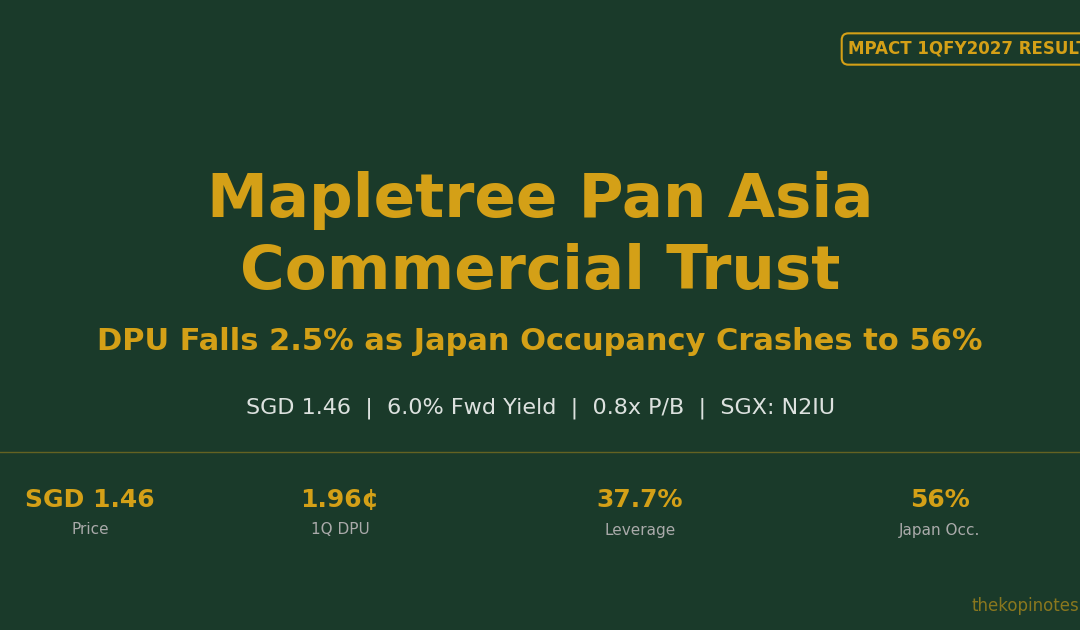
Mapletree Pan Asia Commercial Trust (SGX: N2IU) reported 1QFY2027 DPU of 1.96 cents, down 2.5% year-on-year, as portfolio occupancy fell 5 percentage points quarter-on-quarter to 84.4%. The drag came almost entirely from Japan, where occupancy at Makuhari Bay Tower slid to just 56%. MPACT trades at SGD 1.46, roughly 0.8x book value, with a 6.0% forward yield.
Not financial advice. All figures are for educational reference only. Data as at August 2026 unless noted.
- MPACT’s 1QFY2027 DPU dipped 2.5% YoY to 1.96 cents, mainly because Japan occupancy collapsed to 56%.
- Singapore’s VivoCity is doing the heavy lifting — 99.9% occupancy and +16.9% rental reversion — while China and Hong Kong stay soft.
- At 0.8x book value with a 6.0% yield, MPACT looks statistically cheap, but the Japan turnaround timeline is the key swing factor for 2026-2027.
Table of Contents
Contents — Click to expand
- What Is Mapletree Pan Asia Commercial Trust?
- MPACT Share Price Today
- 1QFY2027 Results: DPU Falls 2.5%
- The Japan Occupancy Crisis: What’s Going Wrong
- China and Hong Kong: Rental Reversions Stay Negative
- Singapore: VivoCity Is Carrying the Portfolio
- Leverage and Cost of Debt
- Analyst Price Targets
- Risks to Watch
- Buy, Hold, or Sell? Our Verdict
- Frequently Asked Questions
What Is Mapletree Pan Asia Commercial Trust?
Mapletree Pan Asia Commercial Trust (MPACT, SGX: N2IU) is Singapore’s largest diversified commercial REIT, with roughly S$15.2 billion in assets. It was formed in August 2022 when Mapletree Commercial Trust merged with Mapletree North Asia Commercial Trust, combining VivoCity and Mapletree Business City with a basket of overseas offices, malls, and business parks.
Today MPACT owns 15 properties spread across five markets: Singapore, Hong Kong, China, Japan, and South Korea. That geographic spread was meant to diversify income. In practice, it has meant that trouble in one market — right now, Japan — can drag down the whole trust even while Singapore performs well.
MPACT is managed by Mapletree Investments, a Temasek-linked manager that also runs Mapletree Logistics Trust and Mapletree Industrial Trust. You can find the full picture of the manager’s other listed REITs in our Mapletree Investments guide, and a property-level look at one of MPACT’s Singapore CBD assets in our Mapletree Anson and MPACT investor guide.
Singapore individual investors can buy N2IU on SGX through any broker, including via the Syfe referral code and sign-up bonus for Syfe Brokerage or the FSMOne referral code for FSMOne’s securities platform.
MPACT Share Price Today
As at early August 2026, MPACT trades at SGD 1.46 per unit. That works out to roughly 0.8x price-to-book — a meaningful discount to net asset value of around SGD 1.82 per unit.
Put in dollar terms: SGD 10,000 invested in MPACT at SGD 1.46 buys roughly 6,849 units. On an annualised DPU basis of around 7.84 cents (four times the latest 1.96-cent quarter), that generates approximately SGD 537 per year in distributions — a running yield of about 5.4% before accounting for any recovery in Japan income.
| Metric | Value (Aug 2026) |
|---|---|
| Share Price | SGD 1.46 |
| Estimated NAV/Unit | ~SGD 1.82 |
| Price-to-Book (P/B) | ~0.8x |
| 1QFY2027 DPU | 1.96 cents |
| DPU YoY Change | -2.5% |
| Forward Yield (broker est.) | ~6.0% |
Source: SGX, MPACT 1QFY2027 business update, Morningstar, August 2026
1QFY2027 Results: DPU Falls 2.5%
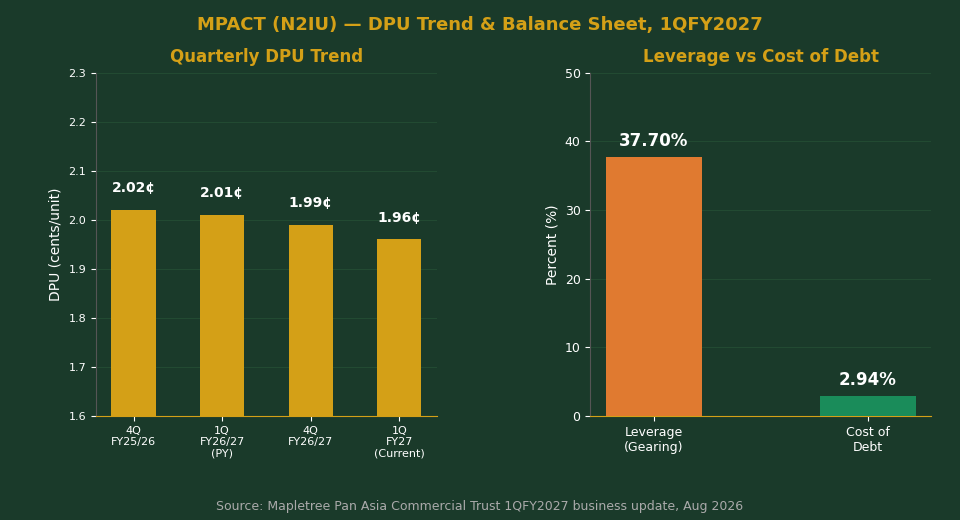
MPACT’s 1QFY2027 distribution per unit came in at 1.96 Singapore cents, down 2.5% from the same quarter a year earlier. That is a small decline in percentage terms, but the underlying story is more uneven than the headline number suggests.
Portfolio-wide committed occupancy dropped 5 percentage points quarter-on-quarter to 84.4%. However, portfolio rental reversion — the change in rent when a lease is renewed or re-let — actually stayed positive at +4.3% on average. In other words, MPACT is still getting higher rents on the leases it renews. The problem is that in one market, it is struggling to find tenants at all.
Aggregate leverage rose to 37.7% following recent debt refinancing, while the weighted average cost of debt actually improved to 2.94% per year — a rare bit of good news, since cheaper debt partly offsets the income pressure from vacant space.
The Japan Occupancy Crisis: What’s Going Wrong
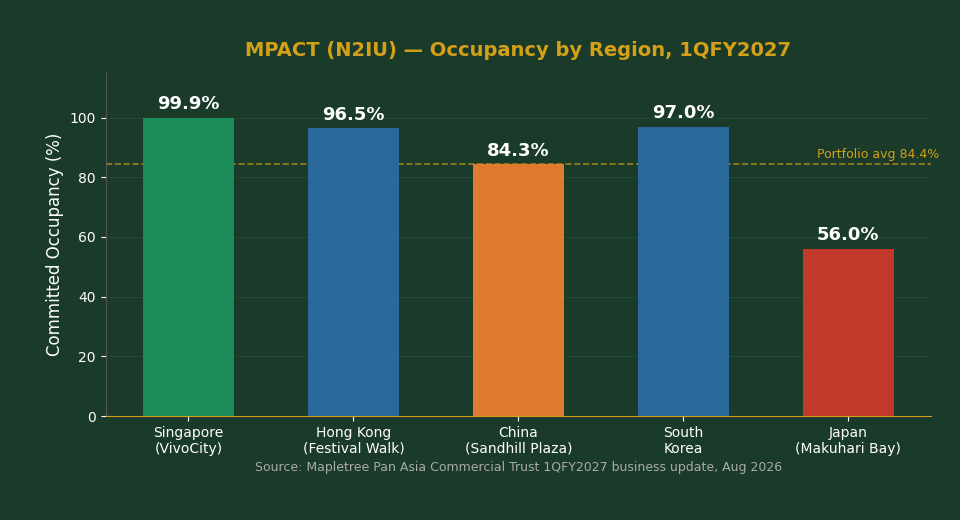
Japan is the single biggest problem in MPACT’s portfolio right now. Occupancy at Makuhari Bay Tower — MPACT’s key Japan office asset — has fallen to around 56%, driven by non-renewal of leases from several large tenants who chose not to extend.
Here’s why this matters more than a single-property headline suggests. Japan office demand near Tokyo has cooled as companies right-size post-hybrid-work space needs, and Makuhari Bay’s suburban location (outside central Tokyo) makes it a harder sell to tenants who now prioritise CBD addresses. Backfilling that much vacant space takes time — typically 12 to 24 months for large-format office space in a soft leasing market.
Management has flagged it is exploring re-leasing at lower rents, alternative use conversions, and potential divestment for parts of the Japan portfolio. None of those options are quick fixes. That’s the key reason DPU pressure from Japan is likely to persist through FY2027 rather than reverse in a single quarter.
China and Hong Kong: Rental Reversions Stay Negative
China and Hong Kong are the second and third weakest links. At Sandhill Plaza in Shanghai, occupancy dipped roughly 2.8 percentage points quarter-on-quarter to about 84.3%, driven by non-renewals as several tenants downsized. Average rental reversions across MPACT’s China assets have run close to -30% — meaning new or renewed leases are being signed at rents 30% below the expiring rate, a reflection of oversupplied office markets in Beijing and Shanghai.
At Festival Walk in Hong Kong, net property income has also declined year-on-year, with rental reversion running around -7%. Hong Kong retail and office demand remains subdued amid a slow economic recovery and continued outbound spending by Hong Kong residents.
Taken together, China and Hong Kong illustrate the flip side of MPACT’s geographic diversification: when overseas commercial property markets are weak simultaneously, the drag compounds rather than diversifies away.
Singapore: VivoCity Is Carrying the Portfolio
Here’s the good news. MPACT’s Singapore assets — anchored by VivoCity and Mapletree Business City — remain the strongest part of the portfolio by a wide margin. VivoCity posted 99.9% occupancy and a striking +16.9% rental reversion, meaning tenants renewing leases are paying substantially more than before.
South Korea is also holding up well, with occupancy around 97%. Between Singapore and South Korea, MPACT has two genuinely resilient markets propping up the group-level numbers while Japan and China work through their issues.
This split matters for how you read the DPU decline: it isn’t a broad-based deterioration across the whole trust. It’s a concentrated problem in specific overseas assets, offset by continued strength at home. If you’re comparing MPACT against Singapore-only alternatives, our best S-REITs in Singapore 2026 guide is a useful benchmark.
Leverage and Cost of Debt
| Metric | 1QFY2027 | Comment |
|---|---|---|
| Aggregate Leverage | 37.7% | Up from refinancing; still under the 50% MAS cap |
| Weighted Avg. Cost of Debt | 2.94% | Improved — a genuine bright spot |
| Portfolio Occupancy | 84.4% | Down 5ppt QoQ, Japan-driven |
Source: Mapletree Pan Asia Commercial Trust 1QFY2027 business update, August 2026
At 37.7%, MPACT still has headroom under the Monetary Authority of Singapore’s 50% aggregate leverage cap for S-REITs. The improved cost of debt at 2.94% is a genuinely encouraging data point — it means MPACT refinanced maturing debt at better rates than before, which softens (though doesn’t eliminate) the income pressure from Japan vacancies. You can benchmark MPACT’s leverage against other S-REITs using our S-REIT Gearing Ratio & ICR Calculator.
Analyst Price Targets
Sell-side analysts are broadly constructive on MPACT despite the near-term Japan overhang, largely because the 0.8x book value discount already prices in a fair amount of bad news.
- DBS Group Research has a BUY rating with a price target of SGD 1.55, implying roughly 6% upside from the current SGD 1.46 price.
- OCBC Investment Research is more cautious, with a target of SGD 1.38, reflecting ongoing concerns about the pace of Japan and China recovery.
The spread between these two targets — SGD 1.38 to SGD 1.55 — tells you analysts broadly agree MPACT is fairly to cheaply valued at current levels, but disagree on how quickly the overseas drag resolves.
| Broker | Rating | Price Target (SGD) | Implied Upside |
|---|---|---|---|
| DBS Group Research | BUY | SGD 1.55 | +6% |
| OCBC Investment Research | HOLD | SGD 1.38 | -5% |
Source: DBS Group Research (4 Aug 2026), OCBC Investment Research (31 Jul 2026), via broker research summaries
Risks to Watch
1. Japan Occupancy Stays Below 60% for Longer Than Expected
If Makuhari Bay Tower can’t find replacement tenants within the next 2-3 quarters, DPU pressure could deepen rather than stabilise. Watch management’s quarterly occupancy updates closely.
2. China’s -30% Rental Reversions Persist
Beijing and Shanghai office oversupply is a structural, multi-year issue, not a one-quarter blip. If China reversions stay this negative through FY2027, that segment alone could keep dragging portfolio DPU lower even as Japan stabilises.
3. Currency Translation Risk
MPACT earns income in SGD, HKD, RMB, JPY, and KRW. A stronger SGD against any of these currencies reduces the SGD value of overseas distributions when translated back — a structural risk for any Singapore REIT with meaningful overseas exposure.
4. Rising Leverage if Asset Values Fall Further
At 37.7% gearing, MPACT has room before the 50% MAS cap, but a further write-down in overseas asset valuations (especially Japan and China office) would push leverage higher automatically, even without new borrowing.
Buy, Hold, or Sell? Our Verdict
Plain-English verdict: MPACT is a HOLD-to-cautious-BUY at SGD 1.46, suited to patient investors who can tolerate near-term DPU volatility while the Japan and China portfolios work through vacancy issues.
Buy if: You believe the 0.8x book value discount overstates the actual risk, given Singapore’s continued strength (99.9% VivoCity occupancy, +16.9% reversions) and an improving cost of debt. You’re comfortable holding through 2-4 quarters of DPU uncertainty for a ~6% yield plus potential re-rating toward NAV.
Hold or wait if: You want to see at least one quarter of stabilising (not just declining more slowly) Japan occupancy before committing new capital. A further pullback toward SGD 1.35-1.40 would offer a more attractive entry with a wider margin of safety.
Sell only if: You need income stability above all else, or you believe the China office oversupply and Japan hybrid-work shift are permanent structural headwinds rather than cyclical ones.
For readers building a broader income portfolio, our passive income Singapore guide covers how to size REIT positions like MPACT within a diversified plan, and our Singapore retirement calculator can help you model how a 6% yield fits your income goals.
To start investing in MPACT or other S-REITs, the Endowus referral code (2V343) is useful for accessing REIT exposure via SRS or CPF, while Syfe Brokerage and FSMOne remain popular choices for direct SGX unit purchases.
Disclaimer: This article is for informational and educational purposes only. It does not constitute financial advice. Past performance is not indicative of future results. Always do your own research or consult a licensed financial adviser before making any investment decision.
Frequently Asked Questions
Why did Mapletree Pan Asia Commercial Trust's DPU fall in 1QFY2027?
MPACT’s 1QFY2027 DPU fell 2.5% year-on-year to 1.96 Singapore cents, mainly because portfolio occupancy dropped 5 percentage points quarter-on-quarter to 84.4%. The single biggest driver was Japan, where occupancy at Makuhari Bay Tower slid to around 56% after several large tenants did not renew their leases. China’s Sandhill Plaza and Hong Kong’s Festival Walk also saw softer performance, partly offset by strength in Singapore and South Korea.
What is happening with MPACT's Japan portfolio?
Occupancy at Makuhari Bay Tower, MPACT’s key Japan office asset, has fallen to roughly 56% due to non-renewal of leases by several tenants. Its suburban Tokyo-area location has made it harder to attract replacement tenants who increasingly prefer central Tokyo addresses. Management is exploring re-leasing at adjusted rents, alternative-use conversions, and potential divestment options, though none of these are quick fixes — backfilling large-format office space typically takes 12 to 24 months.
Is MPACT still a good dividend stock despite the DPU decline?
MPACT offers a forward yield of approximately 6.0% at SGD 1.46, and trades at roughly 0.8x book value — a meaningful discount to NAV. Whether that makes it “good” depends on your risk tolerance: the 2.5% DPU decline is modest so far, but Japan occupancy needs to stabilise for the yield to be sustainable rather than declining further. Investors comfortable with 2-4 quarters of uncertainty may find the current valuation attractive; more conservative income investors may prefer to wait for confirmed stabilisation.
What are analyst price targets for MPACT (N2IU) in 2026?
As at early August 2026, DBS Group Research has a BUY rating with a SGD 1.55 price target (about 6% upside from SGD 1.46), while OCBC Investment Research is more cautious with a SGD 1.38 target. The spread reflects general agreement that MPACT is fairly valued to cheap, with disagreement over how quickly the Japan and China portfolios recover.
How does MPACT's Singapore portfolio compare to its overseas assets?
MPACT’s Singapore assets, anchored by VivoCity and Mapletree Business City, are the strongest part of the trust — VivoCity posted 99.9% occupancy and +16.9% rental reversion in the latest update. South Korea is also performing well at around 97% occupancy. By contrast, Japan (56% occupancy), China (around -30% rental reversions), and Hong Kong (negative reversions at Festival Walk) are all under pressure, illustrating how MPACT’s geographic diversification is currently a headwind rather than a hedge.
What is MPACT's gearing ratio and is it safe?
MPACT’s aggregate leverage stood at 37.7% as at 1QFY2027, following recent debt refinancing. That is comfortably below the Monetary Authority of Singapore’s 50% cap for S-REITs, though it has room to rise further if overseas asset valuations are written down. On the positive side, MPACT’s weighted average cost of debt improved to 2.94%, which helps offset some of the income pressure from vacant space in Japan and China.
Can I invest in MPACT using CPF or SRS funds?
Yes. Mapletree Pan Asia Commercial Trust (N2IU) is eligible for investment under the CPF Investment Scheme (CPFIS) using CPF Ordinary Account funds above the required minimum balance, and is also eligible under the Supplementary Retirement Scheme (SRS). Check with your broker or the CPF Board for the latest eligibility requirements and account minimums before investing.
Start Building Your Singapore REIT Portfolio
Compare brokerages and use referral codes for sign-up bonuses when opening your account.
This article was researched with the help of AI. While we strive to keep all information accurate and up to date, there may be errors. If you notice any discrepancies, please contact us.