Endowment Plan vs Unit Trust Singapore 2026: Guaranteed Growth vs Actively Managed Funds
An endowment plan gives you a guaranteed return set by your insurer, typically 1.5% to 2% p.a., while a unit trust invests in a professionally managed basket of stocks or bonds with no guaranteed return. You could earn more with a unit trust over the long run, but you could also lose money in a bad year — an endowment plan never will.
Not financial advice. All figures are for educational reference only. Data verified as at 7 August 2026 unless otherwise noted.
- Endowment plans give you a fixed, guaranteed rate — usually 1.5-2% p.a. — that never goes down, even in a market crash.
- Unit trusts can grow faster (illustratively 4-5% p.a. over the long term), but the value can fall in a bad year since there’s no guarantee.
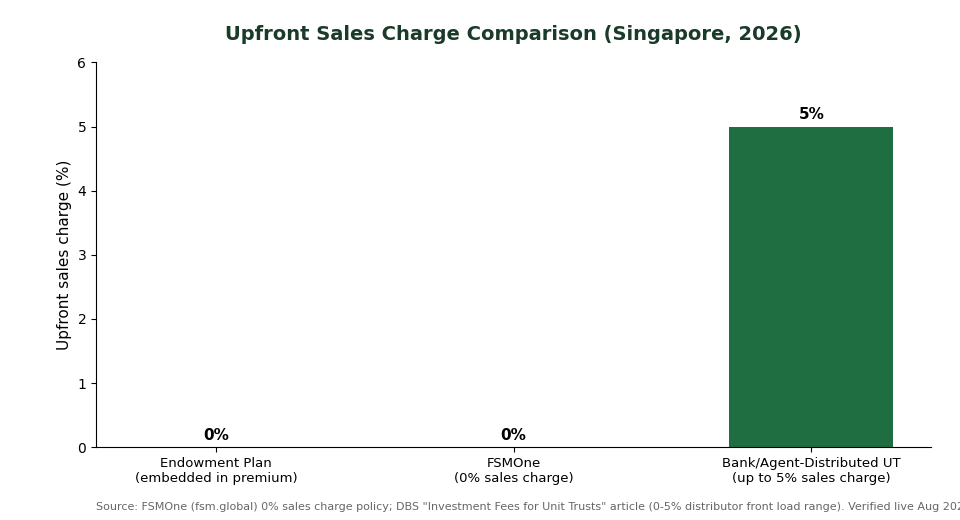
- FSMOne now charges 0% sales charge on unit trusts, while bank/agent-sold funds can still take up to 5% off the top before your money is even invested.
Table of Contents
What Is an Endowment Plan?
What Is a Unit Trust?
Key Differences at a Glance
Fees Compared: Sales Charges & TER
The Numbers: S$20,000 Over 3 Years
Guaranteed vs Market Risk
Which Should You Choose?
Frequently Asked Questions
What Is an Endowment Plan?
An endowment plan is a life insurance policy with a savings component. You pay premiums for a set period — a single lump sum, or monthly over 2 to 25 years — and the insurer guarantees you a fixed payout at maturity.
Here’s the key part: your insurer invests your premiums in a participating fund, which they manage on your behalf. However, unlike a unit trust, you don’t get to see the fund’s daily performance, and you don’t bear the investment risk directly. That’s the trade-off — you give up upside potential for certainty.
Most TKN readers already know the basics from our complete endowment plan guide. If you’re new here, that’s a good place to start.
What Is a Unit Trust?
A unit trust is a pooled fund. You and thousands of other investors put money into the same fund, and a professional fund manager decides what stocks, bonds, or other assets to buy and sell on your behalf.
Unlike an ETF, a unit trust isn’t traded on a stock exchange. You buy and sell units directly through a distributor — a bank, an insurance agent, or an online platform like FSMOne — at the fund’s Net Asset Value (NAV), which is calculated once a day.
Because a fund manager is actively picking investments (rather than passively tracking an index like an ETF does), unit trusts usually charge higher ongoing fees. That’s the Total Expense Ratio (TER) — basically the yearly cost of running the fund, taken out of the fund’s returns automatically. You never write a separate cheque for it; it’s already baked into the NAV.
If your portfolio is CPF Investment Scheme (CPFIS) or SRS-eligible, you can also buy certain unit trusts using CPF-OA or SRS funds — something you can’t do with most standalone stocks.
Key Differences at a Glance
| Feature | Endowment Plan | Unit Trust |
|---|---|---|
| Return | Guaranteed, ~1.5-2% p.a. | Not guaranteed, market-linked |
| Downside risk | None on guaranteed portion | Can lose money in a bad year |
| Regulated by | MAS (as insurance product) | MAS (as Collective Investment Scheme) |
| Liquidity | Early surrender = surrender charge/loss | Sell any business day at NAV |
| Insurance coverage | Yes, small death benefit included | No, pure investment product |
| CPF/SRS eligible | Some plans, via CPFIS | Many funds, via CPFIS/SRS |
Source: MAS product classifications; individual insurer and fund factsheets. Verified 7 August 2026.
Fees Compared: Sales Charges & TER
Fees quietly eat into your returns, so it’s worth knowing exactly what you’re paying. An endowment plan’s costs are baked into the guaranteed rate you’re quoted — you never see a separate “sales charge” line item, but the insurer’s distribution cost is already priced in.
A unit trust is more transparent, but also more variable depending on where you buy it. Here’s what the two most common routes charge, verified against their official pages.
| Distributor | Sales Charge | Platform/Wrap Fee | TER (fund-level) |
|---|---|---|---|
| FSMOne (iFAST) | 0%, permanently | 0.35% p.a. cash/SRS (S$300k and below); 0% for CPF and Diamond tier (AUA ≥ S$500k) | 1-2.5%, varies by fund |
| DBS/POSB Invest-Saver (RSP) | 1% on regular monthly purchases | None disclosed for RSP | 1-2.5%, varies by fund |
| Bank/insurance agent (lump sum) | Up to 5% front-end load | None or wrap fee 0.5-1% p.a. | 1-2.5%, varies by fund |
Source: FSM Global unit trust pricing page; DBS “Investment Fees for Unit Trusts”. Verified 7 August 2026.
The Numbers: S$20,000 Over 3 Years
Let’s put a real number on it. Say you have S$20,000 to invest for 3 years. Here’s how the three most common routes stack up, using the endowment industry’s current average guaranteed rate and a conservative, illustrative unit trust return assumption.
For the endowment plan, we use the 7-insurer average guaranteed rate of 1.81% p.a. that we’ve verified across this series (see our endowment vs money market fund comparison for the full insurer breakdown). For the unit trust, we assume an illustrative 4.5% p.a. gross fund return (a conservative long-term balanced-fund assumption, net of TER), minus platform fees where applicable.
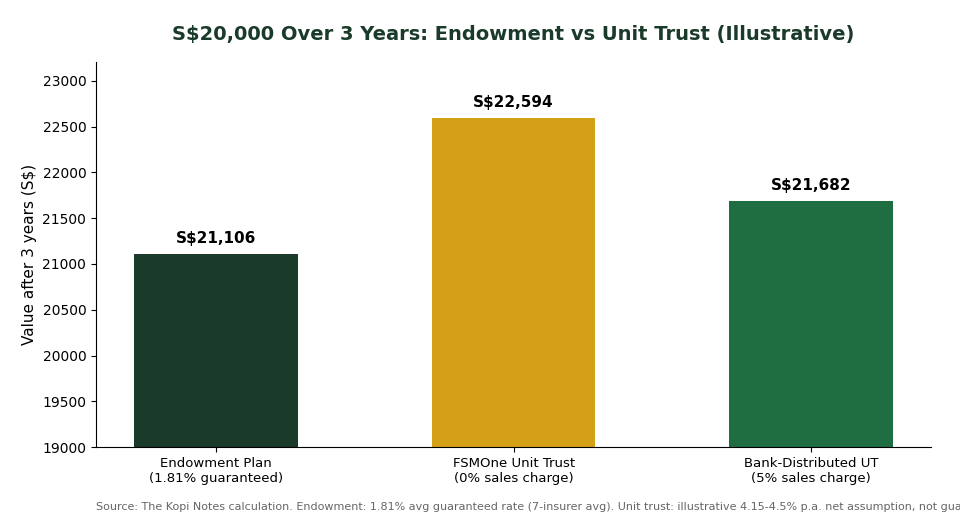
| Route | Starting Capital | Assumed Net Return | Value After 3 Years |
|---|---|---|---|
| Endowment plan (guaranteed) | S$20,000 | 1.81% p.a. | S$21,105.78 |
| FSMOne unit trust (0% sales charge) | S$20,000 | 4.15% p.a. (net of 0.35% platform fee) | S$22,594.14 |
| Bank-distributed unit trust (5% sales charge) | S$19,000 invested | 4.5% p.a. | S$21,682.15 |
Source: The Kopi Notes calculation, verified by hand. Unit trust returns are illustrative and not guaranteed — actual fund performance varies widely by asset class and manager. Data as at 7 August 2026.
Notice something interesting? Even after the 5% upfront sales charge, the bank-distributed unit trust still edges out the guaranteed endowment plan in this scenario — because it starts with less capital but compounds at a higher assumed rate. That said, this only holds if the fund actually delivers a positive 4.5% p.a. return. In a down year, the unit trust could easily end up below S$20,000, while the endowment plan never will.
Guaranteed vs Market Risk
Here’s the part many first-time investors miss: an endowment plan’s guaranteed return is genuinely guaranteed, backed by your insurer’s balance sheet and regulated capital requirements under MAS. A unit trust has no such backstop. If the fund manager’s picks underperform, or the broader market falls, your unit trust value falls with it — there’s no floor.
That’s also the tradeoff on the sales-charge side. FSMOne’s 0% sales charge is a genuine structural advantage over the traditional bank/agent model, which can still take up to 5% off the top before your money is even invested. That 5% has to be earned back through fund performance before you’re even at breakeven.
Which Should You Choose?
Pick an endowment plan if: you want zero downside risk, you’re saving toward a fixed goal (a child’s education, a wedding, retirement top-up) with a specific date in mind, and you’re comfortable locking up funds for years without needing early access.
Pick a unit trust if: you’re comfortable with market ups and downs, you have a longer time horizon (5+ years) to ride out volatility, and you want the flexibility to sell any business day without a surrender penalty.
Many TKN readers use both: an endowment plan for money they can’t afford to lose, and a unit trust or ETF for money they’re willing to grow more aggressively. If you’re weighing this against other options, our endowment vs ETF comparison and endowment vs robo-advisor comparison cover two other popular routes.
Ready to start? You can compare your retirement shortfall using our free retirement planning calculator, or open an account with FSMOne or Endowus if you decide a unit trust fits your goals better.
Frequently Asked Questions
Is a unit trust safer than an endowment plan?
Can I lose money in a unit trust?
Do all unit trusts charge a 5% sales charge?
Can I use CPF or SRS to buy a unit trust?
What happens if I surrender my endowment plan early?
Which has better long-term returns, endowment or unit trust?
Is a unit trust the same as an ETF?
Get Free Insurance Advice
Speak with a licensed insurance advisor. No obligation, no cost.
By submitting this form, you agree to our Privacy Policy.
This article was researched with the help of AI. While we strive to keep all information accurate and up to date, there may be errors. If you notice any discrepancies, please contact us.