CPF Contribution Rate Changes 2027: How Much More Senior Workers Will Pay
CPF rates for workers above 55 are rising again — here’s the exact 2026 vs 2027 breakdown, by age band, in plain SGD terms.
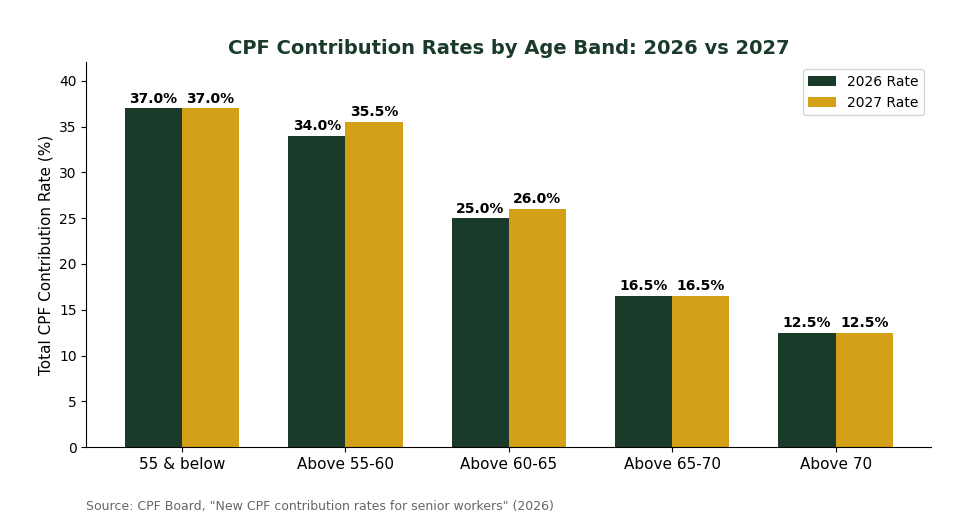
From 1 January 2027, CPF contribution rates for employees above age 55 to 65 will rise again. The Above 55-to-60 band moves from 34% to 35.5% (employer +0.5%, employee +1%), and the Above 60-to-65 band moves from 25% to 26% (employer +0.5%, employee +0.5%). Every extra dollar goes straight into your Retirement Account, up to your Full Retirement Sum.
Not financial advice. All figures are for educational reference only. Data as at August 2026, sourced directly from the CPF Board.
- From Jan 2027, workers aged above 55-60 see rates rise from 34% to 35.5% combined; above 60-65 rises from 25% to 26%
- At the $7,400 Ordinary Wage (OW) ceiling, that’s up to S$111 more going into your CPF each month — split between you and your employer
- All of the increase is fully allocated to your Retirement Account (RA), up to your Full Retirement Sum, so it directly boosts your future CPF LIFE payouts
Free download: The Singapore Money Playbook — 7 money mindset shifts written for Singapore, with the CPF-adjusted retirement number most guides get wrong (PDF + Notion).
Contents — Click to expand
- What’s Changing in 2027?
- CPF Contribution Rates: 2026 vs 2027 (Full Table)
- Why the Government Keeps Raising Senior Worker Rates
- How Much Extra Will You Pay? (Worked SGD Examples)
- Where the Extra Contributions Go
- What This Means for Employers
- How to Prepare for the 2027 Increase
- Frequently Asked Questions
What’s Changing in 2027?
Singapore has been raising CPF contribution rates for senior workers every year since 2022. It’s part of a long roadmap to bring older workers’ CPF rates closer to the 37% rate that younger workers already pay.
On 13 February 2026, the CPF Board confirmed the next step. From 1 January 2027, workers aged above 55 will see their combined CPF rate go up again. The increase is smaller than in past years, but it’s still real money — and it applies to hundreds of thousands of Singaporeans in this age group.
Here’s why this matters even though 2027 is still some months away. Employers need to budget for higher staff costs now. And if you’re in this age band, you’ll want to know exactly how much less take-home pay to expect — and how much more goes into your Retirement Account instead.
CPF Contribution Rates: 2026 vs 2027 (Full Table)
Here’s the complete picture. These rates apply to monthly wages above $750, up to the Ordinary Wage (OW) ceiling of $7,400.
| Age Group | 2026 Total | 2027 Total | 2027 Employer | 2027 Employee |
|---|---|---|---|---|
| 55 and below | 37% | 37% | 17% | 20% |
| Above 55 to 60 | 34% | 35.5% | 16.5% | 19% |
| Above 60 to 65 | 25% | 26% | 13% | 13% |
| Above 65 to 70 | 16.5% | 16.5% | 9% | 7.5% |
| Above 70 | 12.5% | 12.5% | 7.5% | 5% |
Source: CPF Board, “New CPF contribution rates for senior workers”, 13 Feb 2026.
Notice that only two age bands actually change: Above 55-to-60 and Above 60-to-65. Everyone below 55, and everyone above 65, sees no change in 2027. Each of the two affected bands rises by exactly 1.5 percentage points — 0.5% from the employer, and the rest from the employee.
Why the Government Keeps Raising Senior Worker Rates
Singaporeans are living and working longer. The statutory retirement age is now 64, and the re-employment age is 69. That means more people are earning a salary — and building CPF savings — well past 55.
However, senior workers’ CPF rates used to fall off a cliff at 55, dropping from 37% to as low as 12.5-16.5% in older schedules. That gap left many older workers with thinner retirement savings, even though they were still working full careers.
Since 2022, the government has closed that gap step by step. Each January, the Above 55-60 and Above 60-65 bands crept up by roughly 1-1.5 percentage points. The 2027 increase is the latest step in this multi-year roadmap — not a one-off policy change.
Here’s the practical upside. A higher contribution rate in your 50s and 60s means a bigger Retirement Account balance right before you start drawing your CPF LIFE monthly payouts. For many workers, these are also peak earning years — so the extra savings compound at a stage when the balance is already large.
How Much Extra Will You Pay? (Worked SGD Examples)
Percentages are hard to picture. Let’s put real salaries through the 2026 and 2027 rates so you can see the actual dollar difference.
Example 1 — Age 57, salary S$6,500/month (Above 55-60 band)
Since S$6,500 is below the S$7,400 OW ceiling, your full salary is CPF-eligible.
- 2026: Employer 16% × S$6,500 = S$1,040. Employee 18% × S$6,500 = S$1,170. Total: S$2,210/month
- 2027: Employer 16.5% × S$6,500 = S$1,072.50. Employee 19% × S$6,500 = S$1,235. Total: S$2,307.50/month
Your own paycheck deduction rises by S$65/month — but that money isn’t lost. It’s redirected into your Retirement Account, boosting your future CPF LIFE payout.
Example 2 — Age 62, salary S$5,000/month (Above 60-65 band)
- 2026: Employer 12.5% × S$5,000 = S$625. Employee 12.5% × S$5,000 = S$625. Total: S$1,250/month
- 2027: Employer 13% × S$5,000 = S$650. Employee 13% × S$5,000 = S$650. Total: S$1,300/month
That’s S$50 more per month total, split evenly — S$25 more from your employer and S$25 more from your own pay.
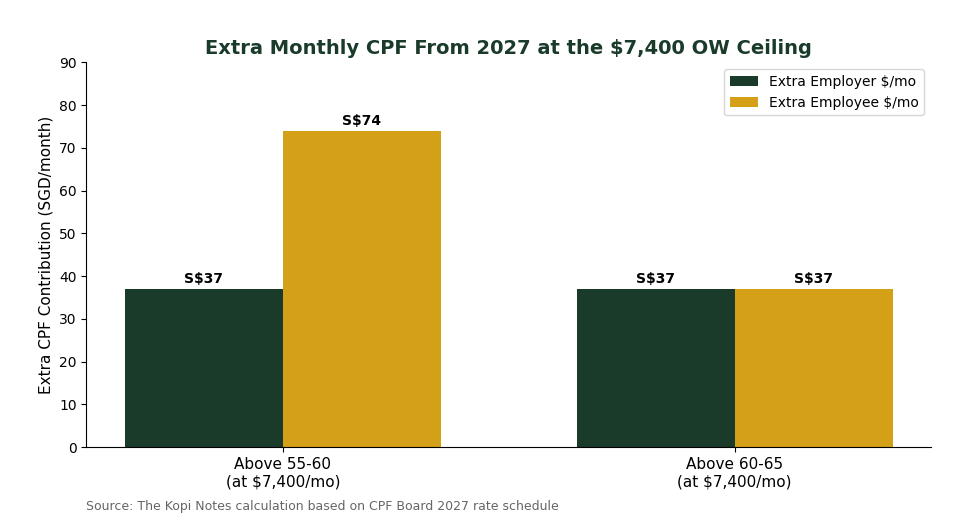
Example 3 — At the S$7,400 OW ceiling, both bands compared
| Age Band | 2026 Monthly CPF | 2027 Monthly CPF | Extra/Month |
|---|---|---|---|
| Above 55-60 | S$2,516 | S$2,627 | +S$111 |
| Above 60-65 | S$1,850 | S$1,924 | +S$74 |
Source: The Kopi Notes calculation based on CPF Board’s 2027 rate schedule, applied to the $7,400 monthly OW ceiling.
Where the Extra Contributions Go
Here’s the part most people miss. The increase isn’t spread across your Ordinary Account (OA) and MediSave like your regular contributions. It goes somewhere specific.
The extra CPF from this rate hike is fully allocated to your Retirement Account (RA) — up to your Full Retirement Sum (FRS). If you’ve already hit your FRS, the extra money flows to your OA instead.
Why does this matter? Your RA balance is what determines your monthly CPF LIFE payout once you start drawing it. Every extra dollar directed there — rather than to your OA, which you might spend on housing — compounds specifically toward your retirement income.
This RA-first allocation rule has applied to every senior-worker CPF increase since the scheme began in 2022, not just the 2027 step.
What This Means for Employers
If you run a business or manage payroll, this increase adds to your staff costs. The employer share rises by 0.5 percentage points for both affected age bands.
For a company with 20 employees aged 55-65 earning around S$6,000/month on average, that 0.5% increase adds roughly S$30 per employee per month — about S$7,200/year across the group. It’s a modest but real line-item increase, especially for SMEs with an older workforce in manufacturing, retail, or facilities roles where senior workers are common.
Employers should update payroll systems ahead of 1 January 2027 and factor the higher rates into 2027 budget planning now, rather than waiting until the new year.
How to Prepare for the 2027 Increase
You can’t opt out of the higher CPF deduction — it’s mandatory. But you can plan around it.
1. Rework your 2027 take-home budget now. If you’re in the Above 55-60 band earning near the OW ceiling, expect roughly S$74 less take-home pay per month from January 2027. Build that into your household budget ahead of time instead of being surprised on your first 2027 payslip.
2. Check your Full Retirement Sum progress. If you’re close to or above your FRS already, the extra contributions redirect to your OA instead of your RA — which changes how you might use that money. Use the CPF Retirement Sum Calculator to see where you stand.
3. Consider voluntary top-ups for tax relief. If your income allows it, voluntary CPF top-ups still earn you tax relief up to S$8,000/year (self) plus another S$8,000 for family top-ups. The CPF Cash Top-Up Tax Relief Calculator shows the exact tax saving for your income bracket.
4. Don’t rely on CPF alone. CPF is your retirement floor, not your whole plan. Many Singaporeans in their 50s and 60s also build passive income through S-REITs, dividend stocks, or SRS-linked portfolios via platforms like Syfe to supplement CPF LIFE payouts in retirement.
For the full picture on 2026’s current rates, OW ceiling, and allocation rules, see our CPF Contribution 2026 Complete Guide — this article focuses specifically on what changes from 2027 onward.
Frequently Asked Questions
When do the new CPF contribution rates for senior workers take effect?
Which age groups are affected by the 2027 CPF rate increase?
How much extra will I pay in CPF contributions from 2027?
Where do the extra CPF contributions go?
Is this the same as the 2026 CPF contribution rate increase?
Why does the government keep raising CPF rates for senior workers?
Can employers avoid paying the higher 2027 CPF rate?
Plan Ahead of the 2027 CPF Increase
Use our free tools to see exactly where your CPF stands today — and build beyond it.
This article was researched with the help of AI. While we strive to keep all information accurate and up to date, there may be errors. If you notice any discrepancies, please contact us.