SGX ETF Asia Ex China: Complete 2026 Guide for Singapore Investors
Three real ways to diversify away from China concentration risk, compared side by side for cost, coverage, and access.
Asia ex China ETFs let you invest in Taiwan, South Korea, India, and Southeast Asia without the single-country concentration that dominates most Asia and emerging market funds. Singapore investors have three real options in 2026: two SGX-listed funds (Amova A93, Lion-CMB EAA) and one much cheaper London-listed UCITS fund (iShares EXCS) at a 0.18% expense ratio.
Not financial advice. All figures are for educational reference only. Data as at 3 August 2026 unless noted.
- Amova A93/A94 (SGX) tracks Taiwan, Korea, India and Southeast Asia. It returned 72.09% over the year to 30 June 2026, driven by the AI chip rally in Taiwan and Korea.
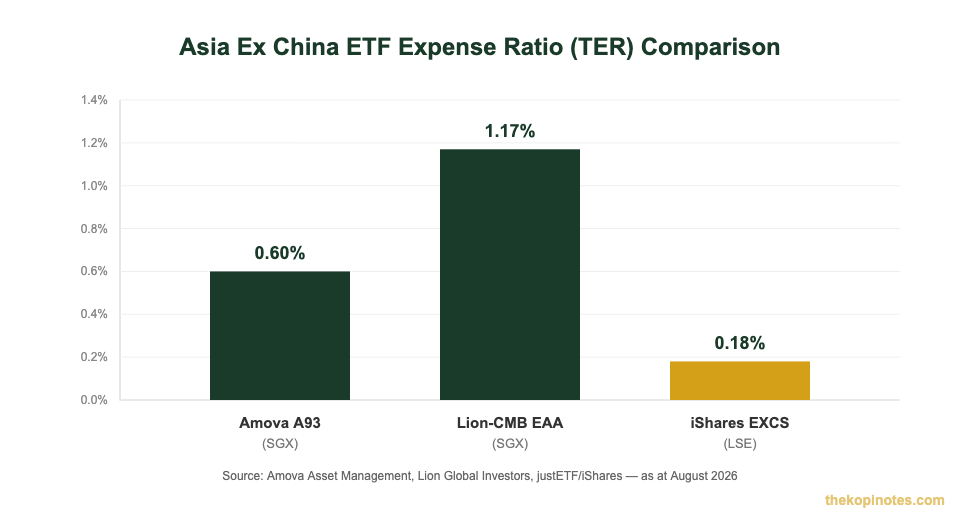
- Lion-CMB EAA/EAU (SGX) tilts to India, Malaysia, Indonesia and Thailand. Its 1.17% expense ratio is over 6x higher than the LSE alternative.
- iShares EXCS (LSE) is the cheapest and largest at 0.18% TER, but tracks broader emerging markets, not pure Asia. Best paired with a separate developed-Asia fund.
What Is “Asia Ex China” Investing?
“Asia ex China” investing means holding an Asian equity fund that deliberately excludes China. Most broad “Asia” or “Emerging Markets” index funds hold China as the single largest country weight, often 25-30% of the fund.
That concentration cuts both ways. A rally in Chinese equities lifts your fund. But a regulatory clampdown, a property-sector wobble, or a capital-outflow episode can drag your entire Asia allocation down, even if the rest of the region is doing fine.
An Asia ex China fund strips out that single-country exposure. It reallocates to the region’s other growth engines instead: Taiwan and South Korea’s semiconductor exporters, India’s consumer and financial sector, and Southeast Asia’s manufacturing and banking names. You still get emerging Asia growth, just without betting the whole basket on one country’s policy direction.
This isn’t a new idea for Singapore investors. What’s new in 2026 is that dedicated products now exist. Before April 2025, getting Asia ex China exposure meant buying a broad Asia fund and separately avoiding China, which was clunky and expensive. Now you can buy the exclusion directly, in one ticker. If you want the full lineup of what else is listed on SGX, see our Singapore REIT ETF guide for the property side of the market.
Why Asia Ex China Is Trending in Singapore in 2026
Three forces are pushing Singapore investors toward Asia ex China ETFs this year.
First, index concentration. MSCI Emerging Markets and MSCI Asia indices have historically carried a heavy China weight. Many Singapore investors already hold China exposure through China-focused funds or individual stocks. An Asia ex China fund lets you add regional growth without doubling down on a single country.
Second, the AI and semiconductor supply chain rally. Taiwan Semiconductor Manufacturing Co (TSMC), Samsung Electronics, and SK Hynix sit at the centre of the global AI chip build-out. These three names are the largest holdings in both the Amova and iShares funds covered below, and overlap heavily with our AI-powered ETF Singapore guide.
Source: Amova Asset Management fund factsheet, as at 30 Jun 2026
That return is unusually large for a diversified regional fund, and it shows how concentrated the AI chip rally has been in Taiwan and South Korea. It’s a reminder that Asia ex China funds are not “safer” than China funds, they simply carry a different set of concentration risks.
Third, capital reallocation. Industry coverage has flagged the Amova MSCI AC Asia Ex Japan Ex China ETF as one of the best-performing SGX-listed ETFs in the first half of 2026. That’s a signal that Singapore retail flows are actively rotating into this theme, not just a marketing narrative.
None of this means China is a bad investment. It means diversification matters. A fund that structurally excludes one country reduces single-country risk, whether or not that country’s own outlook improves.
Best Asia Ex China ETFs for Singapore Investors
As at August 2026, three funds give Singapore investors real, tradable Asia ex China exposure. Two trade on the SGX in SGD or USD. One trades on the London Stock Exchange and is domiciled in Ireland as a UCITS fund.
| Feature | Amova A93 / A94 | Lion-CMB EAA / EAU | iShares EXCS |
|---|---|---|---|
| Exchange | SGX | SGX | London Stock Exchange |
| Index Tracked | MSCI AC Asia ex Japan ex China | iEdge Emerging Asia Select 50 | MSCI Emerging Markets ex China |
| Core Countries | Taiwan, S. Korea, India, SEA | India, Malaysia, Indonesia, Thailand | Taiwan, S. Korea, India, Brazil + |
| Domicile | Singapore (VCC) | Singapore | Ireland (UCITS) |
| Expense Ratio (TER) | 0.60% p.a. (capped) | 1.17% p.a. (FYE 2025) | 0.18% p.a. |
| Fund Size | SGD 107.75m | Smaller, newer fund | EUR 4,709m |
| Listing Date | 2 Apr 2025 | 11 Dec 2024 | 26 Apr 2021 |
| Trading Currency | SGD / USD | SGD / USD | USD / GBP |
| CPF / SRS | SRS-eligible; not CPFIS | Cash / SRS; not CPFIS at launch | SRS via applicable brokers; not CPFIS |
Source: Amova Asset Management fund page (3 Aug 2026); Lion Global Investors fund page (as at 29 May 2026 / FYE 31 Dec 2025); iShares EXCS fund page (Aug 2026).
The cost gap is the headline. On a SGD 20,000 portfolio, Amova A93 costs roughly SGD 120 a year in fees, Lion-CMB EAA costs roughly SGD 234 a year, and iShares EXCS costs roughly SGD 36 a year. That’s before accounting for FX spreads on the LSE trade.
But cost isn’t the whole story. Amova A93 and Lion-CMB EAA give you pure Asia exposure with no Latin America or Eastern Europe mixed in. iShares EXCS tracks the broader MSCI Emerging Markets ex China index, so Asia is the largest region but not the only one, with roughly 22% of the fund sitting outside Taiwan, Korea and India as at 29 May 2026.
Top Holdings: Amova A93 vs iShares EXCS
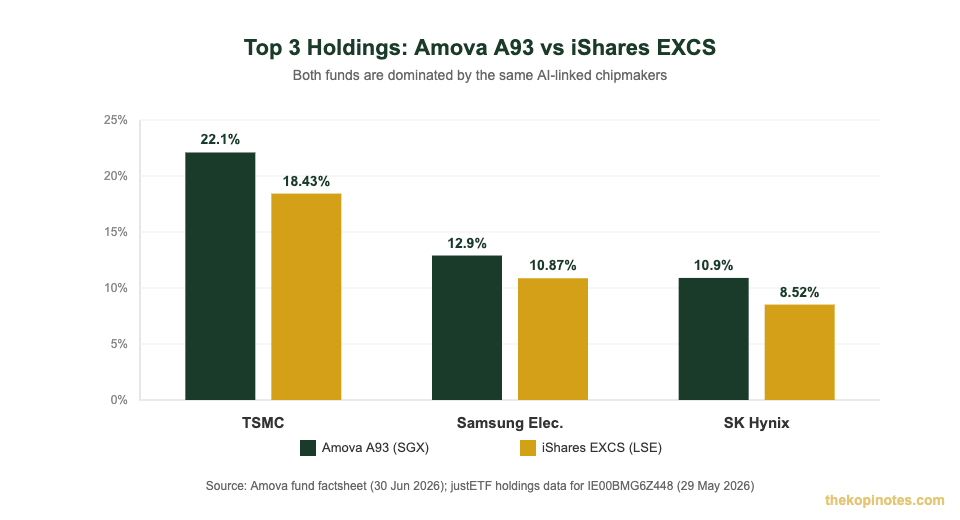
Both funds are dominated by the same three companies, which tells you how concentrated the “Asia ex China” theme really is around AI-linked chipmakers.
| Top Holding | Amova A93 Weight | iShares EXCS Weight |
|---|---|---|
| Taiwan Semiconductor (TSMC) | 22.1% | 18.43% |
| Samsung Electronics (incl. pfd) | 12.9% | 10.87% |
| SK Hynix | 10.9% | 8.52% |
| Top 3 Combined | ~45.9% | ~37.8% |
Source: Amova fund factsheet (30 Jun 2026); justETF holdings data for IE00BMG6Z448 (29 May 2026).
How to Buy Asia Ex China ETFs in Singapore
For the SGX-listed funds (Amova A93/A94, Lion-CMB EAA/EAU): you buy these exactly like any other SGX stock. Open a brokerage account with any local broker, for example our moomoo Singapore review covers one popular option, search for the SGX code (A93, A94, EAA, or EAU), and place a normal buy order. A single lot is just 1 unit for both funds, so you can start with a very small amount. Both funds also accept SRS funds, and you can check current sign-up terms via our FSMOne referral code if you use FSMOne as your SRS platform.
For the LSE-listed fund (iShares EXCS): you need a broker with London Stock Exchange access. Interactive Brokers (IBKR) and Saxo Markets both support LSE trading for Singapore residents. Fund your account, search for the ticker EXCS, select the London Stock Exchange listing, and place your order in GBP. IBKR tends to be more cost-effective for larger trade sizes, while Saxo’s platform may suit beginners who want a simpler interface.
Whichever route you choose, check your broker’s FX conversion fee before buying. A cheap TER can be eaten up by a wide FX spread on a small trade. If you’d rather not pick individual ETFs yourself, our Endowus referral code gives you access to a managed regional and global equity portfolio instead.
Risks to Consider
Sector concentration. Both Amova A93 and iShares EXCS put over a third of the fund into just three semiconductor-linked names (TSMC, Samsung, SK Hynix). “Ex China” diversification does not mean “diversified” in the broader sense. You’re swapping single-country risk for single-sector risk.
Currency risk. You’re exposed to SGD, USD, GBP, and the underlying Taiwan dollar, Korean won, and Indian rupee moves, depending on which fund and share class you pick. Currency swings can add to or subtract from your returns independently of the underlying stocks.
Fund size and liquidity. Amova A93 (SGD 107.75m) and Lion-CMB EAA are both small relative to iShares EXCS (EUR 4.7 billion). Smaller SGX-listed ETFs can have wider bid-ask spreads, which adds a hidden cost on top of the stated TER.
Excluded Investment Product status. Lion-CMB EAA is classified as an Excluded Investment Product (EIP) by SGX, reflecting its narrower, higher-risk focus on Emerging Asia. Check your broker’s risk classification requirements before trading it.
Past performance isn’t a guide. Amova A93’s 72.09% one-year return was driven by an unusually strong AI chip rally. That pace of return is not typical and should not be extrapolated forward. If you’re planning around a longer retirement horizon rather than a single theme, our CPF investment strategy guide covers how to size thematic bets like this one against your core portfolio.
Frequently Asked Questions
What is an Asia ex China ETF?
An Asia ex China ETF is a fund that tracks Asian equities while deliberately excluding mainland China. It typically reallocates that weight to Taiwan, South Korea, India, and Southeast Asian markets, giving you regional growth exposure without China’s single-country concentration.
Is the Amova Asia ex Japan ex China ETF CPF or SRS approved?
Amova A93/A94 is SRS-eligible through participating dealers such as FSMOne, but it is not currently on the CPF Investment Scheme (CPFIS) list. Always check your broker’s current CPFIS fund list before assuming eligibility, as this can change.
Which is cheaper, Amova A93 or Lion-CMB EAA?
Amova A93 is cheaper, with a capped total expense ratio of 0.60% per annum. Lion-CMB EAA’s expense ratio was 1.17% per annum for the financial year ended 31 December 2025, nearly double Amova’s cost, though the two funds track different countries and aren’t a like-for-like swap.
Can I buy the iShares MSCI EM ex-China UCITS ETF from Singapore?
Yes. iShares EXCS trades on the London Stock Exchange, and Singapore investors can access it through brokers with LSE market access, such as Interactive Brokers or Saxo Markets. It is Ireland-domiciled, which also means lower US dividend withholding tax than a comparable US-listed fund.
Is Asia ex China investing the same as avoiding China completely?
Not necessarily. Many Singapore investors use an Asia ex China fund alongside a separate, smaller China-focused holding, rather than avoiding China entirely. The point is to control how much of your portfolio depends on one country, not to eliminate China exposure altogether.
What are the main risks of Asia ex China ETFs?
The biggest risk is sector concentration, not country concentration. Both Amova A93 and iShares EXCS put over a third of their assets into three semiconductor-linked companies. Smaller funds like Amova A93 and Lion-CMB EAA also carry more liquidity risk than larger global funds.
Ready to Diversify Beyond China?
Open a brokerage account and compare these Asia ex China ETFs for yourself. Use our referral links for exclusive sign-up bonuses.
This article was researched with the help of AI. While we strive to keep all information accurate and up to date, there may be errors. If you notice any discrepancies, please contact us.