Keppel REIT 1H2026 Results: DPU Falls 4% to 2.61 Cents Despite Distributable Income Up 22.8% (SGX: K71U)
Why an enlarged unit base is masking a genuinely stronger half for Keppel REIT — and what it means for your yield.
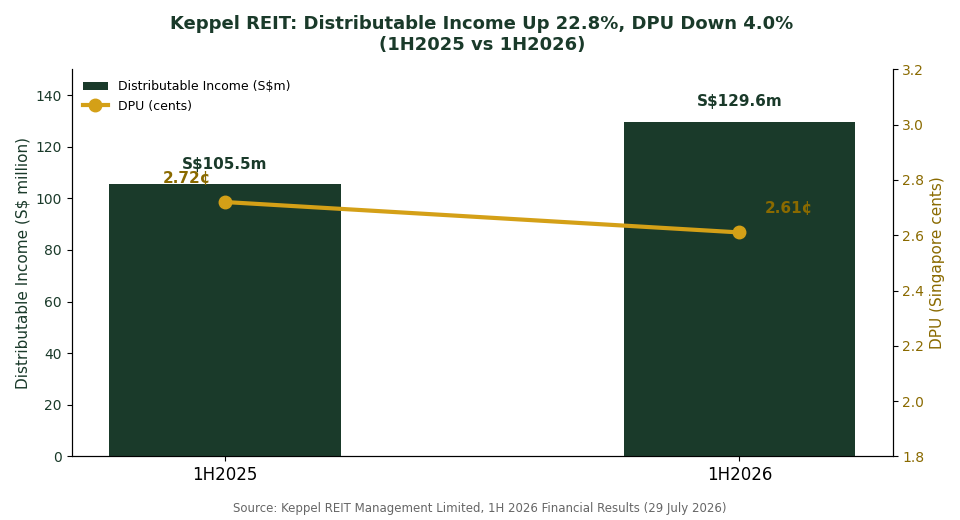
Keppel REIT’s 1H2026 distribution per unit (DPU) fell 4.0% year-on-year to 2.61 cents, even though distributable income rose 22.8% to S$129.6 million. The gap is mechanical: a January 2026 preferential offering grew the unit base 28.0% to fund a bigger stake in Marina Bay Financial Centre Tower 3, diluting per-unit payouts despite stronger underlying earnings.
Not financial advice. All figures are for educational reference only. Data as at 29 July 2026 (1H2026 results announcement) unless otherwise noted.
- DPU fell 4.0% to 2.61 cents, but that’s dilution from a 28% larger unit base — distributable income actually grew 22.8% to S$129.6 million.
- Keppel REIT is exiting Japan (KR Ginza II sold at a premium) and gearing dropped from 47.9% to 40.0% after the equity raise repaid bridge loans.
- Keppel Bay Tower and Pinnacle Office Park in Australia are the two soft spots to watch; Singapore’s core CBD towers are still posting positive rental reversions.
Table of Contents
Contents — Click to expand
- What Happened in Keppel REIT’s 1H2026 Results
- Why DPU Fell While Distributable Income Rose 22.8%
- The MBFC Tower 3 Trade: What the Extra Equity Bought
- Keppel REIT Exits Japan: The KR Ginza II Divestment
- Balance Sheet: Gearing Improves to 40.0%
- Singapore Portfolio: The Reversion Runway Is Still Positive
- Where It Softened: Keppel Bay Tower and Seoul’s T Tower
- Distribution Timeline and DPU Breakdown
- Should You Buy Keppel REIT After the 1H2026 Results?
- Frequently Asked Questions
What Happened in Keppel REIT’s 1H2026 Results
Keppel REIT (SGX: K71U) released its 1H2026 financial results on 29 July 2026, alongside a same-day announcement that it’s selling its last property in Japan. Both numbers tell a story of active portfolio management rather than a business standing still.
Property income rose 16.7% year-on-year to S$159.3 million. Net property income (NPI) — property income minus the direct costs of running the buildings — climbed 13.1% to S$122.5 million. Distributable income, including a one-off anniversary component, jumped 22.8% to S$129.6 million. Yet DPU, the actual cents-per-unit you’d receive, fell 4.0% to 2.61 cents from 2.72 cents a year earlier.
| Metric | 1H2026 | 1H2025 | Change |
|---|---|---|---|
| Property income | S$159.3m | S$136.5m | +16.7% |
| Net property income (NPI) | S$122.5m | S$108.3m | +13.1% |
| Share of joint venture results | S$83.8m | S$61.1m | +37.1% |
| Distributable income (incl. anniversary) | S$129.6m | S$105.5m | +22.8% |
| DPU | 2.61¢ | 2.72¢ | -4.0% |
| Aggregate leverage | 40.0% | 47.9%* | -7.9 ppt |
*47.9% is the leverage figure as at 31 December 2025, the most recent comparable pre-offering data point. Source: Keppel REIT Management Limited, 1H 2026 Financial Results, 29 July 2026.
If you’re holding Keppel REIT for its DPU history and dividend track record, the headline decline looks worse than the operating reality. The next section walks through exactly why.
Why DPU Fell While Distributable Income Rose 22.8%
Here’s the mechanical explanation. Keppel REIT computes DPU by dividing total distributable income by the number of units in issue at period end. On 19 January 2026, Keppel REIT issued 923,189,327 new units in a preferential offering, raising roughly S$886.3 million.
That single event grew the unit count from about 3,880,485,390 units (30 June 2025) to about 4,967,343,572 units (30 June 2026) — an increase of 28.0%. Distributable income grew 22.8% over the same period. When the denominator (units) grows faster than the numerator (dollars), the DPU quotient falls, even though the REIT is objectively earning more.
There’s no operational deterioration hiding inside this number. It’s a straightforward case of “the pie got bigger, but so did the number of people sharing it.” Whether that trade was worth it comes down to what the new equity actually bought — covered next.
The MBFC Tower 3 Trade: What the Extra Equity Bought
The January 2026 preferential offering funded an additional one-third interest in Central Boulevard Development Pte. Ltd., the entity that holds Marina Bay Financial Centre (MBFC) Tower 3. Keppel REIT completed this purchase on 31 December 2025, taking its total stake in the tower to two-thirds.
That’s why the “share of results of joint ventures” line jumped 37.1% year-on-year to S$83.8 million. Strip out the acquisition entirely and the same line still grew 11.6% (S$7.1 million) on higher rents and lower borrowing costs — so the underlying joint venture was already improving before the extra stake was added.
MBFC Tower 3 itself is one of Keppel REIT’s strongest assets, running at 99.5% committed occupancy. Owning more of a near-fully-let, blue-chip Marina Bay tower is a reasonable use of capital — the question for unitholders is simply whether the DPU dilution from funding it with new units was worth the extra income it brought in. For now, distributable income says yes; the per-unit maths says the payoff will take time to fully show up.
Keppel REIT Exits Japan: The KR Ginza II Divestment
On the same morning as its results, Keppel REIT announced it’s selling its 98.47% interest in KR Ginza II, an eight-storey freehold office building in Tokyo, for JPY 11.52 billion. That’s 28.4% above what it paid in November 2022, and 9.7% above an independent valuation struck just 19 days before the announcement.
The reasoning is straightforward once you look at the asset. KR Ginza II was running at 85.5% committed occupancy at 30 June 2026 — the weakest in Keppel REIT’s 14-property portfolio — in a Tokyo market where JLL puts Grade A office occupancy at roughly 99%. Selling an underperforming, boutique building into an exceptionally tight market, at a premium to both cost and a recent valuation, is disciplined capital recycling rather than a distressed exit.
Japan was Keppel REIT’s smallest market at just 0.7% of portfolio value, entered in 2022 and exited within four years. Completion is expected in the third quarter of 2026. Once it closes, Keppel REIT holds 13 properties worth roughly S$11.7 billion, split across Singapore (79.3%), Australia (18.5%) and South Korea (2.2%) — a simpler, more concentrated footprint. Assuming sale proceeds go toward debt, management expects aggregate leverage to ease further to about 39.6% on a pro forma basis.
Balance Sheet: Gearing Improves to 40.0%
Aggregate leverage fell 7.9 percentage points to 40.0% as at 30 June 2026, down from 47.9% at end-2025. The improvement came from repaying the equity bridge loans that had pre-funded the MBFC Tower 3 stake — those loans were cleared on 20 January 2026 using proceeds from the preferential offering.
Under MAS rules, S-REITs generally must keep aggregate leverage below 50%. At 40.0%, Keppel REIT sits with a reasonable buffer. Other balance sheet metrics also improved: the weighted average cost of debt eased to 3.27% per annum (from 3.41%), interest coverage stands at 2.7 times, 62% of borrowings are on fixed rates, and 80% of total funding is now sustainability-linked.
The item worth watching isn’t gearing — it’s refinancing timing. Of the debt maturing in 2026, roughly 1% falls in the third quarter and 99% in the fourth quarter, with documentation described as underway. Undrawn credit facilities of S$1,115.7 million comfortably cover the S$894.8 million of gross borrowings due within the next twelve months, which is a reasonable liquidity cushion — but refinancing costs in Q4 2026 will still depend on where SGD interest rates sit by then.
Singapore Portfolio: The Reversion Runway Is Still Positive
Portfolio rental reversion — the change in rent when a lease is renewed or replaced, compared to the previous rent on the same space — came in at +12.8% for 1H2026, across about 1.12 million square feet of leases committed. Retention rate was 75.7%, meaning most existing tenants chose to stay rather than leave when their leases expired.
The reversion runway is visible in the numbers. The weighted average signing rent across Ocean Financial Centre, Marina Bay Financial Centre and One Raffles Quay was S$13.14 per square foot per month in 1H2026 — above the rents on leases expiring through 2028.
| Singapore Office Leases | Average Rent (psf/month) |
|---|---|
| Signed in 1H2026 | S$13.14 |
| Expiring in 2026 | S$12.24 |
| Expiring in 2027 | S$11.49 |
| Expiring in 2028 | S$12.66 |
Source: Keppel REIT Management Limited, 1H 2026 Results Presentation, 29 July 2026.
As long as new signing rents hold above these expiring levels, positive reversion stays mathematically available through 2027 and into 2028. For context, CBRE puts average core CBD Grade A rents at S$12.50 psf per month with 96.7% occupancy — Keppel REIT’s flagship Singapore assets sit above that benchmark, led by MBFC Tower 3 (99.5% committed) and One Raffles Quay (99.1% committed).
Where It Softened: Keppel Bay Tower and Seoul’s T Tower
Not every asset in the portfolio is moving in the same direction. Keppel Bay Tower — Keppel REIT’s only Singapore property located outside the core CBD — saw property income fall 11.5% to S$17.0 million and NPI drop 14.2% to S$13.0 million. Its committed occupancy of 95.8% is the lowest among Keppel REIT’s Singapore assets, though still respectable in absolute terms.
In Seoul, T Tower’s NPI fell 12.4% to S$5.7 million, against a broader Seoul CBD Grade A market where JLL recorded occupancy sliding to 87.7% in the second quarter of 2026, down from 93.1% just a quarter earlier. That’s a market-wide softening, not necessarily a Keppel REIT-specific problem — but it’s worth watching given North Asia’s smaller share of the portfolio doesn’t leave much room for further slippage.
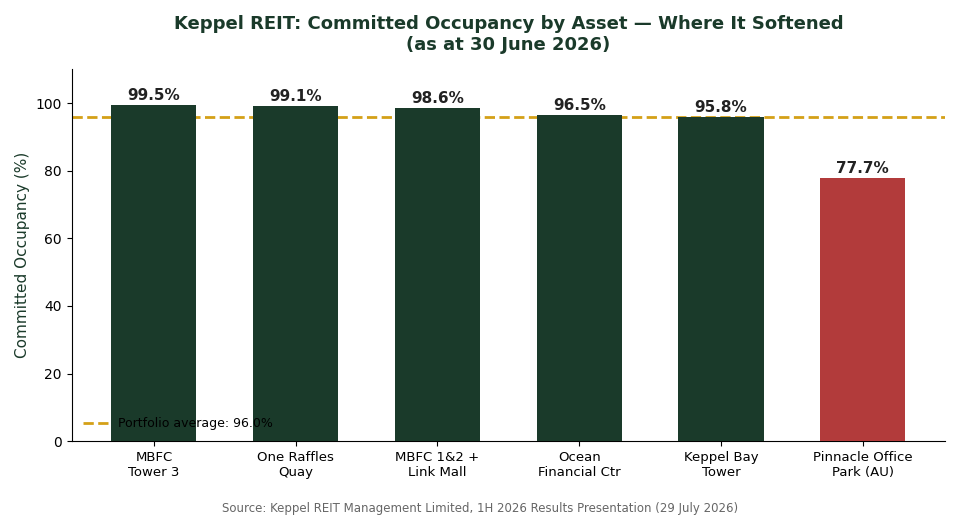
In Australia, Pinnacle Office Park is the portfolio’s clear laggard at 77.7% committed occupancy — well below the 96.0% portfolio average. The silver lining: its NPI still grew 14.5% year-on-year, and a lobby upgrade at Building A reached practical completion in April 2026, which could help attract new tenants over the next few quarters. Whether that leasing follows through is one of the more important things to track into Keppel REIT’s next results.
Distribution Timeline and DPU Breakdown
The 2.61 cents per unit for 1H2026 is made up of 1.18 cents of taxable income, 1.23 cents of tax-exempt income and 0.20 cents of capital gains. If you’re holding Keppel REIT units through a CPF Ordinary Account or Supplementary Retirement Scheme (SRS) account via a broker like Syfe or Endowus, the tax-exempt and capital gains components generally remain tax-free at the individual investor level — but always check your specific account type’s treatment before assuming.
Key dates for this distribution:
- Ex-distribution date: 5 August 2026
- Record date: 6 August 2026, 5.00pm
- Payment date: 15 September 2026
One structural detail worth flagging: the S$10.0 million anniversary distribution included in each half-year payout is worth 0.20 cents per unit at the current enlarged unit base — and it has a published expiry. It stops after the half-year ending 30 June 2027. That means roughly 0.40 cents of Keppel REIT’s current annualised DPU has a known end date and will need to be replaced by organic income growth, or you should expect DPU to step down again for reasons unrelated to operating performance.
Should You Buy Keppel REIT After the 1H2026 Results?
Annualising the 1H2026 DPU (2.61 cents x 2) gives roughly 5.22 cents a year. At a unit price of around S$0.92 (31 July 2026), that’s an approximate yield of 5.7% — a simplified estimate, not a guaranteed forward rate, since the anniversary distribution component steps down after 1H2027.
The case for Keppel REIT rests on genuinely improving fundamentals: NPI up, distributable income up, rental reversions positive, and gearing down sharply after the equity raise cleared its bridge financing. The case for caution rests on the parts of the story that are temporary or unresolved — the anniversary distribution’s known expiry, Q4 2026 refinancing, and softness at Keppel Bay Tower, T Tower and Pinnacle Office Park.
If you’re building a diversified S-REIT position rather than betting on a single counter, our Keppel REIT investor guide and 1Q 2026 results deep-dive cover the longer operating history, while our retirement planning calculator can help you see how a REIT like this fits into a broader income plan. This is not financial advice — always do your own research or speak to a licensed advisor before investing.
Frequently Asked Questions
Why did Keppel REIT's DPU fall if distributable income rose 22.8%?
It’s a unit-count problem, not an earnings problem. Keppel REIT issued 923.2 million new units in a preferential offering on 19 January 2026 to help fund its extra one-third stake in Marina Bay Financial Centre (MBFC) Tower 3. That grew the total unit base by 28.0% year-on-year, from about 3.88 billion to about 4.97 billion units. Distributable income grew 22.8%, but it’s now split across 28% more units. When the denominator grows faster than the numerator, DPU falls even though the REIT is earning more in absolute dollars.
What is Keppel REIT's dividend yield after the 1H2026 results?
Annualising the 1H2026 DPU of 2.61 cents (multiplying by two) gives roughly 5.22 cents a year. At a unit price of around S$0.92 (31 July 2026), that works out to an approximate yield of 5.7%. This is a simplified annualisation, not a forecast — Keppel REIT’s second-half DPU could differ once the anniversary distribution steps down after 1H2027, so treat this as a rough guide rather than a guaranteed rate.
When is Keppel REIT's 1H2026 distribution paid out?
Units trade ex-distribution from 5 August 2026. The distribution register closes at 5.00pm on 6 August 2026, and payment is scheduled for 15 September 2026. If you want to receive this particular payout, you need to hold units before the ex-date, not just before the payment date.
Why is Keppel REIT selling KR Ginza II in Tokyo?
Keppel REIT is exiting Japan entirely by selling its 98.47% stake in KR Ginza II for JPY 11.52 billion — 28.4% above what it paid in November 2022 and 9.7% above an independent valuation struck just 19 days before the sale was announced. The building’s occupancy had slipped to 85.5%, the weakest in Keppel REIT’s 14-asset portfolio, in a Tokyo market where Grade A office occupancy sits near 99%. Selling a lagging asset into a historically tight market, at a premium to both cost and valuation, is a textbook capital-recycling move — Japan was only 0.7% of portfolio value, so the exit barely dents overall scale.
Is Keppel REIT's gearing ratio safe?
Aggregate leverage fell to 40.0% as at 30 June 2026, down sharply from 47.9% at end-2025, after Keppel REIT repaid the bridge loans used to pre-fund the MBFC Tower 3 purchase with proceeds from the January 2026 preferential offering. That’s comfortably under MAS’s 50% regulatory gearing ceiling for S-REITs. Once the KR Ginza II sale completes, management expects leverage to ease further to about 39.6% on a pro forma basis. Interest coverage stands at 2.7 times and 62% of borrowings are on fixed rates, which limits (but doesn’t eliminate) exposure to future rate moves.
What is Keppel REIT's anniversary distribution and when does it end?
The anniversary distribution is a S$10.0 million payout added to each half-year distribution, worth 0.20 cents per unit at the current enlarged unit base. It’s part of a structured arrangement tied to an earlier transaction and has a published expiry: it stops after the half-year ending 30 June 2027. That means close to 0.40 cents of Keppel REIT’s current annual DPU has a known end date and will need to be replaced by organic portfolio growth, or DPU will step down again independent of operating performance.
Which Keppel REIT property is underperforming?
Two assets are the ones to watch. Keppel Bay Tower, Keppel REIT’s only Singapore property outside the core CBD, saw property income fall 11.5% to S$17.0 million and net property income drop 14.2% to S$13.0 million, with committed occupancy at 95.8% — the lowest among its Singapore assets. In Australia, Pinnacle Office Park is the portfolio’s weakest link at just 77.7% committed occupancy, though its net property income still grew 14.5% and a lobby upgrade at Building A completed in April 2026, which could support future leasing.
Is Keppel REIT a good buy after the 1H2026 results?
The underlying operating story is constructive: NPI, distributable income, rental reversions and gearing all moved in the right direction in 1H2026. The DPU dip is a mechanical side effect of the equity raise, not a sign of weaker earnings power. That said, you’re not getting the extra MBFC Tower 3 income for free — the enlarged unit base is permanent, while part of the current distribution (the anniversary component) is not. Whether Keppel REIT suits your portfolio depends on your view of Singapore Grade A office rents holding up through 2027, and how you weigh a near-term yield of about 5.7% against upcoming refinancing of the debt maturing in Q4 2026. This isn’t financial advice — do your own research or speak to a licensed advisor before investing.
Build Your S-REIT Income Portfolio
Buy Keppel REIT and other S-REITs commission-efficiently through Syfe or Endowus, or explore our full retirement planning calculator to see how dividend income fits your retirement number.
This article was researched with the help of AI. While we strive to keep all information accurate and up to date, there may be errors. If you notice any discrepancies, please contact us.