Keppel REIT Dividend 2026: DPU History, 6% Yield & MBFC Tower 3 Deep-Dive (K71U)
Updated April 2026 | SGX: K71U | Office REIT | Semi-Annual Distribution
Keppel REIT (SGX: K71U) is one of Singapore’s largest and longest-standing office REITs, anchored by trophy assets in the Marina Bay Financial Centre (MBFC) precinct. As at April 2026, it offers a trailing dividend yield of approximately 6.2%, trades at a 35% discount to its net asset value (NAV), and has just completed a transformative acquisition that takes its ownership of MBFC Tower 3 to 100%.
For Singapore income investors, that combination — high yield, deep NAV discount, and a quality portfolio — deserves a careful look. But the interest rate environment, refinancing pressure, and a weak Singapore office leasing market mean the picture isn’t without risk.
In this deep-dive, we break down Keppel REIT’s DPU history, financial health, portfolio quality, peer comparison, and give you our honest verdict. This article is for informational purposes only and is not financial advice. Always do your own due diligence before investing.
Table of Contents
Contents — Click to expand
- Fast Facts: Keppel REIT at a Glance
- DPU History: FY2019–FY2024
- Peer Comparison: Singapore Office REITs 2026
- Financial Health: Gearing, ICR and Debt Profile
- Portfolio Analysis: Properties, Occupancy and Tenants
- MBFC Tower 3 Acquisition: What It Means for Unitholders
- Key Risks
- Verdict: Buy, Hold or Watch?
- FAQ: Keppel REIT Dividend 2026
1. Fast Facts: Keppel REIT at a Glance
Data as at April 2026 unless stated otherwise.
| Metric | Value |
|---|---|
| SGX Ticker | K71U |
| Sector | Commercial / Office REIT |
| Unit Price (Apr 2026) | ~SGD 0.895 |
| Annual DPU (FY2024) | 5.60 cents |
| Trailing Dividend Yield | ~6.2% |
| Distribution Frequency | Semi-annual (H1 + H2) |
| Gearing Ratio | 38.0% |
| NAV Per Unit | ~SGD 1.30 |
| P/NAV | ~0.69x (deep discount) |
| Market Capitalisation | ~SGD 4.4 billion |
| Portfolio AUM | SGD 11.7 billion (14 assets) |
| Committed Occupancy | 96.3% (as at Q3 2025) |
| WALE (Portfolio) | 4.7 years |
| Manager | Keppel REIT Management Ltd |
2. DPU History: FY2019–FY2024
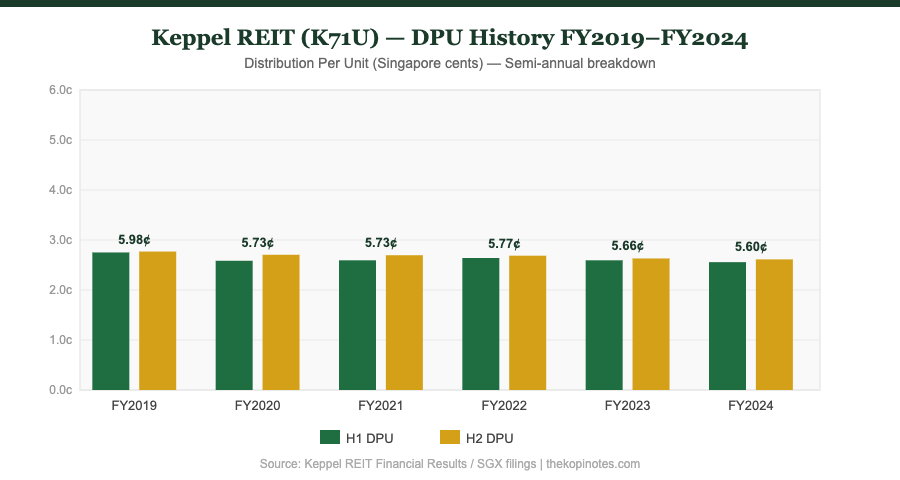
Keppel REIT distributes income to unitholders twice a year — typically in March (H2 DPU for the prior year) and September (H1 DPU). The table below tracks six years of distribution history, showing the gradual pressure from rising interest rates from 2022 onwards.
| Financial Year | H1 DPU (¢) | H2 DPU (¢) | Full Year DPU (¢) | YoY Change |
|---|---|---|---|---|
| FY2019 | 2.98 | 3.00 | 5.98 | — |
| FY2020 | 2.80 | 2.93 | 5.73 | ▼ 4.2% |
| FY2021 | 2.81 | 2.92 | 5.73 | — flat |
| FY2022 | 2.86 | 2.91 | 5.77 | ▲ 0.7% |
| FY2023 | 2.81 | 2.85 | 5.66 | ▼ 1.9% |
| FY2024 | 2.77 | 2.83 | 5.60 | ▼ 1.1% |
Source: Keppel REIT financial results / investor presentations, SGX filings. All data as at respective FY full-year results announcements.
The DPU trend tells a clear story. After a COVID-related dip in FY2020, Keppel REIT partially recovered in FY2021–2022. But rising SORA rates from 2022 onwards increased financing costs, dragging DPU lower in FY2023 and FY2024. The good news: with SORA now at a trough of ~1.07% (as at early 2026), the DPU headwinds from higher borrowing costs are easing. Read our full analysis of the SORA rate and what it means for S-REIT investors.
3. Peer Comparison: Singapore Office REITs 2026
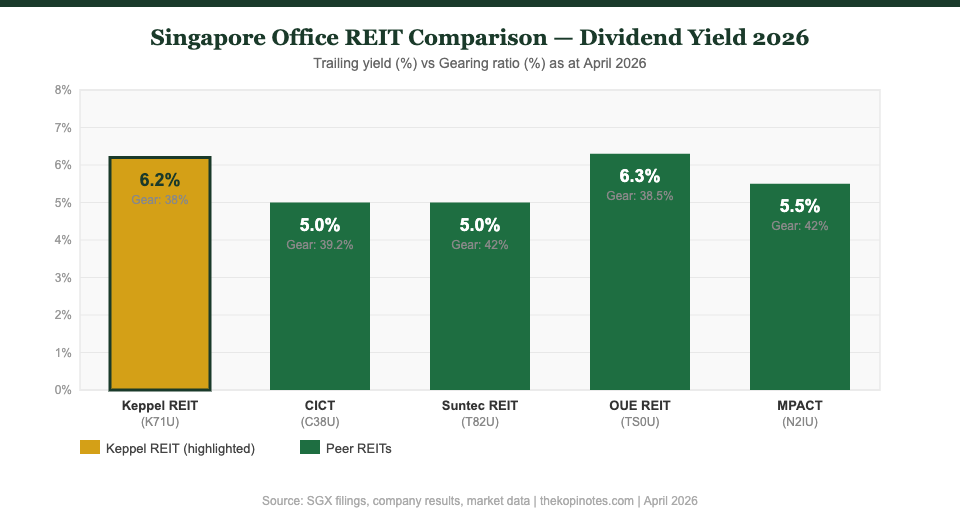
How does Keppel REIT (K71U) stack up against its closest Singapore-listed peers? We compared five commercial/office REITs on the metrics that matter most to income investors.
| REIT | Ticker | Yield (%) | Gearing | P/NAV | Market Cap |
|---|---|---|---|---|---|
| Keppel REIT ★ | K71U | 6.2% | 38.0% | 0.69x | ~SGD 4.4B |
| CICT | C38U | 5.0% | 39.2% | 0.85x | ~SGD 16.5B |
| Suntec REIT | T82U | 5.0% | ~42% | ~0.60x | ~SGD 3.5B |
| OUE REIT | TS0U | 6.3% | 38.5% | ~0.55x | ~SGD 2.0B |
| MPACT | N2IU | 5.5% | ~42% | ~0.70x | ~SGD 7.2B |
Source: SGX filings, company quarterly results, market data. As at April 2026. P/NAV based on latest available book values.
Keppel REIT stands out with the highest yield among pure office-focused peers (matching OUE REIT), while maintaining a more conservative gearing than Suntec REIT and MPACT. Its P/NAV of 0.69x is among the lowest, suggesting the market is pricing in persistent headwinds — but also offering valuation upside if conditions improve. For the MPACT deep-dive, see our MPACT dividend 2026 article.
4. Financial Health: Gearing, ICR and Debt Profile
Keppel REIT’s balance sheet is one of its stronger attributes relative to its office REIT peers.
Gearing ratio: 38.0% — comfortably below the 50% MAS regulatory limit, and lower than several peers. This provides buffer for acquisitions or adverse asset revaluations without triggering a breach.
Weighted average cost of debt: ~3.45% p.a. — declining from the peak of the hiking cycle. With SORA now at a trough (~1.07% as at early 2026), the all-in cost of floating-rate debt is rolling lower. Approximately 65–70% of Keppel REIT’s borrowings are on fixed rates, which reduces near-term sensitivity to SORA movements.
Debt maturity profile: The REIT has approximately SGD 1.2 billion in debt maturing within 12 months (including SGD 300 million due Q2 2026). This is the primary refinancing risk to monitor — though management has historically been proactive in managing maturities with staggered drawdowns and revolving credit facilities. The average debt maturity stretches to approximately 2028 on a portfolio basis.
NAV discount: At ~0.69x P/NAV, Keppel REIT trades at a 31% discount to book value. Historically, it traded at parity to slight discount. The current wide discount reflects market concerns about Singapore office cap rate expansion and refinancing risk — but also implies meaningful upside if cap rates stabilise or compress.
For investors accessing S-REITs via robo advisors, platforms like Endowus and Syfe offer curated REIT portfolios if you prefer managed exposure over direct unitholding.
5. Portfolio Analysis: Properties, Occupancy and Tenants
Portfolio Overview
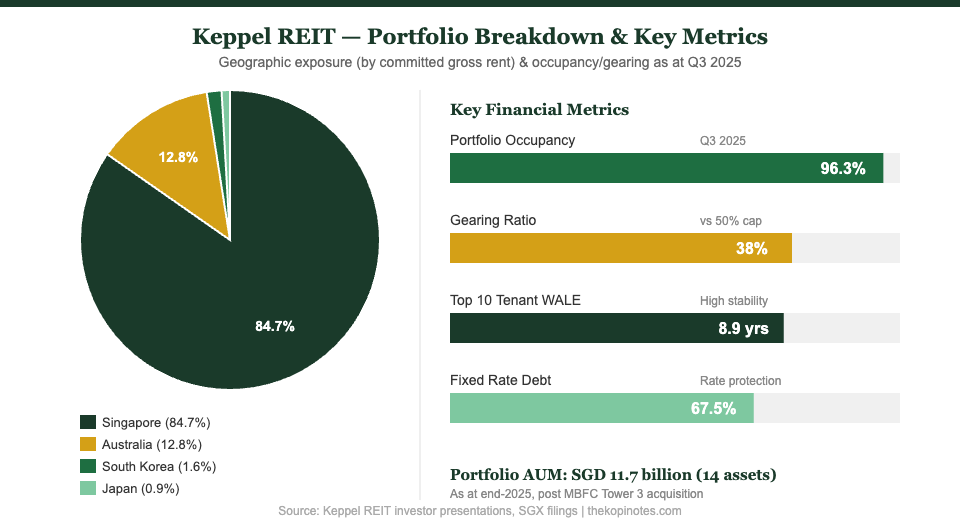
As at end-2025, Keppel REIT’s portfolio comprises 14 prime commercial assets with a total AUM of SGD 11.7 billion. The portfolio is heavily weighted towards Singapore’s Core CBD, with 84.7% of committed gross rent from Singapore assets.
Key Singapore assets include:
- Marina Bay Financial Centre (MBFC) Towers 1, 2 and 3 — iconic waterfront Grade A offices; Keppel REIT holds 33.33% of Towers 1 & 2 and 100% of Tower 3 (post-December 2025 acquisition)
- Ocean Financial Centre — 79.9% stake; 43-storey Grade A office in Raffles Place
- One Raffles Quay — 33.33% stake; premium Grade A office at the intersection of CBD and Marina Bay
- Keppel Bay Tower — 100% owned; waterfront commercial building at HarbourFront
Overseas assets include properties in Sydney, Melbourne and Perth (Australia), T Tower in Seoul (South Korea), and assets in Japan.
Geographic Breakdown (by committed gross rent, as at Q3 2025)
- Singapore: 84.7%
- Australia: 12.8%
- South Korea: 1.6%
- Japan: 0.9%
Occupancy and WALE
Portfolio committed occupancy stands at 96.3% (as at September 30, 2025) — a resilient figure that reflects the flight-to-quality trend in Singapore’s CBD office market. Grade A buildings in Marina Bay and Raffles Place continue to command strong tenant interest even as secondary office buildings face higher vacancy.
The portfolio WALE is 4.7 years. Notably, Keppel REIT’s top 10 tenants have a WALE of 8.9 years, indicating anchor tenants are locked in for the long term. Singapore leases average 2.8 years WALE, while Australia government leases average 10.0 years.
Tenant Quality
Keppel REIT’s top 10 tenants account for 40.2% of NLA and 35.6% of total rent. Its tenant base is dominated by financial services firms, government entities, professional services and blue-chip corporations — providing high credit quality. Major tenants include DBS Group, the Government of Western Australia, the State of Victoria, Ernst & Young and large multinational financial institutions.
This tenant profile means distribution income is resilient even in economic downturns — a key differentiator from retail or hospitality REITs. For a broader view of how S-REITs fit into a Singapore investor’s portfolio, read our guide to the best S-REITs in Singapore 2026.
6. MBFC Tower 3 Acquisition: What It Means for Unitholders
In December 2025, Keppel REIT completed the acquisition of an additional one-third stake in Marina Bay Financial Centre (MBFC) Tower 3 from a Hong Kong Land subsidiary for SGD 1,453 million. This brought its ownership from 66.7% to 100% of the tower.
To fund the acquisition, Keppel REIT launched a non-renounceable preferential offering in December 2025–January 2026, raising SGD 886.3 million gross at an issue price of SGD 0.96 per unit. The offering was underwritten by DBS Bank, OCBC and UOB.
Why this matters for investors:
- Consolidation premium: Full ownership of MBFC Tower 3 removes shared ownership complications and allows full optimisation of the asset’s leasing strategy.
- DPU accretion: At full ownership, all income from the tower flows directly to Keppel REIT — expected to be accretive to DPU on a stabilised basis.
- Singapore concentration: Post-acquisition, Singapore’s share of portfolio value rises from 75.8% to approximately 79.0%.
- Dilution risk: The preferential offering issued approximately 923 million new units (~23 per 100 held). Unitholders who did not participate experienced dilution to their per-unit DPU in the near term.
The MBFC Tower 3 deal is strategically sound — MBFC remains one of the most prestigious office addresses in Southeast Asia. The key question for 2026 is whether accretion from 100% ownership will be sufficient to stabilise or grow per-unit DPU against the backdrop of the rising unit count.
7. Key Risks
Risk 1: Refinancing Pressure (Near-Term)
Keppel REIT has approximately SGD 1.2 billion in debt maturing within 12 months (as at early 2026), including SGD 300 million due in Q2 2026. While the REIT has managed its maturities well historically, any deterioration in credit markets or widening of credit spreads could increase refinancing costs and compress DPU. Monitor the FY2025 full-year results announcement for updates on refinancing progress.
Risk 2: Singapore Office Market Headwinds
Singapore’s CBD Grade A office market has faced pressure from an increase in new supply and some demand softness from financial sector rightsizing. While Keppel REIT’s 96.3% occupancy is healthy, Singapore leases have a WALE of only 2.8 years — meaning a meaningful portion of leases come up for renewal in the near term. If renewal rents come in lower than passing rents, DPU could face additional pressure.
Risk 3: Interest Rate Sensitivity
Despite 65–70% of borrowings being on fixed rates, the remaining floating-rate component is sensitive to SORA movements. While SORA has fallen to a trough of ~1.07% in 2026, any reversal could push up borrowing costs and reduce distributable income. Read our SORA rate deep-dive for the full rate environment picture.
Risk 4: Currency Risk (AUD, KRW, JPY)
Keppel REIT derives approximately 15% of its income from assets denominated in Australian dollars, Korean won and Japanese yen. Currency hedging policies partially mitigate this risk, but a sustained SGD appreciation would reduce the SGD value of income from overseas assets.
Risk 5: Unitholder Dilution from Capital Recycling
The December 2025 preferential offering at SGD 0.96 per unit increased the unit count by ~18.6%. Future acquisitions funded by equity issuance would similarly dilute per-unit DPU. Assess whether acquisitions are genuinely accretive over a 12–24 month horizon rather than just increasing AUM scale. For context on REIT ETF investing as an alternative, see our Singapore REIT ETF guide.
8. Verdict: Buy, Hold or Watch?
Our take: WATCH with a BUY trigger at SGD 0.85–0.87
Keppel REIT is a high-quality office REIT with trophy Singapore CBD assets, blue-chip tenants, and a well-managed balance sheet. The 6.2% trailing yield is attractive for income investors, and the 31–35% NAV discount offers genuine upside if the Singapore office market recovers and interest rates stay low.
However, near-term headwinds are real: SGD 1.2 billion in upcoming refinancing, the lease renewal cliff in Singapore, and a post-preferential-offering unit count that dilutes per-unit metrics. At the current price of ~SGD 0.895, the risk-reward is reasonable but not outright compelling.
Bull case (target yield ~6.5%): Rate cuts in H2 2026 compress cap rates → NAV per unit re-rates higher → P/NAV narrows → unit price recovers toward SGD 1.05–1.15. MBFC Tower 3 full ownership accretion stabilises DPU.
Bear case (target yield ~7.5%): Refinancing at elevated spreads + lease renewal shortfalls → DPU falls toward 5.0–5.2 cents → unit price drifts to SGD 0.70–0.75.
For CPF-OA investors: Keppel REIT is approved for CPF Investment Scheme (CPFIS-OA) investment. At a 6.2% yield versus CPF OA’s 2.5%, the income spread is generous — but CPFIS rules require you to account for capital risk. Read our CPF investment strategy guide before investing via CPF-OA.
Want to Invest in Keppel REIT?
You can buy Keppel REIT (K71U) on the SGX via most Singapore brokerages. For lower-cost investing and access to curated REIT portfolios, consider these platforms:
9. FAQ: Keppel REIT Dividend 2026
What is the Keppel REIT dividend yield in 2026?
When does Keppel REIT pay dividends?
Is Keppel REIT a good buy in 2026?
What is the difference between Keppel REIT and Keppel DC REIT?
Can I buy Keppel REIT using CPF?
What is the NAV of Keppel REIT?
What are the main assets in Keppel REIT's portfolio?
How does Keppel REIT compare to CICT?
References
- Keppel REIT Financial Results — keppelreit.com
- Keppel REIT Portfolio Overview — keppelreit.com
- Keppel REIT SGX Filings — Singapore Exchange
- MAS REIT Regulatory Framework — Monetary Authority of Singapore
- Keppel REIT Dividend History — Dividends.sg
- Keppel REIT 3Q 2025 Operational Updates (SGX Filing, October 2025)
- Keppel REIT Preferential Offering Announcement (SGX Filing, December 2025)
Disclaimer: This article is for informational and educational purposes only. It does not constitute financial advice. The Kopi Notes is not a licensed financial adviser. Past dividend distributions are not a guarantee of future distributions. Always conduct your own due diligence and consider consulting a qualified financial adviser before making any investment decisions.
This article was researched with the help of AI. While we strive to keep all information accurate and up to date, there may be errors. If you notice any discrepancies, please contact us.