Endowment Plan vs S-REITs Singapore 2026: Guaranteed Returns vs Dividend Income
A Singapore investor’s real-numbers comparison of endowment plan guaranteed returns against S-REIT dividend yields, tax treatment, and a worked S$20,000 growth scenario.
Endowment plans guarantee your capital plus a modest bonus, averaging about 1.81% p.a. across major Singapore insurers. S-REITs offer no guarantee, but the iEdge S-REIT Index yielded around 6.3% p.a. as at May 2026. Both are largely tax-free for individual investors in Singapore, so the real decision comes down to your risk tolerance, not tax.
Not financial advice. All figures are for educational reference only. Data verified as at 3 August 2026 unless otherwise noted.
- Endowment plans guarantee your capital plus roughly 1.81% p.a. on average. S-REITs pay no guaranteed amount but yield around 6.3%-6.9% p.a. on average as at 2026.
- On a S$20,000 lump sum over 10 years, reinvested S-REIT distributions could compound to about S$36,844 versus S$23,930 for a guaranteed endowment — but REIT unit prices can fall, unlike your endowment’s guaranteed sum.
- Both endowment payouts and most S-REIT distributions are tax-free for individuals in Singapore, so lock-in periods and volatility tolerance matter more than tax when you choose.
Table of Contents
Quick Answer
If you want certainty, an endowment plan is the safer pick. You know your guaranteed sum from day one, and most insurers add a non-guaranteed bonus on top. Our tracking of seven major Singapore insurers puts the average total guaranteed-plus-illustrated return at roughly 1.81% p.a.
If you can stomach price swings, S-REITs have historically paid more. The iEdge S-REIT Index yielded about 6.3% p.a. on a market-cap-weighted basis as at May 2026, with an equal-weighted average closer to 6.8%-6.9% across all SGX-listed REITs. That is roughly 3.5 times the endowment average.
Here’s the catch: your endowment’s principal is guaranteed by the insurer (subject to its solvency and the SDIC policy owners’ protection scheme). Your S-REIT units are not. Unit prices move daily, and distributions can be cut — as several REITs did during the 2020 pandemic. You’re trading a guarantee for a shot at meaningfully higher income.
Key Differences at a Glance
Before the numbers, here’s how the two products actually differ in mechanics — not just returns.
| Feature | Endowment Plan | S-REITs |
|---|---|---|
| Return Type | Guaranteed + non-guaranteed bonus | Market-linked, no guarantee |
| 2026 Average Yield | ~1.81% p.a. (7-insurer average) | ~6.3% p.a. (iEdge S-REIT Index, mkt-cap wtd) |
| Capital Guarantee | Yes, at maturity (insurer-backed) | No — unit price fluctuates daily |
| Liquidity | Low — surrender before maturity usually means a loss | High — sell on SGX any trading day |
| Typical Lock-In | 2-25 years depending on plan | None |
| Distribution Frequency | Lump sum at maturity (or periodic payout plans) | Quarterly or semi-annual, varies by REIT |
| Diversification | Single insurer’s participating fund | Can hold 10-20+ REITs across sectors |
| CPF/SRS Eligibility | Some plans are CPF-OA/SRS eligible — confirm with your insurer | Select S-REITs are CPFIS-OA approved; most are SRS-eligible via your brokerage |
Tax Treatment Compared
This is where a lot of Singapore investors assume S-REITs lose out. They don’t. Under the Inland Revenue Authority of Singapore’s e-tax guide, distributions from SGX-listed REITs paid to individuals — local or foreign — are tax-exempt at source. You receive the full, gross distribution with nothing withheld.
The exception: if you receive the distribution through a partnership, or as part of carrying on a trade or business (for example, if REIT trading is your registered profession), it becomes taxable income you must declare. For the vast majority of retail investors buying S-REITs through a personal brokerage account, this exception simply doesn’t apply.
Endowment plan payouts work similarly. Life insurance policy proceeds — including maturity benefits, surrender values, and death benefits — are treated as capital in nature, not income, and Singapore does not tax capital gains. So your endowment payout is also tax-free in the vast majority of cases.
The practical takeaway: tax is a wash between the two. Neither product gives you a tax edge over the other for a typical individual investor. Your decision should rest on the numbers below, not on tax planning.
Guaranteed Return vs Dividend Yield
Here’s where the products really diverge. Our endowment tracking series — built from Great Eastern, Prudential, AIA, Manulife, NTUC Income, HSBC Life, and Etiqa illustrated benefit tables — puts the average total guaranteed-plus-projected return at 1.81% p.a. This figure already blends the guaranteed and non-guaranteed portions of a typical 15-25 year policy.
S-REITs work completely differently. There’s no “average return” promised by anyone. Instead, you look at the trailing distribution yield — how much cash the REIT actually paid out over the past 12 months, divided by the current unit price. As at May 2026, the iEdge S-REIT Index (market-cap-weighted) yielded about 6.3% p.a. An equal-weighted average across all SGX-listed REITs — which gives smaller REITs the same weight as giants like CapitaLand Integrated Commercial Trust — runs closer to 6.8%-6.9% p.a.
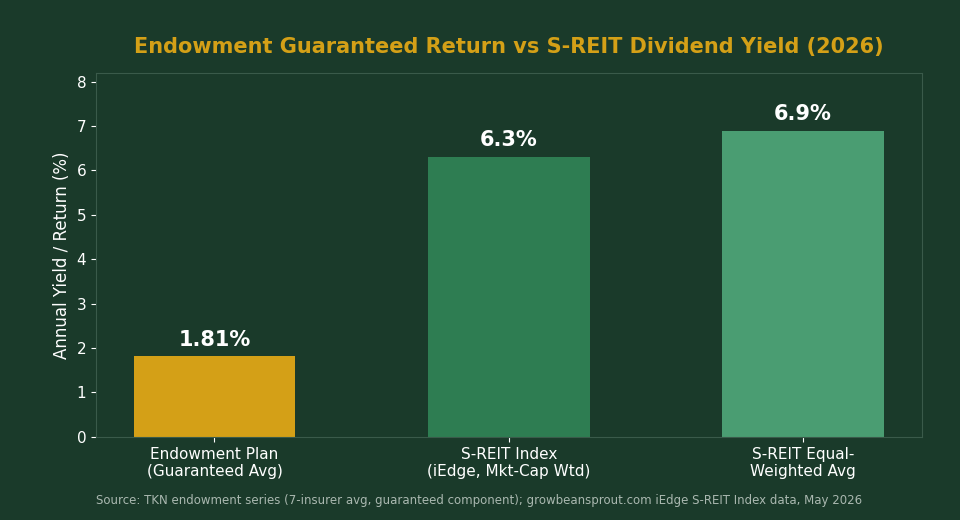
Source: TKN endowment series 7-insurer average (guaranteed component); growbeansprout.com iEdge S-REIT Index data, May 2026
However, a higher yield doesn’t mean a higher total return every year. S-REIT unit prices can rise or fall, and a REIT can cut its distribution if rental income drops — something several retail and hospitality REITs did in 2020. Your endowment’s guaranteed component doesn’t move regardless of what the stock market does.
The S$20,000 Growth Comparison
Numbers make this concrete. Say you invest a S$20,000 lump sum today and leave it untouched for 10 years.
In the endowment plan, growing at the 1.81% p.a. guaranteed average with annual compounding, your S$20,000 becomes S$23,929.54 at the end of year 10. No more, no less — this is what the insurer contractually owes you (assuming it isn’t purely non-guaranteed bonus, which can vary).
In an S-REIT portfolio yielding 6.3% p.a., with every distribution reinvested and unit prices assumed flat (no capital gain or loss — a conservative, deliberately cautious assumption), your S$20,000 compounds to S$36,843.65 over the same 10 years. That’s a S$12,914.11 gap in the S-REIT portfolio’s favour.
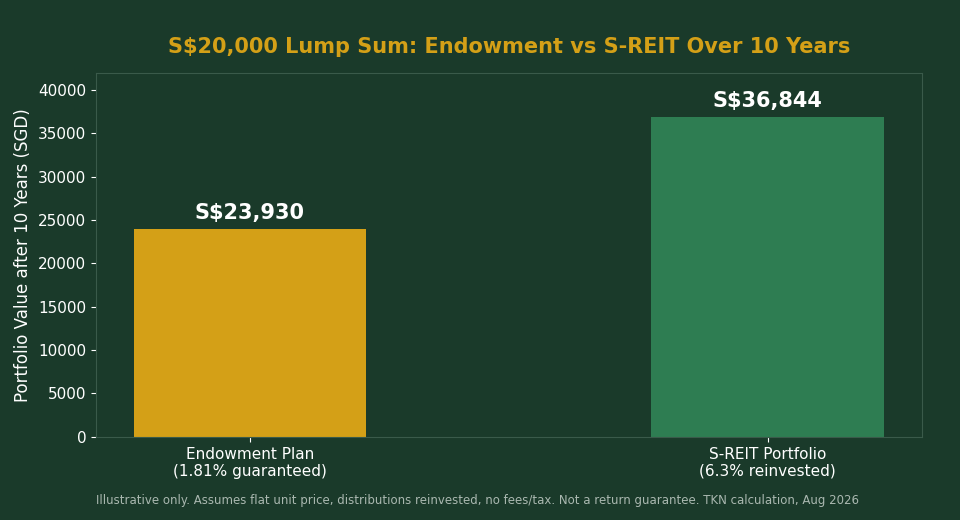
Source: TKN calculation, August 2026. Illustrative only — assumes flat REIT unit price and full distribution reinvestment.
That flat-price assumption matters. In reality, S-REIT unit prices have swung significantly — down more than 30% during the March 2020 crash, and recovering unevenly since. If unit prices had also risen over your 10-year holding period, your total return would be even higher than S$36,843.65. If they’d fallen, it could be lower than even the S$23,929.54 endowment figure. That volatility is the real price you pay for the higher average yield.
Risks You Need to Weigh
Every product has downsides. Being honest about both is how you make the right call for your own situation.
| Endowment Plan Risks | S-REIT Risks |
|---|---|
| Opportunity cost — 1.81% p.a. may not beat inflation in some years | Unit price volatility — can fall 20-30%+ in a downturn |
| Illiquidity — surrendering early usually means a financial loss | Distribution cuts — REITs can and have reduced payouts in downturns |
| Non-guaranteed bonus portion is not contractually certain | Interest rate sensitivity — REITs often fall when rates rise sharply |
| Insurer solvency risk (mitigated by SDIC’s Policy Owners’ Protection Scheme) | Sector concentration risk if you hold only 1-2 REITs |
Source: MAS Policy Owners’ Protection Scheme guidelines; historical S-REIT price performance during the March 2020 market downturn.
Who Should Pick Which?
An endowment plan is a better fit if you need a guaranteed lump sum for a specific goal — a child’s university fees in 18 years, or a fixed retirement date — and you cannot tolerate the account balance moving in the meantime. It also suits investors who know they lack the discipline to avoid panic-selling during a market downturn.
S-REITs are a better fit if you already have an emergency fund in a high-yield savings account, you don’t need this specific pool of money by a fixed date, and you’re comfortable seeing your portfolio value fluctuate in exchange for meaningfully higher long-run income. They also suit investors building a passive income Singapore strategy for retirement, since distributions can be spent or reinvested at your discretion — unlike an endowment’s fixed payout date.
Many Singapore households do both: an endowment plan for a specific guaranteed goal, alongside a diversified basket of S-REITs (or a REIT ETF) for long-run wealth building. If you’ve already compared this endowment guaranteed rate against your endowment plan vs CPF options, S-REITs are simply another instrument on the growth side of that same guaranteed-vs-market spectrum — much like our endowment plan vs robo-advisor comparison covers for diversified equity portfolios.
Whichever path you take, start with the full picture. See our best S-REITs in Singapore 2026 yield comparison table before picking individual counters, and run your numbers through our Singapore retirement calculator to see how each option affects your retirement timeline. If you’d rather invest through a robo-advisor that includes REIT exposure, our Syfe referral code page has the current sign-up bonus details.
Disclaimer: This article is for educational purposes only and does not constitute financial advice. Endowment plan figures are averages illustrated by insurers and are not guaranteed to represent any specific product. S-REIT yields and prices fluctuate and past distributions do not guarantee future payouts. Please speak to a licensed financial adviser before making any investment or insurance decision.
Frequently Asked Questions
Is an endowment plan safer than investing in S-REITs?
Yes, in terms of capital guarantee. An endowment plan’s guaranteed sum is contractually promised by the insurer (backed by the SDIC Policy Owners’ Protection Scheme up to certain limits). S-REIT unit prices fluctuate daily and are not guaranteed, so you could sell for less than you paid. In exchange, S-REITs have historically offered a much higher average yield — about 6.3% p.a. versus 1.81% p.a. for endowment plans as at 2026.
Are S-REIT dividends taxed in Singapore?
No, not for most individual investors. Under IRAS rules, distributions from SGX-listed REITs paid to individuals are tax-exempt at source, whether you’re a Singapore resident or a foreigner. The only exception is if you receive the distribution through a partnership or as part of running a trading business — a scenario that doesn’t apply to typical retail investors.
Can I use CPF or SRS money to invest in S-REITs?
Some S-REITs are approved under the CPF Investment Scheme for your CPF Ordinary Account — check CPF Board’s current CPFIS-included list before investing, since not every REIT qualifies. Most S-REITs can also be bought with SRS funds through SRS-linked brokerage accounts. Endowment plans have their own separate CPF/SRS eligibility rules — always confirm directly with your insurer.
What is the average dividend yield of S-REITs in 2026?
As at May 2026, the iEdge S-REIT Index yielded about 6.3% p.a. on a market-cap-weighted basis. An equal-weighted average across all SGX-listed REITs — giving smaller REITs the same weight as large-cap names — was closer to 6.8%-6.9% p.a. Individual REIT yields vary widely by sector and gearing, so always check a specific counter’s trailing yield before buying.
Can I lose money in S-REITs the way I can't with an endowment plan?
Yes. S-REIT unit prices can fall below what you paid, and distributions can be cut if rental income drops — both happened to several REITs during the 2020 pandemic. An endowment plan’s guaranteed sum, by contrast, does not fall in value as long as you hold it to maturity and the insurer remains solvent. This capital protection is the main reason endowment plans exist, despite the lower average return.
Should I choose one over the other, or hold both?
Many Singapore households hold both. An endowment plan can lock in a guaranteed sum for a specific goal with a fixed date, like school fees, while a diversified S-REIT portfolio builds long-run passive income for retirement. The right split depends on how much guaranteed capital you need versus how much volatility you can tolerate for higher potential income.
What happens if I need my money early from an endowment plan?
Surrendering an endowment plan before maturity usually returns only the policy’s surrender value, which is frequently less than the total premiums you’ve paid in the early years. This is a key liquidity disadvantage versus S-REITs, which you can sell on the SGX on any trading day at the prevailing market price, with no surrender penalty.
Ready to Build Your Guaranteed-Plus-Growth Portfolio?
Compare S-REITs, open a brokerage account, or start a robo-advisor portfolio with our referral bonuses below.
Get Free Insurance Advice
Speak with a licensed insurance advisor. No obligation, no cost.
By submitting this form, you agree to our Privacy Policy.
This article was researched with the help of AI. While we strive to keep all information accurate and up to date, there may be errors. If you notice any discrepancies, please contact us.