AIA Critical Illness Insurance: Is AIA Protect 3 Worth Adding? (Singapore 2026)
AIA’s newest critical illness plan launched in May 2026 — here’s what it covers, what it costs, and why it isn’t open to everyone.
AIA Protect 3 is a critical illness plan AIA launched on 19 May 2026 for its 95th anniversary. It covers cancer, heart attack and stroke — the three conditions behind about 90% of critical illness claims in Singapore — from S$0.565 a day. The catch: it’s exclusive to existing AIA individual or corporate policyholders and their spouses and children, not the general public.
Not financial advice. All figures are for educational reference only. Data verified as at 2 August 2026 against AIA’s official press release and product pages.
- AIA Protect 3 covers cancer, heart attack and stroke only — not the 30+ conditions a standard critical illness (CI) plan covers.
- You can only buy it if you already hold an AIA personal or corporate policy, or you’re the spouse or child of someone who does.
- It’s a cheap top-up, not a replacement — pair it with a broader plan like AIA Absolute Critical Cover if you don’t already have one.
Table of Contents
What Is AIA Protect 3?
AIA launched Protect 3 on 19 May 2026, timed to its 95th anniversary in Singapore. It’s a multi-stage critical illness (CI) plan built around just three conditions: cancer, heart attack and stroke, covered from early to major stage.
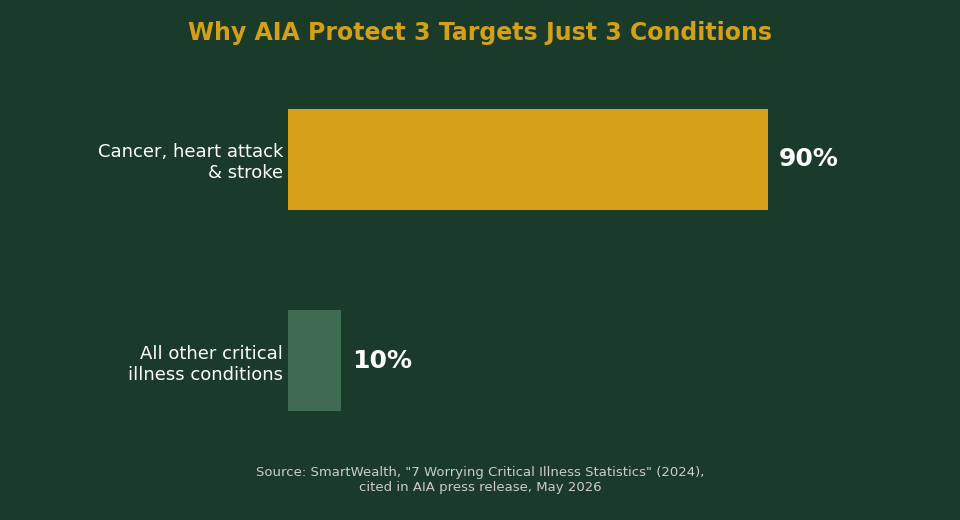
That narrow focus isn’t an accident. Cancer, heart attack and stroke together account for roughly 90% of all critical illness claims in Singapore, according to a 2024 SmartWealth analysis cited in AIA’s own launch materials. Rather than build another sprawling plan covering 100+ conditions, AIA designed Protect 3 to handle the illnesses that actually generate most payouts — at a lower price than a comprehensive plan.
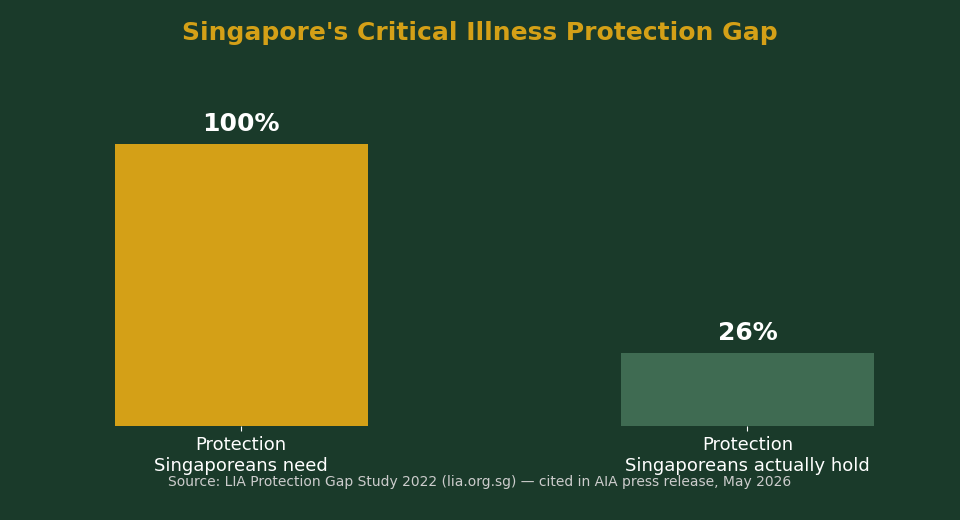
AIA frames this as closing part of Singapore’s critical illness protection gap. The Life Insurance Association’s 2022 Protection Gap Study found Singapore residents hold roughly 26% of the CI coverage they actually need — a 74% shortfall. AIA Protect 3 is pitched as an easy, low-cost way to close part of that gap, especially for people who already have some AIA coverage but no dedicated CI protection.
Key Facts at a Glance
| Feature | Detail |
|---|---|
| Launch date | 19 May 2026 |
| Conditions covered | Cancer, heart attack, stroke — early to major stage |
| Who can buy it | Existing AIA individual or corporate policyholders, plus their spouses and children |
| Coverage age | Up to age 85 |
| Starting premium | From S$0.565/day (illustrative: 16-year-old male non-smoker, S$100,000 coverage) |
| Cashback | 25% of premiums at age 65 or entry age + 15 years (whichever is later), if claim-free |
| Underwriting | Simplified — 4 questions, no medical check-up required |
| Vitality integration | Optional — up to 15% of premiums back in Vitality coins annually |
Source: AIA Singapore press release, “95 years of protecting Singapore: AIA launches AIA Protect 3,” 19 May 2026.
Who Can Actually Buy AIA Protect 3?
This is the detail most comparison sites will bury: AIA Protect 3 is not sold to the general public. It’s exclusive to people who already hold a personal or corporate AIA insurance policy, plus their spouses and children.
AIA’s own launch materials confirm this is deliberate — Protect 3 is positioned as an exclusive perk for AIA’s existing base, covering both personally-insured customers and those covered through a corporate or employee benefits scheme, plus their immediate family. If you’ve never bought an AIA product, you can’t apply for Protect 3 directly. You’d need to become an AIA customer through another plan first, or check with an AIA Financial Services Consultant on current eligibility rules.
This matters for how you should search for this plan. If you’re comparing critical illness insurance from scratch with no existing AIA policy, Protect 3 isn’t on your shortlist yet — you’ll want to compare across all insurers, not just AIA’s exclusive add-on.
How Much Does AIA Protect 3 Cost?
AIA’s quoted starting rate is S$0.565 a day. That works out to roughly S$206 a year (S$0.565 × 365 days), for a 16-year-old male non-smoker with S$100,000 of coverage. AIA calculates this by dividing the annual premium rate by 365 — it’s not a separate “daily plan,” just a way of making the annual cost feel smaller.
That figure is a floor, not a typical price. AIA is explicit that “premiums will increase with age and are not guaranteed.” A 16-year-old entry age produces the cheapest possible quote — someone starting Protect 3 at 35 or 45 will pay meaningfully more for the same S$100,000 of coverage, though AIA hasn’t published a full age-banded rate table.
One useful feature: you can switch to level premiums — where the amount stays fixed instead of rising every year — from age 70. That’s worth asking about if you’re adding Protect 3 later in life and want cost certainty heading into retirement.
Sign-up is also deliberately friction-free. AIA requires just 4 health questions and no medical check-up, which speeds up approval but also means the underwriting is lighter than a fully underwritten CI plan — a trade-off for the lower entry barrier.
The 25% Cashback, Explained
Protect 3’s headline retention feature is a 25% cashback on premiums paid, triggered at age 65 or entry age plus 15 years — whichever comes later — provided you haven’t made a claim.
“Whichever is later” matters more than it sounds. Here’s how the timing actually plays out for three different entry ages:
| Entry Age | Entry Age + 15 Years | Age 65 | Cashback Triggers At |
|---|---|---|---|
| 25 | 40 | 65 | Age 65 |
| 45 | 60 | 65 | Age 65 |
| 55 | 70 | 65 | Age 70 |
Illustrative timing based on AIA’s published cashback rule (age 65 or entry age + 15 years, whichever is later). Not an official AIA table.
In practice, most people who join before age 50 will see their cashback land at exactly age 65. Only those entering later in life — age 51 and above — push the trigger date past 65, since entry age + 15 years starts to overtake it. Remember: this cashback disappears entirely the moment you make a valid claim, since the whole point of the benefit is rewarding a claim-free record.
AIA Protect 3 vs AIA’s Other Critical Illness Plans
AIA sells several CI plans side by side, and it’s easy to pick the wrong one if you only look at price. Protect 3 sits at the affordable, narrow-coverage end. For comparison, AIA’s flagship comprehensive plan, AIA Absolute Critical Cover, covers 187 separate conditions: 150 multi-stage critical illnesses (with up to S$350,000 payable for early or intermediate-stage claims), 25 special conditions such as diabetic complications, and 12 pre-early conditions including age-related illnesses from age 51 onwards.
| Plan | Focus | Open to General Public? |
|---|---|---|
| AIA Protect 3 | Multi-stage protection for cancer, heart attack and stroke only | No — existing AIA customers and family only |
| AIA Absolute Critical Cover | 187 conditions: multi-stage CIs, special conditions, pre-early conditions, plus cash/maturity value to age 100 | Yes |
| AIA Beyond Critical Care | Major-stage CIs and relapse, plus mental illness cover and a premium refund feature | Yes |
| AIA Ultimate Critical Cover | Unlimited critical illness claims with 100% coverage reset | Yes |
Source: AIA Singapore official product pages, aia.com.sg (accessed August 2026). Plan features summarised from AIA’s own marketing descriptions — always confirm current terms directly with AIA before purchasing.
The practical read: Protect 3 is a top-up, not a substitute. It’s built for people who already have AIA coverage and want a cheap way to add protection against the three conditions that cause most claims. If you have no CI coverage at all, a broader plan like Absolute Critical Cover — or a competitor’s equivalent — covers far more ground, including cancers and conditions Protect 3 simply doesn’t touch.
If you want the full picture of what “comprehensive” critical illness coverage should include before you commit to a narrower plan, our guide on how much critical illness insurance you actually need in Singapore walks through the maths.
Who Should (and Shouldn’t) Get AIA Protect 3?
AIA Protect 3 makes sense if:
You already hold an AIA policy (personal or through your employer) and have no dedicated critical illness cover yet. You want a low-cost way to protect against the highest-probability claims — cancer, heart attack and stroke — without going through full underwriting. You’re comfortable that premiums will rise as you age, and you value the claim-free cashback as a bonus, not a core reason to buy.
Consider a broader plan instead if:
You have zero critical illness coverage and want protection against a wide range of conditions, not just three. You’re not an existing AIA customer and can’t access Protect 3 anyway. You want fixed, contractually guaranteed coverage terms rather than a plan positioned as a “starter” or add-on product. In those cases, compare Protect 3’s parent-category options against our complete critical illness insurance comparison guide, or check why identical S$100,000 coverage can cost anywhere from S$296 to S$3,411 a year depending on insurer and plan design.
Also worth knowing: AIA already sells a full term life insurance range alongside its CI plans. If you’re weighing AIA’s broader protection lineup, see our review of AIA’s term life insurance plans in Singapore for how the two product lines fit together.
One more limitation worth flagging honestly: AIA has not published a public age-banded premium table for Protect 3, and the exclusivity requirement means most readers researching “critical illness insurance Singapore” from a cold start won’t be eligible to buy it at all. Treat this article as background for existing AIA customers deciding whether to top up — not a general buying guide.
Frequently Asked Questions
What is AIA Protect 3 and who can buy it?
AIA Protect 3 is a critical illness plan launched on 19 May 2026 that covers cancer, heart attack and stroke from early to major stage. It’s exclusive to existing AIA individual or corporate policyholders and their spouses and children — it isn’t sold to the general public.
How much does AIA Protect 3 cost?
AIA quotes a starting rate of S$0.565 a day (about S$206 a year) for a 16-year-old male non-smoker with S$100,000 of coverage. Premiums rise with age and aren’t guaranteed, and AIA hasn’t published a full age-banded rate table. You can switch to fixed level premiums from age 70.
What does AIA Protect 3 actually cover?
Multi-stage protection for cancer, heart attack and stroke, from early to major stage, up to age 85. It also covers gender-specific cancers — such as prostate and testicular cancer for men, and breast and ovarian cancer for women — from the third policy year onwards.
How does the 25% cashback work?
If you make no claims, AIA pays back 25% of premiums at age 65 or your entry age plus 15 years, whichever is later. For most people who join before age 50, that means the cashback lands at exactly age 65.
Is AIA Protect 3 enough critical illness coverage on its own?
Usually not. Protect 3 only covers three conditions, even though they account for around 90% of CI claims. A comprehensive plan like AIA Absolute Critical Cover covers 187 conditions. If you have no other CI coverage, treat Protect 3 as a supplement, not your only protection.
Can I buy AIA Protect 3 if I'm not an AIA customer?
No. AIA has positioned Protect 3 as an exclusive plan for existing AIA policyholders — personal or corporate — and their immediate family. If you’re not already an AIA customer, look at AIA’s broader public plans or compare across insurers instead.
Not an AIA Customer? Compare Your Options First
Critical illness insurance shouldn’t depend on which insurer you happen to already use. See what else is available before you decide.
Get Free Insurance Advice
Speak with a licensed insurance advisor. No obligation, no cost.
By submitting this form, you agree to our Privacy Policy.
This article was researched with the help of AI. While we strive to keep all information accurate and up to date, there may be errors. If you notice any discrepancies, please contact us.