How Much Critical Illness Insurance Do You Need in Singapore (2026)?
The LIA’s 4x-income rule, real SGD treatment costs, and a step-by-step framework to find your number.
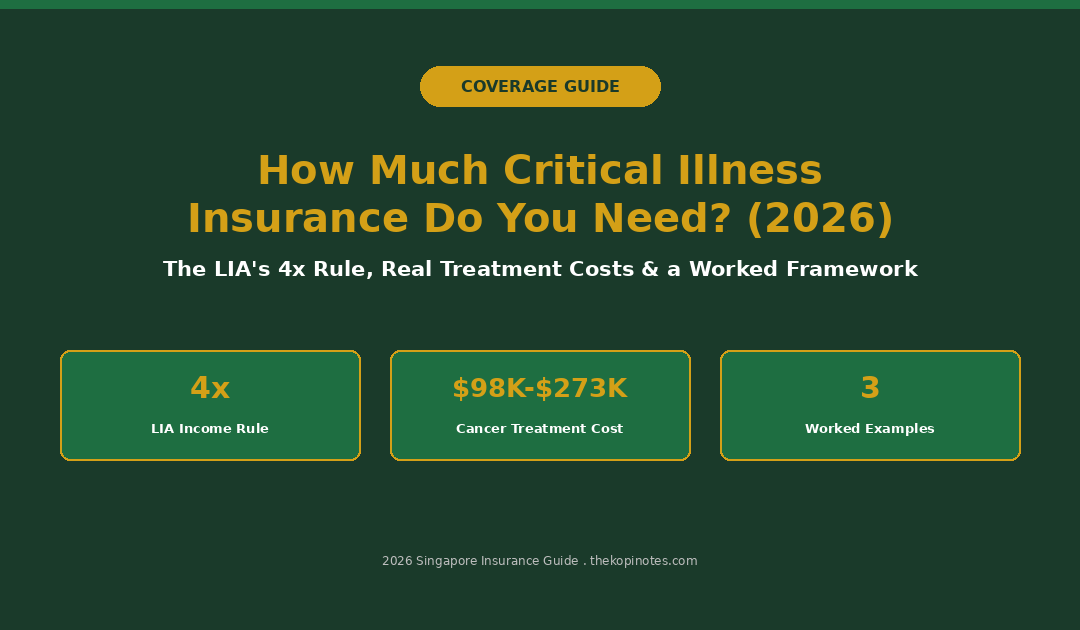
The Life Insurance Association (LIA) Singapore recommends critical illness (CI) coverage equal to 4 times your annual income. But income alone understates the real number — private-hospital cancer treatment can cost S$98,000 to S$273,000 over 18 months, so your CI payout also needs to clear that treatment-cost floor, plus a buffer for debt, minus cover you already have.
Not financial advice. All figures are for educational reference only. Data verified as at 24 July 2026 against official MOH, DBS and Singlife sources unless otherwise stated.
- The LIA’s rule of thumb is 4x your annual income — a useful starting point, not a personalised number.
- Cancer alone can cost S$98,000-S$273,000 to treat privately over 18 months, so your coverage needs a treatment-cost floor too, not just an income multiple.
- MediShield Life only covers Cancer Drug List treatments up to S$200-S$9,600 a month depending on the drug — it won’t replace lost income or fund private care.
The LIA’s 4x-Income Guideline
The Life Insurance Association (LIA) Singapore recommends holding critical illness protection equal to four times your annual income, according to guidance cited by DBS Bank’s cancer cost planning guide. The idea is simple: if you’re diagnosed with a major illness, you may be unable to work for one to several years, and your household still needs to pay for food, rent or mortgage, and your children’s school fees while you recover.
For a Singaporean earning S$5,000 a month (S$60,000 a year), that works out to S$240,000 in CI coverage. It’s a reasonable starting point, but it’s also a generic one — it doesn’t account for your specific treatment costs, existing debt, or how much CI cover you already hold through your employer. Those three factors are exactly what the framework further down this guide adds back in.
You should also treat “4x income” as a floor, not a ceiling. If you’re self-employed with no employer group insurance, support ageing parents, or have a family history of cancer or heart disease, your real number is likely higher than the guideline alone suggests.
What Critical Illness Actually Costs in Singapore
Cancer drives the majority of CI claims in Singapore — it accounts for roughly 73% of all critical illness claims and 40% of all death claims, according to Singlife claims data compiled by SmartWealth Singapore. That makes cancer treatment cost the single most important number in any CI coverage calculation.
Late-stage cancer treatment in Singapore can cost S$100,000 to S$200,000 a year, or roughly S$8,400 to S$16,700 a month — a figure independently confirmed by both DBS Bank and Singapore Cancer Society-sourced estimates. Medical inflation makes this worse every year: healthcare costs in Singapore rose 15.5% in 2025 and are projected to rise 16.9% in 2026, the highest rate in the region, with cancer cited as the single biggest driver.
| Procedure | Private Hospital | Public (Unsubsidised) | Public (Subsidised) |
|---|---|---|---|
| Breast cancer surgery | $32,378 | $12,014 | $3,404 |
| Lung cancer surgery | $76,758 | $36,277 | $7,479 |
| Colorectal cancer surgery | $55,865 | $23,887 | $6,288 |
| Prostate cancer surgery | $67,809 | $28,409 | $8,850 |
| Chemotherapy (per course) | $12,766 | $2,058 | $774 |
Source: MOH Fee Benchmarks (TOSP/DRG codes), compiled via SmartWealth Singapore — data as at 2026.
Radiotherapy adds a further S$25,000 to S$30,000 per course, and immunotherapy — increasingly common for late-stage cancers — costs around S$9,000 per dose, with a full course running S$156,000 to S$234,000. Our breakdown of Q1 2026 LIA claims data shows the average CI claim across all conditions came in around S$100,780 — useful context, but well below what a serious cancer diagnosis alone can cost at a private hospital.
Why MediShield Life Won’t Close the Gap
MediShield Life covers outpatient cancer drugs on the Cancer Drug List (CDL), but only up to a monthly claim limit that depends on the specific drug’s category. As at 1 June 2026, those limits range from just S$200 a month for the lowest category to S$9,600 a month for the highest, according to the Ministry of Health’s official Cancer Drug List.
That leaves a real gap. Immunotherapy, for example, can cost around S$9,000 per dose — a single dose can already exceed many CDL categories’ entire monthly claim limit, before even counting the drugs that aren’t on the CDL at all, which MediShield Life doesn’t cover at any amount. An Integrated Shield Plan (IP) extends this further, but MediShield Life and most IPs are built for hospitalisation and approved drug costs — neither is designed to replace your income while you’re off work.
MOH’s own 1 April 2026 reform of Integrated Shield Plan riders raised the minimum co-payment cap from S$3,000 to S$6,000 a year, specifically to keep IP premiums sustainable — which means your own out-of-pocket exposure under a Shield Plan rider actually went up this year, not down. We covered the full mechanics of that change, including MOH’s own worked examples, in our guide to the new ISP rider rules.
This is exactly the gap a CI lump sum is designed to fill: unlike MediShield Life or an IP, a CI payout isn’t tied to a specific medical bill. You can use it for non-CDL drugs, private treatment, lost income, or simply keeping the household running while you focus on recovery.
The 4-Step Coverage Framework
Here’s the framework this guide uses to turn the LIA’s generic guideline into a number that reflects your actual situation. It’s a TKN-built illustration on top of the LIA’s official 4x-income guideline — not a substitute for advice from a licensed financial adviser.
- Step 1 — Income replacement floor. Take 4x your gross annual income, per the LIA guideline above.
- Step 2 — Treatment cost floor. Compare Step 1 against a S$150,000 floor, based on real private-hospital cancer treatment costs of S$98,000-S$273,000. Use whichever number is higher.
- Step 3 — Debt buffer. Add roughly 3 years of mortgage or loan instalments you’d still need to pay during treatment and recovery — not your full outstanding loan balance. A CI payout is meant to bridge your recovery, not pre-pay a decades-long mortgage.
- Step 4 — Subtract existing cover. Deduct any CI coverage you already hold, including employer group insurance and personal CI riders.
The next section walks through this formula for three different life stages, using real (illustrative) SGD figures.
Worked Examples by Life Stage
These three profiles show how the same framework produces very different coverage targets depending on income, debt, and existing cover.
| Step | Single, 28 $3,500/mo, no debt |
Young Parent, 35 $6,000/mo, $2k/mo mortgage |
Sandwich Gen, 45 $8,000/mo, $2.5k/mo mortgage |
|---|---|---|---|
| 1. Income x4 | $168,000 | $288,000 | $384,000 |
| 2. Treatment floor ($150k) | No change | No change | No change |
| 3. +3yr debt buffer | +$0 | +$72,000 | +$90,000 |
| 4. -Existing CI cover | -$0 | -$100,000 | -$150,000 |
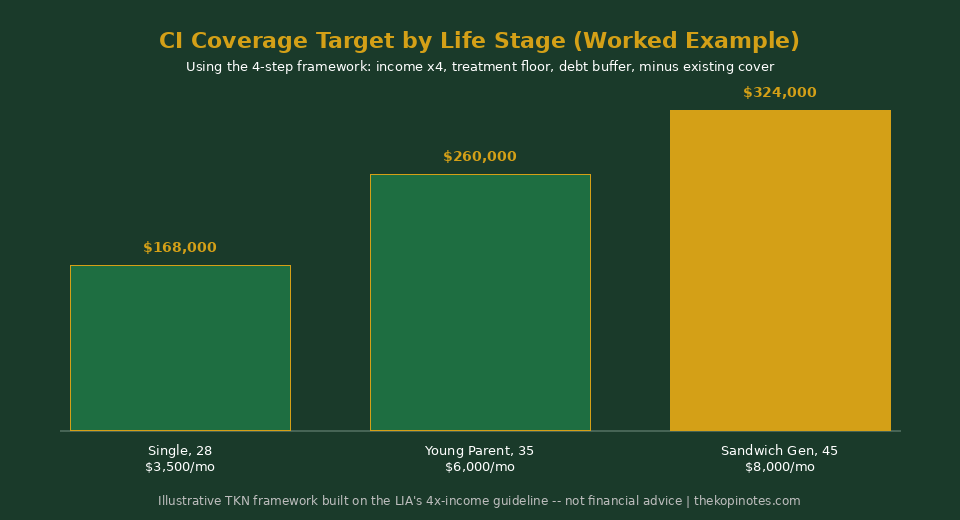
| Coverage target | $168,000 | $260,000 | $324,000 |
Illustrative TKN framework, built on the LIA’s official 4x-income guideline. Not financial advice — your own number will depend on your actual income, debt, dependants and existing coverage.
Notice that the single 28-year-old’s target of $168,000 comes entirely from the income-replacement step — with no mortgage and no dependants, there’s no debt buffer to add. The sandwich-generation profile at 45 ends up with the highest target despite already holding $150,000 in existing cover, because a higher income and a larger debt buffer push the baseline up faster than existing cover brings it down.
Does Early CI Change the Amount You Need?
Not by much — the coverage amount from the framework above should stay roughly the same whether you buy standard CI or an Early Critical Illness (ECI) plan. What changes is when you get paid. Standard CI only pays out at the severe or late stage of an illness. ECI plans pay from an earlier stage too, which can matter if a cancer or heart condition is caught early — but ECI premiums typically cost 1.5x to 2x more than standard CI for the same sum assured.
If budget allows it, ECI is worth considering precisely because early detection is more common today — five-year cancer survival rates in Singapore have climbed from roughly 22.6% in the late 1970s to around 61.4% in the most recent reporting period, which means more people are being diagnosed and treated at earlier, more survivable stages. Our complete guide to Early CI plans, coverage and costs breaks down exactly which stages and conditions ECI adds on top of standard CI.
How to Close Your Coverage Gap
Once you have a target number, the next step is figuring out how much of it you already have. Start by adding up your employer’s group CI coverage (check your HR portal or employee handbook), any personal CI plans or riders you’ve bought, and any CI component bundled into a whole life or endowment policy.
If you’re not sure where you stand, our Insurance Gap Calculator and Life Insurance Needs Calculator can both help you work through this faster than doing it by hand — plug in your income, dependants and existing policies, and they’ll estimate your gap using a similar logic to the framework above.
Once you know your gap, compare standalone CI, a CI rider on a term life plan, and an ECI plan side by side before deciding — premiums, payout structure and the number of conditions covered can vary significantly between insurers for the same sum assured.
Ready to Close Your Coverage Gap?
Compare plans, or start investing the difference if you’re already adequately covered.
Frequently Asked Questions
How much critical illness insurance do I need in Singapore?
The Life Insurance Association (LIA) Singapore recommends CI coverage equal to 4 times your annual income. Treatment costs matter just as much as income — private-hospital cancer treatment alone can run S$98,000 to S$273,000, so we recommend using whichever is higher, the 4x-income figure or a S$150,000 treatment-cost floor, then adding a debt buffer and subtracting cover you already have.
What is the LIA's 4x income rule for critical illness insurance?
The Life Insurance Association of Singapore recommends holding CI protection equal to four times your annual income, to replace lost earnings and cover household expenses during a multi-year recovery period. It’s a widely used industry starting point, not a personalised calculation — your own treatment costs, debt and dependants can push your real number higher.
Does MediShield Life cover critical illness treatment costs?
Only partially, and only for drugs on the Cancer Drug List (CDL). MediShield Life’s monthly claim limits for CDL drugs range from S$200 to S$9,600 depending on the drug category, as at 1 June 2026, and it doesn’t cover income loss, non-CDL drugs, or private hospital treatment at all — that’s what a CI lump sum is for.
Should my critical illness coverage cover my full outstanding mortgage?
Not necessarily. Most financial planners suggest budgeting for 2-3 years of mortgage instalments in your CI coverage, not the entire outstanding loan balance, since a CI payout is meant to bridge your recovery period, not pre-pay a decades-long mortgage that other assets or life insurance can also cover.
How much does cancer treatment cost in a Singapore private hospital?
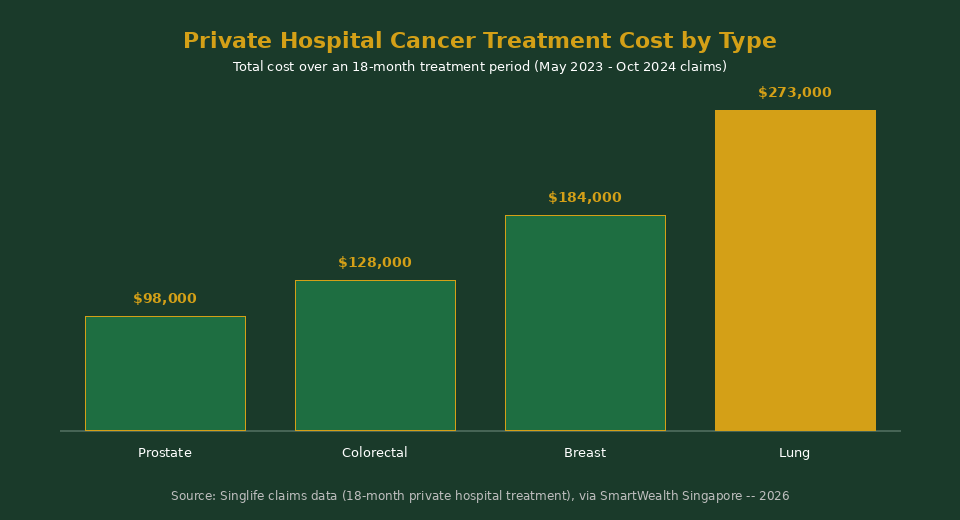
It varies significantly by cancer type. Claims data shows 18-month private hospital treatment costs averaging around S$98,000 for prostate cancer, S$128,000 for colorectal cancer, S$184,000 for breast cancer, and S$273,000 for lung cancer, with drug costs as the single biggest driver in every case.
Is S$100,000 in critical illness coverage enough in Singapore?
For most working adults, probably not on its own. S$100,000 sits below the real cost of treating several major cancers at a private hospital, and below the LIA’s 4x-income benchmark for anyone earning more than roughly S$25,000 a year. It can still be a reasonable starting point if budget is tight, topped up over time as your income grows.
Should I buy early critical illness insurance in addition to standard CI?
It depends on your budget and risk tolerance. Early CI (ECI) plans pay out at earlier disease stages, which can matter for conditions caught early, but they typically cost 1.5 to 2 times more than standard CI for the same sum assured. Whether the extra premium is worth it depends on your family history and how much cover you can realistically afford.
Not financial advice. Data verified as at 24 July 2026 against official MOH, DBS and Singlife-sourced figures and is subject to change — always verify current rates and plan terms before acting. The Kopi Notes may earn referral fees when you sign up using our codes.
Get Free Insurance Advice
Speak with a licensed insurance advisor. No obligation, no cost.
By submitting this form, you agree to our Privacy Policy.
This article was researched with the help of AI. While we strive to keep all information accurate and up to date, there may be errors. If you notice any discrepancies, please contact us.