How to Top Up Your CPF Ordinary Account in Singapore (2026): What You Can Actually Do
CPF Board’s own rule, the Voluntary Contribution workaround, and the little-known exception once you turn 55.
Short answer: you can’t top up your CPF Ordinary Account (OA) on its own. CPF Board’s own rules only allow voluntary cash top-ups to your Special/Retirement Account (SA/RA) or MediSave — never OA alone. But your OA still grows through mandatory contributions, a three-way Voluntary Contribution split, and one lesser-known rule that kicks in once you turn 55.
Not financial advice. All figures are for educational reference only. Data as at July 2026 unless noted.
- You cannot voluntarily top up CPF OA by itself — CPF Board explicitly disallows an “OA-only” top-up
- A Voluntary Contribution (VC) splits across OA, SA and MediSave using the 2026 allocation rate (e.g. 62.17% / 16.21% / 21.62% if you’re 35 or below) — but you get no tax relief on this route
- Once you’ve set aside the Full Retirement Sum in your Retirement Account after age 55, any further contributions flow straight into your OA instead — this is the closest thing to an “OA top-up” CPF actually allows
Free download: The Singapore Money Playbook — 7 money mindset shifts written for Singapore, with the CPF-adjusted retirement number most guides get wrong (PDF + Notion).
Table of Contents
Contents — Click to expand
- Can You Top Up CPF OA Directly?
- How Your OA Balance Actually Grows
- Voluntary Contribution (VC-3A): The Closest Thing to an OA Top-Up
- Topping Up OA After Age 55
- Other Ways Your OA Balance Grows
- “OA Top-Up” vs RSTU (SA/RA Top-Up): Which Should You Actually Do?
- How to Make a CPF Voluntary Contribution: Step-by-Step
- Frequently Asked Questions
Can You Top Up CPF OA Directly?
No. If you’ve searched “how to top up CPF Ordinary Account” hoping for a scheme like the Retirement Sum Topping-Up (RSTU) scheme, CPF Board has already answered this directly on their own site: you cannot make a voluntary cash top-up to your OA alone.
CPF only offers two voluntary top-up routes for cash contributions: the Retirement Sum Topping-Up Scheme, which goes into your Special Account (SA) if you’re below 55 or your Retirement Account (RA) if you’re 55 and above, and a MediSave-only top-up. Neither lets you choose OA as the destination.
That’s a deliberate policy choice, not an oversight. CPF’s SA and RA earn a much higher interest rate than OA (4.0% p.a. versus OA’s 2.5% p.a. base rate), and the entire point of a voluntary top-up scheme is to help you build retirement income — so CPF steers voluntary cash into the accounts that compound faster and can’t be withdrawn early. If you want that OA-earns-2.5% cash instead, CPF’s stance is that you should simply keep it as cash or invest it, not funnel it through a voluntary top-up mechanism.
How Your OA Balance Actually Grows
Even though you can’t cherry-pick OA for a voluntary top-up, your OA balance isn’t stuck. It grows through several channels that most people don’t think about as “topping up,” but that’s exactly what they do.
The biggest one is your monthly CPF contribution from employment. Every month, a slice of both your own contribution and your employer’s contribution gets allocated to OA, SA (or RA) and MediSave according to CPF’s official allocation rate — and that rate depends on your age, not your income.
CPF Allocation Rates 2026 (Verified Bands)
| Age Band | Share to OA | Share to SA / RA | Share to MediSave |
|---|---|---|---|
| 35 and below | 62.17% | 16.21% (SA) | 21.62% |
| 55 to 60 | 35.30% | 33.82% (RA) | 30.88% |
Source: CPF Board, “What are the CPF allocation rates?”, 2026. The split also changes at ages 45, 50, 60, 65 and 70 — use our CPF OA/SA/MA Allocation Calculator for your exact age band.
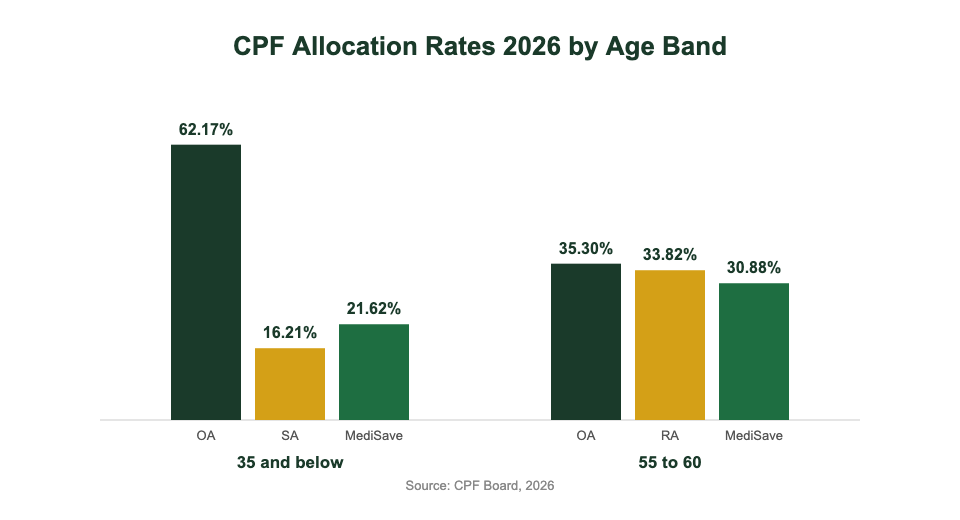
You’ll notice OA gets the largest share when you’re young (62.17% under 35) — that’s deliberate, so you have enough in OA for a home down payment or education loan. As you get older, more of each dollar shifts toward SA/RA and MediSave, because CPF assumes your retirement adequacy matters more than liquidity by then.
The other routes that grow OA specifically — Voluntary Contributions, the post-55 rule, and property refunds — are covered in the next three sections.
Voluntary Contribution (VC-3A): The Closest Thing to an OA Top-Up
If you want to voluntarily add cash to your CPF accounts and have some of it land in OA, the Voluntary Contribution scheme (sometimes called VC-3A, or VC-All 3 Accounts) is your only option. It’s different from RSTU: instead of choosing SA/RA specifically, VC-3A splits your top-up across OA, SA/RA and MediSave using the exact same allocation rate shown in the table above.
So if you’re 35 or younger and you make a $10,000 Voluntary Contribution, here’s what actually happens to your money:
Worked Example: $10,000 Voluntary Contribution (Age 35 and Below)
| Account | Allocation Rate | Amount Received |
|---|---|---|
| Ordinary Account (OA) | 62.17% | $6,217 |
| Special Account (SA) | 16.21% | $1,621 |
| MediSave (MA) | 21.62% | $2,162 |
Source: CPF Board allocation rate table, 2026. Figures rounded to the nearest dollar.
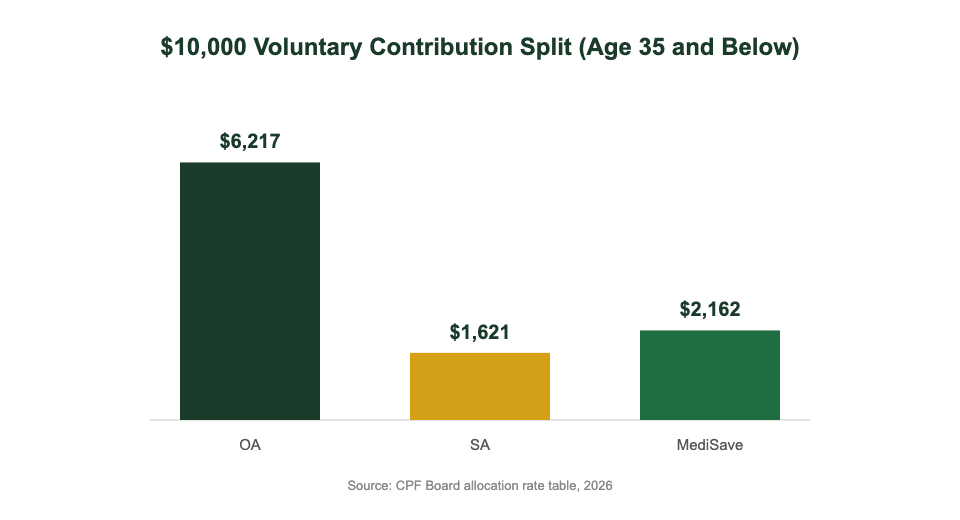
Two things to flag here. First, you can’t ask CPF to send the full $10,000 to OA — the split is automatic and non-negotiable. Second, and more importantly: Voluntary Contributions (VC-3A) don’t qualify for tax relief. Only RSTU top-ups to SA/RA (and voluntary MediSave-only top-ups) qualify for CPF Cash Top-up Relief of up to $8,000 for yourself per year, according to IRAS. If tax savings matter to you, doing a VC-3A purely to nudge some cash into OA is usually the wrong move — you’d be giving up the tax break for a comparatively small OA credit.
Topping Up OA After Age 55
This is the part most articles miss, and it’s the actual answer if you searched “can I top up my CPF Ordinary Account after 55.” Once you turn 55, your Special Account closes and a Retirement Account (RA) is created, initially filled from your SA and OA up to your cohort’s Full Retirement Sum (FRS) — $220,400 in 2026.
Here’s the exception: if you’ve already set aside the Full Retirement Sum in your RA, any further mandatory or voluntary contributions that would normally go to your RA get redirected to your OA instead. This is CPF Board’s own rule for members aged 55 and above. In practice, this means once your RA is “topped out” at the FRS, your OA effectively becomes the default landing spot for extra CPF money — no special application needed.
For a 55-to-60-year-old, remember the allocation rate is 35.30% OA / 33.82% RA / 30.88% MediSave. Once the RA slice hits the FRS ceiling, that 33.82% doesn’t just disappear — CPF redirects it to OA, effectively raising your OA’s share of each dollar. This is the one legitimate way your CPF contributions can end up weighted more heavily toward OA later in life, and it happens automatically once the FRS condition is met.
If you haven’t yet met your FRS and you’re 55+, you can also choose to top up your RA (not OA) via RSTU up to the Enhanced Retirement Sum of $440,800 in 2026 — but again, that’s SA/RA-bound money, not OA.
Other Ways Your OA Balance Grows
Beyond monthly contributions and the post-55 rule, a few other events can add money back into your OA specifically:
Property sale refunds. If you used CPF-OA savings to fund a home purchase and later sell that property, CPF requires you to refund the principal amount withdrawn plus the accrued interest you would have earned had the money stayed in OA. This refund goes back into your OA (and MediSave, if MediSave was used for the down payment) — it’s not new money, but it does restore your OA balance to what it “should” have been.
CPF Investment Scheme (CPFIS) proceeds. If you’ve invested part of your OA savings under CPFIS-OA and later sell those holdings, sale proceeds and dividends are credited back to your OA.
OA’s own interest. OA earns a base 2.5% p.a. (floor guaranteed by CPF Board), plus up to 1% extra interest on the first $60,000 of your combined CPF balances (capped at $20,000 from OA) if you’re below 55. That interest is credited annually and compounds — it’s a small but real form of “automatic top-up” every January.
“OA Top-Up” vs RSTU (SA/RA Top-Up): Which Should You Actually Do?
Since you can’t top up OA directly, the real decision is whether to do a Voluntary Contribution (which lands some money in OA) or an RSTU top-up (which goes entirely to SA/RA with tax relief). Here’s how they actually compare:
| Route | Where It Goes | Tax Relief? | Best For |
|---|---|---|---|
| Voluntary Contribution (VC-3A) | OA + SA/RA + MediSave (by allocation rate) | No | Self-employed members hitting the CPF Annual Limit, or those wanting a small OA/MediSave boost alongside SA |
| RSTU (Retirement Sum Topping-Up) | SA (below 55) or RA (55+) only | Yes — up to $8,000/yr (self) | Anyone prioritising tax savings and the higher 4.0% p.a. SA/RA rate |
| Voluntary MediSave (VC-MA) | MediSave only | Yes — shares the $8,000 cap | Self-employed members topping up MediSave for Medisave-cap compliance |
Source: CPF Board & IRAS CPF Cash Top-up Relief guidance, 2026. Tax relief cap of $8,000 for self top-ups is shared across RSTU and MediSave-only top-ups combined; a further $8,000 is available for top-ups made to a loved one’s account.
For most people reading this because they want more cash sitting in OA specifically — say, to prepare for a future home purchase — the honest advice is: don’t use a CPF top-up scheme at all. Keep that cash outside CPF (in a savings account, T-bills, or Singapore Savings Bonds) where you retain full flexibility, since none of CPF’s voluntary schemes let you land money in OA on demand anyway.
How to Make a CPF Voluntary Contribution: Step-by-Step
If you’ve decided a VC-3A (or RSTU, or VC-MA) makes sense for you, here’s how to actually make the payment in 2026:
Fastest method — CPF Mobile app: Open the CPF Mobile app, go to “My Requests” then select the relevant top-up scheme. Submit your application, and the app generates a PayNow QR code at the acknowledgement page. Scan it using your PayNow-participating bank app (DBS/POSB Digibank, UOB TMRW, OCBC Digital, and others all work) and the payment is typically processed and credited immediately.
Internet banking / GIRO: You can also set up a top-up directly through your bank’s CPF payment function if you’d rather not use the CPF Mobile app, though processing can take a few business days longer than PayNow.
What you’ll need: Your NRIC, the CPF account(s) of the recipient (yourself, a family member, or both), and confirmation of which scheme you’re using — Voluntary Contribution to all 3 accounts, RSTU (SA/RA), or MediSave-only. Choosing the wrong scheme on the form is the single most common mistake people make, since the CPF portal doesn’t let you switch after submission.
Before you submit anything, check your CPF Annual Limit headroom — the combined cap on mandatory plus voluntary contributions is $37,740 for 2026. If your employer’s contributions already used up most of that limit, a large voluntary top-up may simply be rejected or refunded.
Frequently Asked Questions
Can I top up my CPF Ordinary Account directly?
No. CPF Board does not offer a voluntary top-up scheme that lets you send cash to your Ordinary Account alone. Voluntary cash top-ups can only go to your Special/Retirement Account (via RSTU) or MediSave (via a MediSave-only top-up). The only way to add fresh cash that partly lands in OA is a Voluntary Contribution to all 3 accounts (VC-3A), which splits automatically by CPF’s allocation rate.
Can I top up my CPF Ordinary Account after 55?
You still can’t do a dedicated OA-only top-up after 55. But once you’ve set aside the Full Retirement Sum ($220,400 in 2026) in your Retirement Account, CPF automatically redirects further contributions that would have gone to your RA into your OA instead. This is the closest thing to an “OA top-up” that CPF allows for members 55 and above.
Is there tax relief for topping up my CPF Ordinary Account?
No. A Voluntary Contribution (VC-3A) that partly credits your OA does not qualify for CPF Cash Top-up Relief. Only RSTU top-ups to SA/RA and MediSave-only top-ups qualify, for up to $8,000 in tax relief per calendar year for topping up your own account (shared across both schemes), plus a further $8,000 for topping up a loved one’s account, according to IRAS.
What is a CPF Voluntary Contribution and how is it split?
A Voluntary Contribution (VC-3A) is a cash top-up that gets automatically divided across your Ordinary, Special/Retirement and MediSave Accounts using the same allocation rate applied to your monthly mandatory contributions. For example, if you’re 35 or below, a $10,000 VC-3A splits into roughly $6,217 to OA, $1,621 to SA and $2,162 to MediSave in 2026.
Can I transfer money from my Special Account to my Ordinary Account?
No, CPF transfers only flow one way — from OA to SA (or MediSave) voluntarily, never from SA back to OA. The only account movement in the opposite direction happens automatically at age 55, when excess RA savings above the Enhanced Retirement Sum can flow back to OA, or when the post-55 FRS-met rule redirects new contributions to OA.
What is the fastest way to make a CPF top-up?
The CPF Mobile app is the fastest method. Submit your top-up request in the app, then scan the PayNow QR code generated at the acknowledgement page using your bank’s app (DBS/POSB Digibank, UOB TMRW, OCBC Digital and others are supported). Payments made this way are typically processed and credited to your CPF account immediately.
What is the CPF Annual Limit for 2026?
The CPF Annual Limit for 2026 is $37,740 — this caps the total of your mandatory (employer + employee) and voluntary CPF contributions combined for the year. If your mandatory contributions already use up most of this limit, a large voluntary top-up (including a VC-3A meant to boost OA) may be capped or rejected.
Plan Your CPF Strategy With the Right Tools
See exactly how your contributions split by age, model your retirement sum, and check your top-up tax relief before you commit any cash.
This article was researched with the help of AI. While we strive to keep all information accurate and up to date, there may be errors. If you notice any discrepancies, please contact us.