Singapore Industrial REIT Tariff Exposure 2026: Which S-REITs Are Most at Risk?
A sector-by-sector look at Section 122, 232 and 301 tariffs — and what they mean for Mapletree Industrial Trust, AIMS APAC REIT, CapitaLand Ascendas REIT and Sabana REIT.
Singapore’s industrial S-REITs face uneven tariff exposure in 2026. The US Section 122 baseline tariff (10%) hits Singapore-made exports directly, and a proposed Section 301 replacement (about 12.5%) looms once Section 122 sunsets on 24 July 2026. Hi-tech and data-centre landlords like Mapletree Industrial Trust and CapitaLand Ascendas REIT look more insulated than general-industrial REITs whose SME tenants export directly to the US.
Not financial advice. All figures are for educational reference only. Data as at July 2026 unless otherwise noted.
- The 10% Section 122 tariff on Singapore exports expires 24 July 2026 — but a roughly 12.5% Section 301 replacement is already being drafted.
- S-REITs don’t pay these tariffs directly. The risk shows up indirectly, through tenant profitability, occupancy and rent renewals.
- Hi-tech and data-centre landlords (MIT, CLAR) look more resilient than SME-heavy general-industrial REITs (AIMS APAC, Sabana), because AI-driven demand is offsetting trade friction.
Table of Contents
Contents — Click to expand
What’s Changed: Section 122, 232 & 301 Tariffs Explained
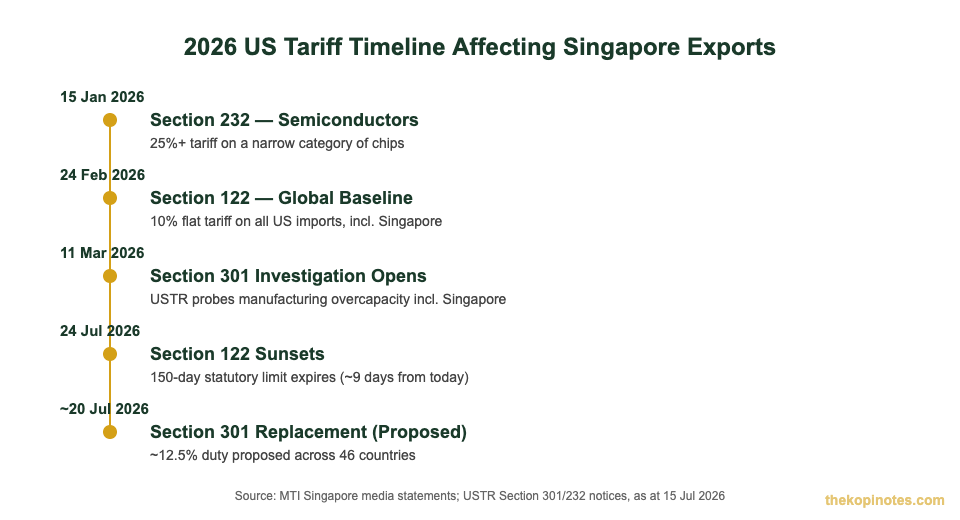
Three separate US tariff tracks now touch Singapore exports. First, Section 122 — a global emergency tariff — added a flat 10% duty on nearly all US imports, including goods from Singapore, from 24 February 2026. That is a national-security tariff track, so the US-Singapore Free Trade Agreement (USSFTA), which normally gives 0% duty on almost all goods, does not exempt it.
Second, Section 232 layered on a much steeper duty for a narrow category of semiconductors — 25% or higher — starting 15 January 2026. This is separate from Section 122 and targets chips specifically, not general manufactured goods.
Third, on 11 March 2026 the US Trade Representative (USTR) opened a Section 301 investigation into “structural excess capacity” in manufacturing, with Singapore named among the countries under review. Section 122 has a hard 150-day statutory limit, so it sunsets on 24 July 2026 — just over a week from today. The reported replacement: a roughly 12.5% Section 301 duty applied across a list of 46 countries, with USTR targeting completion around 20 July 2026.
Here’s why this matters for you as an S-REIT investor: Singapore’s industrial landlords don’t export anything themselves. But a meaningful slice of their tenants — electronics manufacturers, precision engineering firms, semiconductor packaging plants — do. If US-bound margins get squeezed, that pressure eventually shows up in how much rent those tenants can afford at renewal.
Why Industrial REITs Are More Exposed Than Retail or Office REITs
S-REITs don’t write a cheque to US Customs. They collect rent in Singapore dollars from tenants who lease their warehouses, factories and business parks. That’s an important distinction. The tariff risk to a REIT is always indirect — it flows through the tenant, not the landlord’s own balance sheet.
That’s exactly why the exposure differs so much by REIT sub-sector. Retail REIT tenants are F&B outlets, fashion retailers and supermarkets serving domestic shoppers. Office REIT tenants are banks, law firms and tech offices billing mostly in SGD. Neither group cares much what happens at the US border.
Industrial REIT tenants are different. Many are manufacturers, logistics operators and precision engineering firms whose customers sit overseas — some of them in the US. When a tenant’s export margin gets squeezed by a new tariff, the REIT doesn’t feel it immediately. Industrial leases in Singapore typically run 3 to 5 years, so today’s tariff headlines mostly affect tomorrow’s renewal negotiations, not this quarter’s distribution per unit (DPU) — the cash payout each REIT unit receives.
That lag is worth remembering. A REIT’s DPU can look perfectly healthy in the same quarter that its tenants are quietly renegotiating smaller floor plates or asking for rent-free periods at renewal. The real test for Singapore’s industrial S-REITs plays out over the 2026–2027 lease renewal cycle, not in this week’s headlines.
Tariff Exposure by Singapore Industrial REIT
Here’s how five of the largest Singapore-listed industrial and logistics REITs compare on tariff exposure, based on their publicly disclosed portfolio mix and tenant profile. This is a qualitative read, not a precise number — REITs don’t disclose what share of tenant revenue is US-export-linked, so treat the “why” column as the reasoning, not a guarantee.
| REIT | Ticker | Sub-Sector Focus | Tariff Exposure | Why |
|---|---|---|---|---|
| Mapletree Industrial Trust | ME8U | Data centres & hi-tech industrial (SG, US, Japan) | Low–Medium | AI/cloud-driven data centre demand structurally offsets trade friction; ~S$8.3B portfolio spans 3 markets |
| CapitaLand Ascendas REIT | A17U (CLAR) | Business parks, hi-tech, logistics, data centres | Low–Medium | Diversified across tech, logistics and life sciences tenants — not concentrated in export manufacturing |
| AIMS APAC REIT | O5RU | General industrial & logistics, SME tenants | Medium–High | ~7.8% yield reflects the risk premium; SME manufacturing tenants have thinner margins to absorb tariff cost pressure |
| Sabana REIT (Alpha Industrial REIT) | M1GU | General industrial, SME multi-tenant | Medium–High | Smaller, SME-heavy tenant base with less pricing power to absorb tariff-driven cost pressure |
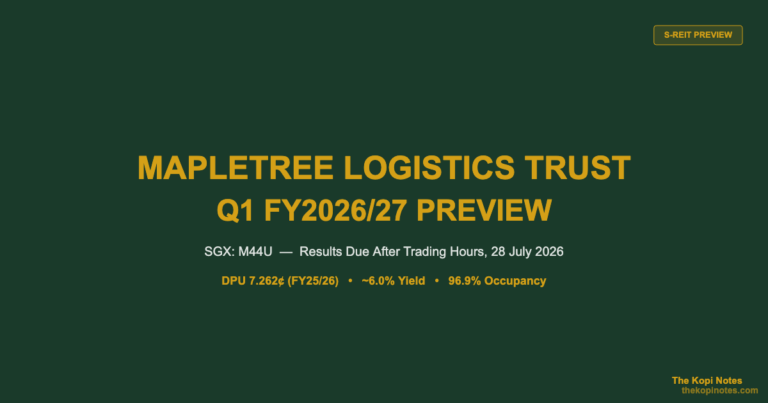
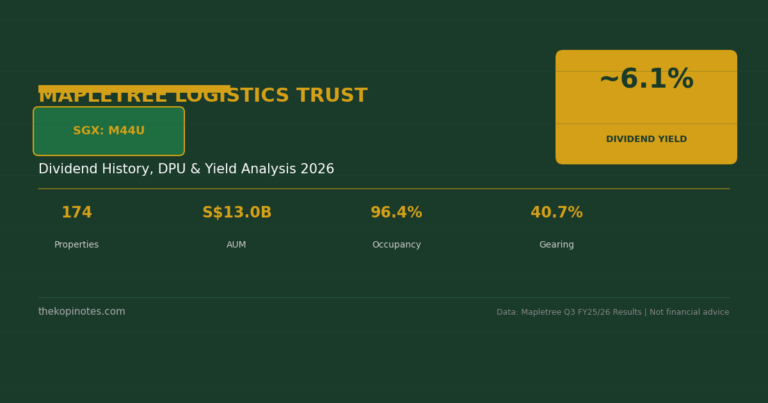
| Mapletree Logistics Trust | M44U (MLT) | Regional logistics & warehousing (Asia Pacific) | Low–Medium | Tenants are mostly 3PL and e-commerce operators serving intra-Asia trade flows, not direct US-bound exporters |
Source: REIT annual reports and portfolio disclosures (FY2025/FY2026); exposure ratings are The Kopi Notes’ qualitative assessment, not an official REIT disclosure. As at July 2026.
Notice the pattern: the REITs skewed toward data centres and hi-tech business parks — Mapletree Industrial Trust’s share price profile and CapitaLand Ascendas REIT — sit at the lower-risk end. That’s not a coincidence — see our Mapletree Industrial Trust price target analysis for the analyst view. Their fastest-growing tenant demand comes from AI compute and cloud infrastructure, a theme that has very little to do with trade policy. The more SME-heavy, general-industrial names — AIMS APAC REIT and Sabana REIT — carry the higher exposure, simply because their tenants have thinner margins and less room to absorb new costs.
What the Data Shows: Industrial Rents Are Still Rising
So has any of this actually hit the ground yet? Not much — at least not in the headline numbers. Cushman & Wakefield’s Q1 2026 Industrial MarketBeat report, cited alongside DBS Vickers’ S-REIT sector note, shows conventional factory rents rose 1.5% quarter-on-quarter, while high-tech and business park space rose a more modest 0.3% quarter-on-quarter.
Both numbers are positive. That tells you landlords haven’t yet seen material demand destruction from the tariff overhang. Cushman & Wakefield’s own outlook language backs this up: the manufacturing sector outlook is expected to remain largely resilient, driven by the electronics cluster — though it flags a more protectionist global landscape and higher tariffs as a dampener on external demand going forward.
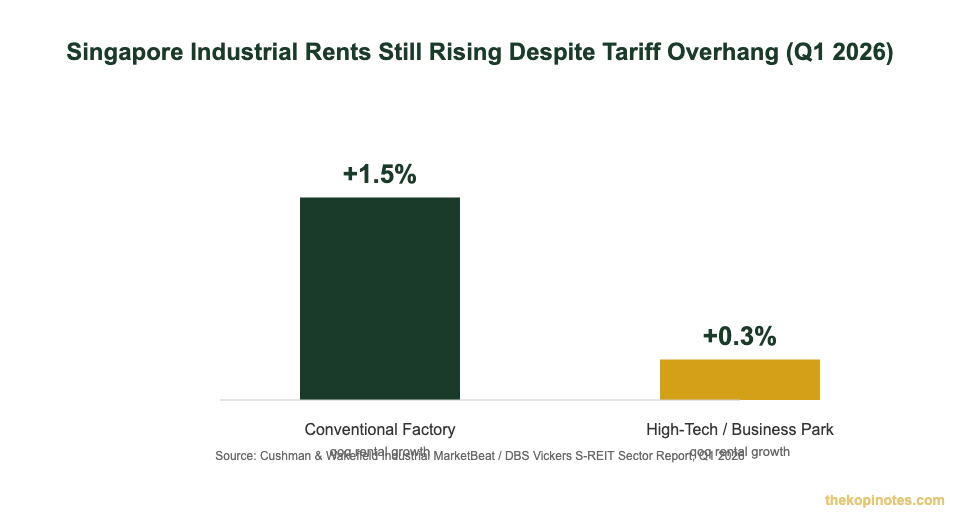
That said, rents are a lagging indicator. Most of the leases behind these numbers were signed before the tariff escalation fully played out in the first half of 2026. The real test comes at the next renewal wave — watch occupancy and rental reversion figures in each REIT’s second-half 2026 results, not the headline rent index.
What This Means for S-REIT Investors
First, don’t panic-sell an industrial REIT just because a tariff headline crosses your feed. The exposure here is indirect — it runs through tenant health, not a line item on the REIT’s own income statement. Singapore’s S-REITs have weathered multiple tariff scares since 2025 without a structural DPU collapse.
Second, watch the second-half 2026 reporting season closely. That’s when you’ll see whether occupancy or rental reversion is softening in the SME-heavy names — AIMS APAC REIT and Sabana REIT — compared with the hi-tech, data-centre-led names like Mapletree Industrial Trust and CapitaLand Ascendas REIT.
Third, diversify across REIT sub-sectors rather than betting on one theme. A portfolio spread across industrial, retail, office and healthcare S-REITs is far less exposed to a single tariff cycle than one concentrated purely in general-industrial names. Our best S-REITs in Singapore 2026 guide breaks down picks across every sub-sector.
Fourth, remember that Singapore’s data-centre demand story — driven by AI compute buildout — is bigger and longer-lasting than any single tariff cycle. That’s the structural tailwind behind MIT and CLAR’s lower-risk rating in the table above, and it’s worth reading alongside our earlier piece on Singapore REIT tariff impact across sectors for the fuller cross-sector picture.
Finally, if you’re building passive income around S-REIT dividends, run the numbers through our Singapore retirement calculator to see how a modest DPU dip in one sub-sector affects your overall portfolio yield — rather than reacting to any single REIT’s quarterly print in isolation.
Frequently Asked Questions
What is Singapore's industrial REIT tariff exposure in 2026?
It’s the indirect risk that Singapore-listed industrial S-REITs face when their manufacturing and logistics tenants are hit by US tariffs — specifically the 10% Section 122 baseline tariff, 25%+ Section 232 semiconductor duties, and a proposed ~12.5% Section 301 replacement. The REIT itself doesn’t pay these tariffs; the risk flows through tenant profitability and rent renewals.
Do S-REITs pay US tariffs directly?
No. S-REITs are landlords collecting Singapore-dollar rent — they don’t export goods to the US and don’t pay US import duties. The exposure is indirect: if a tenant’s export margins shrink because of tariffs, that tenant may struggle to afford the same rent at renewal, which can eventually show up in occupancy or rental reversion.
Is the Section 122 tariff going to disappear on 24 July 2026?
The 10% Section 122 tariff has a hard 150-day statutory limit and is due to sunset around 24 July 2026. However, the US Trade Representative has been preparing a replacement — a Section 301 duty of roughly 12.5% across a list of 46 countries — so Singapore exporters should not assume tariffs disappear entirely after that date.
Which Singapore industrial REIT is least exposed to US tariffs?
Based on portfolio composition, Mapletree Industrial Trust and CapitaLand Ascendas REIT look the least exposed. Both have significant data centre and hi-tech business park exposure, where tenant demand is driven mainly by AI and cloud computing growth rather than US-bound export manufacturing.
How do semiconductor tariffs affect Mapletree Industrial Trust?
Mapletree Industrial Trust leases space to some data centre and technology-related tenants, but its biggest growth driver is data centre demand tied to AI and cloud computing, not chip exports. The Section 232 semiconductor tariff (25%+ on a narrow chip category, from 15 January 2026) is more directly relevant to chip fabrication and packaging tenants elsewhere in the industrial REIT universe.
Does the US-Singapore Free Trade Agreement protect against these tariffs?
Not fully. The USSFTA gives 0% duty on almost all goods under the free trade agreement track, but Section 122, 232 and 301 tariffs are separate emergency and trade-remedy measures that sit outside the FTA framework. That means Singapore exports can face these tariffs even though the underlying FTA rate is still 0%.
Should I sell industrial REITs because of tariff risk?
Not on tariff headlines alone. The exposure is indirect and plays out gradually over lease renewal cycles, not overnight. A more useful approach is to diversify across REIT sub-sectors and watch each REIT’s occupancy and rental reversion figures in its second-half 2026 results before making any portfolio changes.
Where can I track Singapore's official position on US tariffs?
Singapore’s Ministry of Trade and Industry (MTI) publishes media statements and parliamentary replies on US tariff developments, including Section 122 and Section 301 updates, on its official newsroom page.
Build a Diversified S-REIT Portfolio
Spread your exposure across REIT sub-sectors and start investing through a low-cost platform.
This article was researched with the help of AI. While we strive to keep all information accurate and up to date, there may be errors. If you notice any discrepancies, please contact us.