Medisave Insurance in Singapore: The Complete 2026 Guide
A plain-English guide to which health insurance premiums your CPF Medisave account can pay for — and the annual limits that apply.
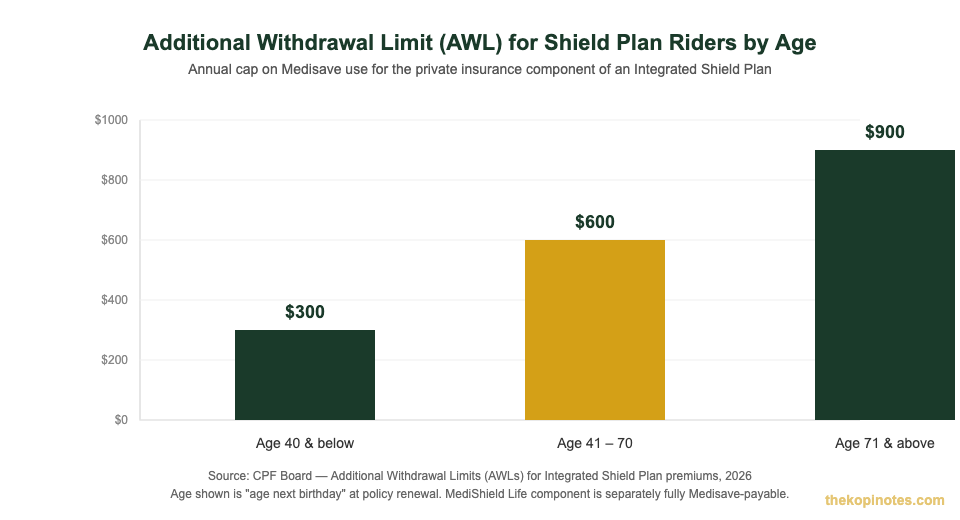
“Medisave insurance” refers to CPF Medisave-approved health insurance schemes — MediShield Life, Integrated Shield Plans (IPs), and CareShield Life — whose premiums you can pay from your Medisave savings. MediShield Life and CareShield Life are fully Medisave-payable. IP riders from private insurers are capped by an Additional Withdrawal Limit (AWL) of $300 to $900 a year, based on your age.
Not financial advice. All figures are for educational reference only. Data verified as at July 2026 unless otherwise noted.
- MediShield Life and CareShield Life premiums can usually be paid in full from Medisave — no cash needed.
- The private insurance part of your Integrated Shield Plan is capped: $300/year (40 and below), $600/year (41–70), or $900/year (71 and above).
- Anything above your limit comes out of your own pocket in cash — check your CPF healthcare dashboard before your policy renews.
Table of Contents
What Counts as “Medisave Insurance”?
Medisave is the healthcare savings component of your CPF account. Every working Singaporean sets aside part of their salary into it automatically. You can use these savings for hospital bills, selected outpatient treatments, and a specific list of insurance premiums that the Ministry of Health (MOH) has approved.
“Medisave insurance” isn’t one single product. It’s shorthand for three MOH-approved schemes that let you pay premiums straight from your Medisave account: MediShield Life, Integrated Shield Plans, and CareShield Life. You can’t use Medisave for a random life insurance policy, an investment-linked plan, or most private critical illness riders bought outside these schemes.
Here’s the quick version of what each one does. MediShield Life covers large hospital bills in public hospital B2 and C wards. An Integrated Shield Plan (IP) upgrades that coverage to A or B1 wards, or private hospitals, through a private insurer. CareShield Life pays you a monthly cash income for life if you become severely disabled. All three sit on top of your Medisave account, but each has different rules for how much of the premium Medisave will actually cover.
MOH reviews these rules periodically, and they do change — the April 2026 rider reforms mentioned later in this guide are a recent example. It’s worth re-checking the current rules every year or two, rather than assuming what applied when you first bought your policy still applies today.
How Each Scheme Uses Your Medisave
MediShield Life
MediShield Life is Singapore’s basic, government-run hospitalisation insurance. Every Singapore Citizen and Permanent Resident is automatically covered, including newborns and people with pre-existing conditions. You can pay your MediShield Life premium fully from Medisave — there’s no annual cap on this component, and no cash outlay is needed for most people, according to the CPF Board.
Premiums rise with age and are reduced by Government subsidies for lower- and middle-income households. As an example, the CPF Board’s own worked illustration shows a person turning 41 facing a base premium of $525 a year before subsidies, while someone turning 70 pays around $1,100 a year before subsidies. Subsidies of 30% or more can cut this substantially for eligible households.
Integrated Shield Plans (IPs)
An Integrated Shield Plan combines your MediShield Life cover with a private insurer’s additional plan, so you can claim for A or B1 ward stays in a public hospital, or treatment in a private hospital. The MediShield Life portion of your IP premium is still fully Medisave-payable. It’s the extra private insurance portion — often bought together with a “rider” — that faces a separate annual cap called the Additional Withdrawal Limit (AWL).
From 1 April 2026, MOH also changed the rules for new IP riders: they can no longer cover your policy’s minimum deductible, and the co-payment cap rose to at least $6,000 a year. This was designed to slow rider premium increases, which had been climbing by an average of 17% a year industry-wide. For a full breakdown by insurer, see our Integrated Shield Plan comparison.
CareShield Life
CareShield Life is a long-term care insurance scheme that pays a monthly cash income for life if you’re assessed as severely disabled — unable to perform 3 or more of 6 basic daily activities like washing or feeding yourself. If you were born in 1980 or later, you’re automatically enrolled once you turn 30. Premiums are fully payable from Medisave, and nobody loses coverage just because they can’t afford to pay — Government subsidies and Additional Premium Support exist for that.
Premiums rise gradually every year until age 67, when they stop (you stay covered for life). Government subsidies of up to 30% apply for lower-income Singapore Citizens, and Participation Incentives worth up to $4,000 over 10 years are available for citizens born in 1979 or earlier who joined by end-2024.
ElderShield (Legacy Scheme)
ElderShield was Singapore’s original long-term care insurance scheme, launched in 2002 and closed to new sign-ups once CareShield Life took over. If you’re still covered under ElderShield 300 or ElderShield 400 and haven’t switched, your premiums remain fully Medisave-payable, just like CareShield Life. Many older policyholders were automatically moved to CareShield Life in phases, but some chose to remain on ElderShield or top it up with a private supplement instead.
If you’re unsure which scheme currently covers you, your CPF Healthcare Dashboard shows whether you’re under ElderShield, CareShield Life, or both. It’s worth checking, since CareShield Life generally offers higher, inflation-adjusted payouts for younger cohorts.
Medisave Withdrawal Limits Explained
The Additional Withdrawal Limit (AWL) only applies to the private insurance portion of your Integrated Shield Plan — not to MediShield Life or CareShield Life, both of which are fully Medisave-payable. The AWL exists so Medisave isn’t drawn down too quickly by higher-tier private coverage, leaving less for your healthcare needs later in retirement.
| Age Next Birthday | Additional Withdrawal Limit (AWL) | Applies To |
|---|---|---|
| 40 and below | $300 / year | Private insurance component of your IP |
| 41 – 70 | $600 / year | Private insurance component of your IP |
| 71 and above | $900 / year | Private insurance component of your IP |
Source: CPF Board, “What are Additional Withdrawal Limits (AWLs) for Integrated Shield Plan (IP) premiums?”, accessed July 2026.
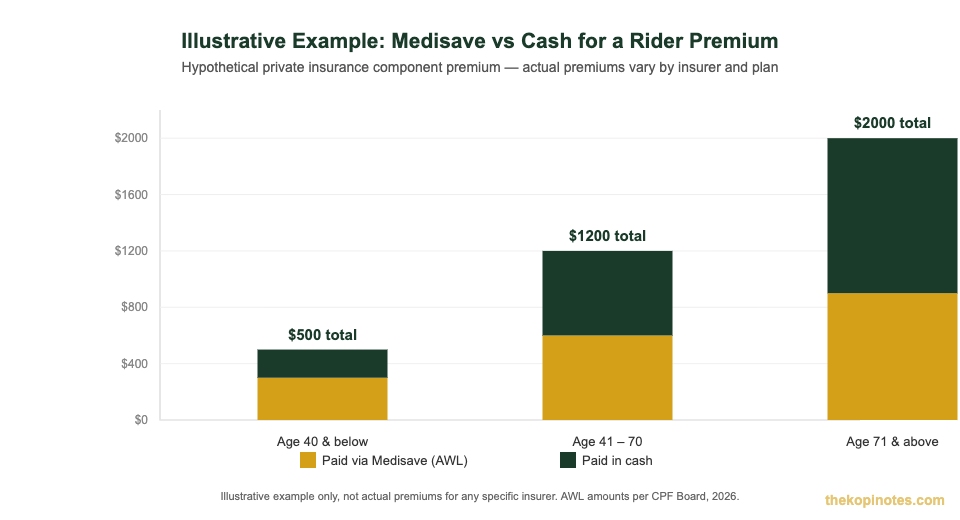
Here’s how it plays out in practice. Say your IP’s private insurance component costs $900 a year and you’re 55 years old, in the 41–70 AWL band. Medisave can cover $600 of that. Your insurer collects the remaining $300 from you in cash — it’s not optional, and it’s usually deducted automatically alongside the Medisave portion at renewal.
If you’re not sure how much of your own premium falls into each bucket, your insurer’s renewal notice normally itemises it. You can also check the “Coverage and premium details” section of your CPF Healthcare Dashboard before your policy renews.
Medisave Insurance Schemes Compared
The three schemes look similar because they all touch your Medisave account, but they cover different things and follow different withdrawal rules. Here’s a side-by-side view.
| Feature | MediShield Life | Integrated Shield Plan (IP) | CareShield Life |
|---|---|---|---|
| What it covers | Public hospital B2/C ward bills | Private hospital or A/B1 ward bills | Monthly cash payout for severe disability |
| Administered by | CPF Board / MOH | Private insurers (AIA, Great Eastern, Prudential, Singlife, NTUC Income) | CPF Board / MOH |
| Who’s covered | All Citizens & PRs, automatic | Optional upgrade, must apply | Automatic at 30 if born 1980+; optional if born 1979 or earlier |
| Medisave payment | Fully payable, no cap | MediShield Life portion: fully payable. Private component: capped by AWL | Fully payable, no cap |
| Annual Medisave limit | None | $300 – $900/year (AWL, private component only) | None |
| Can you opt out? | No — compulsory | Yes — IP itself is optional | Optional only if born 1979 or earlier |
| Government subsidies | Yes, income-tested, up to ~60% | No, for the private component; MediShield Life portion gets standard subsidy | Yes, up to 30% (Citizens), 15% (PRs) |
Source: CPF Board and Ministry of Health — MediShield Life, CareShield Life and Integrated Shield Plan scheme pages, accessed July 2026.
The comparison above only tells half the story, though — how much you should actually pay for private coverage depends heavily on which insurer and ward class you pick. It’s also worth understanding the difference between MediShield Life and CareShield Life, since people often confuse the two. One insures your hospital bills. The other insures against losing the ability to care for yourself.
One practical lever many policyholders overlook: choosing a lower ward class. Downgrading from an A ward or private hospital plan to a B1 ward plan typically lowers your private component premium, which narrows the gap between what you owe and your AWL. It’s worth revisiting this trade-off every few years, especially once your premiums start climbing past your comfortable AWL band.
A Worked Example: Calculating Your Out-of-Pocket Cost
Let’s walk through a realistic scenario. Suppose you’re 52 years old (age next birthday, so you fall in the 41–70 AWL band) and your Integrated Shield Plan’s private insurance component costs $1,400 a year. This sits on top of your MediShield Life premium, which is separately and fully payable from Medisave.
Your AWL at this age is $600. Medisave can cover $600 of the $1,400 private component. The remaining $800 has to come from your own pocket, either in cash or through a family member’s Medisave top-up made ahead of renewal. Add in a MediShield Life premium of, say, $700 a year before subsidies, paid in full from Medisave, and your total Medisave outflow for the year is $1,300 — with a cash outflow of $800.
Now compare that to someone who is 35 years old with the same $1,400 private component premium. Their AWL is only $300, so they’d need to find $1,100 in cash — a much bigger gap. This is one reason younger policyholders often choose a lower ward class rider, or accept a higher deductible, to keep their private component premium closer to their AWL.
Note: Premium figures in this example are illustrative and do not represent any specific insurer’s actual rates. AWL amounts are official CPF Board figures as at July 2026.
What to Do If Your Premium Exceeds the Limit
If your IP rider premium is higher than your AWL, you’ll need to pay the difference in cash every year at renewal. That’s manageable for most people in their 30s and 40s, but it can catch older policyholders off guard once premiums climb well past the $900 cap.
Here are a few practical steps. First, check your Medisave withdrawal limit for 2026 before your renewal date, so the cash portion isn’t a surprise. Second, if your Medisave balance itself is running low, you or a family member can top up your Medisave account ahead of time — cash top-ups also come with CPF tax relief within limits. Third, if your private component premium keeps rising faster than you’re comfortable with, ask your insurer or a financial adviser about a lower ward class rider, or a plan with a higher deductible that you self-fund.
Finally, remember family support is allowed. Your spouse, children, or parents can use their own Medisave savings to help pay your MediShield Life, IP, or CareShield Life premiums, subject to the same AWL rules for the IP private component. This is arranged through CPF’s “change of payer” service, and it can meaningfully help if one family member has a larger Medisave balance than another.
If you’re a senior with a thinner Medisave balance, it’s also worth checking whether you qualify for CPF’s Matching Grant for MediSave. It tops up part of your own cash contributions for eligible lower-income seniors, on top of any premium subsidy you already receive. Combined with family support, this can meaningfully close the gap between your AWL and your actual premium.
Frequently Asked Questions
What is Medisave insurance in Singapore?
“Medisave insurance” refers to the CPF Medisave-approved health insurance schemes you can pay for with your Medisave savings: MediShield Life, Integrated Shield Plans, and CareShield Life. It isn’t a specific product you buy — it describes which schemes qualify for Medisave payment.
Can I use Medisave to pay my Integrated Shield Plan premium in full?
You can pay the MediShield Life portion of your IP premium fully from Medisave. The additional private insurance portion is capped by the Additional Withdrawal Limit ($300–$900 a year depending on your age), so any amount above that cap needs to be paid in cash.
What is the Additional Withdrawal Limit (AWL) for Shield Plan riders?
The AWL is $300 a year if you’re 40 or younger (age next birthday), $600 a year if you’re 41 to 70, and $900 a year if you’re 71 or older. It applies only to the private insurance component of an Integrated Shield Plan, according to the CPF Board.
Is CareShield Life compulsory, and can I pay for it using Medisave?
CareShield Life is compulsory for Singapore Citizens and PRs born in 1980 or later, who are automatically covered from age 30. It’s optional for those born in 1979 or earlier. Premiums for CareShield Life are fully payable from Medisave, with no annual cap.
Can I use my Medisave to pay for my parents' or spouse's insurance premiums?
Yes. Family members can use their own Medisave savings to help pay your MediShield Life, Integrated Shield Plan, or CareShield Life premiums. You can arrange this through CPF’s change of payer service, and the same withdrawal limits still apply to the private insurance component of an IP.
What happens if I don't have enough Medisave to pay my premiums?
You won’t lose your MediShield Life or CareShield Life coverage simply because you can’t afford the premium — Government subsidies and Additional Premium Support exist for genuinely lower-income households. For Integrated Shield Plans, any shortfall beyond your Medisave balance or AWL needs to be paid in cash, or you can ask your insurer about adjusting your coverage. IRAS can also take enforcement action for unpaid MediShield Life premiums if you have the means but simply choose not to pay, so it’s better to arrange a subsidy review early than to fall into arrears.
What's the difference between ElderShield and CareShield Life?
ElderShield was the original long-term care scheme, closed to new sign-ups once CareShield Life launched. If you’re still on ElderShield 300 or 400, your premiums remain fully Medisave-payable. CareShield Life generally offers higher, inflation-adjusted payouts, which is why most younger cohorts were automatically transitioned or enrolled into it instead of ElderShield.
Planning Ahead for Your Healthcare Costs?
Knowing what Medisave can and can’t cover is one part of a bigger retirement and healthcare funding plan. Not financial advice — figures above are for educational reference only.
Get Free Insurance Advice
Speak with a licensed insurance advisor. No obligation, no cost.
By submitting this form, you agree to our Privacy Policy.
This article was researched with the help of AI. While we strive to keep all information accurate and up to date, there may be errors. If you notice any discrepancies, please contact us.