MediSave Dental Claim Singapore: What’s Covered in 2026 (Complete Guide)
- What Counts as a “MediSave Dental Claim”?
- What’s Covered vs What’s Not (At a Glance)
- How Much Can You Claim for Surgical Dental Procedures?
- Flexi-MediSave: The Mid-2026 Dental Benefit for Seniors
- CHAS Dental Subsidies (Updated October 2025)
- Worked Example: Stacking CHAS + Flexi-MediSave
- How to Make a MediSave Dental Claim
- Does Your Integrated Shield Plan Cover Dental?
- Frequently Asked Questions
MediSave dental claims in Singapore are narrow: only surgical procedures classified under MOH’s Table of Surgical Procedures qualify, such as impacted wisdom tooth removal or medically necessary implants. Routine treatments like fillings, cleanings and standard root canals aren’t claimable — except for seniors 60 and above, who can now use Flexi-MediSave for crowns and root canals from mid-2026. Here’s exactly what’s covered.
Not financial or medical advice. All figures are for educational reference only. Data verified as at 13 July 2026. Source: CPF Board, Ministry of Health Singapore.
- MediSave only covers surgical dental procedures under TOSP — think impacted wisdom teeth, not fillings or cleanings
- From mid-2026, seniors 60+ can claim up to $400/year via Flexi-MediSave for root canals and crowns
- CHAS cardholders of any age get separate subsidies — up to $625 off a permanent crown for Pioneer Generation members
What Counts as a “MediSave Dental Claim”?
MediSave is Singapore’s national medical savings scheme, funded by a slice of your monthly CPF contributions. You can use it for hospital bills, day surgeries, and a defined list of outpatient treatments.
Dental care sits in a narrow corner of that list. The Ministry of Health classifies all surgical procedures — dental included — under the Table of Surgical Procedures, or TOSP. If your treatment has a TOSP code, MediSave can help pay for it. If not, it can’t.
To qualify, three things must be true. The treatment must be done at an accredited institution — a licensed dental clinic, polyclinic, or hospital. It must be classified as surgical under TOSP. And you must be a Singapore Citizen or Permanent Resident.
Who Can You Claim For?
You don’t need to rely only on your own MediSave. You can also use a close family member’s account — your spouse, children, parents, parents-in-law, grandparents, grandparents-in-law, or siblings — as long as they’re Singapore Citizens or PRs too.
For the full picture of how your MediSave account works, including contribution rates and the annual savings cap, see our complete MediSave Singapore guide.
MediSave Dental Claim: What’s Covered vs What’s Not
Here’s the fastest way to check if your treatment qualifies. This table covers the most common dental procedures in Singapore and how each one is funded.
| Procedure | Standard MediSave | Flexi-MediSave (60+) | CHAS Subsidy |
|---|---|---|---|
| Surgical wisdom tooth extraction (impacted) | Yes | — | — |
| Dental implant (medically necessary) | Yes, if TOSP-classified | — | — |
| Apicoectomy (surgical root canal) | Yes | — | — |
| Gum / periodontal surgery | Yes, if TOSP-classified | — | — |
| Simple (non-surgical) extraction | No | No | Yes |
| Root canal treatment | No | Yes, up to $400/yr | Yes |
| Permanent crown | No | Yes, up to $400/yr | Yes |
| Fillings | No | No | Yes |
| Scaling & polishing | No | No | Yes |
| Dentures | No | No | Yes |
| Braces, veneers, whitening (cosmetic) | No | No | No |
Source: CPF Board & Ministry of Health Singapore, 2026.
The pattern is simple. Standard MediSave only pays for surgery. Flexi-MediSave, from mid-2026, adds two specific non-surgical procedures for seniors. CHAS subsidises a much wider list, but it’s a direct subsidy rather than a MediSave withdrawal, so it applies regardless of your age.
Need surgical wisdom tooth removal? Our wisdom tooth extraction MediSave claims guide breaks down the exact TOSP withdrawal amounts. Weighing up a root canal? Our root canal MediSave claim guide walks through the CHAS and Flexi-MediSave numbers step by step.
How Much Can You Claim for Surgical Dental Procedures?
When a dental procedure does qualify as surgical, how much you can claim depends on its complexity. CPF Board sorts every surgical procedure into Tables 1 through 7, with sub-categories A, B and C for increasing complexity. Table 1A is the simplest case in the whole MediSave system; Table 7C covers the most complex.
Most dental surgery — impacted wisdom teeth, surgical extractions, and straightforward implant placements — falls between Table 1 and Table 4.
| TOSP Table | A | B | C |
|---|---|---|---|
| Table 1 | $240 | $420 | $490 |
| Table 2 | $760 | $1,120 | $1,120 |
| Table 3 | $1,390 | $1,740 | $1,920 |
| Table 4 | $2,380 | $2,440 | $2,540 |
Source: CPF Board, MediSave Withdrawal Limits, effective 1 April 2025.
These limits cover the combined surgeon, anaesthetist and facility fees for the operation itself. If your procedure happens in a hospital as day surgery or an inpatient stay, you can claim ward charges separately — up to $830 a day for day surgery, or $1,130 a day for your first two days in an approved hospital, then $400 a day after that.
Your dentist or oral surgeon will tell you which table your case falls under before the procedure, so you know roughly what to expect out of pocket. For the exact figure on your specific case, use the MediSave and MediShield Life claims calculator on cpf.gov.sg.
Flexi-MediSave: The Mid-2026 Dental Benefit for Seniors
Flexi-MediSave is a separate, more flexible scheme for older Singaporeans. Unlike standard MediSave, it doesn’t require your treatment to be surgical.
The scheme has grown over time. It started in 2019 with a $200 annual limit. That rose to $300 in June 2021, then to $400 from 1 October 2025 — the level it remains at today.
From mid-2026, MOH added a major new use case: two restorative dental procedures. If you’re 60 or older, you can now tap up to $400 a year — combined across both procedures — for root canal treatment and permanent crowns.
| Condition | Requirement |
|---|---|
| Age | 60 and above (you or your spouse, if also 60+) |
| Clinic | CHAS-accredited dental clinics or public healthcare institutions |
| Procedures covered | Root canal treatment, permanent crowns |
| Annual limit | Up to $400/year, combined for both procedures |
| Effective from | Mid-2026 |
Source: Ministry of Health Singapore, Press Release, 1 September 2025; CPF Board.
This is separate from, and doesn’t reduce, your standard MediSave withdrawal limits for surgical dental work. You can use both in the same year — for example, wisdom tooth surgery under standard MediSave and a root canal under Flexi-MediSave.
Not every clinic is onboarded yet. MOH is requiring all CHAS dental clinics to sign up to Flexi-MediSave by 31 December 2026, so coverage will keep expanding through the year. For everything else Flexi-MediSave can pay for beyond dental, see our Flexi-MediSave Singapore guide.
CHAS Dental Subsidies (Updated October 2025)
CHAS — the Community Health Assist Scheme — is separate again from MediSave. It’s a direct subsidy, not a CPF withdrawal, so it applies whether you’re 25 or 75. If you hold a CHAS Orange, CHAS Blue, Merdeka Generation (MG), or Pioneer Generation (PG) card, you qualify.
Subsidies were significantly enhanced from 1 October 2025. Basic and preventive procedures were extended to CHAS Orange cardholders for the first time, and restorative procedure subsidies rose across the board.
| Procedure | Pioneer Gen | Merdeka Gen | CHAS Blue | CHAS Orange |
|---|---|---|---|---|
| Extraction (Anterior) | $38.50 | $33.50 | $28.50 | $19.00 |
| Extraction (Posterior) | $78.50 | $73.50 | $68.50 | $45.50 |
| Filling (Simple) | $40.00 | $35.00 | $30.00 | $20.00 |
| Filling (Complex) | $60.00 | $55.00 | $50.00 | $33.50 |
| Permanent Crown | $625.00 | $620.00 | $615.00 | $410.00 |
| Root Canal (Anterior) | $336.00 | $331.00 | $326.00 | $217.50 |
| Root Canal (Molar) | $594.50 | $589.50 | $584.50 | $389.50 |
| Denture, Complete | $418.50 | $413.50 | $408.50 | $272.50 |
Source: Ministry of Health Singapore, Enhanced CHAS Dental Subsidy Caps, Annex A, 1 October 2025.
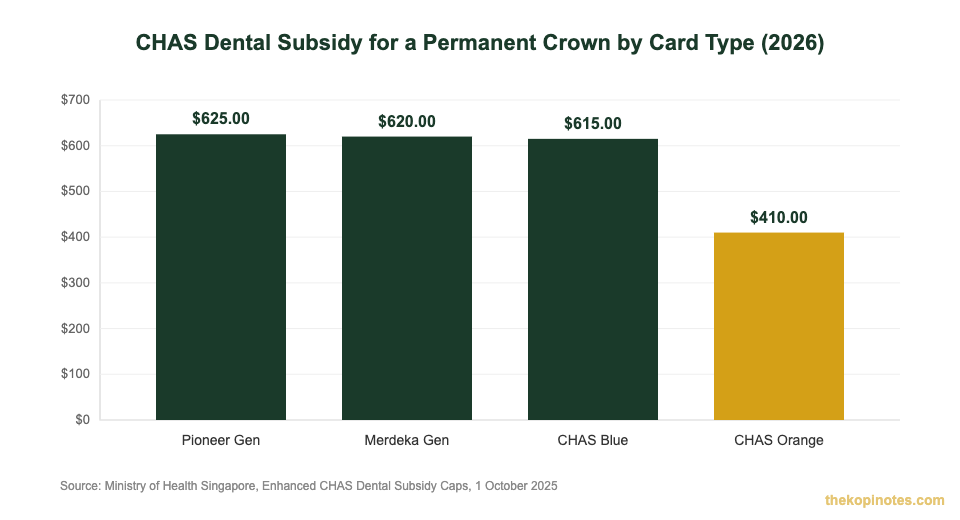
These are maximum subsidy caps — your actual subsidy depends on what your clinic charges. To help you compare, MOH also published dental fee benchmarks for 18 common procedures, covering typical charges in private clinics.
| Procedure | Lower Bound | Upper Bound |
|---|---|---|
| Extraction (Anterior) | $70 | $120 |
| Filling (Simple) | $65 | $160 |
| Permanent Crown | $750 | $1,400 |
| Root Canal (Molar) | $872 | $1,400 |
| Denture, Complete | $500 | $818 |
Source: Dental Fee Benchmarking Advisory Committee, Ministry of Health Singapore, September 2025.
From 1 October 2025, CHAS clinics must display these benchmarks next to their price lists, so you can walk in already knowing the ballpark before you commit to treatment.
Worked Example: Stacking CHAS + Flexi-MediSave
Let’s put the numbers together. Say you’re a Pioneer Generation cardholder, aged 60 or above, and you need a permanent crown. The MOH benchmark for a typical case is $750 to $1,400 — a midpoint of about $1,075.
First, your CHAS Pioneer Generation subsidy applies: up to $625 off. That brings your bill down to roughly $450.
Then, because you’re 60 or older, Flexi-MediSave can offset up to $400 more from your remaining balance — leaving you with around $50 out of pocket.
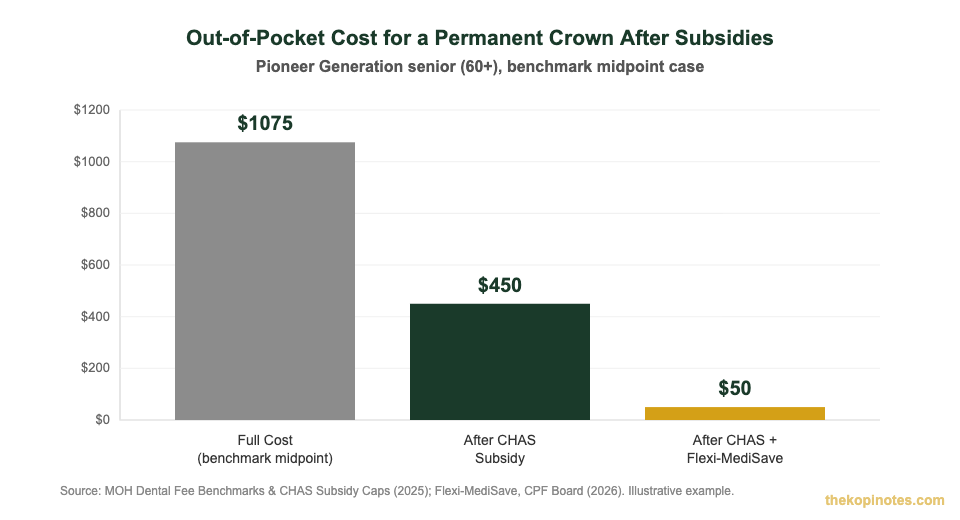
That’s a real drop — from over a thousand dollars to about $50 — just by using subsidies you’re already entitled to. The order matters: CHAS is applied first, then Flexi-MediSave covers what’s left.
How to Make a MediSave Dental Claim
Good news: you don’t handle any paperwork yourself. Here’s how it works in practice.
- Ask upfront: Before your appointment, tell the clinic you want to use MediSave or Flexi-MediSave. Bring your NRIC.
- Get it confirmed: For surgical claims, the dentist checks whether your case has a TOSP code and gives you the likely claim amount. For Flexi-MediSave, confirm the clinic is CHAS-accredited and onboarded to the scheme.
- Treatment happens: Your procedure goes ahead as planned.
- Clinic submits the claim: The clinic files the claim electronically with CPF Board on your behalf.
- You pay the balance: Any amount above the MediSave, Flexi-MediSave or CHAS offset is paid in cash or by card.
- Track it: Claims are usually processed within a few days. Check status on cpf.gov.sg or the CPF mobile app.
Using a family member’s MediSave works the same way — just bring their NRIC and their consent, and the clinic handles the rest.
Curious how your MediSave balance and the annual Basic Healthcare Sum affect what you can claim? See our MediSave withdrawal limits and caps 2026 guide.
Does Your Integrated Shield Plan Cover Dental?
Short answer: generally no. Integrated Shield Plans (ISPs) extend MediShield Life to cover hospital bills — inpatient stays, day surgeries, and certain outpatient specialist treatments. Routine dental care, done at a dental clinic, falls outside that scope almost entirely.
There’s one exception. If a dental problem turns into a medical emergency — say, an infection that spreads and requires hospital admission for IV antibiotics or surgery — the resulting hospital bill may be covered by your ISP. The dental procedure itself still isn’t.
Where your ISP does matter is hospital-based surgical dental cases, like a wisdom tooth removed under general anaesthesia in a hospital setting. That’s a hospitalisation, and your ISP can help with the bill above your deductible.
Not sure which plan fits your situation? Our MediSave account guide breaks down how your healthcare savings and shield plan coverage work together.
Frequently Asked Questions
Can I use MediSave for dental treatment in Singapore?
Only for surgical procedures classified under MOH’s Table of Surgical Procedures (TOSP) — such as impacted wisdom tooth removal or medically necessary implants. Routine treatments like fillings and cleanings are not claimable under standard MediSave.
What dental procedures are MediSave claimable?
Surgical extractions of impacted teeth, medically necessary dental implants, apicoectomy (surgical root canal), and other procedures classified under TOSP. Claim limits range from $420 to $2,440 or more depending on complexity, based on CPF Board’s MediSave Withdrawal Limits effective 1 April 2025.
Can seniors use MediSave for root canals and crowns?
Yes. From mid-2026, Singaporeans aged 60 and above can use Flexi-MediSave to offset up to $400 a year, combined, for root canal treatment and permanent crowns at CHAS-accredited clinics and public healthcare institutions.
Does CHAS help with dental costs if I'm not 60?
Yes. CHAS subsidies apply to Orange, Blue, Merdeka Generation and Pioneer Generation cardholders, covering procedures from extractions and fillings to crowns and dentures. Age eligibility depends on your specific CHAS card tier, not the Flexi-MediSave 60+ rule.
How much can I claim for wisdom tooth surgery?
Between $420 and $2,440 per session under standard MediSave, depending on TOSP complexity (Table 1B to Table 4B). The exact amount depends on how your oral surgeon classifies your case.
Does my Integrated Shield Plan cover dental treatment?
Generally no. ISPs cover hospital-based care — inpatient stays and day surgeries. Standalone dental clinic procedures are excluded, except when a dental emergency leads to hospital admission.
Can I use a family member's MediSave for my dental treatment?
Yes. You can use your spouse’s, children’s, parents’, parents-in-law’s, grandparents’, or siblings’ MediSave, provided they are Singapore Citizens or Permanent Residents and consent to the claim. Inform the clinic upfront and bring their NRIC.
This article is for general informational purposes only and does not constitute medical or financial advice. MediSave, Flexi-MediSave and CHAS subsidy eligibility and limits are subject to MOH and CPF Board guidelines, which may change. Always confirm with your healthcare provider and check cpf.gov.sg for the latest figures. TKN may earn referral fees from partner links on this site.
Data verified as at 13 July 2026 | Source: CPF Board, Ministry of Health Singapore
Get Free Insurance Advice
Speak with a licensed insurance advisor. No obligation, no cost.
By submitting this form, you agree to our Privacy Policy.
This article was researched with the help of AI. While we strive to keep all information accurate and up to date, there may be errors. If you notice any discrepancies, please contact us.