MediSave Contribution Singapore (2026): Rates, Calculation & How to Top Up
Your MediSave contribution is the portion of your CPF that flows into the MediSave Account (MA) — a dedicated healthcare savings account. Every Singapore employee automatically contributes between 8% and 10.5% of gross salary to MediSave each month, depending on age. Self-employed persons must contribute too if their net trade income exceeds S$6,000 per year. In 2026, MediSave earns 4% per annum interest and is capped at S$79,000.
Not financial advice. All figures are for educational reference only. Data verified as at July 2026 from CPF Board and MOH official sources.
- Employees contribute 8%–10.5% of gross salary to MediSave monthly — automatically via CPF.
- Self-employed persons contribute 8%–9.5% of Net Trade Income per year if NTI exceeds S$6,000.
- MediSave earns 4% p.a. interest (guaranteed until Dec 2026) and is capped at the BHS of S$79,000.
Table of Contents
- What Is a MediSave Contribution?
- Employee MediSave Contribution Rates by Age (2026)
- Self-Employed MediSave Contribution Rates (2026)
- The MediSave Cap: Basic Healthcare Sum (BHS)
- How to Make a Voluntary MediSave Top-Up
- What Can You Use MediSave For?
- MediSave and Your Integrated Shield Plan
- Frequently Asked Questions
What Is a MediSave Contribution?
When you receive your CPF contributions each month, the money doesn’t go into one pot. It’s split across three accounts: the Ordinary Account (OA), Special Account (SA), and MediSave Account (MA). The MediSave contribution is simply the MA’s share.
Think of MediSave as Singapore’s compulsory healthcare savings. It’s separate from your regular CPF savings and can only be used for approved healthcare expenses — hospitalisation, insurance premiums, and specific outpatient treatments.
Every employed Singaporean and Permanent Resident contributes to MediSave automatically. You don’t have to do anything — it’s deducted alongside the rest of your CPF. But knowing how much flows in (and how to optimise it) is worth understanding.
The MediSave Account earns a minimum of 4% per annum interest — the same floor rate as the Special and Retirement Accounts. The Singapore Government confirmed this floor rate is extended until 31 December 2026, regardless of market conditions.
Employee MediSave Contribution Rates by Age (2026)
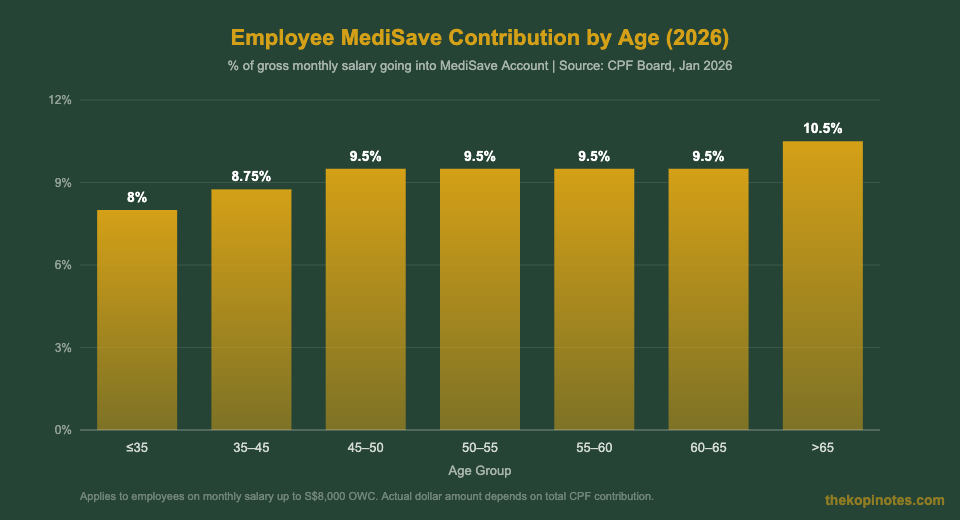
As an employee, your MediSave contribution is automatic. Your employer and you make combined CPF contributions — for example, 37% of gross salary if you’re under 35 (20% employee + 17% employer). That total is then split between OA, SA, and MA based on your age group.
Here’s what your MA contribution looks like as a percentage of your gross monthly salary in 2026:
| Age Group | MA (% of Gross Salary) | On S$5,000/month |
|---|---|---|
| 35 and below | ~8% | ~S$400/month |
| 36 – 45 | ~8.75% | ~S$438/month |
| 46 – 50 | ~9.5% | ~S$475/month |
| 51 – 55 | ~9.5% | ~S$475/month |
| 56 – 60 | ~9.5% | ~S$475/month |
| 61 – 65 | ~9.5% | ~S$475/month |
| Above 65 | ~10.5% | ~S$525/month |
Source: CPF Board Allocation Rates, January 2026. Approximate figures derived from CPF allocation table. Actual amounts may vary; verify exact rates at cpf.gov.sg. Applies to salaries up to the OWC of S$8,000/month.
From 1 January 2026, the Ordinary Wage Ceiling (OWC) rose to S$8,000 per month. This means CPF contributions — including MediSave — only apply to the first S$8,000 of your monthly salary. Salary above that threshold does not attract CPF.
Here’s a practical example. You’re 40 years old and earn S$7,000/month. Your MediSave contribution is roughly 8.75% × S$7,000 = S$613/month. Over a year, that’s S$7,350 flowing into your MediSave — all earning 4% interest, compounding quietly.
Self-Employed MediSave Contribution Rates (2026)
If you’re self-employed — a freelancer, sole proprietor, or business owner — CPF contributions work differently. You don’t contribute to OA or SA automatically. But you must still contribute to MediSave if your annual Net Trade Income (NTI) exceeds S$6,000.
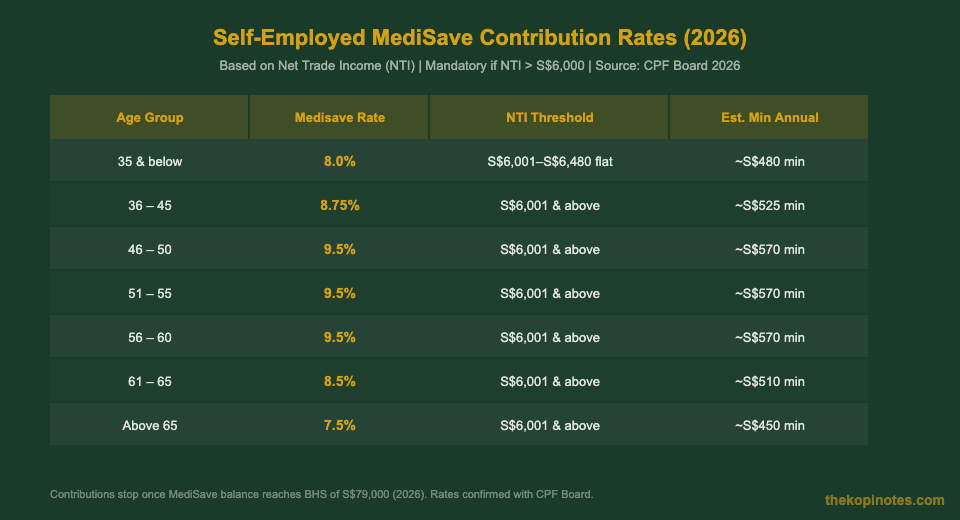
Your NTI is your business income after deducting allowable expenses. IRAS assesses this when you file your taxes, and the CPF Board then calculates how much MediSave you owe. Here are the 2026 rates by age group:
| Age Group | MediSave Rate (% of NTI) | Example: S$60,000 NTI/yr |
|---|---|---|
| 35 and below | 8.0% | S$4,800/year |
| 36 – 45 | 8.75% | S$5,250/year |
| 46 – 50 | 9.5% | S$5,700/year |
| 51 – 55 | 9.5% | S$5,700/year |
| 56 – 60 | 9.5% | S$5,700/year |
| 61 – 65 | 8.5% | S$5,100/year |
| Above 65 | 7.5% | S$4,500/year |
Source: CPF Board, 2026. Contributions stop once MediSave balance reaches the BHS of S$79,000. For NTI between S$6,001 and S$18,000, a graduated rate applies — use the CPF SEP MediSave Calculator for exact figures.
If your NTI is between S$6,001 and S$18,000, you don’t pay the full percentage. A graduated calculation applies. Use the official CPF Self-Employed MediSave Contribution Calculator to get your exact number.
What happens if you don’t pay? IRAS deducts the outstanding MediSave from your tax refund. If there’s no refund due, they can recover it from your bank account. Don’t ignore the notice — penalties accumulate.
The MediSave Cap: Basic Healthcare Sum (BHS)
Your MediSave Account can’t grow forever. Once it hits the Basic Healthcare Sum (BHS), contributions redirect elsewhere instead.
The BHS is set each year and increases to keep pace with rising healthcare costs. From 1 January 2026, the BHS is S$79,000. Once your MA hits this amount, new MediSave contributions automatically flow into your Ordinary Account (if you’re below 55) or Retirement Account (if you’re above 55).
When you turn 65, your BHS becomes fixed for life. If you turn 65 in 2026, your lifelong MediSave cap is S$79,000 regardless of future BHS changes. Those who are already 66 or above in 2026 keep their existing cohort BHS.
Having a “full” MediSave is not a bad thing. The overflow goes into your OA or RA, where it continues earning CPF interest. You don’t lose the money.
Planning for retirement and wondering if your CPF is on track? Our Singapore retirement calculator can help you model your CPF accounts over time.
How to Make a Voluntary MediSave Top-Up
You don’t have to wait for your employer to build up your MediSave. You can top up voluntarily with cash — and Singapore’s tax rules make this genuinely attractive.
Here’s what you get when you voluntarily top up your MediSave:
- Up to S$8,000 tax relief on cash top-ups to your own MediSave Account per year
- Up to another S$8,000 tax relief on top-ups for a parent, parent-in-law, grandparent, grandparent-in-law, spouse, or sibling’s MediSave
- 4% interest on every dollar contributed, guaranteed until end-2026
That’s up to S$16,000 in tax relief annually if you also top up for a family member. For someone in the 15% income tax bracket, that could save you S$2,400 in taxes in a single year. For higher earners, the saving is even larger.
Two important rules before you top up. First, MediSave cash top-ups are irreversible — the money can only be used for approved healthcare purposes, never withdrawn as cash. Second, you can only top up until your MA reaches the BHS of S$79,000.
You can make a top-up via the CPF Board’s online portal with your Singpass login. It takes about five minutes.
For a broader perspective on growing your CPF savings, a sound CPF investment strategy covers how to make your OA and SA work harder as well. And if you’re looking to invest your SRS funds or cash savings, platforms like Endowus (referral code 2V343) offer low-cost access to index funds.
What Can You Use MediSave For?
MediSave isn’t just for hospital stays. The list of approved uses has expanded significantly over the years. Here’s what you can use it for in 2026:
- Hospitalisation bills — including day surgery and in-patient treatment at public or private hospitals
- MediShield Life premiums — your basic national health insurance is deducted from MediSave automatically
- Integrated Shield Plan premiums — pay ISP premiums with MediSave, within approved withdrawal limits
- CareShield Life premiums — long-term care insurance for severe disability
- Approved outpatient treatments — chemotherapy, dialysis, radiotherapy, and selected chronic disease management
- Psychiatric treatment — for approved conditions under the Chronic Disease Management Programme (CDMP)
- Selected vaccinations — for National Childhood Immunisation Schedule (NCIS) vaccines
Each use category has withdrawal limits. For hospitalisation, the limit depends on ward class and treatment type. For ISP premiums, MediSave can only cover the base plan up to certain age-specific caps. Your insurer’s premium statement will show exactly how much is MediSave-payable versus cash. Full withdrawal limits are published on the CPF Board website.
One rule that never changes: MediSave cannot be withdrawn as cash. Once it’s in, it stays in — earning 4% interest and waiting for approved healthcare use.
MediSave and Your Integrated Shield Plan
MediSave and your Integrated Shield Plan (ISP) are closely linked. Your MediShield Life premium — embedded in every ISP — is automatically deducted from MediSave. You don’t manage this yourself.
For the additional ISP coverage (the part that upgrades you from subsidised B2 wards to Class A or private hospital), you can also use MediSave to pay premiums — up to the approved withdrawal limit for your age. Anything beyond that limit must be paid in cash.
Since April 2026, MOH’s new ISP rider rules changed the landscape. Riders sold after 27 November 2025 no longer cover your deductible. The co-payment cap has increased to S$6,000. However, new rider premiums are around 30% cheaper on average. If you bought your rider before 27 November 2025, your existing benefits are grandfathered — do not switch plans unnecessarily.
To understand how these changes affect which ISP and rider makes sense for you, read our complete MediSave Singapore Guide 2026 and our Integrated Shield Plan comparison for a side-by-side breakdown of all providers.
Frequently Asked Questions
How much of my CPF goes to MediSave?
What is the MediSave contribution rate for self-employed persons in 2026?
What is the MediSave limit in 2026?
Can I top up MediSave voluntarily and get a tax deduction?
Can MediSave pay for my Integrated Shield Plan premium?
What happens to MediSave contributions when my account reaches the BHS?
Is the MediSave interest rate guaranteed in 2026?
Get Free Insurance Advice
Speak with a licensed insurance advisor. No obligation, no cost.
By submitting this form, you agree to our Privacy Policy.
This article was researched with the help of AI. While we strive to keep all information accurate and up to date, there may be errors. If you notice any discrepancies, please contact us.