Singlife Shield Plan Premium Table 2026: Plans 1, 2 & Standard Rates
Singlife Shield Plan premiums for 2026 range from around S$90 per year for young children on the Standard Plan to over S$5,000 per year for older policyholders on Plan 1 (private hospital coverage). All base plan premiums are fully payable by MediSave for most age groups. From April 2026, new Health Plus riders cost approximately 30–84% less than before — but they no longer cover your annual deductible.
Not financial advice. All premium figures are indicative — verify your exact premium at singlife.com before purchasing. Data verified as at July 8, 2026.
- Singlife has three ISP tiers: Plan 1 (private hospital), Plan 2 (Class A ward), and Standard (Class B1) — each with different limits, deductibles, and premium levels
- Plan 2 premiums are roughly 55–60% lower than Plan 1 at the same age, making it the value sweet spot for those happy with restructured hospitals
- From April 2026, new Health Plus riders are 30–84% cheaper — but no longer cover your deductible, raising worst-case out-of-pocket on Plan 2 to S$8,000/year
Table of Contents
Singlife Shield Plan Overview
Singlife offers three main Integrated Shield Plan (ISP) tiers — Plan 1 for private hospitals, Plan 2 for Class A wards at restructured hospitals, and the Standard Plan for Class B1 wards. Each plan sits on top of your MediShield Life, extending your annual claim limit and your ward entitlement. The table below shows the key features across all three plans.
| Feature | Standard (B1) | Plan 2 (Class A) | Plan 1 (Private) |
|---|---|---|---|
| Hospital Entitlement | Class B1, restructured | Class A, restructured | Private hospitals |
| Annual Policy Limit | ~S$600,000* | S$1,200,000 | S$2,000,000 |
| Annual Deductible | S$1,500 | S$2,000 | S$3,500 |
| Co-Insurance (no rider) | 10% of bill | 10% of bill | 10% of bill |
| MediSave Payable? | Yes (most ages) | Yes (most ages) | Yes (most ages) |
Source: Singlife Shield plan terms, July 2026. Plan 2 S$1,200,000 limit confirmed by Singlife as highest in market for Class A plans. *Standard Plan limit is indicative — verify at singlife.com. Plan 1 and deductible figures per TKN research cross-referenced with Singlife policy terms.
The S$1,200,000 Plan 2 annual limit is the highest among Class A ISPs in Singapore as confirmed by Singlife in March 2026. Plan 1 at S$2,000,000 covers even catastrophic private hospital stays. The Standard Plan has a lower limit — but still far above what base MediShield Life provides alone.
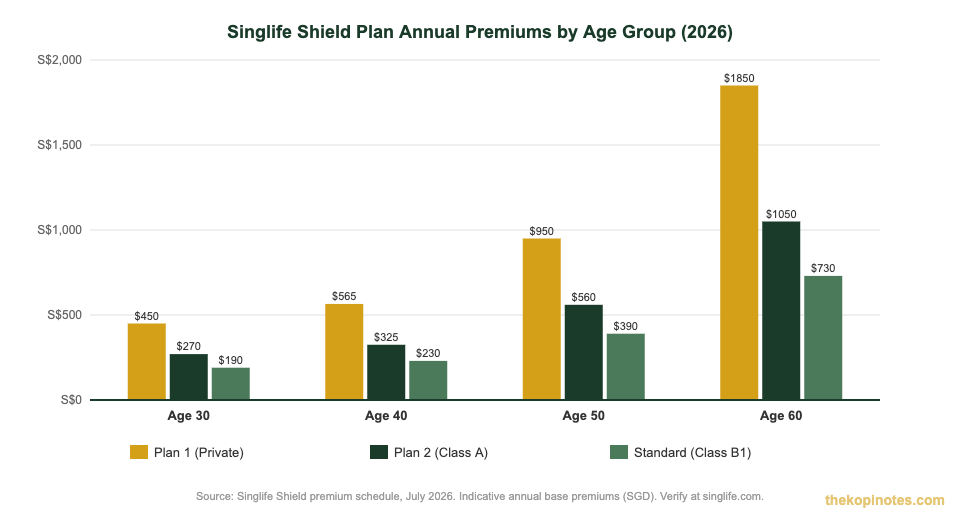
Singlife Shield Plan 1 Premiums 2026 (Private Hospital)
Plan 1 covers private hospitals — Gleneagles, Mount Elizabeth, Parkway East, and others. It carries the highest premiums and has seen the sharpest increases in 2026. If you’re on Plan 1, the combination of rising base plan premiums and even more dramatically rising rider premiums means your total annual cost has likely jumped significantly at your last renewal.
| Age Band | Plan 1 Annual Premium (Indicative) | MediSave Payable? |
|---|---|---|
| Age 1–20 | ~S$155–S$310 | Yes |
| Age 21–30 | ~S$360–S$445 | Yes |
| Age 31–40 | ~S$465–S$635 | Yes |
| Age 41–50 | ~S$740–S$960 | Yes (check limits) |
| Age 51–60 | ~S$1,400–S$1,870 | Partially |
| Age 61–70 | ~S$3,230–S$4,250 | Partially — cash needed |
| Age 71+ | ~S$5,100+ | Partial — check with Singlife |
Source: Singlife Shield premium schedule, July 2026. Indicative annual base premiums. Verify at singlife.com for your exact age. Plan 1 premiums rose sharply in 2026.
Investment Moats data from April 2026 shows Plan 1 Lite rider (co-insurance only) at age 40–55 jumping to over S$1,100 per year. That’s more than the entire base premium for Plan 2. Many Plan 1 policyholders are now questioning whether private hospital coverage is worth the combined premium cost. For a full review of Plan 1 coverage and benefits, see our Singlife Shield Plan 1 review 2026.
Singlife Shield Plan 2 Premiums 2026 (Class A Ward)
Plan 2 is the mid-tier option, covering Class A ward stays at restructured hospitals. It’s the most popular ISP tier because it balances good coverage with manageable premiums. At age 40, you’re looking at around S$325 per year for the base plan — less than S$28 per month. Plan 2 premiums have been far more stable than Plan 1 in recent years.
| Age Band | Plan 2 Annual Premium (Indicative) | MediSave Payable? |
|---|---|---|
| Age 1–20 | ~S$90–S$180 | Yes |
| Age 21–30 | ~S$210–S$260 | Yes |
| Age 31–40 | ~S$270–S$370 | Yes |
| Age 41–50 | ~S$430–S$560 | Yes (check limits) |
| Age 51–60 | ~S$820–S$1,100 | Partially |
| Age 61–70 | ~S$1,900–S$2,500 | Partially — cash needed |
| Age 71+ | ~S$3,000–S$5,500+ | Partial — check with Singlife |
Source: Singlife Shield Plan 2 premium schedule, July 2026. Indicative ranges based on published data. Age 40 figure (~S$325) cross-referenced with TKN research. Verify at singlife.com.
A notable point from Investment Moats April 2026 data: Plan 2 premiums for ages 46–50 were essentially unchanged in 2026. This stability is rare — most plans saw increases of some kind. It suggests restructured hospital costs remain well-managed. For full Plan 2 coverage details including worked hospitalisation examples, see our Singlife Shield Plan 2 review 2026.
Singlife Shield Standard Plan Premiums 2026 (Class B1)
The Standard Plan covers Class B1 ward hospitalisation at restructured hospitals. B1 wards are 4–6 bed shared rooms — you get the same specialist care as higher wards but in a shared environment. The Standard Plan is the cheapest Singlife ISP tier. For budget-conscious Singaporeans who want some upgrade from base MediShield Life (which only covers B2/C wards), the Standard Plan is a logical first step.
| Age Band | Standard Plan Annual Premium (Indicative) | MediSave Payable? |
|---|---|---|
| Age 1–20 | ~S$60–S$120 | Yes |
| Age 21–30 | ~S$140–S$175 | Yes |
| Age 31–40 | ~S$180–S$250 | Yes |
| Age 41–50 | ~S$285–S$380 | Yes |
| Age 51–60 | ~S$545–S$740 | Yes / Partial |
| Age 61–70 | ~S$1,270–S$1,690 | Partially |
| Age 71+ | ~S$2,000–S$3,700+ | Partial — check with Singlife |
Source: Singlife Shield Standard Plan premium schedule, July 2026. Indicative ranges only. *Annual limit and deductible are approximate — verify the current policy terms at singlife.com. Standard Plan limit is lower than Plan 2’s confirmed S$1,200,000.
At ages 31–40, the difference between the Standard Plan and Plan 2 is roughly S$90–S$120 per year in additional premium. That gap buys you the upgrade from B1 to a single-bedded Class A ward and nearly doubles your annual claim limit. Many advisers suggest that S$100/year premium difference is worth paying if your budget allows it — but the Standard Plan remains a valid choice for those optimising every dollar.
Singlife Health Plus Rider Premiums 2026
The Health Plus rider reduces your co-insurance after a claim. Without any rider, you pay 10% of your bill after the deductible. With a rider, that co-insurance is capped. From April 2026, there are now two generations of riders — with very different costs and coverage.
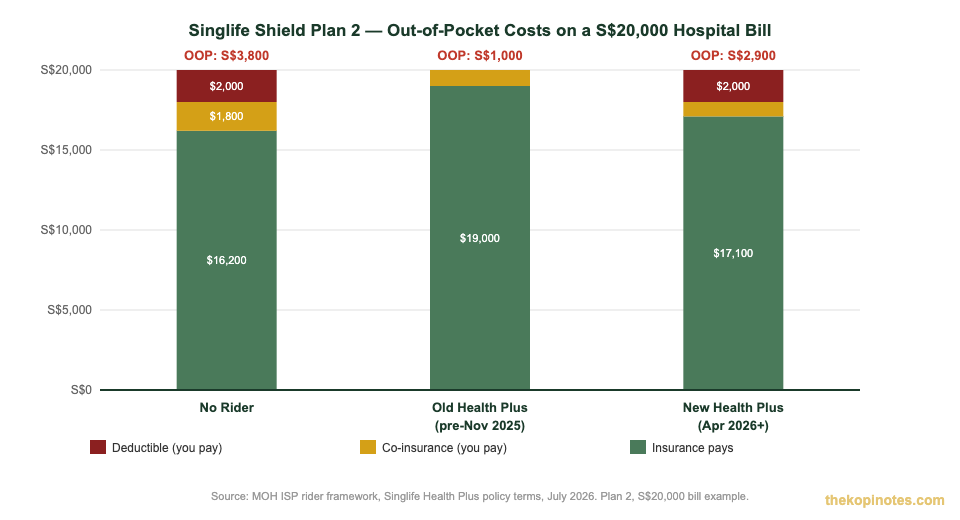
Old riders (bought before 27 November 2025 — grandfathered): Cover both the deductible and co-insurance, capping your annual out-of-pocket at S$3,000 post-deductible. If you have one, keep it. Premiums rose in 2026, but coverage is more comprehensive than new riders.
New Health Plus riders (from 1 April 2026): Cover co-insurance only — you pay the deductible yourself. Co-insurance cap rises from S$3,000 to S$6,000. But premiums are 30–84% lower, and a new Recovery Support Benefit of up to S$20,000 (lifetime) for home nursing and rehabilitation is included.
| Age | Old HP Public Lite (Plan 2, 2026 renewal) | New Health Plus Public (Apr 2026+) | Approx. Saving |
|---|---|---|---|
| Age 30 | ~S$65/yr | ~S$46/yr | ~29% |
| Age 40 | ~S$86/yr | ~S$60/yr | ~30% |
| Age 50 | S$191/yr | ~S$134/yr | ~30% |
| Age 60 | ~S$380/yr | ~S$266/yr | ~30% |
Source: Old rider at age 50 (S$191) from Investment Moats April 2026 data, confirmed against Singlife premium tables. New rider figures are indicative (~30% reduction per Singlife March 2026 press release). Verify new rider premiums at singlife.com.
Note: The 30–84% premium reduction range comes from Singlife’s own announcement. The widest savings are on plans where the old rider covered the most expensive deductibles (i.e., Plan 1 private hospital riders). For Plan 2’s public hospital rider, the saving is closer to 30%.
MediSave Payability — What You Can Use
All three Singlife Shield plans allow you to use MediSave for the base plan premium, up to the annual withdrawal limits set by MOH. For most Singaporeans under 50, the base plan premium falls within these limits — meaning no cash needed for the base plan itself.
From your 50s onwards, the base premium starts exceeding what you can withdraw from MediSave, especially for Plan 1. You’ll need to top up with cash. For a 60-year-old on Plan 1, the base premium alone could require a substantial cash contribution each year — on top of any rider premium.
- Rider premiums may need cash. The Health Plus rider premium is separate from the base plan and may require partial or full cash payment depending on your age and MediSave balance.
- Parents can use MediSave for children’s plans. Up to S$300/year from a parent or grandparent’s MediSave can be used for a child’s ISP premium under the MediSave Care arrangement.
- MediSave limits are reviewed by MOH. Check the current withdrawal limits at CPF Board’s website for the most up-to-date figures.
Planning how your ISP fits into your long-term finances? Our Singapore retirement planning calculator lets you model healthcare costs alongside your CPF and investment projections.
April 2026 Changes — What They Mean for Your Costs
The April 2026 ISP rider reforms were MOH-mandated. All insurers, including Singlife, had to launch new riders that no longer cover the annual deductible. The changes took effect from 1 April 2026. Here’s what changed and what it means for your total annual cost.
For Plan 2 policyholders: The new Health Plus Public rider no longer covers the S$2,000 deductible. Your worst-case out-of-pocket per year rises from about S$3,000 (old rider, all-in) to S$8,000 (S$2,000 deductible + S$6,000 co-pay cap). However, the rider premium is roughly 30% cheaper.
For Plan 1 policyholders: The impact is more dramatic. The new Health Plus Private rider no longer covers the S$3,500 deductible. Worst-case out-of-pocket could reach S$9,500 per year (S$3,500 deductible + S$6,000 co-pay cap). Private hospital rider premiums have also already risen sharply in 2026, independent of the April changes.
Should you switch to the new rider? If you bought your rider before 27 November 2025, your old terms are grandfathered. Don’t switch unless a licensed financial adviser reviews your situation and recommends it. The deductible protection in the old rider is genuinely valuable — especially as hospitalisation frequency increases with age.
For a detailed comparison with worked examples, see our Singlife Shield Plan 2 review 2026, which includes a full old-vs-new rider cost breakdown.
Which Singlife Shield Plan Should You Choose?
The best plan depends on your budget, your hospital preferences, and how much out-of-pocket risk you’re comfortable absorbing. Here’s a plain-English decision framework.
Choose Plan 2 if: You’re happy being treated at restructured hospitals (SGH, NUH, TTSH, KKH) and want a high S$1,200,000 annual limit at a premium roughly 55% lower than Plan 1. At S$325/year for a 40-year-old, Plan 2 gives you the best value in Singlife’s lineup.
Choose Plan 1 if: You strongly prefer private hospital access or want to choose your private specialist directly. Be aware that Plan 1 rider premiums are now dramatically more expensive — model your total lifetime cost before committing.
Choose the Standard Plan if: You want the cheapest upgrade from base MediShield Life and are comfortable in a shared B1 ward. It’s a sensible foundation, especially in your 20s and 30s. That said, the step-up to Plan 2 costs only S$90–S$120/year more at ages 31–40 — a small premium for a significantly higher annual limit.
Want to compare Singlife against AIA, Prudential, or Great Eastern? Our integrated shield plan guides cover each insurer in detail. And to check how your ISP coverage fits your overall financial picture, the insurance gap calculator helps you see exactly where gaps may exist.
Not financial advice. Always consult a licensed financial adviser before making insurance decisions. Data as at July 2026.
Frequently Asked Questions
How much does Singlife Shield Plan 2 cost per year?
Is Singlife Shield Plan 1 worth the higher premium?
What is the cheapest Singlife Shield plan?
How did the Health Plus rider change in April 2026?
Can I pay Singlife Shield premiums with MediSave?
Will Singlife Shield premiums keep rising?
Should I downgrade from Plan 1 to Plan 2 to save money?
Get Free Insurance Advice
Speak with a licensed insurance advisor. No obligation, no cost.
By submitting this form, you agree to our Privacy Policy.
This article was researched with the help of AI. While we strive to keep all information accurate and up to date, there may be errors. If you notice any discrepancies, please contact us.