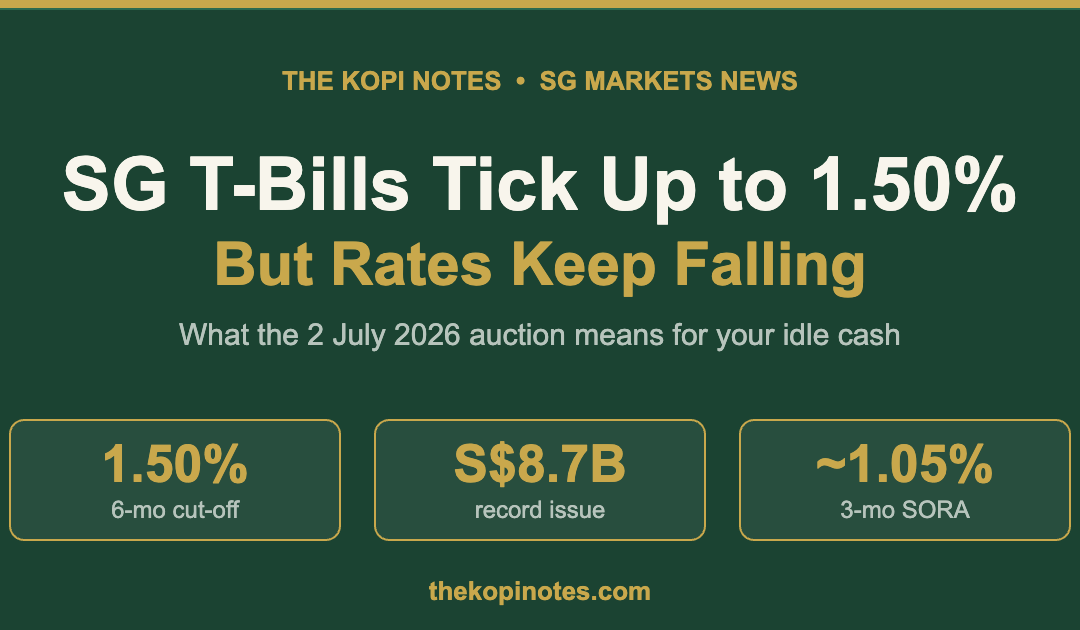
Singapore’s 6-month T-bill cut-off yield ticked up to 1.50% at the 2 July 2026 auction, its first rise in months, even as a record S$8.7 billion was issued and demand cooled to S$17.4 billion. But the bigger story for retail investors is the year-long slide in yields: from above 3% in January to roughly 1.5% today, as 3-month SORA sits near 1.05%. Idle cash now barely beats inflation.
This is an editorial analysis. Not financial advice.
What Just Happened at the 2 July T-Bill Auction
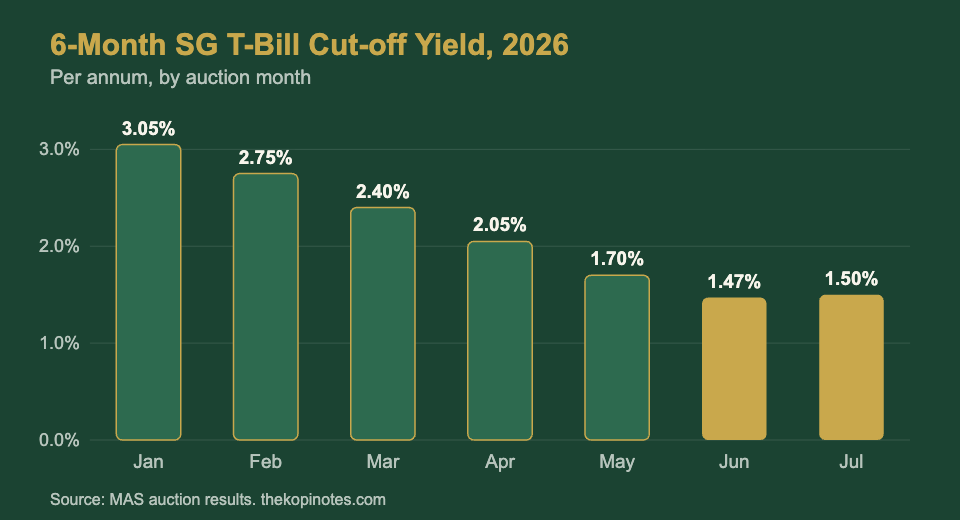
The latest 6-month Singapore Treasury bill (BS26113X), which closed on 2 July 2026, cleared at a cut-off yield of 1.50% per annum — up three basis points from the 1.47% recorded at the 18 June auction (BS26112T). It was a small move, but it broke a run of steadily falling cut-offs that had defined the first half of 2026.
Two other numbers matter more than the headline yield. First, the Singapore Government issued a record S$8.7 billion of 6-month bills at this auction — the largest single issuance to date. Second, total applications fell to S$17.4 billion, down from S$19.4 billion at the previous auction. Divide the two and you get a bid-to-cover ratio of roughly 2.0x — still comfortably oversubscribed, but noticeably softer demand meeting a much larger supply. When supply jumps and demand softens, yields drift up. That is the simplest explanation for the 3bp uptick. (You can track every auction on our running Singapore T-bill auction results page.)
What this means for Singapore retail investors: Do not read one auction as a trend reversal. A 1.47% to 1.50% move is noise, driven by a supply-demand mismatch on the day, not a change in the direction of Singapore interest rates. The multi-month trend is still firmly down.
The Real Trend: Yields Have Halved in Six Months
Zoom out and the picture is stark. Singapore’s 6-month T-bill yields began 2026 above 3%, an echo of the high global rate environment of 2024 and 2025. By July they had settled near 1.5% — roughly half their January level. The engine behind that collapse is the Singapore Overnight Rate Average (SORA), the domestic benchmark that anchors local yields.
The 3-month compounded SORA has fallen to around 1.05% as of early June 2026, down from a near-3% peak in early 2025 and a cycle high near 4% back in 2023 — a drop of more than 110 basis points year-on-year. Because T-bills are priced off short-term SGD rates, they have followed SORA down almost mechanically.
What this means for Singapore retail investors: The era of parking cash at 3.7% “risk-free” is over. If you rolled T-bills or fixed deposits through 2024, every renewal in 2026 has reset lower. The question is no longer “which instrument pays the most?” but “how do I stop my cash from quietly losing to inflation?”
Where the Yield Now Sits: A Cash Parking Comparison
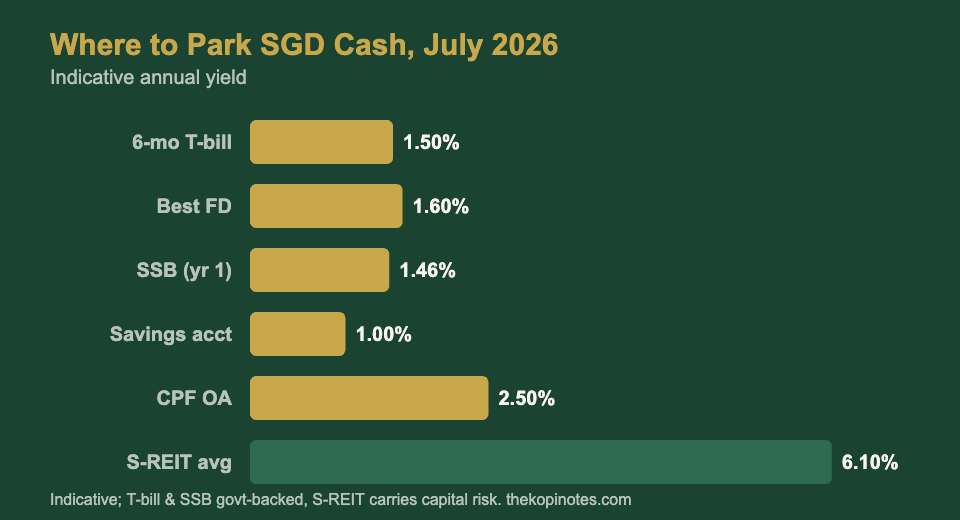
Here is how the main “safe” options for Singapore dollars stack up as of July 2026. All figures are indicative and change with each auction, promotion, or policy review.
| Instrument | Indicative Yield (Jul 2026) | Lock-up / Liquidity | Key Consideration |
|---|---|---|---|
| 6-month T-bill (BS26113X) | 1.50% p.a. | 6 months | Government-backed; yield set at auction |
| Best fixed deposits | ~1.55–1.60% p.a. | 3–12 months | Promo rates, minimum sums apply |
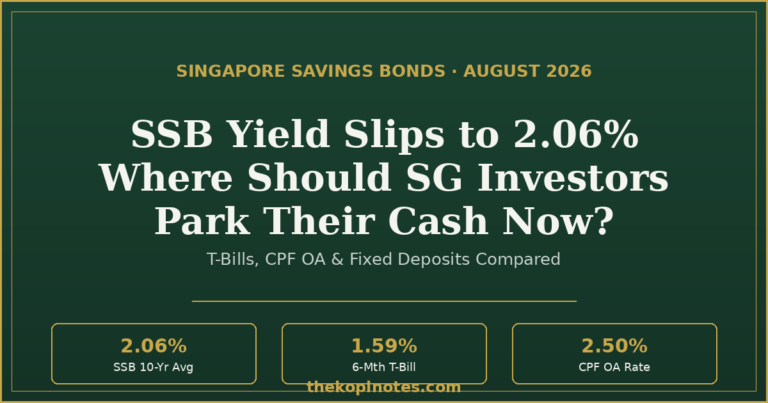
| Singapore Savings Bonds (Jul 2026) | 1.46% (yr 1), 2.11% (10-yr avg) | Flexible, redeem monthly | Step-up structure rewards holding |
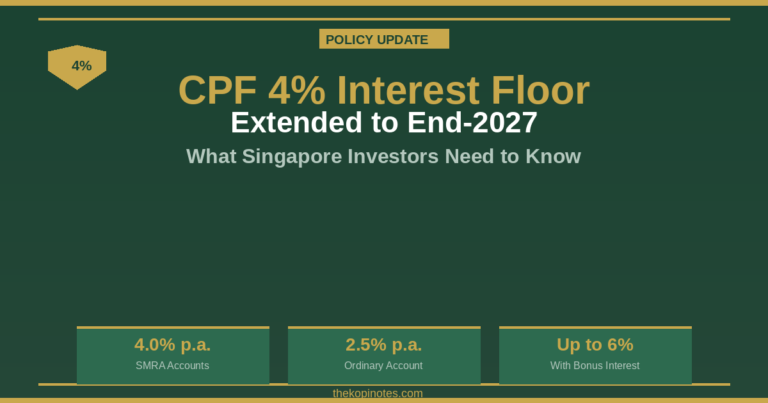
| CPF Ordinary Account | 2.50% p.a. | Restricted (retirement) | Floor rate; highest guaranteed return here |
| High-yield savings accounts | ~0.05–2.0% p.a. | Instant | Top tiers need salary + spend hurdles |
| iEdge S-REIT Index (avg) | ~5.9–6.3% dividend yield | Daily (market risk) | Not cash; capital can fall |
What this means for Singapore retail investors: For genuinely short-term money you cannot risk, the best fixed deposits now narrowly edge out T-bills, and the SSB is the more flexible cousin because you can redeem in any month without penalty. But notice the standout number in the table: your CPF Ordinary Account still pays a legislated 2.50% floor — higher than every liquid cash option on the market. In a falling-rate world, CPF has quietly become one of the best “risk-free” rates a Singaporean can access.
The Inflation Problem Nobody Advertises
With T-bills and fixed deposits both sitting below 1.6%, and Singapore headline inflation running in the 1.5% to 2.5% range, the uncomfortable truth is that idle cash is now losing the real-return battle. A 1.50% T-bill against 2% inflation is a negative real return of roughly half a percent. You are preserving nominal dollars while their purchasing power slowly erodes.
This is a psychological trap. Through 2023 and 2024, cash felt like a winning trade — 3.7% for doing nothing was hard to argue with. That anchor makes 1.5% feel merely “a bit lower,” when in real terms the entire premium has evaporated.
What this means for Singapore retail investors: Cash still has a job — your emergency fund and any money you need within 12 months belongs in T-bills, SSBs, or fixed deposits regardless of yield. But money with a multi-year horizon sitting in cash “for safety” is now the risky choice, because inflation is the near-certain drag.
Falling Rates Are a Tailwind for S-REITs and Bonds
The same force squeezing your cash yields is a tailwind elsewhere. Lower SORA means cheaper refinancing for leveraged businesses — and no sector is more sensitive to that than Singapore REITs. Roughly 80% of S-REITs are expected to benefit from stable or lower benchmark rates in 2026, as SGD-denominated debt maturing this year reprices at materially lower cost. That flows straight to distributable income.
Valuations reflect a market still deciding whether to believe it. The iEdge S-REIT Index trades near 0.86x price-to-book with a market-cap-weighted yield around 6.3%, and several quality high-yield industrial names push yields past 7%. The catch: S-REIT unit prices often track US Treasury yields, because global investors discount REIT cash flows against the US risk-free rate. So even as SGD funding gets cheaper, prices can stay capped while the Fed stays “higher for longer.” That is why 2026 has been a year of selective optimism rather than a blanket REIT rally.
What this means for Singapore retail investors: If you are moving money out of maturing T-bills, S-REITs and SGD bond funds are the natural next rung on the risk ladder — you trade guaranteed 1.5% for a 6% yield that carries capital risk. That is a real trade-off, not a free lunch. Size positions to a horizon you can actually hold through a drawdown.
A Practical Playbook for Your Maturing Cash
You do not need to pick a single winner. A simple tiered approach handles falling rates without market-timing:
Keep three to six months of expenses in the most liquid, decent-yielding option — today that is a top high-yield savings account or a short T-bill ladder you can roll. Place money you will need in one to three years in a mix of the best available fixed deposits and Singapore Savings Bonds, using the SSB’s monthly redemption flexibility as your release valve. For money with a five-year-plus horizon, accept that cash is the wrong home and step into diversified equity or S-REIT exposure sized to your risk tolerance. And if you have CPF headroom, remember the 2.5% OA floor now beats every liquid cash rate on the board.
Bottom Line for SG Investors
The 2 July auction’s move to 1.50% is a blip in a clear downtrend, not a turning point. Singapore’s short-term risk-free yields have halved in six months and are likely to stay soft while SORA hovers near 1%. For emergency and near-term money, T-bills, the best fixed deposits, and SSBs remain sensible and roughly interchangeable at ~1.5%. But the strategic message is bigger: in a sub-2% cash world, letting long-horizon money sit idle is no longer the safe choice — it is a slow, near-guaranteed loss to inflation. Match each dollar to its time horizon, lean on your CPF OA’s 2.5% floor where you can, and treat the falling-rate cycle as your cue to put lazy cash to work.
Frequently Asked Questions
What was the cut-off yield of the 2 July 2026 Singapore T-bill?
The 6-month T-bill (BS26113X) cleared at a cut-off yield of 1.50% per annum, up from 1.47% at the 18 June 2026 auction. A record S$8.7 billion was issued while total applications fell to S$17.4 billion.
Why did the T-bill yield rise when interest rates are falling?
The 3bp rise reflects a supply-demand mismatch on the day — a record-large issuance met softer demand — rather than a change in trend. The multi-month direction of Singapore yields remains firmly down, tracking a 3-month SORA near 1.05%.
Are T-bills or fixed deposits better in July 2026?
They are close. The best fixed deposits (~1.55–1.60%) now narrowly edge the 6-month T-bill (1.50%). T-bills are government-backed and need a CDP or SRS account; fixed deposits often require minimum sums and promo conditions. Both are sensible for short-term cash.
Is my cash losing money to inflation right now?
In real terms, likely yes. With cash yields below 1.6% and Singapore inflation around 1.5%–2.5%, a 1.50% T-bill can deliver a slightly negative real return. Nominal dollars are preserved, but purchasing power erodes.
What is the best guaranteed rate a Singaporean can get now?
Among widely accessible options, the CPF Ordinary Account’s legislated 2.50% floor is the highest guaranteed return, though the funds are restricted for retirement and housing use. It now beats every liquid cash instrument on the market.
Should I move money from T-bills into S-REITs?
Only money you can hold for years. S-REITs offer ~5.9%–6.3% yields and benefit from cheaper SGD refinancing, but unit prices carry capital risk and often track US Treasury yields. It is a genuine risk trade-off, not a like-for-like swap for T-bills.
This article was researched with the help of AI. While we strive to keep all information accurate and up to date, there may be errors. If you notice any discrepancies, please contact us.