Best REITs Singapore 2026: Top Picks for Passive Income
Yield comparison, DPU history, valuation analysis, and practical buying guide — updated June 2026.
The best REITs in Singapore for 2026 include Keppel DC REIT (data centres), ParkwayLife REIT (healthcare), Capitaland Ascendas REIT (industrial), AIMS APAC REIT (industrial/logistics), and Mapletree Logistics Trust (logistics). These S-REITs offer yields ranging from 4% to 8%, are listed on SGX, and are eligible for CPF and SRS investment — making them powerful tools for building passive income.
Not financial advice. All figures are for educational reference only. Data as at June 2026 unless noted.
- S-REITs currently yield 5–7% on average — attractive vs Singapore T-bills and fixed deposits in 2026.
- Many S-REITs trade below NAV (net asset value), suggesting the market may be undervaluing them.
- You can buy S-REITs through your brokerage account, using CPF OA funds, or SRS contributions.
Table of Contents
Contents — Click to expand
- What Is a Singapore REIT (S-REIT)?
- Why Invest in S-REITs in 2026?
- Best REITs Singapore 2026: Our Top Picks
- S-REIT Yield Comparison Table 2026
- S-REIT Valuation: Are They Cheap Now?
- How to Buy S-REITs in Singapore
- Using CPF or SRS to Buy S-REITs
- Risks of Investing in S-REITs
- Frequently Asked Questions
What Is a Singapore REIT (S-REIT)?
A Singapore Real Estate Investment Trust — or S-REIT — is a company that owns and operates income-producing real estate. Think shopping malls, office buildings, data centres, warehouses, hospitals, and hotels. Instead of buying property yourself, you buy units in a REIT and receive a share of the rental income.
By law, S-REITs must distribute at least 90% of their taxable income to unitholders. This makes them one of the most reliable sources of passive income on SGX. You get paid quarterly or semi-annually — just for holding the units.
S-REITs are regulated by the Monetary Authority of Singapore (MAS) under the Code on Collective Investment Schemes. They must also comply with MAS leverage limits — currently capped at 50% aggregate leverage — which protects investors from excessive debt risk.
As at June 2026, there are over 40 S-REITs listed on SGX, covering sectors from industrial logistics to healthcare to data centres. Combined market capitalisation exceeds SGD 100 billion.
Why Invest in S-REITs in 2026?
Three reasons S-REITs are worth serious consideration this year:
1. Yields are attractive vs fixed income. Singapore T-bills currently yield around 3.2–3.5% (as at June 2026). The average S-REIT yields 5–7%. For income-seeking investors, that’s a meaningful spread — even after accounting for higher risk.
2. Many are trading below NAV. A Price-to-NAV (P/NAV) ratio below 1.0x means the market is valuing the REIT’s properties at less than their book value. As at June 2026, several S-REITs trade at 0.6–0.8x NAV — a potential opportunity for long-term investors who believe the underlying assets are worth more.
3. CPF and SRS eligibility. Many SGX-listed S-REITs are approved for investment using CPF Ordinary Account (OA) funds. You can also use SRS contributions. This means you can invest your CPF money — which otherwise earns 2.5% — into higher-yielding real assets. For more on this, see our CPF investment strategy Singapore guide.
Best REITs Singapore 2026: Our Top Picks
Here are five S-REITs worth considering for a diversified income portfolio. These are selected based on yield, sector resilience, DPU track record, and balance sheet strength. This is not a buy recommendation — always do your own research before investing.
1. Keppel DC REIT (AJBU) — Best for Data Centre Exposure
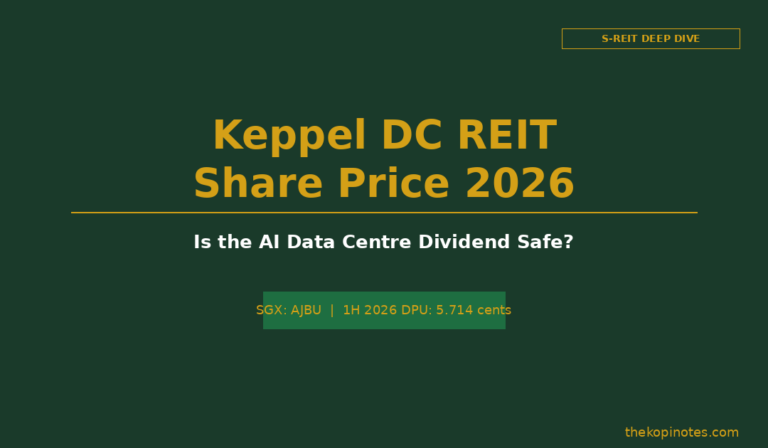
Keppel DC REIT owns a portfolio of 23 data centres across 9 countries, with Singapore and Europe forming the core. Data centre demand is rising rapidly — driven by AI workloads, cloud adoption, and hyperscaler expansion. As at June 2026, the REIT trades at around SGD 2.05 per unit with a yield of approximately 5.5%.
It trades at a premium to NAV (around 1.35x), which reflects market confidence in data centre fundamentals. If you want exposure to the AI and digital infrastructure theme via a dividend-paying vehicle, Keppel DC is the cleaner play among S-REITs. For a detailed breakdown, read our best S-REITs in Singapore 2026 roundup.
2. ParkwayLife REIT (C2PU) — Best for Defensive Income
ParkwayLife REIT owns hospitals and healthcare facilities in Singapore, Japan, and Malaysia. It’s the most defensive S-REIT on this list — healthcare demand doesn’t disappear in recessions. The three Singapore hospitals (Mount Elizabeth, Gleneagles, Parkway East) account for over 50% of revenue and are on long-term leases.
DPU has grown consistently for over a decade. The current yield is around 4.2% — lower than peers, but priced correctly for its defensive characteristics. If capital preservation and steady income matter more to you than maximum yield, ParkwayLife deserves a spot in your portfolio.
3. Capitaland Ascendas REIT (A17U) — Best Blue-Chip S-REIT
Capitaland Ascendas REIT (CLAR) is Singapore’s largest industrial REIT by market cap. It owns over 230 properties across Singapore, Australia, the US, and the UK — covering business parks, logistics warehouses, data centres, and suburban offices. It’s the closest thing to a “blue chip” in the S-REIT space.
Current yield is approximately 5.3%, with a P/NAV of around 0.95x. CLAR is CPF OA-approved, meaning you can use your CPF savings to invest. For income investors who want diversification across industrial sub-sectors and geographies, CLAR is a natural anchor holding.
4. AIMS APAC REIT (O5RU) — Best for High Yield + Industrial
AIMS APAC REIT is a mid-cap industrial REIT with properties in Singapore and Australia. As at June 2026, it offers one of the highest yields among Singapore-listed REITs at approximately 7.8%, trading at around 0.95x NAV. Its Singapore portfolio (logistics, warehouse, light industrial) benefits from tight industrial land supply and strong occupancy.
The trust has maintained or grown DPU for several consecutive years, which builds confidence in the sustainability of the payout. For yield-focused investors comfortable with mid-cap risk, AIMS APAC REIT is a compelling option. You can start investing via a regular savings plan — see our guide on passive income Singapore.
5. Mapletree Logistics Trust (M44U) — Best for Logistics/E-Commerce
Mapletree Logistics Trust (MLT) owns 186 logistics properties across Singapore, Hong Kong, China, Japan, Australia, South Korea, Vietnam, and India. E-commerce growth and supply chain reshoring are tailwinds for logistics demand. MLT currently yields approximately 6.0% with a P/NAV of around 0.82x.
The discount to NAV reflects concerns about China exposure and rising interest rates impacting borrowing costs. However, for investors with a longer time horizon who believe in Asia’s logistics growth story, MLT at current prices offers an interesting risk-reward profile. Our Singapore retirement calculator can help you model how MLT fits into your long-term income plan.
S-REIT Yield Comparison Table 2026
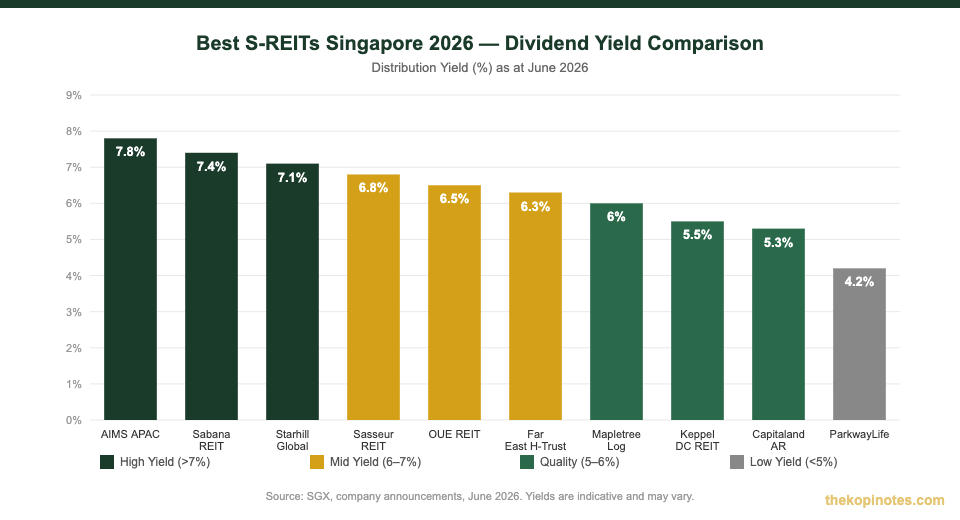
The table below covers 10 of the most-tracked S-REITs on SGX, ranked by indicative distribution yield as at June 2026. Yields are calculated based on the trailing 12-month DPU divided by the unit price. They will change as unit prices and DPU figures are updated.
| REIT Name | Sector | SGX Code | Indicative Yield | P/NAV | CPF OA? |
|---|---|---|---|---|---|
| AIMS APAC REIT | Industrial | O5RU | 7.8% | 0.95x | Yes |
| Sabana REIT | Industrial | M1GU | 7.4% | 0.72x | Yes |
| Starhill Global REIT | Retail/Office | P40U | 7.1% | 0.68x | Yes |
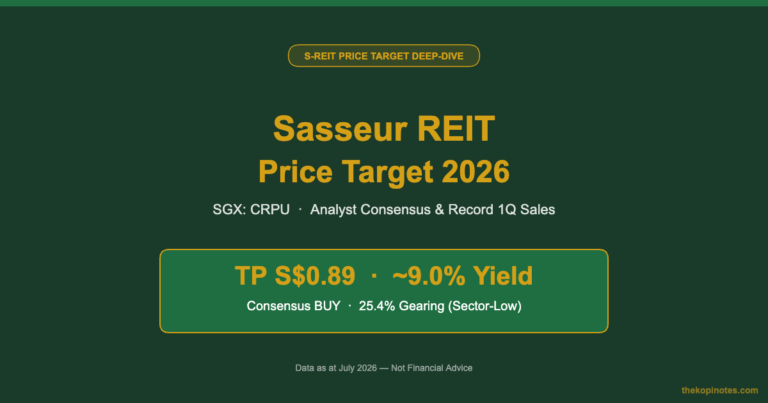
| Sasseur REIT | Retail (China) | CRPU | 6.8% | 0.72x | No |
| OUE REIT | Retail/Office/Hotel | TS0U | 6.5% | 0.55x | Yes |
| Far East H-Trust | Hospitality | Q5T | 6.3% | 0.65x | Yes |
| Mapletree Logistics | Logistics | M44U | 6.0% | 0.82x | Yes |
| Capitaland Ascendas | Industrial | A17U | 5.3% | 0.95x | Yes |
| Keppel DC REIT | Data Centre | AJBU | 5.5% | 1.35x | Yes |
| ParkwayLife REIT | Healthcare | C2PU | 4.2% | 1.18x | Yes |
Source: SGX, company announcements, analyst estimates, June 2026. Yields are indicative based on trailing 12-month DPU ÷ unit price. Figures will change as prices and DPU are updated. Not financial advice.
S-REIT Valuation: Are They Cheap Now?
One of the most useful tools for evaluating S-REITs is the Price-to-NAV (P/NAV) ratio. NAV — or Net Asset Value — is the estimated market value of a REIT’s properties minus its liabilities, divided by the number of units outstanding.
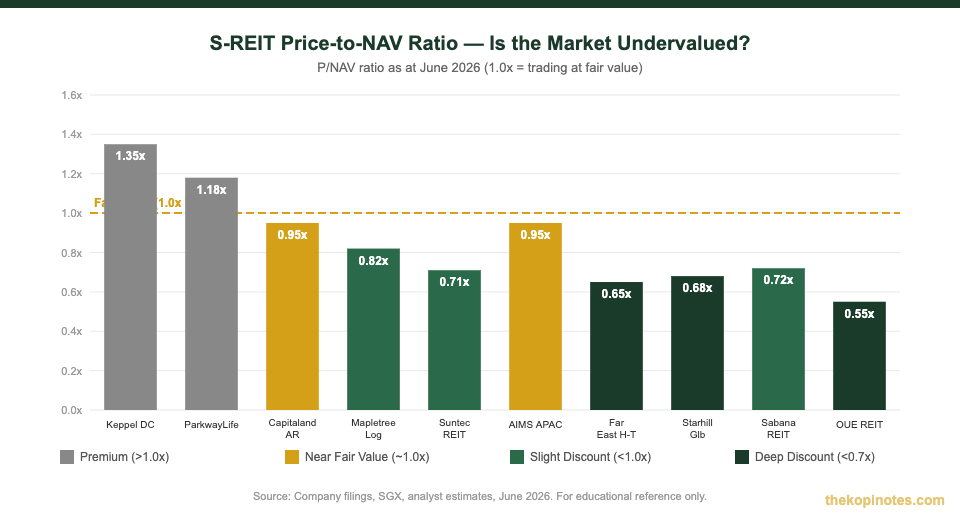
A P/NAV of 1.0x means the REIT trades at exactly what its assets are worth. Below 1.0x means the market thinks the assets are worth less than their book value — or that investors demand a risk premium. Above 1.0x (like Keppel DC and ParkwayLife) signals that the market is paying a premium for quality and growth.
As at June 2026, most S-REITs trade between 0.55x and 0.95x NAV. This is historically low. For context, the sector average hovered around 0.9–1.1x NAV between 2018 and 2022. The current discount reflects higher interest rates (which increase borrowing costs and compress valuations) and uncertainty around China-exposed REITs.
Historically, buying S-REITs when they trade at a significant discount to NAV — combined with strong occupancy and stable DPU — has proven profitable over 3–5 year horizons. You can explore our Singapore REIT ETF guide if you prefer to access the sector via a fund rather than picking individual REITs.
How to Buy S-REITs in Singapore
Buying S-REITs is straightforward. You need a brokerage account and a CDP (Central Depository) account. Here’s how to do it in three steps.
Step 1: Open a Brokerage Account
You need a broker that gives you access to SGX. Popular options in Singapore include:
- Syfe Trade — commission-free for the first month, no minimum. Good for beginners. Use our Syfe referral code for a sign-up bonus.
- FSMOne — SGD 10 minimum commission per trade. Good for regular savers. See our FSMOne referral code for cash rewards.
- moomoo Singapore — competitive fees, good charting tools. Check our moomoo Singapore review for full details.
- Endowus — if you want to invest via CPF or SRS in a managed S-REIT portfolio. Use our Endowus referral code for fee rebates.
Most brokers require a Singapore bank account and SingPass for identity verification. Setup typically takes 1–3 business days.
Step 2: Fund Your Account and Search for the REIT
Transfer SGD to your brokerage account. Then search for the REIT by its SGX ticker (e.g. “AJBU” for Keppel DC REIT) or by name. Make sure you’re buying on SGX — not a foreign exchange.
All S-REITs trade in SGD on SGX. There is no currency risk from the exchange itself, though individual REITs with overseas assets will have underlying foreign currency exposure (e.g. MLT has HKD and JPY property income).
Step 3: Place Your Order
S-REITs trade in lots of 100 units. So if AIMS APAC REIT is at SGD 1.40 per unit, you need at least SGD 140 per lot. You can place a market order (buys immediately at current price) or a limit order (buys only if price hits your target).
For a SGD 10,000 investment in AIMS APAC REIT at 7.8% yield, you’d receive approximately SGD 780 in annual distributions — paid quarterly at roughly SGD 195 per payment. That’s a simple worked example of what passive income from S-REITs looks like in practice.
Using CPF or SRS to Buy S-REITs
One of the biggest advantages of S-REITs over global ETFs or bonds is CPF and SRS eligibility. Here’s how each works:
| Account | Interest Rate (Default) | Can Invest in S-REITs? | Tax Benefit? |
|---|---|---|---|
| CPF Ordinary Account (OA) | 2.5% p.a. | Yes (approved REITs only) | Tax-free returns |
| CPF Special Account (SA) | 4.0% p.a. | No | Tax-free returns |
| SRS Account | Negligible (bank rate) | Yes (all SGX-listed REITs) | Tax deferral on contributions |
Source: CPF Board, IRAS, June 2026. Check CPF Board for the updated approved list of CPFIS investments.
To invest using CPF OA, you need to open a CPFIS account with an approved bank (DBS, OCBC, or UOB) and link it to a brokerage. The REIT must be on the CPF Investment Scheme (CPFIS) approved list — most major S-REITs qualify.
With SRS, any SGX-listed S-REIT is eligible. You contribute to your SRS account (up to SGD 15,300 per year for Singaporeans) and use those funds to buy S-REIT units. You get an income tax deduction on your SRS contributions, and withdrawals after 62 are taxed at a 50% concession rate.
Risks of Investing in S-REITs
S-REITs are not risk-free. Here are the main risks to understand before investing:
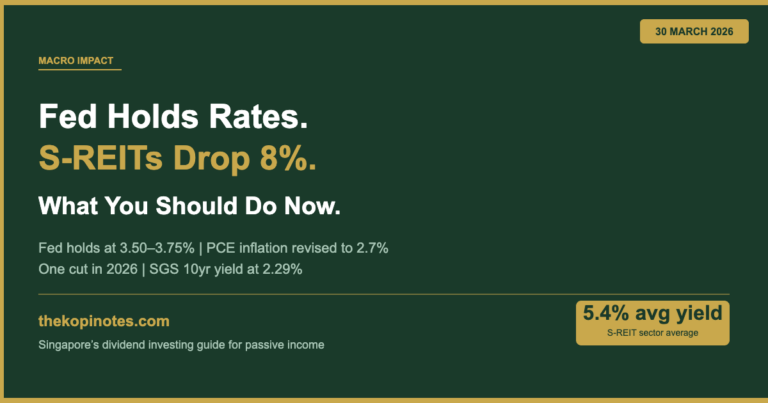
Interest rate risk. When interest rates rise, REIT valuations tend to fall. Higher rates mean higher borrowing costs (reducing distributable income) and make bonds more attractive as alternatives. The 2022–2024 rate hiking cycle was a major reason S-REIT prices fell. In 2026, rates are stabilising but haven’t fully normalised.
Occupancy and rental risk. If tenants leave or lease renewals come in below expectations, DPU can fall. Watch occupancy rates (aim for >90%) and weighted average lease expiry (WALE) — higher is better.
Leverage risk. S-REITs borrow to buy properties. MAS caps leverage at 50% of total assets. A REIT near this limit has less room to manoeuvre if property values fall or refinancing becomes expensive.
Currency risk. REITs with overseas assets face exchange rate risk. MLT’s HKD and China RMB exposure, for example, means a weakening HKD or RMB reduces SGD-denominated DPU.
Concentration risk. Single-country or single-sector REITs are more exposed to local downturns. A Singapore-only retail REIT suffers if Singapore retail spending slows. Diversify across sectors and geographies where possible.
Compare S-REIT yields against safer alternatives before committing. Our guide to Singapore T-bills 2026 and Singapore Savings Bonds guide can help you benchmark the risk-return tradeoff.
Disclaimer: This article is for educational purposes only and does not constitute financial advice. S-REIT prices, yields, and DPU figures change regularly. Always refer to the latest SGX filings and company announcements before making investment decisions. Past performance is not indicative of future results.
Frequently Asked Questions
What are the best REITs to invest in Singapore in 2026?
The top S-REITs for 2026 based on yield, quality, and sector resilience include AIMS APAC REIT (7.8% yield, industrial), Keppel DC REIT (5.5% yield, data centres), ParkwayLife REIT (4.2% yield, healthcare), Capitaland Ascendas REIT (5.3% yield, industrial), and Mapletree Logistics Trust (6.0% yield, logistics). Each serves a different investor need — high yield, defensive income, blue-chip stability, sector growth, or geographic diversification. Always research each REIT’s occupancy rates, DPU track record, and leverage ratio before investing.
How much money do I need to start investing in S-REITs?
S-REITs trade in minimum lots of 100 units on SGX. The minimum investment depends on the unit price — most S-REITs trade between SGD 0.30 and SGD 3.00 per unit, meaning a minimum lot costs between SGD 30 and SGD 300. With a broker like Syfe Trade (commission-free for the first month), you can start with as little as SGD 50–100. For CPF OA investment, there’s a minimum balance requirement — you can only invest CPF OA funds above SGD 20,000.
Can I buy S-REITs using my CPF Ordinary Account?
Yes. Most major SGX-listed S-REITs are approved under the CPF Investment Scheme (CPFIS). You can invest CPF OA funds above SGD 20,000 in approved REITs through a CPFIS-registered brokerage linked to your CPF account. Note that the CPF SA cannot be used for REIT investment — only the OA. If a REIT earns more than the 2.5% OA interest rate (which most currently do at 5–7% yield), the investment can enhance your retirement returns — but it carries higher risk than leaving funds in the OA.
Are S-REIT distributions taxed in Singapore?
For individual Singapore tax residents, S-REIT distributions are generally tax-exempt at the personal level. The REIT itself pays tax on a portion of its income, and distributions to individual investors from Singapore-sourced rental income are exempt from personal income tax. However, if the REIT derives income from foreign properties, that portion may be taxable depending on the source country’s tax treatment. Most major S-REITs structure their distributions to be largely tax-exempt for Singapore individual investors — always check the distribution breakdown in the REIT’s payout announcement.
What is a good dividend yield for a Singapore REIT?
As at June 2026, a yield of 5–7% is considered healthy for an S-REIT with strong fundamentals. Yields above 8% may signal higher risk — perhaps from high leverage, concentrated asset exposure, or uncertain DPU sustainability. Yields below 4% typically reflect premium-quality REITs (like ParkwayLife or Keppel DC) where the market prices in growth and defensiveness. Rather than chasing the highest yield, look for REITs with consistent DPU growth, strong occupancy, and manageable debt levels.
What is the difference between S-REITs and REIT ETFs?
Buying individual S-REITs lets you choose specific properties, sectors, and REITs — but requires research and portfolio management. A REIT ETF (like the Lion-Phillip S-REIT ETF or Nikko AM STT REIT ETF) holds a basket of S-REITs, giving you instant diversification with a single purchase. ETFs are better for beginners or investors who don’t want to track individual REITs. However, individual REIT selection can outperform if you pick well. See our dedicated Singapore REIT ETF guide for a full breakdown of available REIT ETF options.
Are S-REITs safe investments?
S-REITs are regulated by MAS and must distribute at least 90% of taxable income — making them more transparent and income-focused than many equities. However, they are not capital-guaranteed. Unit prices fluctuate with interest rates, property markets, and tenant health. During the 2020 COVID lockdowns, hospitality and retail REITs saw DPU cuts of 30–60%. During the 2022–2024 rate hiking cycle, most S-REIT prices fell 20–40%. They are best treated as medium-to-long-term income investments rather than short-term holdings.
Ready to Start Investing in S-REITs?
Open a brokerage account and start building your S-REIT income portfolio today. Use our referral links for exclusive sign-up bonuses.
This article was researched with the help of AI. While we strive to keep all information accurate and up to date, there may be errors. If you notice any discrepancies, please contact us.