Great Eastern SupremeHealth P Plus Premium Table 2026 (With April Rider Changes)
Complete premium rates by age band, what changed in April 2026, and whether P Plus still makes sense for you.
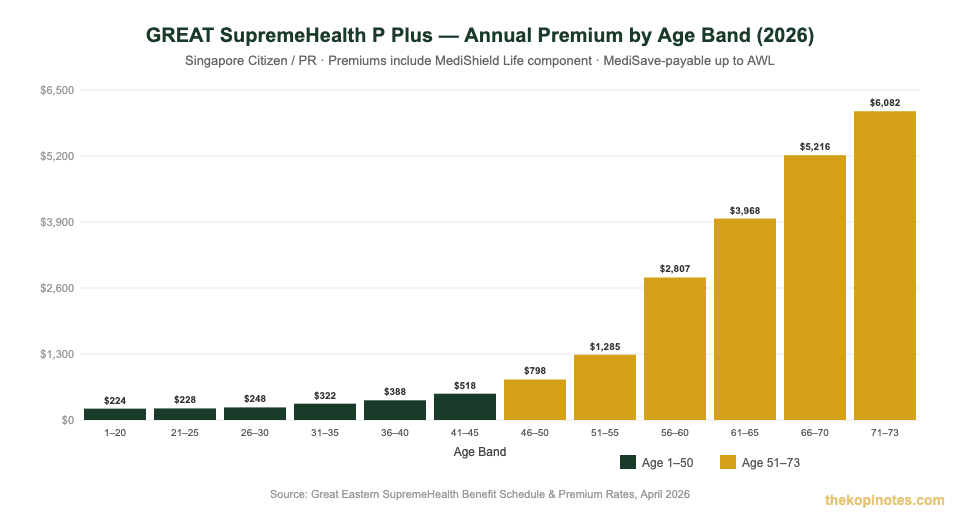
GREAT SupremeHealth P Plus is Great Eastern’s private hospital Integrated Shield Plan (ISP) tier, covering Class A restructured and private hospital stays with an annual claim limit of $1.5 million. As at April 2026, annual premiums for a Singapore Citizen range from $224 (age 1–20) to $6,082 (age 71–73), payable via MediSave up to the Additional Withdrawal Limit (AWL). From 1 April 2026, new riders for P Plus can no longer cover the $3,500 annual deductible — meaning your maximum out-of-pocket cost per year has risen to $9,500.
Not financial advice. All figures are for educational reference only. Data as at April 2026 unless noted. Always verify current premiums directly with Great Eastern before purchasing.
- P Plus premiums have not changed dramatically — but the rider rules changed significantly from April 2026.
- New riders are ~30% cheaper but no longer cover your deductible. You pay the first $3,500 yourself each year.
- If you bought your rider before 27 November 2025, your existing coverage is grandfathered until renewal after April 2028.
Table of Contents
Contents — Click to expand
What Is GREAT SupremeHealth P Plus?
GREAT SupremeHealth is Great Eastern’s Integrated Shield Plan (ISP). In Singapore, all ISPs sit on top of MediShield Life — the mandatory national health insurance scheme. They extend your coverage to higher ward classes and private hospitals.
P Plus is the highest tier in the SupremeHealth range. It covers private hospital stays and Class A restructured hospital wards, with an annual benefit limit of $1.5 million. That’s well above what most Singaporeans will ever claim in a year — it’s essentially unlimited for practical purposes.
The plan is underwritten by Great Eastern Life Assurance, one of the five insurers authorised by the Ministry of Health (MOH) to offer ISPs. The other tiers — B Plus (Class B1 and above) and A Plus (Class A and above) — are cheaper but cap your hospital choice.
| Feature | Detail |
|---|---|
| Plan Name | GREAT SupremeHealth P Plus |
| Insurer | Great Eastern Life Assurance (Singapore) |
| Ward Coverage | Private hospital + Class A restructured hospital |
| Annual Benefit Limit | $1,500,000 per policy year |
| Deductible (private ward) | $3,500 per policy year (from April 2026) |
| Co-insurance | 10% of remaining bill after deductible |
| Co-pay cap (new riders) | $6,000 per policy year (above deductible) |
| Available Rider | GREAT TotalCare Plus (cash rider, optional) |
Source: Great Eastern SupremeHealth Benefit Schedule & Premium Rates, April 2026
P Plus Premium Table 2026 (All Age Bands)
The premiums below cover Singapore Citizens and Permanent Residents. They include the MediShield Life component, which is the mandatory base layer. You pay the full premium via MediSave up to the Additional Withdrawal Limit (AWL) — and then cash for anything above the AWL.
These rates took effect from 1 April 2026 following Great Eastern’s annual premium review and the MOH restructuring of ISP riders.
| Age Band | Annual Premium (SGD) | Monthly Equivalent | MediSave-Payable? |
|---|---|---|---|
| 1–20 | $224 | ~$19/mo | Yes (up to AWL) |
| 21–25 | $228 | ~$19/mo | Yes |
| 26–30 | $248 | ~$21/mo | Yes |
| 31–35 | $322 | ~$27/mo | Yes |
| 36–40 | $388 | ~$32/mo | Yes |
| 41–45 | $518 | ~$43/mo | Yes |
| 46–50 | $798 | ~$67/mo | Yes (partial cash above AWL) |
| 51–55 | $1,285 | ~$107/mo | Partial — cash top-up required |
| 56–60 | $2,807 | ~$234/mo | Partial — significant cash top-up |
| 61–65 | $3,968 | ~$331/mo | Partial — significant cash top-up |
| 66–70 | $5,216 | ~$435/mo | Partial — large cash top-up |
| 71–73 | $6,082 | ~$507/mo | Partial — largest cash component |
Source: Great Eastern SupremeHealth Benefit Schedule & Premium Rates, April 2026. Premiums include MediShield Life component. Rider premiums are additional and must be paid in cash.
Important: Rider premiums (for GREAT TotalCare Plus) are on top of the above and must be paid entirely in cash — MediSave cannot be used for riders.
April 2026 Rider Changes: What Actually Changed
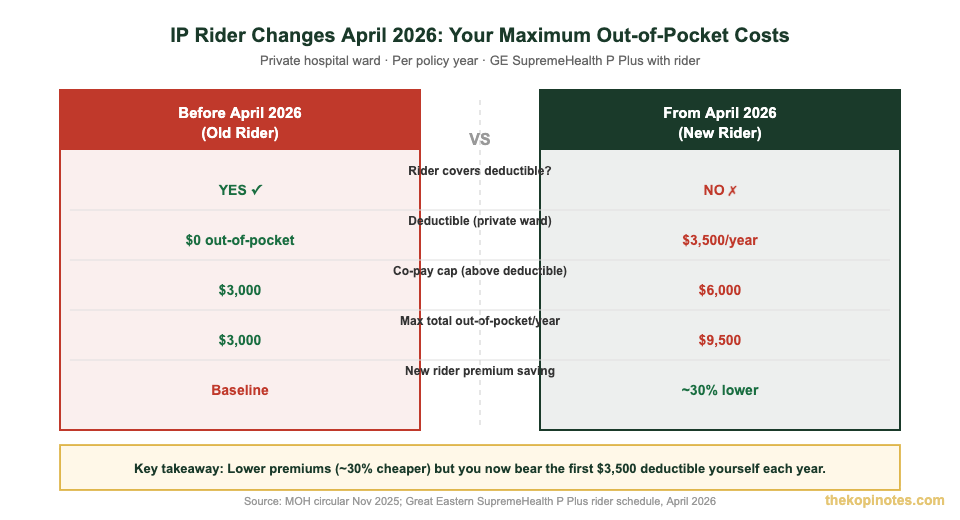
This is the big one. From 1 April 2026, MOH mandated that all new IP riders sold in Singapore can no longer cover the minimum annual deductible. This affects every insurer — not just Great Eastern.
Here’s the before-and-after for P Plus policyholders with a private hospital rider:
| What Changed | Before April 2026 | From April 2026 |
|---|---|---|
| Rider covers deductible? | Yes — $0 out-of-pocket | No — you pay first $3,500 |
| Co-payment cap | $3,000 max per year | $6,000 max per year |
| Max out-of-pocket (private) | $3,000 | $9,500 ($3,500 + $6,000) |
| New rider premium | Higher (full coverage) | ~30% lower on average |
| Existing rider holders | Grandfathered if bought before 27 Nov 2025 | Must transition at renewal after 1 April 2028 |
Source: MOH press release, November 2025; Great Eastern rider schedule, April 2026
MOH’s rationale was sustainability. When riders covered 100% of hospital bills, policyholders had little incentive to moderate healthcare usage. This drove up private hospital costs for everyone. The new co-payment structure reintroduces some “skin in the game” — without removing the catastrophic coverage that ISPs are designed for.
The 30% rider premium reduction helps offset the higher potential out-of-pocket cost. Whether you come out ahead depends on how often you actually claim. If you go years without a hospitalisation, you save on premiums. If you need major surgery, you pay up to $9,500 more than before.
The Deductible Explained: What You Now Pay
A deductible is the amount you pay before your insurance kicks in. Under the new P Plus rider rules, you pay the first $3,500 per policy year — regardless of how many hospital admissions you have in that year.
Here’s a worked example. You’re 42 years old. You have a planned surgery at a private hospital and your total bill is $28,000.
| Bill Component | Who Pays | Amount |
|---|---|---|
| Deductible (first portion) | You | $3,500 |
| Remaining bill ($24,500) — co-insurance 10% | You | $2,450 (capped at $6,000) |
| Remainder of bill | Great Eastern (P Plus) | $22,050 |
| Your total out-of-pocket | You | $5,950 |
Illustrative example only. Actual claims subject to policy terms, panel conditions, and MediShield Life component offsets.
In the worst case — if your co-insurance hits the $6,000 cap — your maximum out-of-pocket for the year is $9,500 ($3,500 deductible + $6,000 co-pay cap). For most Singaporeans, that’s a manageable emergency fund target. You can use our Singapore retirement calculator to factor this into your long-term planning.
MediSave vs Cash: How to Pay for P Plus
Your P Plus plan premium can be paid via MediSave, but only up to the Additional Withdrawal Limit (AWL) set by CPF. The AWL increases with age because premiums rise as you get older.
For younger policyholders (under 40), MediSave typically covers the full P Plus premium. But from your 50s onwards, you’ll need to top up with cash — sometimes significantly. At age 61–65, you’re paying $3,968 per year. If the AWL for your age covers $1,400, you’re paying $2,568 out of pocket in cash.
Here’s what you should know about the payment rules:
- The ISP base plan premium can be paid via MediSave (up to AWL).
- The GREAT TotalCare Plus rider must be paid in full in cash — no MediSave allowed.
- If your MediSave balance is insufficient, premiums can be paid via the CPF member’s or spouse’s MediSave.
- Foreigners on Employment Pass can purchase P Plus and pay premiums in cash.
For a deeper understanding of how to maximise your CPF for healthcare and investments, see our guide on CPF investment strategy Singapore.
P Plus vs Other ISP Tiers
P Plus isn’t the only tier in the SupremeHealth range — and it may not be the right one for you. Here’s how it stacks up against the other options, and against rival insurers’ equivalent tiers.
| Plan | Insurer | Ward Coverage | Annual Limit | Est. Premium (Age 40) |
|---|---|---|---|---|
| SupremeHealth P Plus | Great Eastern | Private + Class A | $1.5M | ~$388 |
| SupremeHealth A Plus | Great Eastern | Class A + B1 | $800K | ~$280 |
| SupremeHealth B Plus | Great Eastern | Class B1 and above | $500K | ~$200 |
| HealthShield Gold Max A | AIA | Private + Class A | As charged | ~$400 |
| PRUShield Premier | Prudential | Private + Class A | As charged | ~$395 |
Source: Individual insurer benefit schedules, April 2026. Premiums are approximate and vary by exact age and insurer. Verify current rates before purchasing.
At the private hospital tier, pricing across insurers is broadly similar at younger ages. The bigger differences emerge at older ages (60+), where premium structures diverge more. It’s worth comparing across all five ISP providers before committing — see the official MOH ISP comparison table for the current official data.
You can also read our complete Great Eastern Integrated Shield Plan review which covers all SupremeHealth tiers in detail.
Should You Choose P Plus in 2026?
P Plus makes sense in specific situations. Here’s a simple framework:
P Plus is a good fit if you:
- Want access to any private hospital or specialist in Singapore without panel restrictions.
- Are willing to self-insure the $3,500 deductible each year (a manageable emergency fund target).
- Prefer to keep your rider costs lower and accept the higher co-pay cap of $6,000.
- Have a complex medical history and want maximum choice of specialists.
- Are aged under 45, where premiums are still relatively affordable without heavy cash top-ups.
Consider downgrading or alternatives if you:
- Are happy with Class A restructured hospitals — SupremeHealth A Plus covers these at a lower premium.
- Are 55+ and face premium increases that require substantial cash payments above the MediSave AWL.
- Prefer an ISP with a strong panel hospital network and don’t mind panel restrictions — some other insurers offer better panel perks.
- Are a foreigner on a temporary pass — compare the full out-of-pocket costs carefully, as you cannot rely on MediSave.
The best ISP for you depends on your age, health status, and hospital preferences. We recommend using our ISP reviews as a starting point, then consulting a licensed financial adviser before purchasing.
For broader financial planning — including how healthcare costs fit into your retirement — try our Singapore retirement calculator.
Disclaimer: The information above is for educational purposes only and does not constitute financial, insurance, or medical advice. Premium data is based on publicly available insurer schedules as at April 2026. Always obtain a personalised quotation from a licensed financial adviser or directly from Great Eastern before making any insurance decision.
Frequently Asked Questions
What is GREAT SupremeHealth P Plus and who is it for?
GREAT SupremeHealth P Plus is Great Eastern’s highest-tier Integrated Shield Plan (ISP), covering stays in private hospitals and Class A restructured hospital wards. It’s designed for Singapore Citizens, PRs, and eligible foreigners who want maximum flexibility in choosing hospitals and specialists, with an annual claim limit of $1.5 million. It’s most suitable for those who want access to any private hospital without panel restrictions and are willing to pay higher premiums compared to lower ISP tiers.
What changed in April 2026 for SupremeHealth P Plus riders?
From 1 April 2026, MOH mandated that all new IP riders — including those for P Plus — can no longer cover the minimum annual deductible. For a private hospital ward, this deductible is $3,500 per policy year. Previously, riders could cover this entirely, leaving you with no deductible to pay. The co-payment cap also increased from $3,000 to $6,000. In exchange, new rider premiums are approximately 30% lower than before. Your maximum annual out-of-pocket cost under the new rules is $9,500 ($3,500 deductible + $6,000 co-pay cap).
Are existing P Plus riders grandfathered under the new rules?
Yes — if you purchased your IP rider before 27 November 2025, your existing benefits are grandfathered. However, this grandfathering is not permanent. Existing old-style riders must transition to the new-style riders at their first renewal after 1 April 2028. If you are in this situation, do not voluntarily cancel or switch your rider before that date, as you will lose your grandfathered status and immediately fall under the new co-payment rules.
Can I use MediSave to pay for GREAT SupremeHealth P Plus?
Yes, the base plan premium can be paid via MediSave, up to the Additional Withdrawal Limit (AWL) set by CPF. The AWL varies by age — younger policyholders typically have their full premium covered by MediSave. From age 50 onwards, you will likely need to top up with cash, as premiums rise above the AWL. Importantly, the GREAT TotalCare Plus rider premium must be paid entirely in cash — MediSave cannot be used for any IP rider.
What is the deductible for GREAT SupremeHealth P Plus in 2026?
Under the April 2026 rules, the minimum annual deductible for P Plus (private hospital or Class A ward) is $3,500 per policy year. This means the first $3,500 of your hospital bill each year is your responsibility — insurance only kicks in after this threshold is met. Lower ward classes have lower deductibles: $2,500 for Class B1, $2,000 for Class B2, and $1,500 for Class C. The deductible applies per policy year, not per hospital admission.
How does GREAT SupremeHealth P Plus compare to AIA HealthShield Gold Max A?
Both P Plus and AIA HealthShield Gold Max A cover private hospital stays at similar premium levels for those aged under 50. The main differences come down to panel hospital networks and rider features. AIA has historically had strong panel perks with certain private hospitals. Great Eastern’s SupremeHealth P Plus offers competitive premiums across age bands and a straightforward claims process. For a detailed comparison, it’s worth getting quotations from both insurers and comparing the specific panel conditions and rider options available to you.
Is it worth upgrading to P Plus from a lower SupremeHealth tier?
Upgrading to P Plus from A Plus or B Plus adds access to private hospitals without panel restrictions, at a higher premium. Whether it’s worth it depends on how much you value that flexibility. If you’re comfortable with Class A restructured hospitals like SGH or NUH — which have strong specialist care — A Plus covers these at a lower cost. If you want to see any private specialist or stay at Mount Elizabeth or Gleneagles without referral constraints, P Plus gives you that freedom. For younger policyholders where the premium difference is under $100–$150 per year, many choose P Plus for peace of mind.
Plan Your Healthcare & Retirement Together
Understanding your ISP is one piece of the puzzle. Use our tools to see the full picture.
Get Free Insurance Advice
Speak with a licensed insurance advisor. No obligation, no cost.
By submitting this form, you agree to our Privacy Policy.
This article was researched with the help of AI. While we strive to keep all information accurate and up to date, there may be errors. If you notice any discrepancies, please contact us.