Tiger Brokers Fees Singapore: Complete Guide (2026)
Commission rates, platform charges, FX fees and how to minimise your trading costs.
Tiger Brokers charges 0.06% per trade for US stocks (minimum USD 0.99) and 0.08% for Singapore stocks (minimum SGD 1.00). There are no platform fees, no inactivity fees, and no account minimum. For most Singapore retail investors trading USD 5,000–50,000 per trade, Tiger Brokers is one of the cheapest online brokers available — though Interactive Brokers (IBKR) edges ahead on very large trades.
Not financial advice. All figures are for educational reference only. Data as at June 2026 unless noted.
- Tiger Brokers fees are among the lowest in Singapore — 0.06% for US stocks, 0.08% for SG stocks, with no hidden platform charges.
- You pay an FX conversion fee (0.15% spread) when switching currencies — factor this into your total cost calculation.
- IBKR is cheaper for very large trades; Tiger Brokers is simpler and cheaper for typical retail-sized positions.
Table of Contents
Tiger Brokers Fees: Quick Overview
Tiger Brokers (also known as UP Fintech) launched in Singapore in 2020 and quickly became popular with retail investors hunting for low-cost access to US and Hong Kong stocks. The platform is regulated by MAS under a Capital Markets Services licence, which means your cash and securities are segregated and protected.
The fee model is simple: you pay a commission per trade, a small FX spread when you convert currencies, and nothing else. No monthly platform fee, no inactivity fee, no custody charge. This transparency is one of the main reasons Tiger Brokers grew so fast in Singapore.
Here is a quick summary of all Tiger Brokers fees at a glance:
| Fee Type | Amount | Notes |
|---|---|---|
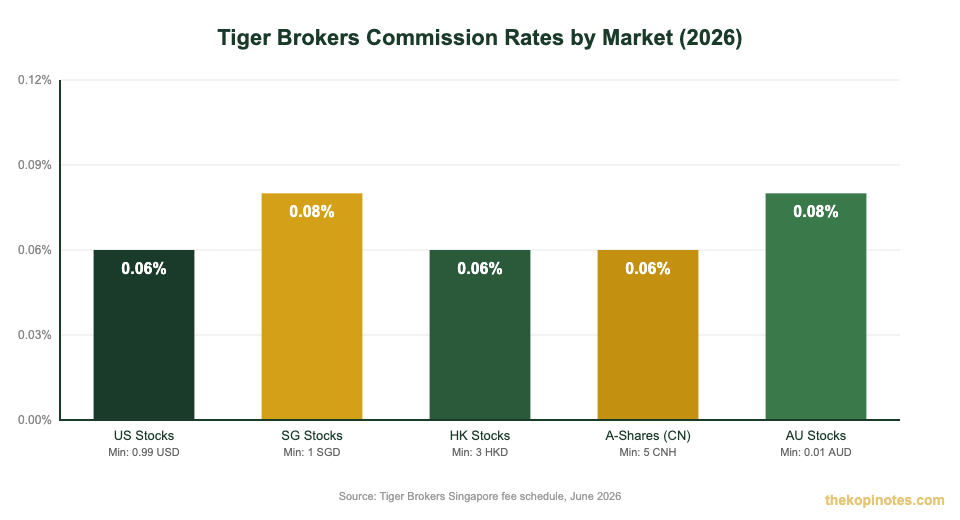
| US Stock Commission | 0.06% (min USD 0.99) | Per trade |
| SG Stock Commission | 0.08% (min SGD 1.00) | Per trade, excl. SGX clearing fee |
| HK Stock Commission | 0.06% (min HKD 3.00) | Per trade, excl. SFC levy |
| A-Shares Commission | 0.06% (min CNH 5.00) | Via Stock Connect |
| FX Conversion | 0.15% spread | Built into exchange rate |
| Platform Fee | SGD 0 | No monthly charge |
| Inactivity Fee | SGD 0 | No inactivity penalty |
| Deposit / Withdrawal | SGD 0 | Free via bank transfer |
Source: Tiger Brokers Singapore fee schedule, June 2026. Third-party exchange and clearing fees may apply and are not included in Tiger’s commission.
Commission Rates by Market
Tiger Brokers uses a percentage-of-trade-value model rather than a per-share model. This is generally better for small trades (you don’t pay a minimum that eats into small positions) and competitive for medium-sized trades. However, per-share pricing (like IBKR’s) can be cheaper on very large trades in expensive stocks.
US Stocks and ETFs
The US market is where most Singapore investors focus. Tiger Brokers charges 0.06% per trade, with a minimum of USD 0.99. This is the all-in commission — there are no additional SEC fees or exchange fees on top of this for retail investors.
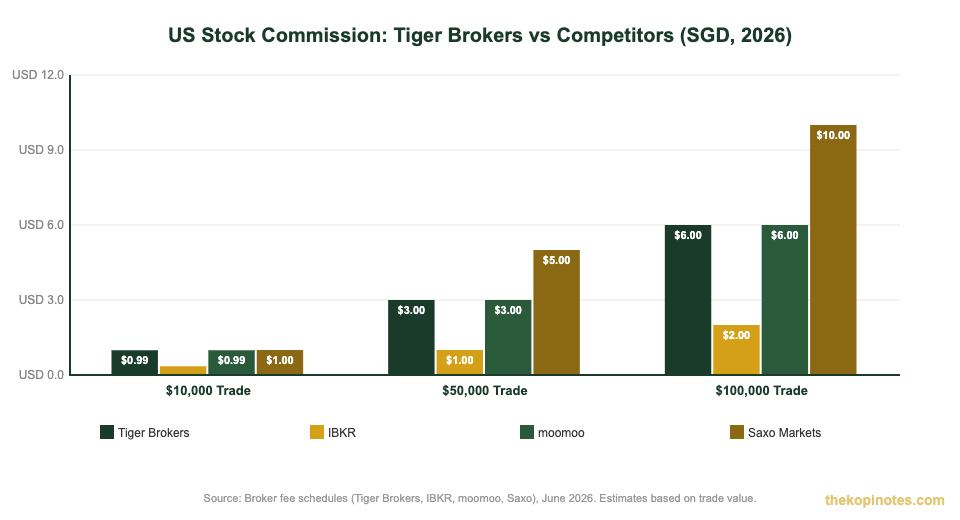
In practice, you hit the minimum on any trade below USD 1,650 (0.06% × USD 1,650 = USD 0.99). If you’re buying a single Apple or Nvidia share worth USD 100–200, you pay USD 0.99 each way. For a USD 10,000 trade, you pay USD 6.00. That’s very competitive.
Singapore Stocks (SGX)
For SGX-listed stocks, Tiger charges 0.08% per trade, minimum SGD 1.00. On top of this, you also pay SGX clearing fees (0.0325%) and SGX trading access fee (0.0075%) — these are third-party charges that all brokers pass through. Tiger doesn’t mark these up.
Traditional local brokers like DBS Vickers and UOB Kay Hian typically charge 0.18%–0.28% for the same trades. Tiger Brokers is roughly 2–3× cheaper on commission alone.
Hong Kong Stocks
HK stocks come in at 0.06% per trade, minimum HKD 3.00. Additional regulatory levies (SFC transaction levy at 0.0027%, HKEX trading fee at 0.005%) apply as pass-throughs — Tiger doesn’t add a markup.
Australian and Chinese Stocks
Australian stocks trade at 0.08% per trade, minimum AUD 0.01 — effectively no meaningful minimum. Chinese A-shares via Stock Connect cost 0.06% per trade, minimum CNH 5.00.
FX, Platform & Other Fees
Beyond commissions, the biggest hidden cost for Singapore investors is the FX conversion fee. When you deposit SGD and then buy USD-denominated stocks, Tiger automatically converts your SGD to USD. This conversion includes a 0.15% spread built into the exchange rate you see.
On a SGD 10,000 deposit converted to USD, that’s SGD 15 in FX cost. It’s not huge, but it adds to your total trading cost — especially if you convert frequently. The smarter approach: keep separate SGD and USD balances in your Tiger account and fund your USD wallet directly via a wire transfer in USD from a multi-currency account like Wise or YouTrip.
Here’s a full breakdown of all charges you might encounter:
| Charge | Amount | Avoidable? |
|---|---|---|
| Trade Commission | 0.06%–0.08% | No (this is the core fee) |
| FX Conversion Spread | ~0.15% | Yes — deposit in target currency |
| SGX Clearing Fee | 0.0325% | No (exchange pass-through) |
| SGX Trading Access Fee | 0.0075% | No (exchange pass-through) |
| Withdrawal Fee | Free | N/A |
| Inactivity Fee | SGD 0 | N/A — none charged |
| Options Contracts | USD 0.65/contract (min USD 1.00) | Per leg, US options only |
Source: Tiger Brokers Singapore fee schedule, June 2026.
Tiger Brokers vs Competitors: Fee Comparison
Tiger Brokers doesn’t exist in a vacuum. As a Singapore investor, you have several alternatives — each with a different fee model. Here’s how Tiger stacks up against the most popular options for US stock trading, which is where most retail investors spend their time.
| Broker | US Stock Commission | SG Stock Commission | Platform Fee | FX Spread |
|---|---|---|---|---|
| Tiger Brokers | 0.06% (min USD 0.99) | 0.08% (min SGD 1.00) | None | ~0.15% |
| IBKR (Tiered) | USD 0.005/share (min USD 1.00) | 0.05% (min SGD 2.50) | None (Lite) | ~0.08% |
| moomoo | 0.06% (min USD 0.99) | 0.05% (min SGD 0.99) | None | ~0.15% |
| Saxo Markets | 0.10% (min USD 5.00) | 0.10% (min SGD 6.00) | None | ~0.25% |
| DBS Vickers | 0.28% (min USD 25.00) | 0.18% (min SGD 25.00) | None | ~0.50% |
| Syfe Brokerage | 0.10% (min USD 1.49) | 0.10% (min SGD 1.49) | None | ~0.15% |
Source: Individual broker fee schedules, June 2026. IBKR tiered pricing shown; fixed pricing differs. Always check current rates on each broker’s website before trading.
The clearest pattern: Tiger Brokers and moomoo are essentially identical on US stock fees. IBKR is cheaper for high-volume traders buying lots of shares (per-share pricing wins on large positions in mid-priced stocks). DBS Vickers and Saxo are significantly more expensive — you’re paying a premium for brand recognition and local bank integration.
One important note: if you’re looking for a moomoo Singapore review to compare head-to-head, both platforms are strong choices for US and HK trading — the decision often comes down to the sign-up promotions available at the time.
Real Cost Examples for Singapore Investors
Percentages can be abstract. Let’s look at what Tiger Brokers fees actually cost you in SGD for typical retail trades. All examples assume you’ve already deposited in the correct currency (no additional FX cost).
Example 1: Buying USD 2,000 of Apple (AAPL) on US market
Commission: 0.06% × USD 2,000 = USD 1.20 (above the USD 0.99 minimum). Return journey (when you sell): another USD 1.20. Total round-trip cost: USD 2.40, or roughly SGD 3.20. That’s 0.12% of your trade value — excellent for a retail investor.
Example 2: Buying SGD 5,000 of DBS shares on SGX
Tiger commission: 0.08% × SGD 5,000 = SGD 4.00. SGX clearing fee: 0.0325% × SGD 5,000 = SGD 1.63. SGX trading access fee: 0.0075% × SGD 5,000 = SGD 0.38. Total: SGD 6.01 one-way, SGD 12.02 round-trip. Contrast this with DBS Vickers minimum SGD 25 each way — Tiger saves you SGD 38 on this trade alone.
Example 3: SGD-to-USD conversion cost
If you deposit SGD 10,000 and convert it all to USD to buy US stocks, the FX spread of 0.15% costs you SGD 15. To avoid this, fund your USD wallet directly in USD. You can use a multi-currency card to withdraw USD cheaply before wiring.
For context, that’s 0.16% round-trip on a SGD 10,000 position. Over a 5-year holding period with quarterly rebalancing, your transaction costs add up — but Tiger’s rates make this manageable for long-term investors.
How to Minimise Your Tiger Brokers Fees
You can’t avoid the commission, but you can reduce total costs with a few simple steps.
Deposit in the right currency. The single biggest lever is avoiding the FX conversion. Fund your USD wallet via a USD bank transfer or convert SGD to USD using a low-spread service before depositing. Services like Wise convert at near-interbank rates for a fraction of 0.15%.
Trade in fewer, larger lots. Because Tiger uses percentage pricing, your cost per dollar invested stays the same whether you do 10 trades of SGD 1,000 or 1 trade of SGD 10,000. However, consolidating trades reduces the number of times you pay the minimum fee. If you’re dollar-cost averaging (DCA) every month, consider using a Regular Savings Plan (RSP) for SG stocks instead — check out our passive income Singapore guide for how RSPs compare to direct stock purchases.
Use limit orders, not market orders. Market orders on less liquid stocks can result in unfavourable fill prices that effectively increase your real cost. Limit orders let you control the price — especially useful for smaller-cap SGX stocks with wider bid-ask spreads.
Claim your sign-up promotions. Tiger Brokers regularly offers commission-free trades for new accounts. Check the current Tiger Brokers promotion page before opening. If you’re evaluating robo-advisors alongside brokerage accounts, the Endowus referral code gives you fee waivers on your first investment — worth comparing for passive investors who don’t want to pick individual stocks.
Consider your total portfolio cost. If you’re building a long-term ETF portfolio, factor in the broker’s FX spread, the ETF’s TER (Total Expense Ratio — the annual management fee), and your own trading frequency. A low-TER ETF held through Tiger Brokers can be a very cost-efficient setup. For a detailed breakdown of how ETF costs compound over time, see our Singapore retirement calculator.
Is Tiger Brokers Worth It?
Tiger Brokers makes sense for most Singapore retail investors who trade US or HK stocks at least occasionally. The fee structure is transparent, the minimums are low, and the app is genuinely good for tracking your portfolio.
Tiger Brokers is ideal if you:
- Trade US stocks or ETFs in the USD 1,000–50,000 range per trade
- Also want access to SG, HK, and A-share markets from a single app
- Want zero platform fees and no inactivity penalties
- Are a beginner who doesn’t want to deal with the complexity of IBKR’s tiered pricing
Consider alternatives if you:
- Trade very large positions (USD 100,000+) where IBKR’s per-share pricing wins
- Want CPF-investable stocks (Tiger Brokers is not a CPFIS-approved agent)
- Prefer a robo-advisor to pick and manage your portfolio — in that case, look at Syfe referral code for automated ETF investing, or syfe vs endowus 2026 to compare the two top robo-advisors
- Need a broker that offers SRS-eligible structured products or bonds — check our CPF investment strategy Singapore guide
For most investors building a long-term stock or ETF portfolio, Tiger Brokers offers one of the best cost structures available in Singapore in 2026. The main competition is moomoo (near-identical fees, different app experience) and IBKR (cheaper at scale, steeper learning curve).
Not financial advice. Always compare current fee schedules before opening an account, as brokers update pricing periodically.
Frequently Asked Questions
What is the Tiger Brokers commission rate for US stocks in Singapore?
Tiger Brokers charges 0.06% per trade for US stocks, with a minimum of USD 0.99 per trade. This means any US stock trade below USD 1,650 is capped at the USD 0.99 minimum. There are no additional platform or custody fees on top of this commission.
Does Tiger Brokers charge an inactivity fee or monthly platform fee?
No. Tiger Brokers does not charge an inactivity fee or a monthly platform fee. You can open an account, not trade for months, and pay nothing. This makes it suitable for investors who trade infrequently or want to keep a brokerage account on standby.
What is Tiger Brokers' FX conversion fee?
Tiger Brokers applies a foreign exchange spread of approximately 0.15% when you convert between currencies within the app — for example, from SGD to USD before buying US stocks. You can avoid this by depositing funds directly in the currency you need (e.g. depositing USD via bank transfer to fund US stock purchases).
Is Tiger Brokers cheaper than IBKR for Singapore investors?
It depends on your trade size. For small to medium trades (under USD 50,000 per trade), Tiger Brokers is simpler and similarly priced to IBKR. For large trades or high-frequency investors buying hundreds of shares at a time, IBKR’s tiered per-share pricing (USD 0.005/share, min USD 1.00) can work out cheaper. IBKR also has a lower FX conversion spread of around 0.08% vs Tiger’s 0.15%.
Can I use Tiger Brokers to invest my CPF or SRS funds?
Tiger Brokers is not a CPF Investment Scheme (CPFIS) approved agent, so you cannot use your CPF Ordinary Account (OA) or Special Account (SA) to invest via Tiger. However, Tiger Brokers does support SRS (Supplementary Retirement Scheme) investments — you can link your SRS account to buy eligible SRS instruments. Check Tiger’s latest SRS eligibility list before investing, as not all products are SRS-eligible.
Is Tiger Brokers safe and regulated in Singapore?
Yes. Tiger Brokers Singapore (Tiger Fintech (SG) Pte. Ltd.) holds a Capital Markets Services (CMS) licence issued by the Monetary Authority of Singapore (MAS). Client assets — both cash and securities — are held in segregated accounts separate from Tiger’s own funds. This means if Tiger were to face financial difficulties, your assets are protected and cannot be used to settle Tiger’s debts.
Ready to Start Investing?
Compare the best brokers and robo-advisors for Singapore investors. Use our referral links for exclusive sign-up bonuses.
This article was researched with the help of AI. While we strive to keep all information accurate and up to date, there may be errors. If you notice any discrepancies, please contact us.