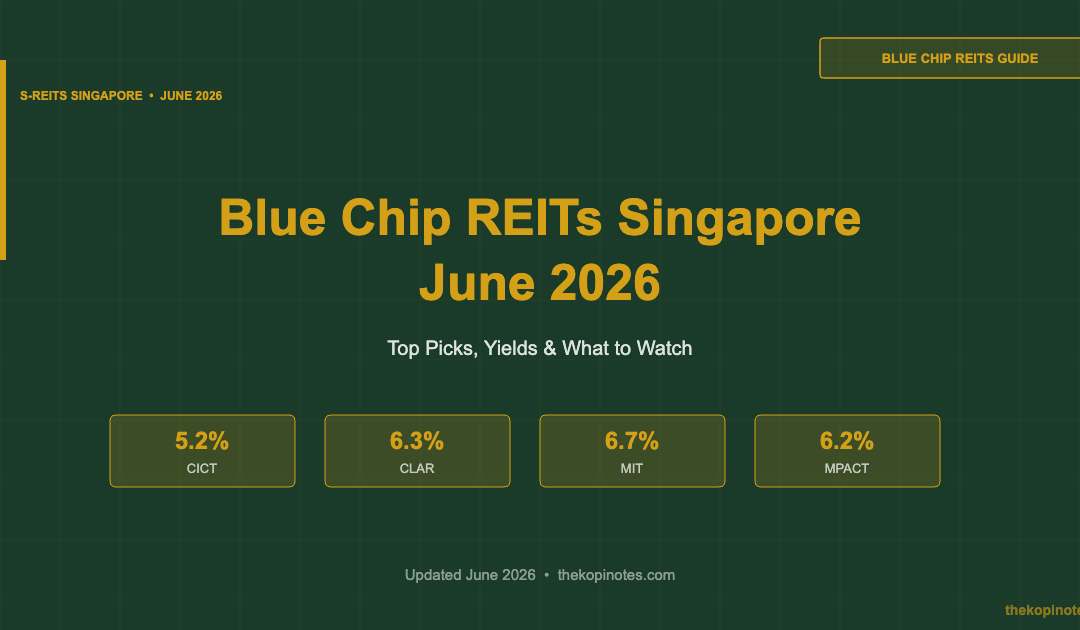
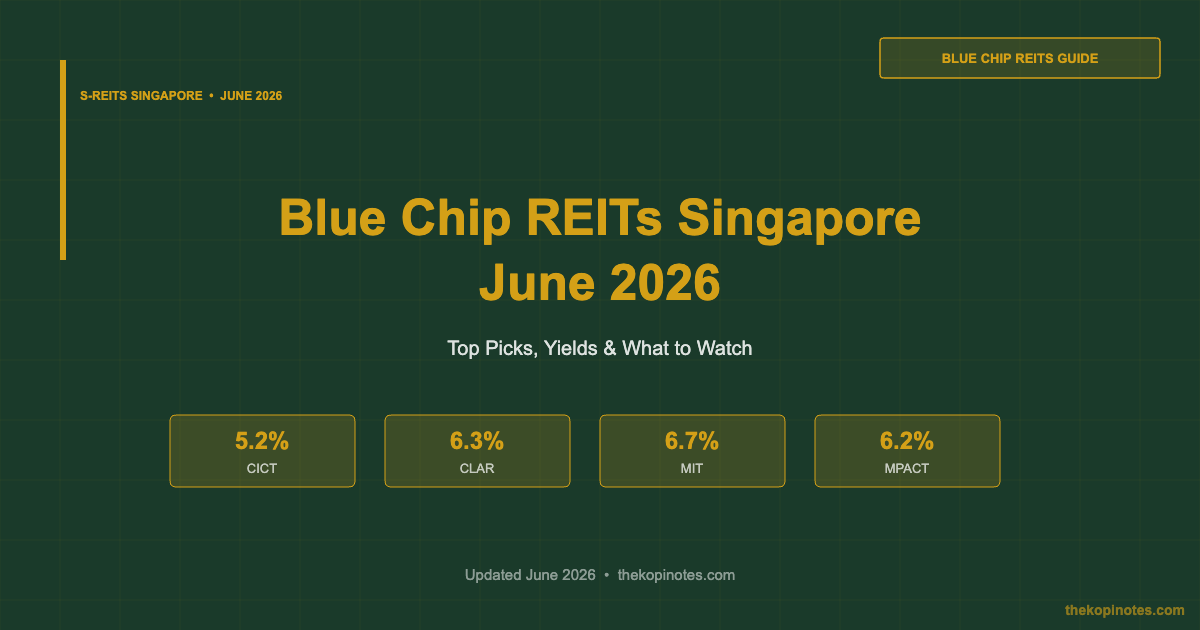
Blue chip REITs in Singapore are large-cap, well-diversified real estate investment trusts listed on the SGX that are widely regarded as lower-risk income investments. As at June 2026, the top blue chip S-REITs — including CapitaLand Integrated Commercial Trust (CICT), CapitaLand Ascendas REIT (CLAR), Mapletree Industrial Trust (MIT) and Mapletree Pan Asia Commercial Trust (MPACT) — offer dividend yields ranging from 5.2% to 6.7%, with most trading near multi-year lows despite resilient operational performance.
Not financial advice. All figures are for educational reference only. Data as at June 2026 unless noted.
- Blue chip S-REITs yield 5.2%–6.7% as at June 2026, with the iEdge S-REIT Index averaging ~6.3%
- The sector underperformed the STI by ~16% YTD as rising bond yield fears weighed on sentiment — but fundamentals remain solid
- CLAR, MIT and CICT are our top watch-list picks for long-term income investors in June 2026
Table of Contents
Jump to Section
- What Are Blue Chip REITs in Singapore?
- Blue Chip REIT Yield Table — June 2026
- 1. CICT (C38U) — Retail & Office Giant
- 2. CLAR (A17U) — Industrial & Data Centre Leader
- 3. MIT (ME8U) — Pure-Play Industrial REIT
- 4. MPACT (N2IU) — Pan-Asia Commercial
- S-REIT Sector Outlook June 2026
- How to Buy Blue Chip REITs in Singapore
- FAQ
What Are Blue Chip REITs in Singapore?
In Singapore, “blue chip” is a term borrowed from the stock market. It means a large, well-established company with a long track record. When applied to REITs, it typically means:
- Large market capitalisation — usually above S$3 billion on the SGX
- Institutional-grade sponsors — backed by major conglomerates like CapitaLand, Mapletree, or Keppel
- Diversified portfolios — multiple properties across sectors or geographies
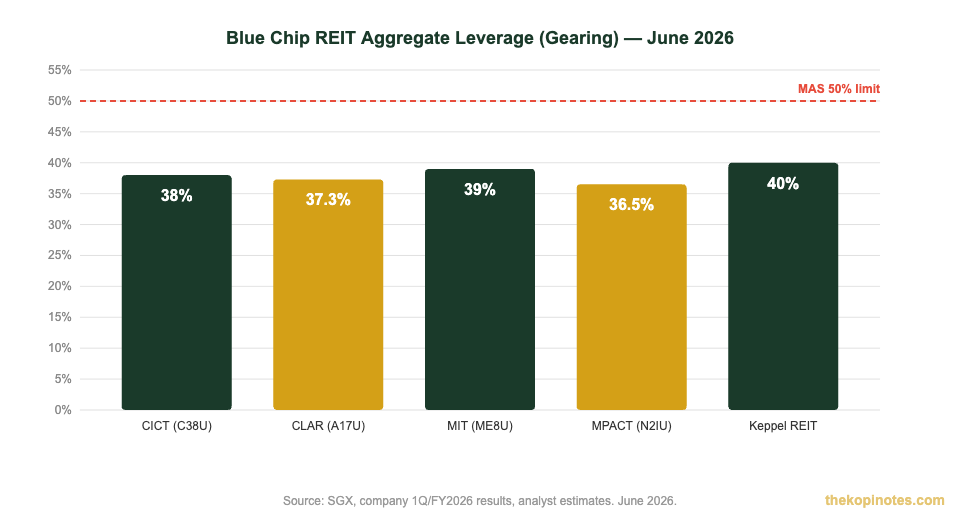
- Conservative gearing — aggregate leverage well below the MAS limit of 50%
- Consistent DPU track record — relatively stable distributions even through market cycles
Think of blue chip REITs as the “safe harbour” of the S-REIT universe. You sacrifice some upside potential compared to smaller, higher-yield REITs — but you get lower volatility, better liquidity, and stronger downside protection.
The four REITs that most Singapore investors consider true “blue chips” are CICT, CLAR, MIT, and MPACT. All four are backed by CapitaLand Group or Mapletree Investments, and all four have market caps exceeding S$5 billion.
Blue Chip REIT Yield Table — June 2026
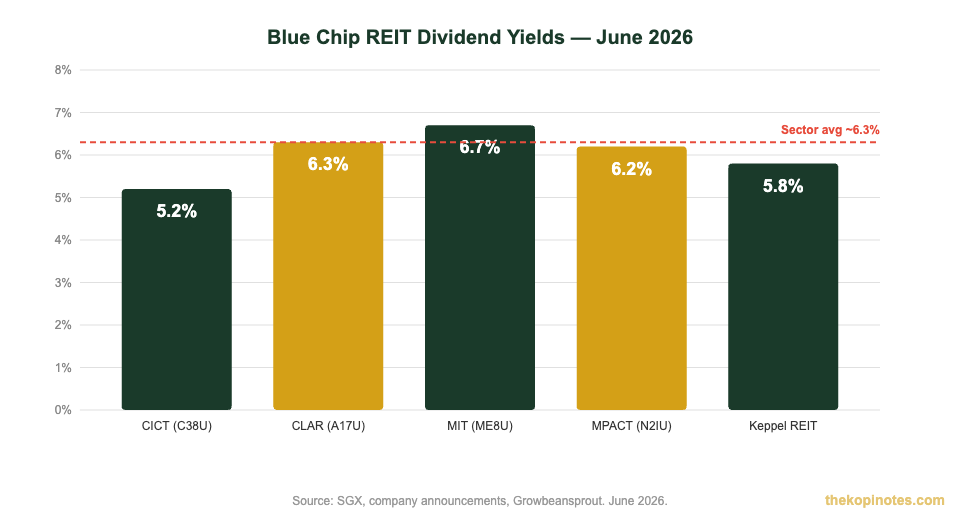
Here’s a snapshot of how the top blue chip S-REITs are positioned as at June 2026. Yields are based on trailing twelve-month DPU divided by the latest unit price.
| REIT (SGX Code) | Sector | Unit Price (Jun 2026) | TTM DPU | Dividend Yield | Gearing |
|---|---|---|---|---|---|
| CICT (C38U) | Retail & Office | S$2.33 | ~S$0.121 | 5.2% | ~38% |
| CLAR (A17U) | Industrial & Data Centre | S$2.46 | ~S$0.187 | 6.3% | ~37.3%* |
| MIT (ME8U) | Industrial | S$1.94 | ~S$0.127 | 6.7% | ~39% |
| MPACT (N2IU) | Pan-Asia Commercial | ~S$1.28 | ~S$0.0797 | 6.2% | 36.5% |
| Keppel REIT (K71U) | Office | ~S$0.86 | ~S$0.050 | 5.8% | ~40% |
*CLAR gearing post-April 2026 equity fundraising. Sources: SGX, company announcements, Growbeansprout, June 2026.
The iEdge S-REIT Index market-cap-weighted average yield sits at approximately 6.3% as at May 2026 — well above Singapore’s CPF OA rate of 2.5% and competitive with current T-bill yields.
1. CICT (C38U) — Singapore’s Largest Retail & Office REIT
CapitaLand Integrated Commercial Trust (CICT) is Singapore’s largest REIT by market cap, owning a portfolio of retail malls (like Raffles City, Plaza Singapura, and Bugis Junction) plus Grade-A office buildings in the CBD. It’s the bedrock of many Singapore dividend portfolios.
In 1Q 2026, CICT delivered solid results:
- Gross revenue up 8.0% year-on-year to S$426.7 million
- Net property income (NPI) up 7.9% YoY to S$314.4 million
- Portfolio occupancy at 95.2% as at 31 March 2026
- Positive rent reversions: retail +4.4%, office +6.1%
CICT also made a major strategic move: acquiring a 100% stake in Paragon (the Orchard Road mall) for S$3.9 billion, while simultaneously agreeing to divest Asia Square Tower 2 for S$2.476 billion. This repositions CICT as Singapore’s premium retail landlord.
The forward yield of 5.2% is the lowest of the four blue chips — but that reflects CICT’s lower risk profile. If you want the most defensive income play among blue chip REITs, CICT is it. It also has a long history of stable distributions through market cycles.
2. CLAR (A17U) — Industrial & Data Centre Powerhouse
CapitaLand Ascendas REIT (CLAR) is Singapore’s largest industrial REIT, owning business parks, logistics facilities, data centres, and life science properties across Singapore, Australia, the UK, and the US. It’s one of the most globally diversified S-REITs.
CLAR’s 1Q 2026 operational update was impressive:
- Rental reversion of +10.6% — showing tenants are paying significantly more on lease renewals
- Completed S$525 million in acquisitions, including a debut into Japan with a 49% stake in a Tier III hyperscale data centre in Greater Osaka
- Aggregate leverage of 42.0% at end-March, but expected to ease to ~37.3% after a S$903.5 million equity fundraising completed in April 2026
The equity fundraising did dilute existing unitholders short-term. However, the Japan data centre acquisition positions CLAR squarely in the AI-driven data centre demand wave — one of the strongest structural growth themes of 2026.
With a forward yield of around 6.3% and a TTM yield of 7.6% (as at mid-May 2026), CLAR offers an attractive entry point for investors willing to hold through integration. This REIT is a natural complement if you’re also building exposure to blue chip REITs near multi-year lows.
3. MIT (ME8U) — Pure-Play Singapore Industrial REIT
Mapletree Industrial Trust (MIT) focuses on Singapore industrial properties — flatted factories, hi-tech buildings, stack-up/ramp-up facilities — plus data centres in the US, Japan, and Singapore. It’s a purer SG-industrial play than CLAR, with more concentrated data centre exposure.
MIT’s FY2025/2026 results were softer:
- Full-year DPU fell 6.3% to S$0.1271
- 4QFY2026 DPU declined 8% YoY to S$0.0309
- Unit price around S$1.94 as at mid-June 2026
The DPU decline was largely driven by higher interest expenses and the dilutive effect of the recent equity placement. However, MIT’s data centre pipeline remains strong, and with a dividend yield of 6.7%, it offers the highest yield among the four core blue chips.
For income investors, a 6.7% yield from a Mapletree-sponsored REIT with data centre exposure is hard to ignore. That said, check that you’re comfortable with DPU potentially remaining flat or slightly lower over the next 12 months as financing costs stabilise.
4. MPACT (N2IU) — Pan-Asia Commercial Portfolio
Mapletree Pan Asia Commercial Trust (MPACT) owns Vivocity (Singapore’s largest mall), Mapletree Business City, and a pan-Asia portfolio of commercial assets in Hong Kong, China, Japan, and South Korea.
FY2025/2026 results reflected ongoing challenges in its overseas markets:
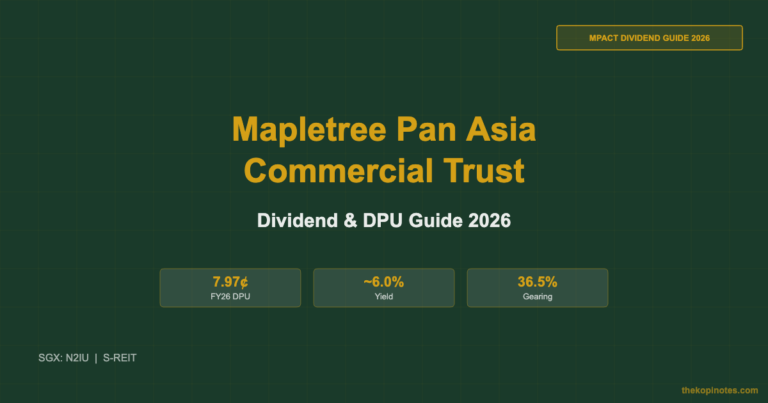
- Full-year DPU dipped 0.6% to S$0.0797
- Gross revenue fell 4.6% YoY to S$867.3 million
- Management completed three major divestments — TS Ikebukuro, ABAS Shin-Yokohama, and Festival Walk Tower — reducing aggregate leverage to a healthy 36.5%
MPACT’s divestment strategy shows management discipline. Selling non-core overseas assets and shoring up the balance sheet positions MPACT well for future acquisitions or capital management initiatives. Vivocity remains one of Singapore’s most resilient retail assets, with strong footfall and NPI growth.
Yield of around 6.2% is attractive. But watch the overseas portfolio performance — macro headwinds in Hong Kong and China remain a risk. You can read our more detailed analysis of building passive income with Singapore REITs for a framework on how to size your positions.
S-REIT Sector Outlook: June 2026
As at early June 2026, the FTSE ST All-Share REIT Index had fallen 6.7% year-to-date, while the broader Straits Times Index (STI) rose 9.1%. That’s a painful ~16 percentage point underperformance.
The culprits? The usual suspects:
- Rising bond yields — when yields go up, REIT valuations are discounted more heavily, pushing prices down
- Higher-for-longer interest rate fears — if rates stay elevated, REITs’ borrowing costs stay high, pressuring DPU
- Macro uncertainty — oil price volatility and concerns about China’s property sector continue to weigh on sentiment
However, the operational fundamentals of Singapore’s blue chip REITs are actually quite good:
- CICT reported 8% revenue growth in 1Q 2026
- CLAR delivered +10.6% rental reversions
- Portfolio occupancies across the sector remain largely above 90–95%
This is the classic setup where the market is pricing in macro fears while the underlying businesses keep performing. For long-term income investors, periods like this — where yields are elevated and prices are depressed — have historically been good entry points.
| Macro Factor | Impact on Blue Chip REITs | Outlook |
|---|---|---|
| Interest rates | Higher borrowing costs reduce DPU | Stabilising; further hikes unlikely |
| Bond yields (SG 10Y) | Compress REIT valuations | Elevated; spread to REIT yield narrows |
| Office demand | Positive for CICT, Keppel REIT | Strong SG Grade-A office rents in 2026 |
| Data centre demand | Positive for CLAR, MIT | AI-driven demand boom continues |
| Retail footfall | Positive for CICT, MPACT (Vivocity) | Singapore tourism recovery supporting malls |
Source: Growbeansprout, The Smart Investor, company 1Q 2026 results. June 2026.
How to Buy Blue Chip REITs in Singapore
You can buy S-REITs through any SGX-connected brokerage. The main options for Singapore retail investors in 2026:
- IBKR (Interactive Brokers) — lowest commissions for SGX trades, ideal for investors buying S$5,000+ at a time
- Syfe Trade — commission-free SGX trades, great for beginners. See the Syfe referral code and sign-up bonus for current promotions
- FSMOne — good for investors who want a one-stop platform across stocks, ETFs, and bonds. Check out our FSMOne referral code for bonus units
- Endowus — for CPF-OA-eligible REIT exposure via funds. See our Endowus referral code for a fee rebate
If you want to invest in blue chip REITs via CPF OA funds, note that only REITs approved under the CPF Investment Scheme (CPFIS) are eligible. CICT and CLAR are typically CPFIS-eligible — check the CPF Board website for the latest approved list.
For a broader guide, read our Singapore REIT complete guide 2026.
Track your REIT portfolio against your retirement goal using our free Singapore retirement calculator.
Frequently Asked Questions
What are blue chip REITs in Singapore?
What dividend yield do blue chip REITs offer in June 2026?
Which blue chip REIT has the highest yield in Singapore in 2026?
Are blue chip REITs safe investments in 2026?
Can I buy blue chip REITs with CPF money?
What is the difference between blue chip REITs and high-yield REITs in Singapore?
Disclaimer
This article is for educational and informational purposes only and does not constitute financial advice. All figures are sourced from publicly available company announcements and financial data as at June 2026. Yields, prices, and distributions are subject to change. The Kopi Notes may earn referral fees from broker links. Please consult a licensed financial adviser before making any investment decisions.
This article was researched with the help of AI. While we strive to keep all information accurate and up to date, there may be errors. If you notice any discrepancies, please contact us.