MOAT vs CSPX: Quality Factor vs Pure S&P 500 — Which Is Better for Singapore Investors? (2026)
A head-to-head comparison of VanEck’s wide moat strategy against the classic S&P 500 index — costs, taxes, performance, and which makes more sense for your portfolio.
MOAT is the VanEck Morningstar Wide Moat ETF — a US-listed fund that picks ~50 undervalued American companies with durable competitive advantages. CSPX is the iShares Core S&P 500 UCITS ETF, an Ireland-domiciled fund on the London Stock Exchange tracking all 500 large-cap US stocks. For Singapore investors, CSPX wins on tax efficiency (15% vs 30% withholding tax, no US estate tax), while MOAT offers a quality-factor tilt that has historically beaten the S&P 500 over certain periods — but at higher cost and with more concentration risk.
Not financial advice. All figures are for educational reference only. Data as at June 2026 unless noted.
- CSPX is cheaper (0.07% TER vs 0.46%), more tax-efficient for SG investors (15% WHT vs 30%), and avoids US estate tax entirely. For most Singapore investors, CSPX is the simpler, lower-cost choice.
- MOAT targets companies with sustainable competitive advantages (“economic moats”) and has beaten the S&P 500 in some long-term windows — but has underperformed in recent years when mega-cap tech dominated.
- You could hold both — 70% CSPX for broad core exposure and 30% MOAT as a quality satellite — but the extra tax drag on MOAT means you need real alpha to break even.
Table of Contents
Contents — Click to expand
What Is MOAT ETF?
MOAT is the ticker for the VanEck Morningstar Wide Moat ETF, a US-listed fund that tracks the Morningstar Wide Moat Focus Index. Instead of buying all 500 stocks in the S&P 500, MOAT narrows the field to roughly 50 US companies that Morningstar’s equity analysts believe have durable competitive advantages — what Warren Buffett famously calls “economic moats.”
The term “economic moat” refers to a company’s ability to maintain its competitive edge and protect its profits from rivals over the long term. Morningstar assigns moat ratings based on five sources: switching costs (hard for customers to leave), network effects (the product gets more valuable as more people use it), intangible assets (patents, brands, licences), cost advantages (producing goods cheaper than competitors), and efficient scale (operating in a market that naturally supports only a few players).
To make it into the index, a company needs two things: a “wide moat” rating from Morningstar (meaning the competitive advantage is expected to last at least 20 years) and a stock price trading below Morningstar’s fair value estimate. This means MOAT isn’t just a quality filter — it’s also a value filter. The fund buys undervalued quality companies and avoids overpriced ones, even if they have wide moats.
The index uses a staggered, equal-weighted structure. It’s split into two sub-portfolios of around 25 stocks each. One sub-portfolio rebalances in March and September, the other in June and December. This quarterly rotation means the portfolio is always refreshed with the latest undervalued wide-moat picks. Equal weighting also means MOAT avoids the mega-cap concentration that dominates the S&P 500.
MOAT was launched on 24 April 2012 and is listed on the NYSE Arca exchange. As at June 2026, it manages approximately USD 13 billion in assets. Top holdings have included names like Bristol Myers Squibb, Fortinet, United Parcel Service, and other companies across healthcare, technology, industrials, and financials.
What Is CSPX?
CSPX is the ticker for the iShares Core S&P 500 UCITS ETF, managed by BlackRock. It tracks the S&P 500 Index — the 500 largest publicly traded companies in the United States, weighted by market capitalisation. If you’ve heard of buying “the index,” this is probably the ETF people are talking about.
CSPX is domiciled in Ireland, listed on the London Stock Exchange (LSE), and structured as an accumulating fund. That means dividends from the underlying US stocks are automatically reinvested into the fund rather than paid out to you as cash. For Singapore investors, this structure is significant: Ireland’s tax treaty with the US reduces the dividend withholding tax from 30% to 15%, and the Ireland domicile sidesteps US estate tax entirely.
If you’re already familiar with VOO (Vanguard S&P 500 ETF), CSPX tracks the exact same index. The difference is structural. VOO is US-domiciled and listed on NYSE, meaning Singapore investors face 30% withholding tax on dividends and potential US estate tax exposure on holdings above USD 60,000. CSPX avoids both issues. You can read more about this in our CSPX ETF Singapore guide.
CSPX launched on 19 May 2010, making it one of the longest-running Ireland-domiciled S&P 500 ETFs. As at June 2026, it manages over USD 150 billion in net assets — one of the largest ETFs in the world. It holds 504 stocks, and the top 10 holdings (Apple, Microsoft, Nvidia, Amazon, Meta, Alphabet, etc.) make up roughly 35% of the fund due to market-cap weighting.
Key Differences at a Glance
| Feature | MOAT | CSPX |
|---|---|---|
| Full Name | VanEck Morningstar Wide Moat ETF | iShares Core S&P 500 UCITS ETF |
| Index Tracked | Morningstar Wide Moat Focus Index | S&P 500 Index |
| Number of Holdings | ~50 (equal-weighted) | ~504 (market-cap weighted) |
| TER (Expense Ratio) | 0.46% p.a. | 0.07% p.a. |
| AUM | ~USD 13 billion | ~USD 150 billion |
| Domicile | United States | Ireland |
| Listing Exchange | NYSE Arca (US) | London Stock Exchange (LSE) |
| Structure | Distributing | Accumulating |
| US Dividend WHT (for SG investors) | 30% | 15% |
| US Estate Tax Risk | Yes (above USD 60k) | None |
| Rebalance Frequency | Quarterly (staggered) | As needed (index changes) |
| Currency | USD | USD |
Source: VanEck and iShares factsheets, June 2026
Performance Comparison: MOAT vs S&P 500
This is where it gets interesting. MOAT’s track record is a mixed bag — and that’s actually important context for deciding whether to buy it.
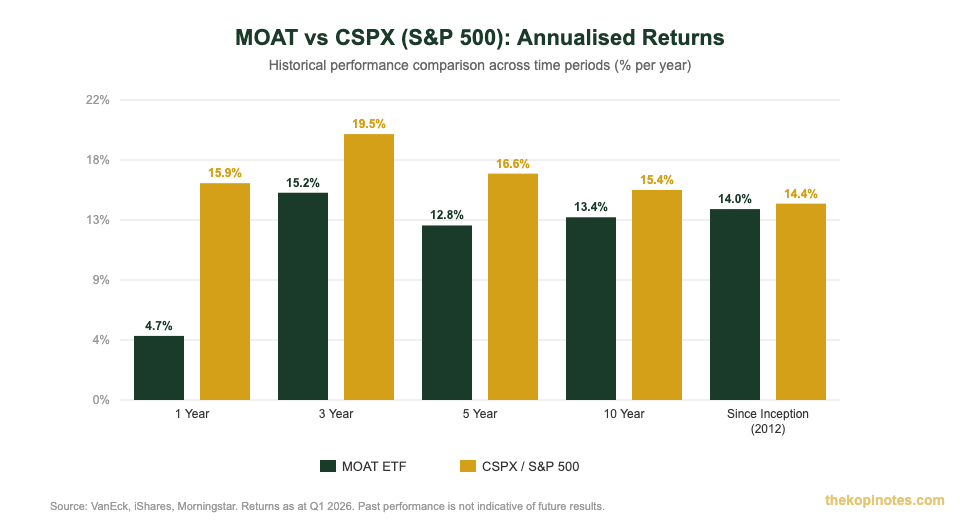
Since its launch in April 2012, MOAT has delivered an annualised return of approximately 14.0%, compared to around 14.4% for the S&P 500. Over the full life of the fund, the gap is narrow — less than half a percent per year. However, the story changes dramatically depending on which time window you look at.
| Period | MOAT (annualised) | S&P 500 (annualised) | Difference |
|---|---|---|---|
| 1 Year | ~4.7% | ~15.9% | -11.2% |
| 3 Years | ~15.2% | ~19.5% | -4.3% |
| 5 Years | ~12.8% | ~16.6% | -3.8% |
| 10 Years | ~13.4% | ~15.4% | -2.0% |
| Since Inception (2012) | ~14.0% | ~14.4% | -0.4% |
Source: VanEck, Morningstar, PortfoliosLab. Returns as at Q1 2026. Past performance is not indicative of future results.
The recent underperformance is largely explained by one factor: the AI-driven mega-cap rally. Since 2023, the S&P 500’s returns have been heavily concentrated in a handful of massive technology stocks — Nvidia, Apple, Microsoft, Meta, Amazon. MOAT’s equal-weighted, value-oriented approach meant it had zero exposure to Nvidia (Morningstar consistently rated it as overvalued) and underweighted the “Magnificent 7” relative to the cap-weighted S&P 500.
However, there have been periods where MOAT significantly outperformed. From 2016 to early 2023, the Morningstar Wide Moat Focus Index beat the S&P 500 by a meaningful margin. One data point: over the five years ending April 2023, MOAT was up roughly 76% versus 56% for the S&P 500. The fund also showed better downside protection during the 2020 COVID crash and the 2022 bear market, with a maximum drawdown of -33% versus -55% for the broader market since inception.
The takeaway? MOAT is not a fund that consistently beats the market every year. It’s a fund that tends to shine when market leadership broadens beyond mega-caps, and it struggles when a small number of very large stocks drive most of the returns.
The Moat Advantage — Why Quality Matters
The core thesis behind MOAT is simple: companies with sustainable competitive advantages tend to generate higher returns on invested capital (ROIC) over time, and buying them when they’re undervalued increases your odds of outperforming.
There’s academic backing for this idea. Research from Morningstar shows that wide-moat companies have historically delivered higher excess returns than no-moat companies over multi-decade periods. The reasons are intuitive — a company with strong pricing power, a sticky customer base, or a cost advantage can reinvest profits more efficiently than competitors.
MOAT adds a valuation overlay on top of the quality screen. It doesn’t just buy any wide-moat company — it buys the ones trading below Morningstar’s estimate of fair value. This value tilt means the fund avoids chasing expensive stocks, even if they have excellent moats. In 2024, for example, MOAT excluded Nvidia entirely because Morningstar judged it as overpriced relative to fair value — a call that cost the fund performance in the short term but reflects the disciplined methodology.
The equal-weighting approach is another differentiator. In the S&P 500, Apple alone can make up 7% of the index. In MOAT, every stock gets roughly the same weight (~2%). This means your returns aren’t dictated by a handful of mega-caps. When market breadth improves — meaning more stocks participate in the rally rather than just the biggest names — equal-weighted strategies tend to outperform.
That said, concentration is a double-edged sword. With only ~50 stocks versus 500 in the S&P 500, MOAT carries more idiosyncratic risk. A single bad earnings report from a top holding has a much larger impact on the fund. The 55% annual portfolio turnover also means more trading costs embedded in the fund, which partly explains the higher TER.
When CSPX Wins
For many Singapore investors, CSPX is the default choice for US equity exposure — and for good reason. Here’s where it holds a clear edge over MOAT.
Tax efficiency is the biggest factor. CSPX is domiciled in Ireland, which means Singapore investors pay only 15% withholding tax on US dividends (thanks to the US-Ireland tax treaty) versus 30% on MOAT’s dividends, since MOAT is a US-domiciled fund with no Singapore tax treaty benefit. On a portfolio with a 1.4% dividend yield, that’s the difference between losing 0.21% per year (CSPX) and 0.42% per year (MOAT) to withholding tax alone.
No US estate tax risk. If you hold more than USD 60,000 in US-situs assets (which includes US-listed ETFs like MOAT), your estate may be subject to US estate tax rates of up to 40% upon death. CSPX is not a US-situs asset because it’s domiciled in Ireland and listed in London. This is a significant consideration for Singapore investors building long-term wealth — especially if your portfolio will grow beyond USD 60,000.
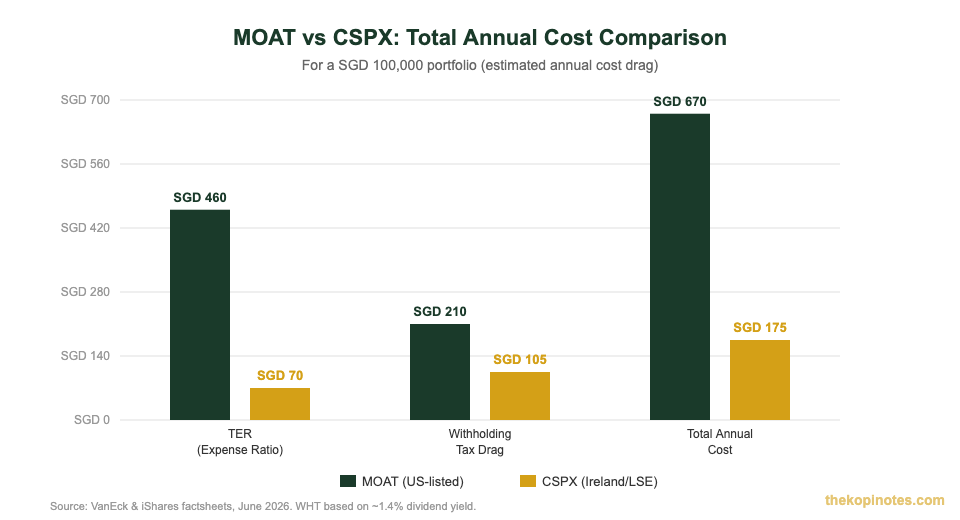
Lower costs, compounded over decades. CSPX charges 0.07% per year versus MOAT’s 0.46%. On a SGD 100,000 portfolio, that’s SGD 70 versus SGD 460 per year in management fees. Over 20 years with compounding, that cost difference alone adds up to thousands of dollars. For MOAT to justify its higher fee, it needs to consistently outperform by at least 0.39% per year — after accounting for the additional withholding tax drag, the hurdle is even higher.
Broader diversification. CSPX holds 504 stocks across all sectors of the US economy. MOAT holds ~50 stocks concentrated in whatever sectors happen to have undervalued wide-moat companies at the time of rebalance. You’re less exposed to single-stock or single-sector blow-ups with CSPX.
Market-cap weighting captures winners automatically. As a company grows larger and more successful, its weight in the S&P 500 increases proportionally. This means CSPX naturally rides winners — it would have automatically increased its Nvidia allocation as the stock surged, while MOAT excluded it entirely. This “letting winners run” effect is a powerful tailwind in momentum-driven markets.
For a deeper look at how CSPX stacks up against other S&P 500 ETFs, check out our CSPX vs SPYL vs VUAA comparison.
Tax & Cost Comparison for Singapore Investors
This is the section that matters most for Singapore investors. Let’s run the numbers on a SGD 100,000 portfolio held for one year, assuming a 1.4% dividend yield on US stocks.
| Cost Component | MOAT (US-listed) | CSPX (Ireland/LSE) |
|---|---|---|
| TER (Expense Ratio) | SGD 460 (0.46%) | SGD 70 (0.07%) |
| Dividend WHT | SGD 420 (30% × 1.4%) | SGD 210 (15% × 1.4%) |
| US Estate Tax Risk | Yes (up to 40%) | None |
| Total Annual Cost Drag | ~SGD 880 (0.88%) | ~SGD 280 (0.28%) |
| Extra Annual Drag of MOAT vs CSPX | SGD 600 per year (0.60%) | |
Source: Calculated based on VanEck and iShares factsheets, June 2026. Assumes 1.4% underlying dividend yield.
That 0.60% annual cost drag is the “hurdle rate” MOAT needs to clear just to break even with CSPX. In other words, MOAT’s underlying stock picks need to generate at least 0.60% more return per year than the S&P 500 — before the fund even starts creating value for you as a Singapore investor. Over the past few years, it hasn’t cleared that bar.
For context, if you’re planning to use your CPF investment strategy or Singapore Savings Bonds for lower-risk allocations, the ETF portion of your portfolio is where every basis point counts. The tax drag on MOAT is a real and permanent cost that compounds against you year after year.
How to Buy MOAT and CSPX from Singapore
Both ETFs are accessible to Singapore investors through major international brokers, but they’re listed on different exchanges and have different tax implications.
Buying CSPX (London Stock Exchange)
CSPX is listed on the LSE and trades in USD. You can buy it through Interactive Brokers (IBKR), Saxo Markets, MooMoo Singapore, or Syfe Brokerage. On IBKR, the commission is as low as USD 1 per trade, making it very cost-effective for larger orders. Syfe Brokerage charges zero commission on LSE-listed ETFs, which is ideal for beginners or smaller portfolios — you can get started using our Syfe referral code and sign-up bonus.
Buying MOAT (NYSE Arca)
MOAT is listed on the NYSE Arca exchange in the US and trades in USD. You can buy it through Interactive Brokers, Saxo, or MooMoo — any broker that provides access to US markets. On IBKR, US-listed ETF trades are commission-free under the IBKR Lite plan.
However, keep in mind: since MOAT is a US-listed ETF, you’ll face the 30% withholding tax on dividends and the US estate tax risk described above. There is currently no Ireland-domiciled UCITS equivalent of MOAT available on the LSE. VanEck does offer a global moat ETF (GOAT / MOTG), but it’s also US-listed.
For a full breakdown of which broker suits your needs, see our best brokerage account Singapore comparison.
The Hybrid Strategy — Core + Satellite
Can you hold both MOAT and CSPX? Absolutely. A common portfolio construction approach is the “core + satellite” model:
Core (70–80%): CSPX. This gives you broad, low-cost, tax-efficient exposure to the entire US large-cap market. It’s your foundation — the part of the portfolio that captures market returns reliably.
Satellite (20–30%): MOAT. This is your active bet on quality and value. You’re betting that Morningstar’s moat analysis will identify companies that outperform the broader market over time. The satellite allocation is small enough that if MOAT underperforms, it doesn’t derail your portfolio — but large enough that if it outperforms, you’ll feel the benefit.
For example, a Singapore investor with SGD 100,000 might allocate SGD 70,000 to CSPX and SGD 30,000 to MOAT. The blended cost drag would be approximately 0.46% per year — significantly lower than going 100% MOAT, but higher than 100% CSPX. You’d want to hold MOAT in a taxable brokerage account and be comfortable with the US estate tax risk on that SGD 30,000 allocation.
This approach makes sense if you believe in the quality factor over the long term but don’t want to bet your entire US equity allocation on 50 stocks. It also gives you diversification across two different investment philosophies — passive market-cap indexing and active quality-value screening.
To model how different allocations affect your long-term wealth, try our Singapore retirement calculator.
Decision Framework: Which Should You Choose?
Choose CSPX if:
- You want the simplest, lowest-cost way to invest in the US stock market from Singapore
- Tax efficiency is a priority — you want 15% WHT, not 30%
- Your portfolio will exceed USD 60,000 and you want to avoid US estate tax
- You believe in passive indexing and don’t want to bet on factor strategies
- You prefer broad diversification across 500 stocks rather than concentrated bets
Choose MOAT if:
- You believe companies with durable competitive advantages will outperform over 10+ year horizons
- You’re comfortable with a concentrated, equal-weighted portfolio of ~50 stocks
- You accept the higher cost (0.46% TER + 30% WHT) as the price of potential alpha
- You’re comfortable with the US estate tax risk and have a plan to manage it (e.g. joint tenancy, trust structure)
- You want to tilt away from mega-cap concentration — you’d rather not have 7% of your portfolio in a single stock
Consider holding both if:
- You want a core S&P 500 position (CSPX) with a quality-factor satellite (MOAT)
- You’re building a long-term portfolio and want diversification across investment philosophies
- Your total portfolio is large enough that the MOAT allocation stays under the USD 60,000 estate tax threshold
Whichever you choose, the most important thing is to start investing consistently. Whether it’s CSPX, MOAT, or a blend, regular contributions over 10–20 years will do more for your wealth than agonising over which fund is marginally better. For broader global exposure beyond just the US, you might also consider the VWRA ETF which tracks the entire world.
Not financial advice. Please consult a licensed financial adviser for personalised recommendations.
Frequently Asked Questions
What is the main difference between MOAT and CSPX?
MOAT holds ~50 US companies with durable competitive advantages (wide moats), selected by Morningstar analysts and equally weighted. CSPX holds all 500 companies in the S&P 500, weighted by market capitalisation. MOAT is a US-listed quality-factor ETF, while CSPX is an Ireland-domiciled UCITS ETF on the London Stock Exchange. For Singapore investors, this domicile difference means CSPX has lower withholding tax (15% vs 30%) and no US estate tax risk.
Has MOAT ETF beaten the S&P 500 historically?
It depends on the time period. Since its 2012 inception, MOAT’s annualised return (~14.0%) has been close to but slightly below the S&P 500 (~14.4%). MOAT outperformed significantly from 2016 to early 2023, but has underperformed since then due to the AI-driven mega-cap rally that favoured market-cap-weighted indices. MOAT also showed better downside protection during market downturns, with a smaller maximum drawdown than the S&P 500.
Can Singapore investors buy MOAT ETF?
Yes. MOAT is listed on the NYSE Arca exchange and can be purchased through brokers like Interactive Brokers (IBKR), Saxo Markets, or MooMoo Singapore — any broker offering access to US stock markets. However, since it is a US-listed ETF, Singapore investors will face 30% withholding tax on dividends and potential US estate tax exposure on holdings exceeding USD 60,000.
Is there a UCITS version of MOAT ETF listed on the London Stock Exchange?
No. As at June 2026, there is no Ireland-domiciled UCITS equivalent of the VanEck Morningstar Wide Moat ETF available on the LSE. VanEck offers a Global Moat ETF (ticker GOAT or MOTG), but it is also US-listed. If you want the tax advantages of a UCITS structure, you would need to choose CSPX or a similar Ireland-domiciled S&P 500 ETF instead.
How much more does MOAT cost compared to CSPX for a Singapore investor?
On a SGD 100,000 portfolio, MOAT’s total annual cost drag is approximately SGD 880 (0.46% TER + 30% WHT on dividends), versus SGD 280 for CSPX (0.07% TER + 15% WHT). That’s an extra SGD 600 per year, or 0.60% — the hurdle rate that MOAT’s stock picks need to overcome just to match CSPX’s net returns for a Singapore investor.
What does 'economic moat' mean and how does Morningstar assign moat ratings?
An economic moat is a company’s durable competitive advantage that protects its profits from competitors. Morningstar assigns moat ratings based on five sources: switching costs, network effects, intangible assets (brands, patents), cost advantages, and efficient scale. A “wide moat” rating means analysts believe the advantage will last at least 20 years. A “narrow moat” means 10–20 years. Companies without significant competitive advantages receive no moat rating.
Should I hold both MOAT and CSPX in my portfolio?
You can use a core-satellite approach: 70–80% in CSPX for broad, low-cost S&P 500 exposure, and 20–30% in MOAT as a quality-factor tilt. This gives you diversification across investment philosophies. However, be aware that the MOAT allocation will carry higher costs and tax drag. Keep your MOAT allocation below USD 60,000 if you want to avoid US estate tax risk, or consult a financial adviser about estate planning structures.
Ready to Start Investing in ETFs?
Open a brokerage account and buy your first ETF today. Use our referral links for exclusive sign-up bonuses.
This article was researched with the help of AI. While we strive to keep all information accurate and up to date, there may be errors. If you notice any discrepancies, please contact us.