Second-Hand Insurance Policies in Singapore: Worth It or Not? (2026 Guide)
A complete guide to buying and selling pre-owned insurance policies on Singapore’s secondary market — how it works, what it costs, and whether it makes financial sense for you.
A second-hand insurance policy is an existing whole life or endowment plan that the original owner sells to a new buyer — usually through a broker — instead of surrendering it to the insurer. In Singapore, this secondary market lets sellers walk away with more cash than the surrender value, while buyers can pick up a mature policy with accumulated bonuses at a discount to what a brand-new plan would cost. It sounds like a win-win, but there are real risks you need to understand first.
Not financial advice. All figures are for educational reference only. Data as at June 2026 unless noted.
- Sellers typically get 5–15% more than the insurer’s surrender value by selling through brokers like REPs Holdings, CapitaSafe, or TES Capital
- Buyers can pick up mature endowment or whole life policies with shorter wait times to maturity and accumulated guaranteed bonuses — but MAS does not regulate this market
- Best for: sellers who want to exit early without losing as much money, and buyers who prefer shorter-term, lower-risk endowment exposure with predictable returns
Table of Contents
Contents — Click to expand
- What Is a Second-Hand Insurance Policy?
- How the Secondary Insurance Market Works
- Why Would Someone Sell Their Policy?
- Why Would Someone Buy One?
- Is It Actually Worth It?
- Types of Policies on the Secondary Market
- Risks and Red Flags
- MAS Regulation and Consumer Protection
- Platforms and Intermediaries in Singapore
- Alternatives to Buying Second-Hand
- Should You Buy or Sell? A Decision Framework
- Frequently Asked Questions
What Is a Second-Hand Insurance Policy?
A second-hand insurance policy — also called a traded life policy (TLP) or traded endowment policy (TEP) — is an existing life insurance or endowment plan that the original policyholder sells to a new owner before the policy matures.
Think of it like buying a resale HDB flat instead of a BTO. The “property” (the policy) already exists. It has accumulated value — guaranteed bonuses, cash value, years of premiums paid. Instead of starting from scratch with a new policy, you take over an existing one partway through its life.
When you buy a second-hand policy, you become the new policy owner through a legal process called absolute assignment. You take over all rights, including the obligation to pay remaining premiums. In return, you receive the full maturity payout (or death benefit) when the policy matures or the insured person passes away.
The original life insured remains unchanged — so if you buy a TEP, you’re essentially betting that the underlying endowment plan will pay out its guaranteed maturity value. The insurance company doesn’t care who owns the policy. They just pay whoever is the registered owner at maturity.
According to MoneySense (a Singapore government initiative), TLPs and TEPs are “commonly known as second-hand policies.” No new policy is created in these transactions — only existing ones change hands.
How the Secondary Insurance Market Works
The process involves three parties: the original policyholder (seller), the intermediary or broker, and the new buyer (investor). Here’s how it typically plays out in Singapore.
Step 1: Seller approaches a broker. A policyholder who wants to exit their whole life or endowment plan contacts a resale broker — companies like REPs Holdings, CapitaSafe, or TES Capital. The broker evaluates the policy’s remaining term, accumulated bonuses, surrender value, and the insurer’s financial strength.
Step 2: Broker makes an offer. The broker offers to buy the policy at a price higher than the insurer’s surrender value — typically 5–15% more, depending on the policy’s age and proximity to maturity. For example, if your insurer offers a surrender value of $50,000, a broker might offer $55,000.
Step 3: Absolute assignment. If the seller accepts, both parties go to the insurance company’s customer service centre to complete an absolute assignment. This is a legal transfer of ownership governed under Singapore’s Policies of Assurance Act (Chapter 392). The insurer registers the new owner.
Step 4: Broker resells or holds. The broker may hold the policy as an investment or resell it to another investor at a markup. The new buyer then pays any remaining premiums and collects the maturity payout.
Major insurers in Singapore — including Great Eastern, Prudential, AIA, and Manulife — all support absolute assignment. You’ll need your NRIC/Passport, and both assignor and assignee must be present.
Why Would Someone Sell Their Policy?
Many Singaporeans buy whole life or endowment policies in their 20s and 30s, only to realise years later that they want out. Here are the most common reasons people sell instead of surrender.
Financial pressure. Job loss, medical bills, or unexpected expenses. You need the cash now, and surrendering means taking a big loss — especially in the first 10 years when surrender values are lowest relative to premiums paid.
Divorce or change of circumstances. A policy bought for a spouse or family situation that no longer applies. Selling makes more sense than letting the policy lapse.
Can’t afford the premiums anymore. Whole life premiums can run $200–$500 per month. If your income drops, those premiums become a burden. Selling gets you more cash than surrendering, and it’s cleaner than a premium holiday (which reduces your coverage).
Bought the wrong product. Many Singaporeans were sold Investment-Linked Policies (ILPs) or expensive whole life plans when they were young. After learning more about personal finance — perhaps through resources like our CPF investment strategy guide — they realise term insurance plus investing the difference is a better approach. Selling the old policy is part of that transition.
Simply want the cash. A 15-year-old endowment plan with 5 years left to maturity might have $60,000 in surrender value. A broker might offer $65,000. That’s $5,000 more in your pocket, and you avoid waiting another 5 years.
Why Would Someone Buy One?
On the flip side, here’s why some investors actively seek out second-hand policies.
Shorter waiting period. A brand-new endowment plan locks your money away for 15–25 years. A second-hand policy that’s already 10 years old means you only wait 5–15 years for maturity. For someone in their 40s or 50s who wants guaranteed returns before retirement, this is appealing. You can use our Singapore retirement calculator to see if the payout timeline fits your retirement plan.
Accumulated guaranteed bonuses. Participating policies build up reversionary bonuses over time. These bonuses, once declared, cannot be taken away. A 10-year-old whole life policy has already accumulated a decade of guaranteed bonuses — something you’d have to wait 10 years for if you bought new.
Potentially better yields. If you buy a second-hand endowment at a price below its projected maturity value, your effective yield can be higher than what a new policy offers. Some brokers claim effective yields of 3–5% per annum on TEPs, which beats most new endowment plans offering 2–3% projected returns.
No medical underwriting needed. Since the original policy is already in force and the life insured doesn’t change, you as the new owner don’t need to pass any medical examination. This is a significant advantage if you have pre-existing health conditions.
However, it’s important to understand that you’re not insuring yourself. The death benefit pays out based on the original insured person’s life — not yours. More on this in the risks section below.
Is It Actually Worth It?
Let’s work through a concrete example with real numbers.
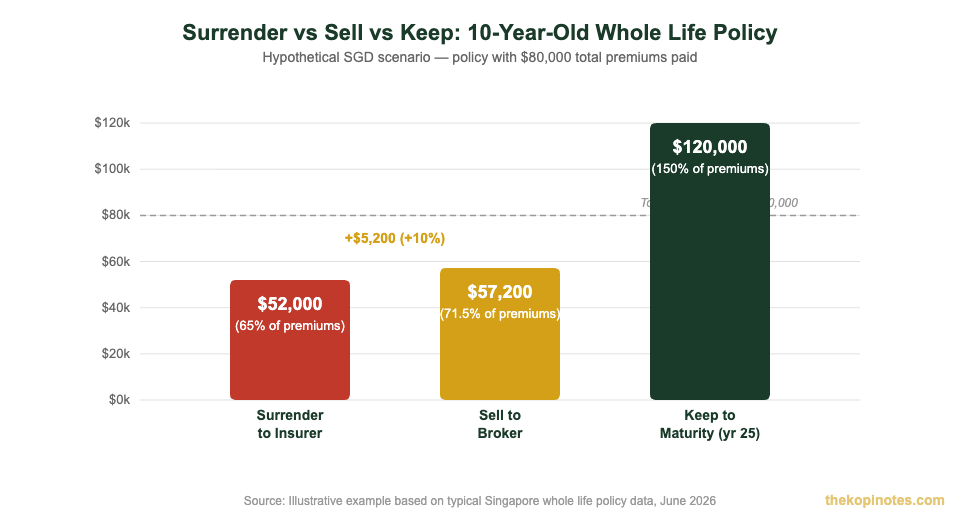
The scenario: A 10-year-old whole life policy from a major Singapore insurer. The original owner has paid $80,000 in total premiums ($8,000/year for 10 years). The policy matures at year 25 — so there are 15 years left.
| Option | You Receive | % of Premiums Paid | What Happens Next |
|---|---|---|---|
| Surrender to insurer | $52,000 | 65% | Policy cancelled. You lose $28,000. |
| Sell to broker | $57,200 | 71.5% | Policy transferred to buyer. You get $5,200 more than surrender. |
| Keep to maturity (yr 25) | ~$120,000 | 150% | Pay 15 more years of premiums ($120,000 total). Net gain depends on non-guaranteed bonuses. |
Source: Illustrative example based on typical Singapore whole life policy data, June 2026
For the seller: Selling gets you $5,200 more than surrendering — that’s a 10% premium. It’s not life-changing money, but it’s meaningful. The real question is whether you should keep the policy instead. If you can afford the premiums and the policy has decent projected returns, keeping it to maturity is almost always better financially. Selling makes sense when you genuinely need to exit.
For the buyer: Let’s say you buy this policy from the broker for $60,000 (they mark it up from the $57,200 they paid the seller). You then pay 15 years of premiums at $8,000/year = $120,000. Your total outlay is $180,000. If the policy matures at $240,000 (including non-guaranteed bonuses), your net return is $60,000 — roughly 2.2% per annum compounded. That’s comparable to a new endowment plan, but with a track record of bonus declarations to guide your expectations.
For a deeper understanding of how surrender values work, check out our guide on insurance surrender value in Singapore.
Types of Policies on the Secondary Market
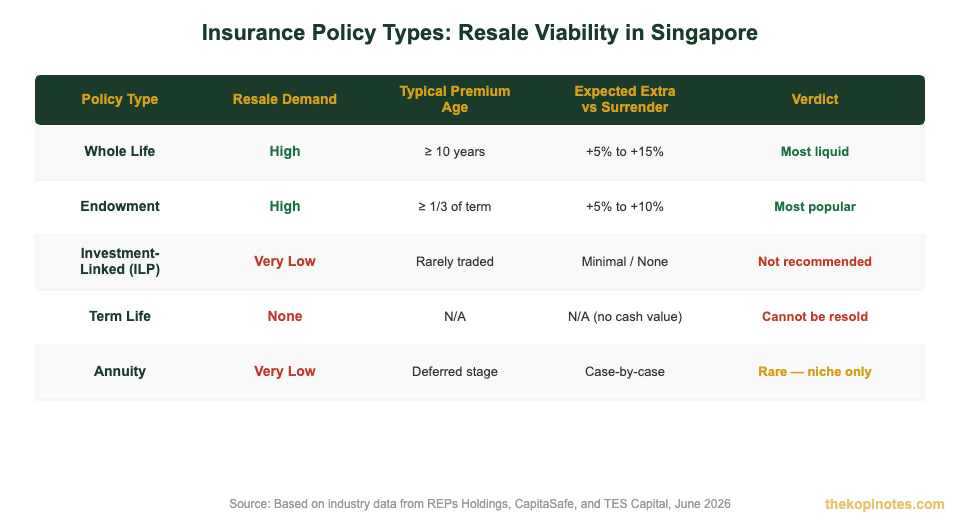
Not all insurance policies can be resold. Here’s a breakdown of what’s actually tradeable in Singapore’s secondary market.
| Policy Type | Resale Demand | Minimum Age to Sell | Typical Extra vs Surrender | Verdict |
|---|---|---|---|---|
| Whole Life | High | ~10 years | +5% to +15% | Most liquid |
| Endowment | High | ≥ 1/3 of policy term | +5% to +10% | Most popular for resale |
| ILP | Very Low | Rarely traded | Minimal or none | Not recommended |
| Term Life | None | N/A | N/A (no cash value) | Cannot be resold |
| Annuity | Very Low | Deferred stage only | Case-by-case | Rare — niche only |
Source: Based on industry data from REPs Holdings, CapitaSafe, and TES Capital, June 2026
Endowment policies are the bread and butter of Singapore’s secondary market. They have a fixed maturity date, guaranteed payouts, and predictable bonus history — making them easy for brokers to price. Whole life policies are also popular, but they’re more complex because they don’t have a fixed maturity date unless the owner surrenders at a specific age.
ILPs are very difficult to resell because their value depends on the performance of underlying investment funds, which are unpredictable. Most brokers won’t touch them. If you want to learn more about why ILPs are problematic, read our guide on whole life insurance in Singapore.
Term life policies cannot be resold at all because they have no cash or surrender value — they only pay out if the insured person dies during the policy term. For understanding how term and whole life differ, our best term life insurance Singapore guide covers this in detail.
Risks and Red Flags
This is the section you need to read most carefully. The secondary insurance market in Singapore comes with real risks that are often glossed over by brokers.
1. No MAS regulation. This is the biggest concern. According to MoneySense, “MAS does not regulate the sale, purchase, or distribution of TLPs and TEPs.” That means if something goes wrong with the broker — if they misrepresent the policy, if they disappear with your money, if the transfer isn’t done properly — you cannot rely on MAS to help you. You would need to pursue civil remedies through the courts.
2. The life insured is not you. When you buy a second-hand policy, the original insured person stays on the policy. For endowment plans with a fixed maturity date, this matters less. But for whole life policies, the death benefit only pays out when the original insured dies — not you. If you bought a TLP as a retirement planning tool, the payout timeline is completely unpredictable.
3. Liquidity risk. If you buy a TEP and later need the money, you may struggle to resell it. The secondary market is small and illiquid. You might have to surrender the policy to the insurer at a loss, negating the advantage you were hoping for.
4. Non-guaranteed bonuses may not materialise. The projected maturity value includes non-guaranteed bonuses. These depend on the insurer’s participating fund performance. If the insurer cuts bonus rates — which has happened during periods of low interest rates — your actual payout could be lower than projected.
5. Broker markup and hidden fees. The broker buys from the seller at one price and sells to you at a higher price. That markup is their profit, and it directly reduces your effective return. Some brokers also charge administrative fees. Always ask for a full breakdown of costs before committing.
6. Foreign policy risk. MoneySense warns that some TLPs and TEPs sold in Singapore may originate from policies bought overseas. If the underlying policy is from a foreign insurer, you face additional risks — unfamiliar legal systems, currency fluctuations, and difficulty enforcing your rights if disputes arise.
7. No cooling-off period. Unlike buying a new insurance policy (which comes with a 14-day free-look period), second-hand policy transactions have no mandatory cooling-off period. Once the assignment is done, it’s done.
- Broker pressures you to decide quickly (“this policy won’t last”)
- Projected returns seem too good to be true (5%+ per annum guaranteed)
- Broker cannot show you the original policy documents
- Assignment is not done at the insurer’s official office
- Broker is not transparent about their markup or fees
MAS Regulation and Consumer Protection
Let’s be very clear about the regulatory landscape. MAS does not regulate the secondary insurance market. Here’s what that means in practice.
In March 2015, MAS issued a Notice to Life Insurers confirming that absolute assignment of life insurance policies is legally permitted. The Policies of Assurance Act (Chapter 392) governs the assignment process. So the transfer itself is legal and well-established — every major insurer in Singapore supports it.
However, the intermediaries who buy and resell these policies are not licensed or regulated by MAS. They are not Financial Advisers under the Financial Advisers Act, and they are not Capital Markets Services Licence holders. This means there are no conduct-of-business rules, no minimum capital requirements, and no MAS-imposed complaint resolution process.
If something goes wrong, your recourse is through the Consumer Protection (Fair Trading) Act (CPFTA). This allows consumers to pursue civil remedies for unfair trade practices. You can also file complaints with the Consumers Association of Singapore (CASE). But this is a very different level of protection compared to buying a regulated financial product.
That said, the underlying policies themselves are issued by MAS-regulated insurers. This means the insurance company is still obligated to honour the policy terms, pay out bonuses, and fulfil death benefit claims. The policy is also covered by the Policy Owners’ Protection (PPF) Scheme administered by the Singapore Deposit Insurance Corporation (SDIC), which protects you if the insurer fails — up to certain limits.
Platforms and Intermediaries in Singapore
Here are the main players in Singapore’s secondary insurance market as at June 2026.
| Platform | Est. | What They Do | For Sellers or Buyers? |
|---|---|---|---|
| REPs Holdings | 2010 | Buy policies from owners; resell as Resale Endowment Policies (REPs) | Both |
| CapitaSafe | — | Resale insurance brokerage; matches sellers with buyers | Both |
| TES Capital / TES Invest | — | Buy policies; offer traded endowment policies to investors | Both |
| PolicyWoke | — | Buy policies at up to 10% above surrender value | Primarily sellers |
| Conservation Capital | — | Traded endowment and whole life policy investments | Both |
| Endowment Exchange | — | Online platform for buying/selling endowment policies | Both |
Source: Company websites, verified June 2026. None of these platforms are regulated by MAS.
Important: The fact that we list these platforms does not constitute an endorsement. Always do your own due diligence. Check their track record, read reviews, and ask for references from past clients. Since these platforms are not MAS-regulated, your buyer protection is limited.
If you’re considering alternatives that are MAS-regulated, platforms like Syfe and Endowus offer regulated investment products including endowment-like savings portfolios with full MAS oversight.
Alternatives to Buying Second-Hand
Before diving into the secondary market, consider whether these regulated alternatives might achieve the same goal.
Buy term + invest the rest (BTIR). This is the most commonly recommended approach in Singapore’s personal finance community. Buy a cheap term life policy for pure protection, and invest the premium savings in a low-cost ETF portfolio or robo-advisor. Over 15–25 years, you’ll likely outperform an endowment plan’s returns.
New endowment plans. If you specifically want guaranteed returns with a savings component, several insurers offer short-to-medium term endowment plans. As at Q4 2025, some plans offer guaranteed maturity yields of up to 3.4% per annum. The advantage: these are fully MAS-regulated, come with a 14-day free-look period, and you deal directly with the insurer.
Singapore Savings Bonds (SSBs). If your goal is capital-guaranteed returns for retirement, SSBs offer up to 10 years of guaranteed returns with full principal protection and complete liquidity — you can redeem any month with no penalty. Read our Singapore Savings Bonds guide for details.
T-bills and fixed deposits. For shorter time horizons (6 months to 1 year), Singapore T-bills and high-interest savings accounts from digital banks offer competitive yields without the complexity and risks of the secondary insurance market.
Robo-advisors. If you want a hands-off, diversified investment approach, check out our best robo-advisor Singapore comparison. These are fully MAS-regulated and offer much better liquidity than endowment policies.
Should You Buy or Sell? A Decision Framework
Consider SELLING your policy if:
- You genuinely cannot afford the premiums and need to exit
- The policy has been in force for at least 10 years (or 1/3 of the term for endowments)
- You’ve already decided to surrender — selling gets you 5–15% more with minimal extra effort
- You’ve compared the broker’s offer against both the surrender value AND the projected maturity value, and selling still makes sense
Consider BUYING a second-hand policy if:
- You understand and accept that MAS does not regulate this market
- You want guaranteed-return exposure with a shorter time horizon than buying new
- You’ve verified the policy documents, bonus history, and the insurer’s financial strength
- You’re comfortable with the illiquidity — you may not be able to resell easily
- The effective yield, after accounting for the broker’s markup and remaining premiums, beats comparable regulated alternatives
AVOID the secondary market if:
- You’re looking for life insurance coverage for yourself — second-hand policies don’t insure the buyer
- You need liquidity within the next 3–5 years
- You’re not comfortable investing in unregulated products
- The broker can’t explain clearly where the policy came from and how it’s priced
Not financial advice. All figures in this guide are for educational reference only. Consult a licensed financial adviser for personalised recommendations. Data as at June 2026 unless noted.
Frequently Asked Questions
Is it legal to buy or sell a second-hand insurance policy in Singapore?
Yes, it is fully legal. The Policies of Assurance Act (Chapter 392) governs the absolute assignment of life insurance policies in Singapore. MAS issued a Notice to Life Insurers in March 2015 confirming that policy assignment is permitted. All major insurers — including Great Eastern, Prudential, AIA, and Manulife — support absolute assignment at their customer service centres. However, while the transfer itself is legal, the brokers and intermediaries who facilitate these transactions are not regulated by MAS.
How much more can I get by selling my policy instead of surrendering it?
Most brokers offer 5–15% above the insurer’s surrender value, depending on the policy type, how close it is to maturity, and the bonus history. For example, if your insurer offers a surrender value of $50,000, a broker might offer between $52,500 and $57,500. Policies that are closer to maturity and have strong bonus track records typically fetch higher premiums. Some brokers like PolicyWoke advertise offers of up to 10% above surrender value. Always get quotes from multiple brokers to compare.
What types of insurance policies can be resold in Singapore?
Whole life and endowment policies are the most commonly resold. Endowment policies are the most popular because they have a fixed maturity date and predictable payouts. Most brokers require the policy to have been in force for at least 1/3 of its term (for endowments) or about 10 years (for whole life). Term life policies cannot be resold because they have no cash value. Investment-Linked Policies (ILPs) and annuities are theoretically transferable but rarely traded due to unpredictable values.
Is buying a second-hand policy regulated by MAS?
No. MAS does not regulate the sale, purchase, or distribution of traded life policies (TLPs) or traded endowment policies (TEPs). The brokers and intermediaries involved are not licensed by MAS. This means you cannot rely on MAS to resolve disputes. Your recourse is through civil courts under the Consumer Protection (Fair Trading) Act. However, the underlying insurance policy itself remains issued by an MAS-regulated insurer, and the insurer must honour its contractual obligations regardless of who owns the policy.
What happens to my insurance coverage if I buy a second-hand policy?
When you buy a second-hand policy, you become the new policy owner, but the original life insured remains unchanged. This means the death benefit pays out when the original insured person dies — not you. For endowment policies with a fixed maturity date, this is less of an issue since you receive the maturity payout regardless. But for whole life policies, the timing of the death benefit is tied to the original insured’s lifespan. If you need life insurance coverage for yourself, a second-hand policy does not provide that.
What are the risks of buying a traded endowment policy in Singapore?
The main risks include: (1) no MAS regulation of intermediaries — you have limited recourse if the broker acts dishonestly; (2) non-guaranteed bonuses may not materialise if the insurer’s participating fund underperforms; (3) liquidity risk — you may struggle to resell the policy if you need cash before maturity; (4) broker markup reduces your effective returns; (5) some policies sold in Singapore may originate from overseas insurers, adding foreign exchange and legal risks; and (6) there is no cooling-off period for second-hand policy purchases, unlike new policies which come with a 14-day free-look period.
How does the absolute assignment process work?
Absolute assignment is the legal transfer of policy ownership. Both the seller (assignor) and buyer (assignee) must visit the insurer’s customer service centre in person, bringing their NRIC or passport. The seller signs a Deed of Assignment and a Notice of Assignment. The insurer registers the transfer — after which all rights, benefits, and correspondence shift to the new owner. The process typically takes about 30 minutes. Both parties must be at least 18 years old (for policies issued on or after 1 March 2009).
Looking for Regulated Investment Alternatives?
If you prefer MAS-regulated platforms with full investor protection, explore these options for your savings and retirement planning.
Get Free Insurance Advice
Speak with a licensed insurance advisor. No obligation, no cost.
By submitting this form, you agree to our Privacy Policy.
This article was researched with the help of AI. While we strive to keep all information accurate and up to date, there may be errors. If you notice any discrepancies, please contact us.