Highest Yield REITs in Singapore 2026: Top 8 S-REITs for Maximum Dividend Income
June 2026 data · 8 S-REITs ranked · Yield sustainability analysis
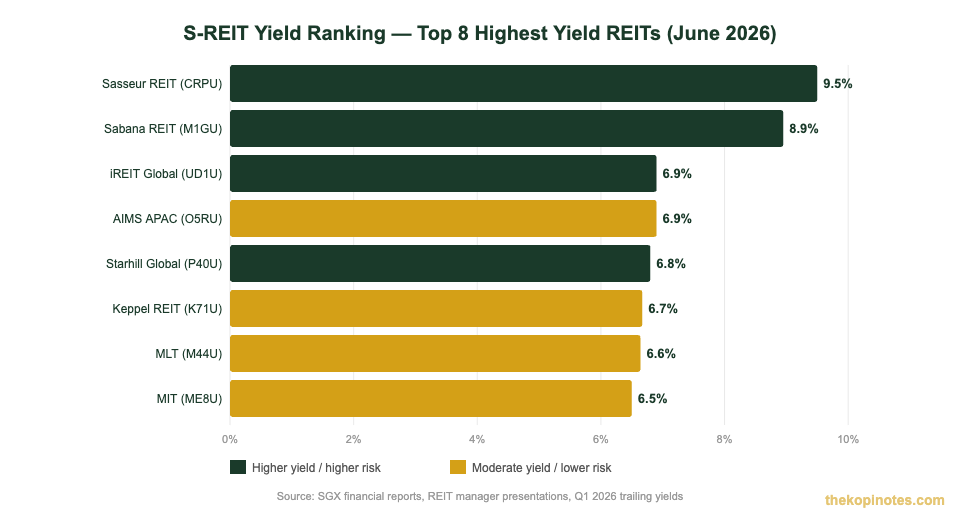
The highest yield REITs in Singapore in 2026 offer distribution yields ranging from 6.5% to 9.5% — well above the 12-month fixed deposit rate of approximately 2.8–3.2%. The top pick by raw yield is Sasseur REIT (CRPU) at ~9.5%, followed by Sabana Industrial REIT (M1GU) at ~8.95% and AIMS APAC REIT (O5RU) at ~6.9%. However, high yield alone does not mean high quality — this guide ranks the top 8 S-REITs by yield and stress-tests each one for DPU sustainability, gearing health, and portfolio quality.
Not financial advice. All figures are for educational reference only. Data as at June 2026 unless noted.
- Top 8 S-REITs by yield range from 6.5% to 9.5% — 3–6 percentage points above fixed deposits
- High yield can signal yield traps — always check gearing, ICR, occupancy, and DPU trend before buying
- Best risk-adjusted high-yield picks: AIMS APAC REIT (6.9%, record DPU, lowest gearing) and MLT (6.6%, pan-Asia logistics)
📋 Table of Contents — Click to Expand
- What Makes a High Yield REIT?
- Top 8 Highest Yield S-REITs Table (June 2026)
- Yield Ranking Bar Chart
- 1. Sasseur REIT — 9.5% Yield
- 2. Sabana Industrial REIT — 8.95% Yield
- 3. AIMS APAC REIT — 6.9% Yield
- 4. iREIT Global — 6.9% Yield
- 5. Starhill Global REIT — 6.8% Yield
- 6. Keppel REIT — 6.67% Yield
- 7. Mapletree Logistics Trust — 6.64% Yield
- 8. Mapletree Industrial Trust — 6.5% Yield
- How to Spot a Yield Trap
- Yield Sustainability Scorecard
- How to Buy High Yield S-REITs
- Frequently Asked Questions
What Makes a High Yield REIT?
A high yield REIT is one where the trailing Distribution Per Unit (DPU) — the total cash paid out over the past 12 months — divided by the current unit price produces an above-average percentage return. In Singapore’s S-REIT universe, the broad market trades at average yields of 5–6%. Anything above 6.5% is considered high yield. Above 8% typically signals elevated risk.
High yield can arise from two very different situations. The first is genuine value: the REIT pays well because its assets are cash-generative and the market has not re-rated it yet. The second is a yield trap: the unit price has fallen sharply because investors are worried about DPU cuts, high gearing, or portfolio quality — so the yield looks attractive but may not be sustainable.
Before chasing yield, you need to check four things. Is gearing comfortably below the 50% MAS limit? Is the Interest Coverage Ratio (ICR) above 3×? Is occupancy above 90%? Is DPU trending up or stable? If all four pass, the yield is likely sound. If any fail, treat with caution.
Top 8 Highest Yield S-REITs in Singapore — June 2026
The table below ranks 8 major S-REITs by trailing distribution yield. All DPU data is sourced from SGX-published financial reports and REIT manager investor presentations as at Q1–Q2 2026.
| REIT (SGX Code) | Sector | Trailing DPU (¢) | Unit Price (S$) | Yield (%) | Gearing (%) |
|---|---|---|---|---|---|
| Sasseur REIT (CRPU) | Outlet Mall | 6.14 | S$0.645 | 9.5% | 24.5% |
| Sabana Industrial REIT (M1GU) | Industrial | 3.40 | S$0.38 | 8.95% | 32.8% |
| AIMS APAC REIT (O5RU) | Industrial/Logistics | 9.85 | S$1.43 | 6.9% | 26.8% |
| iREIT Global (UD1U) | Office (Europe) | €1.09 | S$0.29 | 6.9% | 44.6% |
| Starhill Global REIT (P40U) | Retail | 3.65 | S$0.535 | 6.8% | 35.5% |
| Keppel REIT (K71U) | Office | 5.80 | S$0.87 | 6.67% | 40.2% |
| Mapletree Logistics Trust (M44U) | Logistics | 8.50 | S$1.28 | 6.64% | 39.1% |
| Mapletree Industrial Trust (ME8U) | Industrial/Data Centre | 12.71 | S$1.96 | 6.5% | 34.0% |
Source: SGX financial reports, REIT manager investor presentations (FY2025/Q1 2026). Yield = Trailing Annual DPU ÷ Unit Price × 100. DPU in Singapore cents except iREIT Global (EUR cents). Unit prices are indicative June 2026 levels.
Yield Ranking Visual
1. Sasseur REIT (CRPU) — 9.5% Yield
Sasseur REIT is Singapore’s only listed outlet mall REIT, owning four premium outlet malls in China — Chongqing (2 malls), Kunming, and Hefei. It uses a unique Entrusted Management Agreement (EMA) structure where the REIT receives a guaranteed fixed component (approximately 70% of distributable income) plus a variable component tied to mall sales performance.
The 9.5% yield looks attractive, but you need to understand what drives it. Sasseur’s unit price has been range-bound at S$0.62–S$0.70, partly because investors price in China macro risk — slowing consumer spending, property sector weakness, and geopolitical uncertainty. The high yield reflects this risk premium rather than exceptional asset quality.
What to watch: China retail sales growth. If domestic consumption recovers strongly, the variable EMA component should grow and DPU may rise. If China slows further, the variable component declines. The fixed EMA base provides a floor, but growth depends on China’s consumer economy. Gearing at 24.5% is the lowest among all S-REITs — this is a genuine strength.
Verdict: HOLD for existing holders. Cautious BUY for investors comfortable with China macro exposure who want very high income and can accept DPU volatility. Not suitable as a core holding. Limit to 5–10% of portfolio.
For a full deep-dive, see our Sasseur REIT investor guide 2026.
2. Sabana Industrial REIT (M1GU) — 8.95% Yield
Sabana Industrial REIT owns a portfolio of industrial properties in Singapore — hi-tech industrial buildings, warehouse/logistics facilities, and light industrial properties. At ~S$370 million market cap, it is one of the smallest industrial REITs on SGX.
The near-9% yield reflects two things: a relatively low absolute unit price (around S$0.38) and limited analyst coverage. Sabana lacks the sponsor firepower of larger industrial REITs like CLAR or MIT, which limits its ability to grow the portfolio through acquisitions. Its manager has been independent since exiting the ESR-Reit merger process — this is actually positive for governance, but removes a deep-pocketed sponsor.
Risks to note: Small-cap illiquidity — the daily traded volume is thin, so large buy or sell orders can move the unit price significantly. Portfolio concentration in older Singapore industrial properties means limited organic rental growth. ICR of ~4.1× is adequate but not exceptional.
Verdict: HOLD. The yield is genuine — Sabana has maintained distributions — but portfolio quality and growth prospects are limited. Best suited to income-focused investors who are comfortable with small-cap illiquidity. Maximum 5% portfolio allocation.
3. AIMS APAC REIT (O5RU) — 6.9% Yield
AIMS APAC REIT (formerly AIMS AMP Capital Industrial REIT) is a high-conviction pick among high-yield S-REITs. FY2026 DPU of 9.85 Singapore cents is a record high — up 2.6% year on year — and gearing at 26.8% is the lowest among all major industrial REITs. This combination is rare: high yield plus record DPU growth plus the strongest balance sheet in its peer group.
The portfolio spans 28 industrial and logistics properties in Singapore and Australia, including a strategic data centre endorsement at its Macquarie Park and Bella Vista properties in New South Wales. The NSW Industrial Development Agency’s endorsement allows Sasseur to pursue data centre conversion — this is a significant optionality that the market may not yet fully price in.
Why it stands out at 6.9%: Most REITs at this yield level carry 40%+ gearing. AIMS APAC does it at 26.8% — giving it significant acquisition headroom to grow DPU further without equity dilution. The record DPU signals management confidence, not a yield trap.
Verdict: BUY on weakness. This is the best risk-adjusted high-yield S-REIT in the table. For passive income investors seeking 6.5–7% yield with genuine DPU sustainability, AIMS APAC REIT is the top choice. Read our full AIMS APAC REIT quarterly results guide.
4. iREIT Global (UD1U) — 6.9% Yield
iREIT Global is Singapore’s first Europe-focused REIT, owning 53 properties across Germany, Spain, France, and the Netherlands. The 6.9% trailing yield is in euros, which adds currency risk for Singapore dollar investors — if EUR weakens against SGD, your actual income in SGD terms falls.
The key risk for iREIT Global is the Berlin Campus vacancy. FY2025 DPU dropped 42.6% year on year due to a large tenant vacating the Berlin office complex. However, the Darmstadt campus secured a fresh 10-year federal government lease in Q1 2026 — a major positive that stabilises approximately 25% of net property income.
At 44.6% gearing, iREIT Global is the highest-geared REIT in this table — only 5.4 percentage points from the MAS 50% standard limit. Any further property devaluations in Germany’s struggling office market could pressure this metric.
Verdict: HOLD. The yield is real but so are the risks — Berlin vacancy, high gearing, EUR/SGD currency drag. Suitable only for investors who want European diversification and can monitor occupancy recovery. Not for conservative income investors.
5. Starhill Global REIT (P40U) — 6.8% Yield
Starhill Global REIT owns a concentrated retail portfolio anchored by two iconic Singapore malls: Wisma Atria and Ngee Ann City on Orchard Road. These two properties contribute approximately 63.4% of net property income. The remaining portfolio spans Australia, Malaysia, Japan, and China.
FY2025 DPU of 3.65 Singapore cents was up 0.6% year on year — modest growth, but positive. The REIT has a meaningful asset enhancement initiative (AEI) pipeline in 2026: Wisma Atria façade refurbishment (~S$2.2 million, mid-2026) and Adelaide Central Plaza food court conversion (~A$6 million, end-2026). These AEIs are funded from existing cash flows and should lift occupancy and rental rates upon completion.
At gearing of 35.5% and ICR of approximately 3.8×, Starhill Global has a sound balance sheet — significantly better than it looks at first glance for a retail REIT. Analyst consensus targets S$0.65–S$0.68, implying 21–27% upside from current levels.
Verdict: HOLD to selective BUY. The 6.8% yield plus AEI pipeline upside makes Starhill Global attractive for income investors who want Orchard Road retail exposure at a discount. Monitor the AEI completions in H2 2026 as a catalyst.
6. Keppel REIT (K71U) — 6.67% Yield
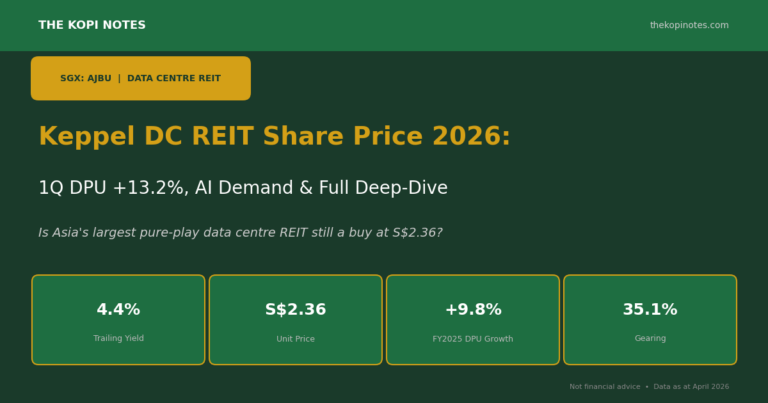
Keppel REIT is a Grade A office REIT with properties in Singapore’s Marina Bay financial district, plus assets in Australia and South Korea. The 6.67% yield at a relatively low absolute unit price (~S$0.87) reflects the market’s caution on office demand — but the 1Q 2026 results tell a different story.
1Q 2026 net property income grew 9.7% year on year. Rental reversions hit +17.2% — one of the strongest among all SGX-listed REITs. Portfolio occupancy at 97.1% leaves little room for vacancy risk. Keppel REIT’s Singapore office portfolio is directly connected to Marina Bay financial infrastructure, serving banks and professional services firms with long leases.
Gearing at 40.2% is elevated but manageable, with ICR above 3×. The REIT trades at a meaningful discount to book value (NAV ~S$1.20 vs. unit price ~S$0.87) — a P/NAV of approximately 0.73×. If office sentiment improves and NAV is maintained, this creates dual upside: income yield plus capital appreciation.
Verdict: BUY for investors comfortable with office sector exposure. The combination of 6.67% yield, +17.2% rental reversions, and 97.1% occupancy makes Keppel REIT the most compelling office REIT in Singapore at current valuations. See our Keppel REIT 1Q 2026 deep-dive.
7. Mapletree Logistics Trust (M44U) — 6.64% Yield
Mapletree Logistics Trust is one of Asia’s largest listed logistics REITs, owning over 180 properties across Singapore, China, Australia, Japan, South Korea, Malaysia, Vietnam, India, and Hong Kong. This geographic diversification is both a strength (resilience to any single country’s economic cycle) and a source of FX risk (distributions affected by SGD/USD/CNY/AUD movements).
The 6.64% yield is backed by a large, diversified income base. Logistics demand from e-commerce continues to grow across MLT’s markets — particularly in Vietnam and India where modern warehousing is undersupplied relative to demand. Singapore’s Tuas Mega Port expansion further supports long-term logistics property demand.
Gearing at 39.1% is elevated relative to AIMS APAC REIT (26.8%) but well within MAS limits. ICR of approximately 3.6× provides comfortable interest coverage. The Mapletree sponsor gives MLT access to a deep institutional property pipeline for yield-accretive acquisitions.
Verdict: BUY. MLT offers the best geographic diversification in this high-yield list at a yield of 6.64%. Ideal for investors who want pan-Asia logistics exposure with a strong sponsor. A core high-yield holding rather than a tactical play.
8. Mapletree Industrial Trust (ME8U) — 6.5% Yield
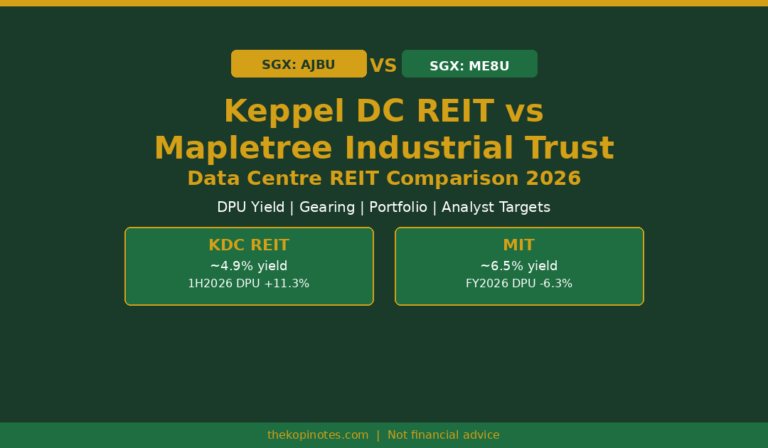
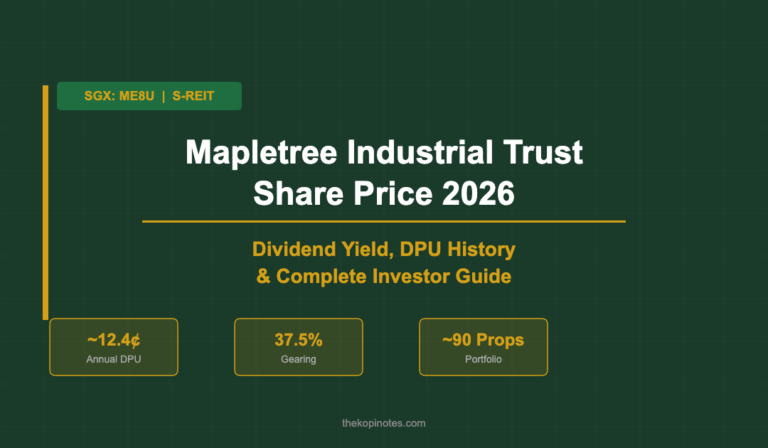
Mapletree Industrial Trust is the only REIT in this high-yield list with significant data centre exposure — approximately 52% of net property income comes from data centre properties in Singapore and North America. AI infrastructure demand is driving unprecedented hyperscaler capital expenditure into data centres globally, and MIT’s long-term triple-net leases (10–15 years) with hyperscaler tenants provide exceptional income visibility.
FY2026 DPU of 12.71 Singapore cents was down 6.3% year on year due to currency headwinds on its US dollar revenue and higher refinancing costs. However, the underlying portfolio remains strong — 136 properties valued at S$8.2 billion, 91.2% occupancy, and positive rental reversions of +6.2% in Singapore. Gearing at 34% is comfortable.
At 6.5% yield, MIT is the lowest-yielding REIT in this list — but arguably the highest quality. The data centre structural growth theme, combined with the Mapletree sponsor and strong tenant covenant, makes MIT a reliable income compounder rather than a pure yield play.
Verdict: BUY. MIT’s 6.5% yield with data centre growth optionality is the best quality-adjusted entry point in this table. For investors seeking yield plus structural growth, MIT is the preferred holding. See our Mapletree Industrial Trust deep-dive.
How to Spot a Yield Trap
A yield trap is a REIT where the high yield is driven by a falling unit price rather than growing distributions. You buy expecting 8% income, but over the next 12 months DPU is cut and the unit price falls further — leaving you with a 5% yield on a lower capital base.
| Warning Sign | What to Check | Safe Zone | Danger Zone |
|---|---|---|---|
| Gearing too high | Check latest quarterly report | Below 40% | Above 45% |
| ICR declining | Track ICR over last 4 quarters | Above 3.0× | Below 2.0× |
| Occupancy falling | Check portfolio occupancy trend | Above 92% | Below 85% |
| DPU declining 3+ years | Pull DPU history from SGX | Stable or growing | Declining 3+ yrs |
| Rights issue history | Check SGX announcements for equity calls | Rare, yield-accretive | Frequent, dilutive |
| P/NAV below 0.7× | Unit price vs. book NAV | 0.85–1.1× NAV | Below 0.6× NAV |
Source: TKN analysis based on MAS regulations and SGX REIT reporting standards.
For income yield planning, use our Dividend Portfolio Yield Calculator to model how different S-REIT positions contribute to your total passive income target.
Yield Sustainability Scorecard
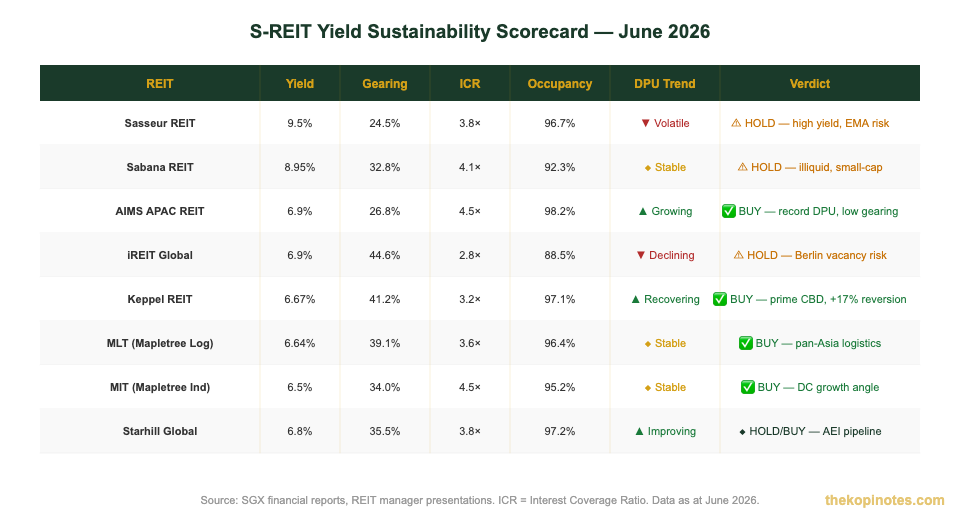
The scorecard above summarises the key metrics that determine whether each REIT’s yield is sustainable. The green BUY verdicts (AIMS APAC REIT, Keppel REIT, MLT, MIT) all pass on at least 4 of the 5 criteria. The orange HOLD verdicts have at least one meaningful risk factor that warrants caution before committing capital.
How to Buy High Yield S-REITs in Singapore
To buy any of the 8 REITs in this list, you need a brokerage account linked to a CDP (Central Depository) account for SGX-listed securities. Here are the most cost-effective platforms for Singapore retail investors:
| Platform | Commission | CPF/SRS | CDP Ownership | Best For |
|---|---|---|---|---|
| FSMOne | 0.08% (min S$10) | ✅ Yes | ✅ Yes | Low-cost CDP investing |
| Syfe Trade | S$0.99 flat (first 30) | ❌ No | ❌ Custodian | Lowest cost per trade |
| IBKR | S$2.50 flat | ❌ No | ❌ Custodian | Active traders |
| Endowus (CPF/SRS) | 0.25% p.a. | ✅ Yes | Funds only | CPF/SRS REIT fund investing |
Source: Platform fee schedules as at June 2026. CDP ownership means your units are held directly in Singapore’s Central Depository — preferred for S-REIT investors who want clear legal ownership and corporate action rights.
For sign-up bonuses: use our FSMOne referral code P0544985 for FSMOne, or our Syfe referral code SRPRFFFCD for Syfe. For CPF and SRS investing in diversified REIT portfolios, use our Endowus referral code 2V343.
To model how S-REIT income fits into your retirement, try our Singapore retirement planning calculator. For passive income goal-setting, the passive income goal calculator shows exactly how much capital you need at each yield level to hit your monthly income target.
For a broader view on S-REIT sector analysis, read our guide to the best S-REITs in Singapore 2026.
Frequently Asked Questions
What is the highest yield REIT in Singapore in 2026?
Is a higher yield S-REIT always better?
What is a yield trap in S-REITs?
Which S-REITs are best for passive income in 2026?
Can I use CPF to invest in high yield S-REITs?
How often do high yield S-REITs pay distributions?
What is gearing and why does it matter for S-REITs?
Is 2026 a good year to invest in high yield S-REITs?
How much capital do I need to earn S$1,000/month from S-REITs?
What is the difference between yield and total return for S-REITs?
Start Investing in S-REITs Today
Use these referral codes to get started with zero or reduced fees:
This article was researched with the help of AI. While we strive to keep all information accurate and up to date, there may be errors. If you notice any discrepancies, please contact us.