Manulife Participating Fund Singapore 2026: How Par Funds Work, Bonus Rates & Is It Worth It?
A complete guide to Manulife’s participating fund — par fund mechanics, bonus history, returns, and how it compares to alternatives for Singapore investors in 2026.
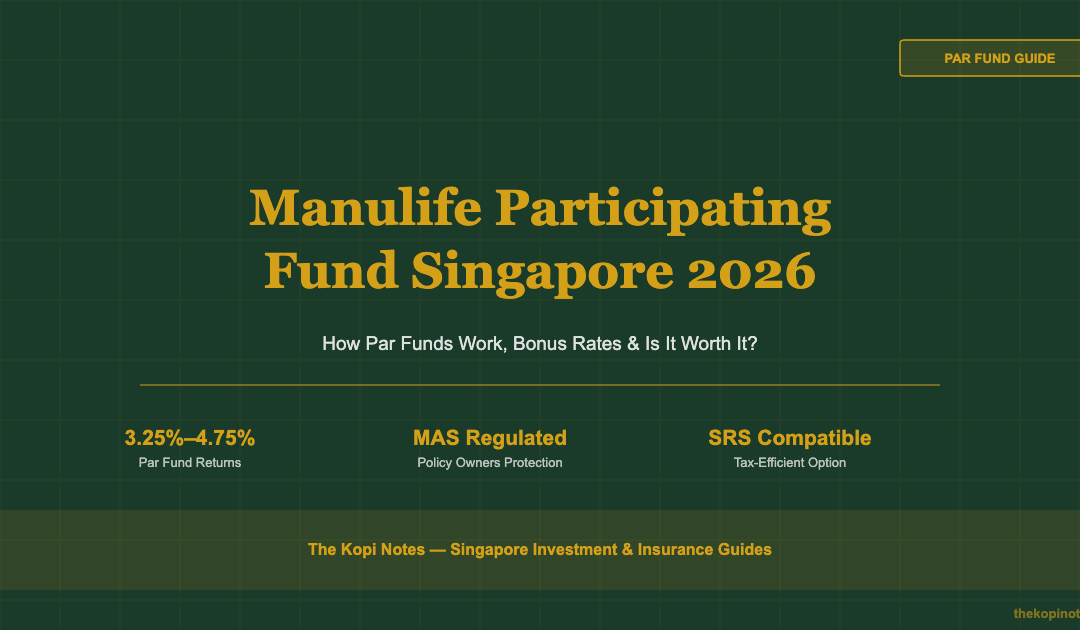
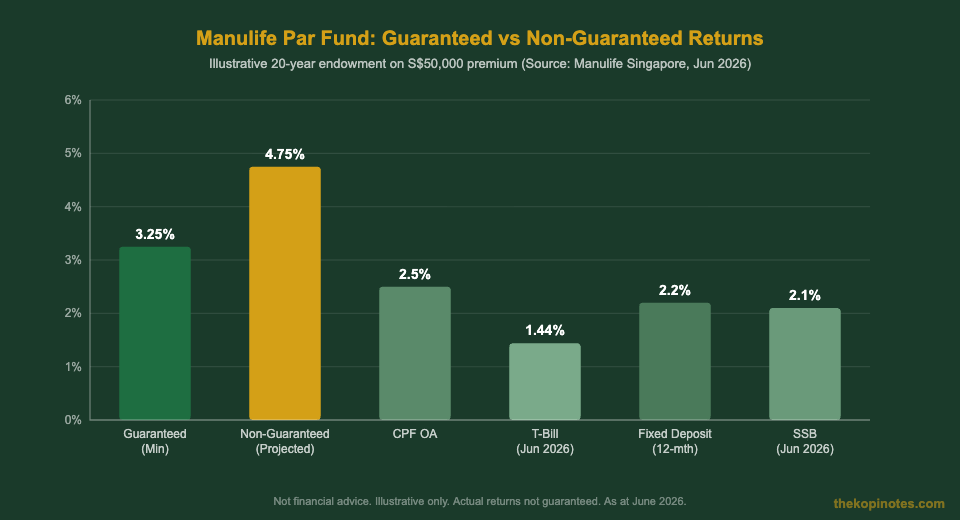
The Manulife participating fund (par fund) is the investment pool backing Manulife’s endowment, whole life, and savings plans in Singapore. When you buy a participating policy, your premiums join this pooled fund managed by Manulife’s investment team. The fund targets a long-term return of 4.25%–4.75% p.a., split between a guaranteed portion (typically ~3.25%) and non-guaranteed bonuses declared annually based on actual performance.
Not financial advice. All figures are for educational reference only. Data as at June 2026 unless noted.
- Manulife’s par fund targets 4.25%–4.75% p.a. long-term returns — a mix of guaranteed and non-guaranteed bonuses
- It is MAS-regulated with PPF Scheme protection up to S$100,000 on guaranteed benefits
- Best for conservative savers wanting capital protection with modest growth — not a replacement for ETFs or S-REITs
Table of Contents
Contents — Click to expand
- What Is a Participating Fund?
- How the Manulife Par Fund Works
- Bonus Rates and Historical Returns
- Which Manulife Products Use the Par Fund?
- Surrender Value: What Happens If You Exit Early?
- Par Fund vs Alternatives
- Who Should Consider a Participating Policy?
- How to Get a Manulife Participating Policy
- Frequently Asked Questions
What Is a Participating Fund?
A participating fund (par fund) is a pooled investment account maintained by a life insurer. When you buy a “participating” insurance policy — such as an endowment plan or a whole life plan with a savings component — your premiums pool with other policyholders’ premiums into this fund.
Manulife’s par fund in Singapore is managed under Monetary Authority of Singapore (MAS) regulations under the Insurance Act. MAS requires participating funds to be ring-fenced from shareholder funds, so your money stays protected.
There are two components to every participating policy’s returns:
- Guaranteed benefits: A fixed sum locked in regardless of how the par fund performs. You receive this even in a poor investment year.
- Non-guaranteed bonuses: Extras distributed when the par fund outperforms. These include reversionary bonuses (added yearly) and terminal bonuses (paid at maturity or claim).
The non-guaranteed component can go up or down — Manulife’s board reviews bonus rates annually based on actual investment performance, claims experience, expenses, and economic conditions.
How the Manulife Par Fund Works
Understanding the mechanics helps you set realistic expectations. Here is how it works.
1. Premiums go into the pool
When you pay your premium, a portion covers insurance charges (mortality risk, admin costs). The remainder is invested into the par fund. For endowment plans, the investment portion is usually 80–90% of your premium.
2. The fund invests across asset classes
Manulife’s par fund targets this approximate allocation as at 2026:
| Asset Class | Approx. Allocation | Purpose |
|---|---|---|
| Government & Corporate Bonds | 60–65% | Stable income, capital preservation |
| Equities (Global & SG) | 25–30% | Long-term capital growth |
| Real Estate & Alternatives | 5–10% | Diversification, inflation hedge |
| Cash & Short-term Instruments | 2–5% | Liquidity for claims and payouts |
Source: Manulife Singapore Annual Fund Report 2025. Allocations are indicative and subject to change.
3. The 90/10 rule protects policyholders
MAS requires insurers to distribute at least 90% of the par fund’s distributable surplus to policyholders each year. This “90/10 rule” is one of the strongest policyholder protections in Asia.
4. Bonuses ratchet upwards
Once a reversionary bonus is declared and added to your policy, it cannot be taken back — even if the par fund underperforms in a later year. This “ratchet” feature gives par fund policies downside protection that pure unit trusts lack. The terminal bonus, however, is discretionary and only locked in at the payment date.
Bonus Rates and Historical Returns
Manulife does not publish a single “par fund return” figure — returns vary by product and policy year. However, the long-term illustrated rate used in all Manulife benefit illustrations follows the Life Insurance Association of Singapore (LIA) standard: 4.75% p.a. for the projected scenario, and 3.25% p.a. for the conservative scenario.
| Return Component | Conservative | Projected | Notes |
|---|---|---|---|
| Guaranteed Return | ~1.5%–2.5% p.a. | ~1.5%–2.5% p.a. | Same in both scenarios |
| Non-Guaranteed Bonus | ~0.75%–1.0% p.a. | ~2.25%–2.5% p.a. | Varies with par fund performance |
| Total Illustrated | 3.25% p.a. | 4.75% p.a. | LIA standard — not guaranteed |
Source: LIA Singapore illustration standards; Manulife benefit illustration methodology, June 2026.
In practice, Manulife’s par fund has historically achieved close to the 4.75% projected scenario over 10–20 year periods. The 2023–2026 rate environment has been more favourable as bond yields recovered from the 2015–2022 low-rate period.
Which Manulife Products Use the Par Fund?
Not all Manulife policies are participating. The par fund backs participating insurance products only. Here are the main Manulife Singapore products that invest in the par fund as at 2026:
| Product Type | Examples | Policy Term | Par Fund Role |
|---|---|---|---|
| Endowment Plans | SmartRetire, ReadyBuilder | 2–25 years | Primary savings vehicle |
| Whole Life (Par) | LifeReady Plus, LifeProtect | Life-long | Cash value accumulation |
| Retirement Annuities | RetireReady Plus II | To age 99 | Non-guaranteed income top-up |
| Education Plans | Ready Education II | 10–18 years | Capital growth for education |
Source: Manulife Singapore product pages, June 2026. Subject to change.
What is NOT a par fund product? Manulife’s Investment-Linked Policies (ILPs) — such as Manulink Enrich and InvestReady Wealth II — are not participating products. ILP returns depend entirely on sub-funds you select. The par fund mechanics here do not apply to ILPs.
Surrender Value: What Happens If You Exit Early?
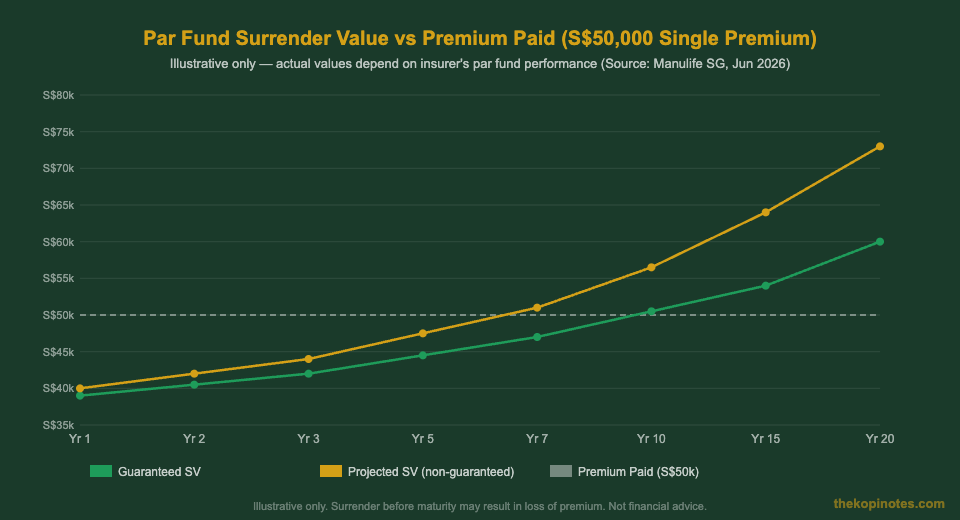
This is where many policyholders get a nasty surprise. If you surrender your participating policy before maturity, you may receive less than the total premiums paid — especially in the first 5–7 years.
In the early years, a significant portion of your premium covers sales commission, underwriting, and insurance charges. The par fund needs time to generate enough returns to offset these upfront costs. Most Manulife par policies only break even on surrender value around Year 7–12.
Here is an illustrative surrender value timeline for a S$50,000 single premium endowment plan:
| Year | Premium Paid | Guaranteed SV | Projected SV (4.75%) | Notes |
|---|---|---|---|---|
| Year 1 | S$50,000 | ~S$39,000 | ~S$40,000 | Loss if surrendered |
| Year 3 | S$50,000 | ~S$42,000 | ~S$44,000 | Still below premium |
| Year 7 | S$50,000 | ~S$47,000 | ~S$51,000 | Approaching break-even |
| Year 10 | S$50,000 | ~S$50,500 | ~S$56,500 | Break-even on guaranteed |
| Year 15 | S$50,000 | ~S$54,000 | ~S$64,000 | Growing well |
| Year 20 (Maturity) | S$50,000 | ~S$60,000 | ~S$73,000 | Full maturity payout |
Source: Illustrative only — based on LIA illustration standards at 3.25% and 4.75% p.a. Actual values differ by product. June 2026.
The key takeaway: only commit money you will not need for at least 10 years. If there is any chance you need the funds earlier, consider a Singapore Savings Bond or fixed deposit instead.
Par Fund vs Alternatives
How does the Manulife par fund compare to other savings and investment options available to Singapore investors in 2026?
| Product | Return p.a. | Guaranteed? | Liquidity | SRS/CPF? |
|---|---|---|---|---|
| Manulife Par Fund | 3.25%–4.75% | Partial | Low | SRS ✅ CPF ❌ |
| CPF OA | 2.50% | Yes | Medium | CPF ✅ |
| Singapore Savings Bonds | ~2.10% | Yes | High | Cash only |
| T-Bills (Jun 2026) | 1.44% | Yes | High | Cash, CPF OA, SRS |
| S-REITs (e.g. CLAS) | ~5.0%–6.5% | No | High | SRS ✅ CPF-OA ✅ |
| Global ETF (e.g. CSPX) | 7%–10% (hist.) | No | High | SRS ✅ CPF ❌ |
Source: MAS, CPF Board, SGX, iShares. Data as at June 2026. Returns are indicative and not guaranteed.
The par fund sits between fixed deposits and equity investing — better long-term returns than T-bills or SSBs, but with the trade-off of illiquidity. If you need flexibility or want higher growth, a diversified ETF portfolio through a robo-advisor like Syfe (referral code SRPRFFFCD) or Endowus (referral code 2V343) may serve you better. For income, explore the best S-REITs in Singapore 2026 which yield 5–7% p.a. You can also use our Singapore retirement calculator to model how a par fund fits into your overall retirement plan.
Who Should Consider a Participating Policy?
A Manulife par fund policy is not for everyone. Here is a clear framework to help you decide:
| Consider a Par Policy If… | Avoid a Par Policy If… |
|---|---|
| You want capital protection with modest growth above FD rates | You may need the money within 10 years |
| You are a conservative saver who dislikes market volatility | You want market-linked returns and can tolerate risk |
| You have excess SRS funds you want to grow tax-efficiently | You have not yet maximised CPF contributions first |
| You are 35–55 and planning for retirement income | You are in your 20s with a 30+ year horizon — equities will outperform |
| You want life insurance coverage bundled with savings | Your emergency fund is not yet 6 months of expenses |
A par policy works well as part of a tiered savings strategy — the “medium-risk, medium-return” middle layer, above your liquid emergency fund (SSBs, fixed deposits) but below your equity investments (ETFs, REITs). For CPF optimisation strategies that can free up cash for a par policy, see our guide on CPF investment strategy.
How to Get a Manulife Participating Policy in Singapore
Unlike ETFs or S-REITs, you cannot buy a participating policy directly online through a brokerage. Here are your options.
Route 1: Through a Manulife Financial Adviser
The most common route. A Manulife-tied FA will assess your needs, recommend an appropriate product, and walk you through the benefit illustration. Note that FA compensation is commission-based — always ask about the commission on any product you are considering.
Route 2: Through an Independent Financial Adviser (IFA)
An IFA represents multiple insurers and can compare Manulife’s par fund products against NTUC Income, Great Eastern, AIA, and Prudential equivalents — giving you a more objective comparison. Platforms like Endowus also offer access to participating policies with fee transparency.
Route 3: Direct Purchase Insurance (DPI)
MAS introduced the Direct Purchase Insurance channel for basic term and whole life plans. However, most of Manulife’s participating endowment and retirement products are not available via DPI.
Whichever route you choose, always ask for the benefit illustration at both 3.25% and 4.75% scenarios, check the surrender value table from Year 1 to Year 10, and confirm the guaranteed maturity value. Also ensure your T-bills and SSB allocation for emergency funds is set before committing cash to a long-term par policy.
This guide is for educational purposes only. Buying a life insurance policy is a long-term financial commitment. Always consult a licensed financial adviser before making any decision. Not financial advice.
Frequently Asked Questions
What is the Manulife participating fund and how does it work?
The Manulife participating fund (par fund) is a pooled investment account backing Manulife’s participating insurance policies in Singapore — such as endowment plans and whole life policies. When you pay premiums for a participating policy, a portion is invested into this fund alongside other policyholders’ premiums. The fund is managed across bonds (60–65%), equities (25–30%), and alternatives, targeting 4.25%–4.75% p.a. Returns split into guaranteed benefits (locked in) and non-guaranteed bonuses (declared annually by Manulife’s board based on fund performance).
Is the Manulife participating fund guaranteed?
Only the guaranteed component is locked in. The guaranteed maturity value is specified in your benefit illustration — it is the minimum you receive if you hold the policy to maturity. Non-guaranteed bonuses (reversionary and terminal bonuses) are declared at Manulife’s discretion based on actual fund performance and are not promised. Historically, par funds have met their projected illustrations over long holding periods, but past performance does not guarantee future results.
What is the par fund investment return rate for Manulife Singapore?
Manulife does not publish a single public par fund return figure. All benefit illustrations use the LIA standard rates: 3.25% p.a. for the conservative scenario and 4.75% p.a. for the projected scenario. The 3.25% figure effectively represents the minimum you should expect over a full policy term. Actual returns declared each year depend on the par fund’s investment performance, claims experience, and expenses. Check your annual bonus declaration via the MyManulife app or portal.
Can I use SRS money to buy a Manulife participating policy?
Yes. Most Manulife participating endowment and whole life plans accept SRS (Supplementary Retirement Scheme) contributions as premiums. Using SRS is tax-efficient: SRS contributions are deducted from taxable income (up to S$15,300 per year for Singaporeans), and the par fund grows tax-free during accumulation. At SRS withdrawal age 62+, only 50% of withdrawals are taxable. This makes par fund policies a popular SRS deployment option for conservative investors. Confirm SRS eligibility for the specific product with your Manulife adviser.
What happens if I surrender my Manulife par fund policy early?
Surrendering early — especially in the first 5–7 years — almost always means receiving less than total premiums paid. Upfront costs (commission, underwriting, admin) are front-loaded, and the par fund needs time to generate returns that offset them. Most Manulife par policies only break even around Year 7–12. If financial circumstances force an early exit, consider a policy loan instead — you can borrow against your policy’s surrender value at a relatively low interest rate, keeping the policy in force while accessing cash.
Is my money in the Manulife par fund protected if Manulife fails?
Yes, to a significant extent. Manulife Singapore is licensed and regulated by MAS under the Insurance Act. Your participating policy is protected under the Policy Owners’ Protection Fund (PPF) Scheme administered by SDIC. Coverage protects guaranteed benefits — up to S$100,000 for guaranteed surrender or maturity value, and up to S$500,000 for guaranteed death benefits. Non-guaranteed bonuses are not covered by the PPF Scheme. Par funds are also ring-fenced from shareholder funds under MAS regulations, adding a further protection layer.
How does the Manulife par fund compare to NTUC Income or Great Eastern?
All major Singapore insurers’ par funds (NTUC Income, Great Eastern, AIA, Prudential, Manulife) use the same LIA illustration rates and are subject to the same MAS regulations and 90/10 surplus distribution rule. Key differences lie in the guaranteed-to-non-guaranteed split, each insurer’s asset allocation, historical bonus track record, and product features (premium terms, partial withdrawal options, coverage amount). An independent financial adviser can run a full cross-insurer comparison for your specific needs and budget.
Plan Your Retirement With the Right Tools
Use our free retirement calculator to see how a par fund endowment fits into your retirement income plan — or explore higher-growth alternatives through robo-advisors.
Get Free Insurance Advice
Speak with a licensed insurance advisor. No obligation, no cost.
By submitting this form, you agree to our Privacy Policy.
This article was researched with the help of AI. While we strive to keep all information accurate and up to date, there may be errors. If you notice any discrepancies, please contact us.