Best Term Life Insurance Singapore 2026: Complete Comparison Guide
Compare AIA, Manulife, Singlife, Prudential and Great Eastern — prices, coverage, and our verdict for each type of buyer.
The best term life insurance in Singapore for most people is Singlife Term Life — it consistently offers the lowest premiums for standard health profiles, with S$510–S$560 per year for S$500,000 coverage at age 30. AIA Premier Term and Great Eastern Supreme Term are close alternatives worth considering if you prefer insurer brand strength or need specific riders. For smokers or those with health conditions, premiums vary significantly, so direct comparison via compareFIRST is essential before buying.
Not financial advice. All figures are for educational reference only. Premium data as at June 2026 unless noted. Actual premiums depend on your health assessment and lifestyle declarations.
- Term life gives you pure death coverage for a fixed period — the cheapest way to protect your family
- Singlife has the lowest premiums for most profiles; AIA and Great Eastern are strong runner-ups
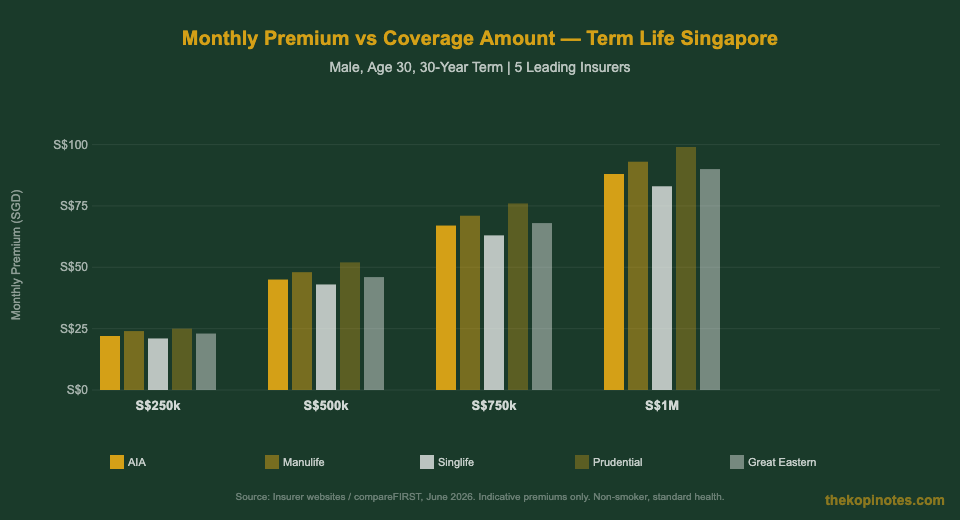
- A 30-year-old male can get S$500,000 coverage for under S$50/month — less than a weekday lunch per day
Table of Contents
Contents — Click to expand
- What Is Term Life Insurance?
- Why Most Singaporeans Should Start With Term Life
- Best Term Life Insurance Singapore 2026 — Comparison Table
- Our Top Picks: Insurer-by-Insurer Breakdown
- How Much Coverage Do You Actually Need?
- How to Buy Term Life Insurance in Singapore
- Term Life vs Whole Life: Which Should You Pick?
- Frequently Asked Questions
What Is Term Life Insurance?
Term life insurance pays a lump sum to your beneficiaries if you die within a set period — the “term.” You choose the coverage amount (called the sum assured), the policy term (typically 10, 20, or 30 years), and pay a fixed monthly or annual premium throughout.
Unlike whole life or investment-linked policies (ILPs), term life builds no cash value. When the term ends, the policy lapses with no payout. That sounds like a downside — but it is also why term life is so cheap. You are paying purely for protection, not investment returns or savings.
In Singapore, term life is regulated by the Monetary Authority of Singapore (MAS) under the Insurance Act. All insurers selling term life must be licensed by MAS, and policies sold here follow standard policy contract guidelines under the LIA (Life Insurance Association Singapore).
Term life policies in Singapore typically come with:
- Death benefit: Paid to your nominated beneficiaries if you die during the term
- Terminal illness benefit: Most policies now accelerate the payout if you are diagnosed with a terminal illness with less than 12 months to live
- Optional riders: You can add critical illness, total and permanent disability (TPD), or disability income riders at extra cost
Why Most Singaporeans Should Start With Term Life
The financial planning rule of thumb in Singapore — endorsed by bodies like MoneySense — is to secure protection first before thinking about investment. Term life lets you get the highest coverage at the lowest cost, freeing up money for other financial goals like investing in ETFs, building your CPF, or growing your emergency fund.
Here is a concrete example. A 30-year-old male non-smoker can get S$500,000 of coverage from Singlife for about S$43/month — roughly S$516 per year. That same S$500,000 in a whole life policy from the same age would cost S$500–S$800 per month. The term life option is more than 10 times cheaper.
The downside? If you outlive the term (which, statistically, most people will), you receive nothing back. However, for most working Singaporeans aged 25–45, the goal of life insurance is not to make money — it is to protect your family during the years when you have dependants, a mortgage, and limited financial reserves.
Once your kids are financially independent and your home loan is paid off, your need for large life cover decreases sharply. Term life is designed exactly for this life stage. You can use the premium savings to build a retirement nest egg using our Singapore retirement calculator to see how much you need.
Best Term Life Insurance Singapore 2026 — Comparison Table
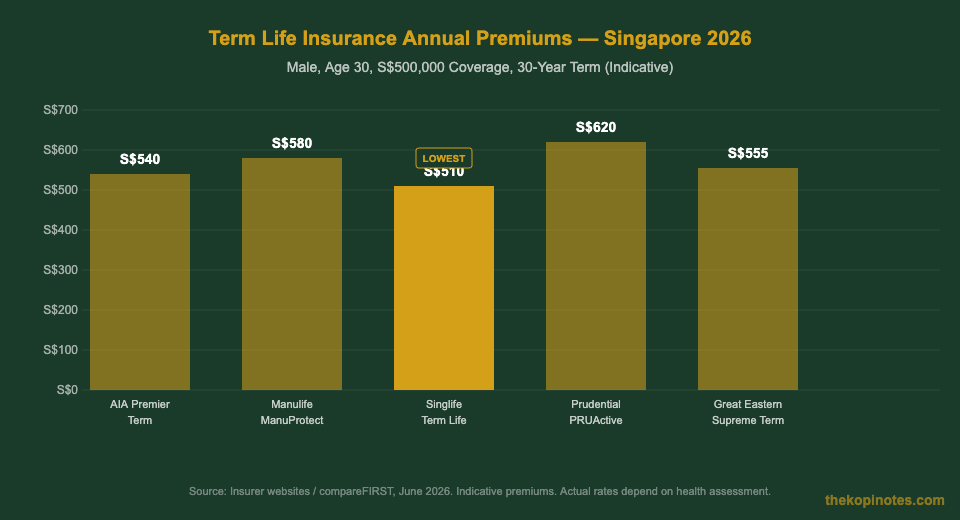
The table below compares the five main term life insurers in Singapore on the metrics that matter most: annual premium, policy features, riders available, and our verdict. Premiums are based on a male, age 30, non-smoker, standard health, S$500,000 sum assured, 30-year term.
| Insurer / Plan | Annual Premium | Terminal Illness | CI Rider Available | Min Entry Age | Our Verdict |
|---|---|---|---|---|---|
| Singlife Term Life | ~S$510 | Yes | Yes | 17 | Best Value |
| AIA Premier Term | ~S$540 | Yes | Yes | 16 | Best Brand + Riders |
| Great Eastern Supreme Term | ~S$555 | Yes | Yes | 18 | Best for HDB mortgage coverage |
| Manulife ManuProtect Term | ~S$580 | Yes | Yes | 18 | Best for convertibility |
| Prudential PRUActive Term | ~S$620 | Yes | Yes | 16 | Best for comprehensive riders |
Source: Insurer websites and compareFIRST (LIA Singapore), June 2026. Indicative premiums for male, age 30, non-smoker, standard health, S$500,000 coverage, 30-year term. Actual premiums depend on individual health declarations and underwriting.
Our Top Picks: Insurer-by-Insurer Breakdown
1. Singlife Term Life — Best Value Overall
Singlife (formerly Aviva Singapore) consistently quotes the lowest base premiums for healthy, non-smoking applicants. For a male turning 30, you are looking at around S$43/month for S$500,000 of coverage over 30 years — that is under S$1.50 per day.
Key features include terminal illness acceleration (100% of sum assured paid out early if life expectancy is under 12 months), conversion options to whole life or endowment policies, and optional critical illness riders. The application process is fully digital and relatively fast.
Best for: First-time buyers who want maximum coverage at minimum cost. Young families and HDB flat owners who want to cover their mortgage without overpaying for insurance.
2. AIA Premier Term — Best Brand + Rider Ecosystem
AIA is Singapore’s largest life insurer by market share, and Premier Term is their flagship term product. Premiums are slightly higher than Singlife — around S$45/month for the same profile — but the rider selection is the most comprehensive in the market.
You can stack AIA Premier Term with AIA Platinum Critical Cover (for 187 conditions including early-stage), AIA Total and Permanent Disability cover, and the AIA Prime Critical Cover rider. This makes it a strong one-stop-shop if you want to consolidate all your coverage under one insurer. You can learn more about building a financial safety net in our guide to passive income Singapore.
Best for: Buyers who want a comprehensive coverage bundle and value insurer brand strength. Also good for those who may have health history and want the most experienced underwriting team.
3. Great Eastern Supreme Term — Best for Mortgage Coverage
Great Eastern is one of Singapore’s oldest insurers (established 1908) and Supreme Term is their straightforward term product. Premiums sit at around S$555/year. Great Eastern’s underwriting tends to be more favourable for specific health conditions like well-controlled diabetes.
Great Eastern also offers a mortgage-specific Decreasing Term variant — coverage reduces in line with your home loan balance, making it significantly cheaper than a level-sum policy. Ideal for HDB flat owners who primarily want to cover their mortgage, not provide a standalone lump sum for dependants.
Best for: HDB homeowners wanting mortgage protection, and buyers with common managed conditions who want fair underwriting.
4. Manulife ManuProtect Term — Best Convertibility
Manulife’s term product stands out for its conversion privilege. You can switch your term policy to a whole life or endowment plan without further medical underwriting, up to a set age. This is valuable if your health changes during the term and you later want permanent coverage.
Premiums are mid-range at around S$580/year. Manulife also has a strong digital platform with clear policy documents and straightforward claim processes.
Best for: Buyers in their 30s who want flexibility to convert to a permanent policy later without worrying about future health underwriting.
5. Prudential PRUActive Term — Most Comprehensive Riders
Prudential’s term offering has the highest base premiums in our comparison (around S$620/year), but also the widest rider selection. You can add PRUExtra Plus CI (critical illness), PRUActiveCash (disability income), and waiver of premium benefits all under one policy.
If your priority is assembling a full protection suite under one insurer, PRUActive Term is worth the premium difference. Consider pairing your insurance with a CPF investment strategy to grow the savings from choosing term over whole life.
Best for: Buyers who want to stack multiple riders efficiently and don’t mind paying slightly more for an established insurer with a comprehensive product suite.
How Much Coverage Do You Actually Need?
The standard rule used by MoneySense and most financial advisers in Singapore is 9–10 times your annual income as a minimum death benefit. A more precise calculation includes these components:
| Factor | What to Include | Example (S$) |
|---|---|---|
| Outstanding mortgage | Remaining HDB / private home loan balance | S$350,000 |
| Income replacement | Annual salary x years until youngest child is independent | S$60k x 20 = S$1.2M |
| Children’s education | University fees x number of children | S$100,000 per child |
| Final expenses | Funeral costs, estate admin, misc | ~S$20,000 |
| Less existing assets | CPF savings, investments, existing policies | -S$200,000 |
Source: MoneySense Singapore coverage guidelines; figures are illustrative examples only.
Using the example above: S$350k (mortgage) + S$1.2M (income) + S$200k (education) + S$20k (final expenses) – S$200k (existing assets) = S$1.57 million target coverage. Many Singaporeans are significantly underinsured — the LIA 2022 Protection Gap Study found the average household needs an additional S$1.1M in life cover.
Check how your financial goals stack up using our Singapore retirement planning calculator.
How to Buy Term Life Insurance in Singapore
You have three main channels. Each trades off convenience, cost, and advice quality.
1. Buy Direct via compareFIRST
CompareFIRST is a free MAS-endorsed comparison portal run by the LIA. You can compare premiums from all major insurers side by side and purchase directly online without an adviser. Direct premiums can be 5–15% lower than adviser-sold premiums for some plans because there is no commission component. Visit comparefirst.sg to compare quotes.
2. Buy Through a Licensed Financial Adviser
If your situation is complex — health conditions, multiple existing policies, or you want a full financial plan — a licensed independent FA adds genuine value. They can advise on coverage amount, navigate underwriting, and structure riders correctly. Verify any adviser on the MAS Financial Adviser Register before buying.
3. Buy via a Digital Channel
Singlife, Income, and AIA all offer digital underwriting for straightforward profiles. If you are under 40 and healthy, you can often get covered within 30 minutes with no medical examination for sums up to S$1–1.5 million. Once your insurance foundation is in place, platforms like the Endowus fee-only investing platform or the Syfe robo-advisory platform can help you put the premium savings from choosing term over whole life to work.
Term Life vs Whole Life: Which Should You Pick?
For most people under 45 without complex estate planning needs, term life wins on pure protection value. Here is a direct comparison:
| Factor | Term Life | Whole Life |
|---|---|---|
| Monthly cost (S$500k, age 30) | ~S$43/mo | ~S$500–800/mo |
| Coverage duration | Fixed term (10–35 yrs) | Lifetime |
| Cash value | None | Yes (grows slowly) |
| Good for | Young families, mortgage holders | Estate planning, legacy needs |
| Buy if you… | Want maximum coverage at minimum cost | Need lifelong coverage + forced savings |
Source: LIA Singapore product guides; indicative premium data from insurer websites, June 2026.
The “buy term and invest the rest” philosophy is widely endorsed by fee-only financial planners in Singapore. The premium savings — potentially S$5,000–9,000 per year — can be invested in low-cost index funds or added to your CPF SA, generating far better long-term returns than whole life cash value accumulation.
Whole life has genuine use cases: estate planning for high-net-worth families, covering final expenses with guaranteed cash value, and locking in permanent coverage for those who may be uninsurable later. We cover the full picture in our whole life insurance Singapore 2026 guide.
Disclaimer: This article is for educational purposes only and does not constitute financial advice. Always consult a licensed financial adviser before purchasing insurance. The Kopi Notes does not hold an insurance licence and does not earn commissions from insurance purchases.
Frequently Asked Questions
What is the best term life insurance in Singapore in 2026?
For most healthy, non-smoking profiles, Singlife Term Life offers the lowest premiums — around S$510–S$560 per year for S$500,000 coverage at age 30. AIA Premier Term and Great Eastern Supreme Term are close alternatives if you value brand strength or specific rider combinations. The best policy depends on your health profile, coverage needs, and preferred insurer, so comparing via compareFIRST before buying is strongly recommended.
How much does term life insurance cost in Singapore?
A 30-year-old male non-smoker can get S$500,000 coverage for approximately S$43–S$52/month (S$510–S$620/year) over a 30-year term. Premiums increase significantly with age — the same coverage at 40 typically costs 60–80% more, and at 50 it can be 2–3 times more expensive. Female applicants generally pay 15–20% less than males. Smokers pay approximately double the non-smoker rate.
Can I buy term life insurance with CPF or SRS in Singapore?
Regular term life premiums cannot be paid from your CPF OA or SA. The government-administered Dependent Protection Scheme (DPS) — a basic group term plan — has premiums deducted automatically from CPF OA. For privately purchased term life, premiums are paid in cash. SRS funds cannot be used to pay life insurance premiums directly either. Some whole life and endowment products allow SRS funding — check with your insurer.
How long a term should I choose for my term life insurance?
Most financial advisers in Singapore recommend covering yourself until your youngest child is financially independent (typically age 23–25) and your largest liability (usually your home loan) is fully repaid. For a 30-year-old with young children and an HDB mortgage, a 25–30 year term is typically appropriate. Beyond that, your need for large life cover decreases significantly. Avoid over-insuring for a very long term purely to lock in a low premium — the premium savings rarely justify decades of excess coverage.
Is it worth getting a critical illness rider on my term life insurance?
Yes, for most people — especially if you do not have a standalone critical illness (CI) policy. A CI rider pays a lump sum on diagnosis of covered conditions (typically 30–37 major conditions, or 100+ for early CI riders). The cost is low when added young. However, many CI riders accelerate or reduce your death benefit, so a CI claim may leave your family underinsured for death coverage. Ideally, keep CI and term life as separate policies if budget allows. Our guide to early critical illness insurance Singapore covers this in detail.
What happens if I miss a premium payment on my term life policy?
Most term life policies in Singapore include a 30-day grace period. If you miss a premium, your coverage continues for 30 days. If not received within that period, the policy lapses. Unlike whole life policies, term life has no cash value — there is no automatic premium loan to keep coverage in force. If your policy lapses, you may be able to reinstate it within two years by paying outstanding premiums plus interest, subject to a new medical assessment.
Should I buy term life insurance through an adviser or direct?
If you are young and healthy with straightforward coverage needs, buying direct via compareFIRST (comparefirst.sg) is typically cheaper — you avoid any commission component built into adviser-sold premiums. If you have health conditions, complex coverage needs, or want a holistic financial plan, working with a licensed independent financial adviser (IFA) adds genuine value. Always verify your FA is registered on the MAS Financial Adviser Register before purchasing through them.
Secure Your Family’s Future — Then Start Investing
Protection first, then wealth building. Once your term life is in place, use our tools to plan your investment journey.
Get Free Insurance Advice
Speak with a licensed insurance advisor. No obligation, no cost.
By submitting this form, you agree to our Privacy Policy.
This article was researched with the help of AI. While we strive to keep all information accurate and up to date, there may be errors. If you notice any discrepancies, please contact us.