CSPX vs SPYL vs VUAA: Which S&P 500 ETF Is Best for Singapore Investors? (2026)
A data-driven comparison for Singapore investors — TER, withholding tax, AUM, and total cost of ownership.
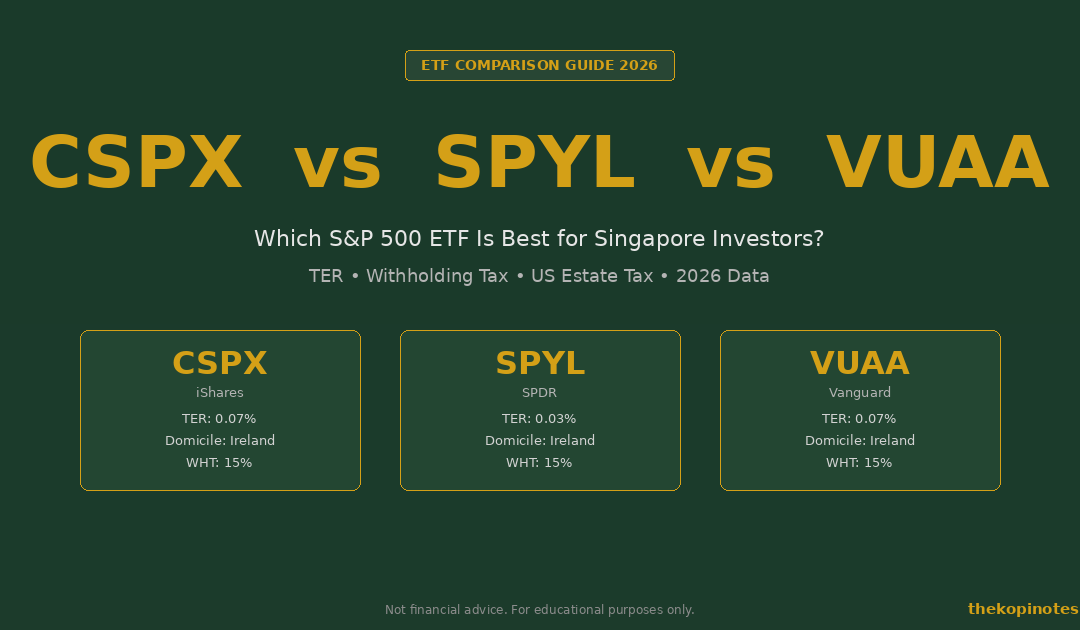
CSPX, SPYL, and VUAA are all Ireland-domiciled, S&P 500-tracking ETFs listed on the London Stock Exchange (LSE). For Singapore investors, all three carry the same tax advantage: 15% US dividend withholding tax and zero US estate tax exposure. The key differences are TER (SPYL wins at 0.03% vs 0.07% for CSPX and VUAA), AUM (CSPX leads with USD 75+ billion), and liquidity. Most long-term Singapore investors are best served by SPYL or CSPX.
Not financial advice. All figures are for educational reference only. Data as at June 2026 unless noted.
Table of Contents
Contents — Click to expand
- Quick Answer: Which ETF Should Singapore Investors Choose?
- Key Differences at a Glance
- Tax & Cost Comparison (The Most Important Factor)
- TER Deep Dive: Does 0.04% Matter?
- Historical Performance Comparison
- Liquidity and AUM
- How to Buy These ETFs in Singapore
- Who Should Pick Which ETF?
- Frequently Asked Questions
Quick Answer: Which ETF Should Singapore Investors Choose?
For most Singapore investors building a long-term, passive S&P 500 position, SPYL is the most cost-efficient choice in 2026 — its 0.03% TER is the lowest of the three, and it has the same Ireland domicile and 15% withholding tax advantage as CSPX and VUAA. However, CSPX’s massive AUM (USD 75+ billion) and longer track record make it the safer pick for investors who prioritise liquidity and fund stability. VUAA, also from Vanguard’s renowned family, sits between the two in terms of AUM. The “right” answer depends on whether you value rock-bottom fees (SPYL), deep liquidity (CSPX), or the Vanguard brand (VUAA).
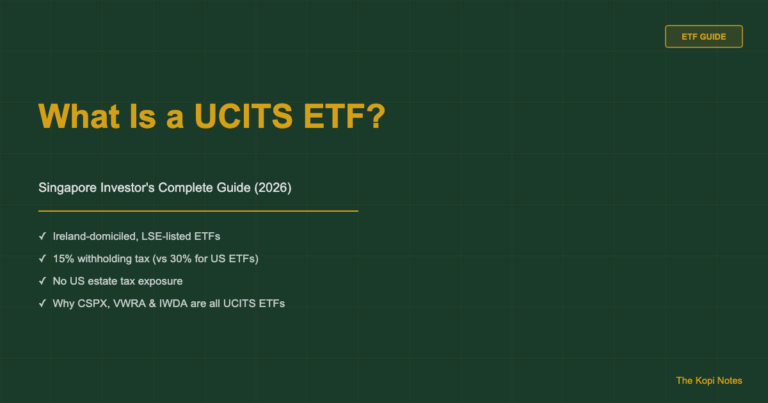
The key insight for Singapore investors: all three ETFs are functionally equivalent from a tax perspective. The Ireland-US tax treaty means all three incur only 15% withholding tax on US dividends — a 15 percentage point saving versus buying VOO or IVV directly on NYSE. None of them expose you to US estate tax. The main differentiation is cost and scale.
Key Differences at a Glance
| Feature | CSPX (iShares) | SPYL (SPDR) | VUAA (Vanguard) |
|---|---|---|---|
| Full Name | iShares Core S&P 500 UCITS ETF | SPDR S&P 500 UCITS ETF | Vanguard S&P 500 UCITS ETF |
| Ticker (LSE) | CSPX | SPYL | VUAA |
| Provider | BlackRock / iShares | State Street / SPDR | Vanguard |
| Index Tracked | S&P 500 | S&P 500 | S&P 500 |
| Domicile | Ireland (UCITS) | Ireland (UCITS) | Ireland (UCITS) |
| Structure | Accumulating | Accumulating | Accumulating |
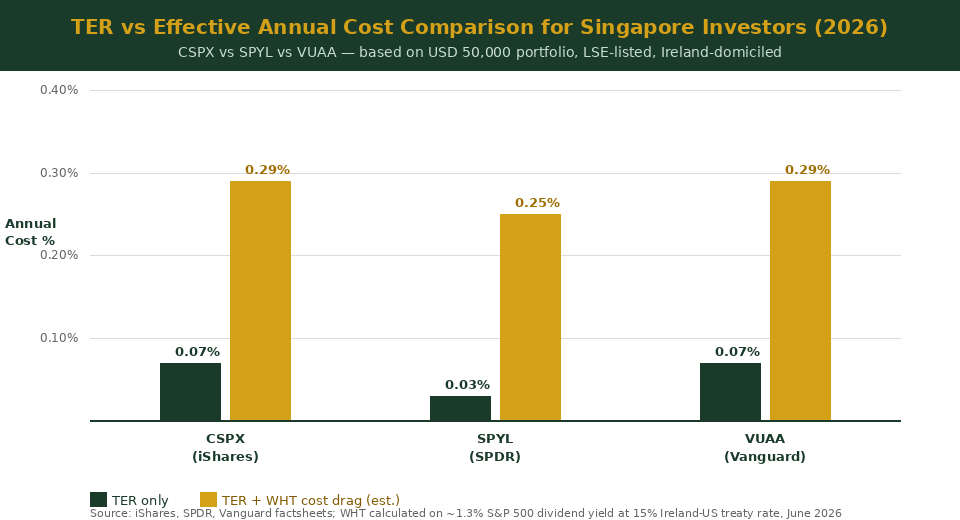
| TER (Expense Ratio) | 0.07% p.a. | 0.03% p.a. ✓ Lowest | 0.07% p.a. |
| AUM (approx.) | USD 75B+ ✓ Largest | USD 8B+ | USD 7B+ |
| US Dividend WHT | 15% (Ireland treaty) | 15% (Ireland treaty) | 15% (Ireland treaty) |
| US Estate Tax Risk | None | None | None |
| Currency (LSE) | USD | USD | USD |
| Holdings | ~500 | ~500 | ~500 |
Source: iShares, SPDR, Vanguard factsheets; AUM as at Q1 2026.
Tax & Cost Comparison (The Most Important Factor)
For Singapore investors, the Ireland domicile of all three ETFs is the single most important structural advantage. Here’s why it matters in dollar terms:
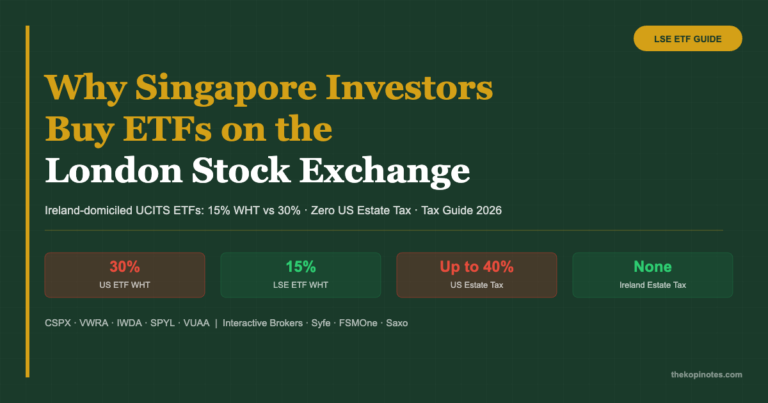
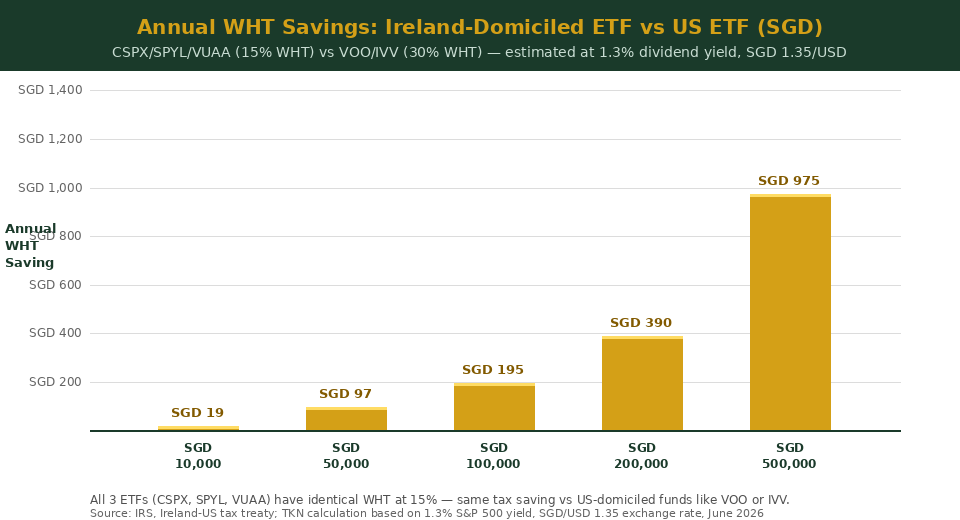
The United States imposes a 30% withholding tax (WHT) on dividends paid to foreign investors holding US-domiciled ETFs like VOO (Vanguard, NYSE) or IVV (iShares, NYSE). Under the Ireland-US double tax treaty, Ireland-domiciled funds like CSPX, SPYL, and VUAA receive US dividends at only 15% WHT — half the rate.
A worked SGD example: assume a Singapore investor holds SGD 100,000 in a S&P 500 ETF, the index yields approximately 1.3% per annum in dividends, and the USD/SGD rate is 1.35.
- VOO (US-domiciled, NYSE): SGD 100,000 ÷ 1.35 = USD 74,074 × 1.3% dividend = USD 963 gross dividend. At 30% WHT: USD 289 lost to tax per year.
- CSPX/SPYL/VUAA (Ireland-domiciled, LSE): Same portfolio. At 15% WHT: USD 144 lost to tax per year.
- Annual saving: approximately USD 144 (SGD 194) on a SGD 100,000 portfolio.
On a SGD 500,000 portfolio, this WHT saving compounds to approximately SGD 970 per year — money that stays invested and compounds via the accumulating structure. Over 20 years at 7% annualised returns, that SGD 970/year saved equals approximately SGD 42,000 in additional final portfolio value.
There is also the critical matter of US estate tax. For Singapore investors (non-US persons), US-domiciled ETFs held directly on US exchanges are subject to US estate tax at 40% on the value above USD 60,000 upon death. Ireland-domiciled ETFs are not treated as US-situs assets — so CSPX, SPYL, and VUAA carry no US estate tax risk regardless of portfolio size. This is a significant estate planning advantage for Singaporean investors with large portfolios.
| ETF | Domicile | US Dividend WHT | US Estate Tax Risk | WHT Saving vs US ETF |
|---|---|---|---|---|
| CSPX / SPYL / VUAA (LSE) | Ireland | 15% | None | +15 percentage points |
| VOO / IVV (NYSE) | USA | 30% | Yes (above USD 60k) | — |
Source: IRS Publication 515, Ireland-US Tax Treaty Article 10; TKN calculation based on 1.3% S&P 500 dividend yield, June 2026.
TER Deep Dive: Does 0.04% Actually Matter?
SPYL’s TER of 0.03% p.a. versus CSPX and VUAA’s 0.07% p.a. is a difference of 0.04 percentage points per year. Let’s put that in SGD terms:
- SGD 50,000 portfolio: SPYL saves you ~SGD 27/year vs CSPX or VUAA (SGD 37 vs SGD 64 in annual fees)
- SGD 200,000 portfolio: SPYL saves you ~SGD 108/year
- SGD 500,000 portfolio: SPYL saves you ~SGD 270/year
Over a 30-year investment horizon at 7% annualised returns, a SGD 270/year annual cost saving on a SGD 500,000 portfolio compounds to approximately SGD 27,000 extra in final portfolio value. This is not trivial — but it must be weighed against CSPX’s advantages in AUM, bid-ask spread, and tracking error stability.
A larger AUM (CSPX at USD 75B+ vs SPYL at USD 8B+) generally means tighter bid-ask spreads on the LSE, which reduces your implicit transaction cost each time you buy or sell. For investors making large lump-sum purchases or frequent top-ups, this spread efficiency can partially offset SPYL’s TER advantage. For an investor making a single annual purchase of SGD 10,000, the difference in bid-ask spread is negligible.
Historical Performance Comparison
Since all three ETFs track the same index (S&P 500), their gross performance should be nearly identical before costs. Any divergence comes from tracking error, securities lending income, and the slight TER difference.
| ETF | 1Y Return (USD, approx.) | 3Y Annualised (USD, approx.) | Since Inception | Tracking Difference |
|---|---|---|---|---|
| CSPX | ~+23% (YTD as at May 2026) | ~+13.5% | 2010 | -0.05% (vs index) |
| SPYL | ~+23% (YTD as at May 2026) | ~+13.5% | 2019 | ~0.00% (vs index) |
| VUAA | ~+23% (YTD as at May 2026) | ~+13.5% | 2019 | ~0.00% (vs index) |
Source: Morningstar, iShares, SPDR, Vanguard fund pages; performance figures approximate and rounded for illustration. Past performance does not predict future returns.
Note: CSPX has a longer track record (since 2010), which makes it the only one of the three with a full S&P 500 bull-bear-recovery cycle on record. SPYL and VUAA both launched in 2019 and have shorter histories — though their structural similarity to established funds means this matters less for confidence.
Liquidity and AUM: Why CSPX Leads
AUM matters for a few practical reasons:
- Bid-ask spread: Larger AUM means more market makers quoting tight prices on the LSE. CSPX typically trades at spreads of 0.01–0.03%, versus slightly wider spreads for SPYL and VUAA. For large trades (USD 50,000+), this matters.
- Fund closure risk: A fund needs minimum viability to remain open. With USD 75B+ in AUM, CSPX has essentially zero closure risk. SPYL and VUAA at USD 7–8B+ are also well above closure thresholds — but CSPX’s scale provides more certainty.
- Securities lending income: Larger funds lend more shares to short-sellers and can earn more income to offset the TER — sometimes resulting in a lower effective cost than the stated TER suggests. CSPX is known to have good securities lending income from BlackRock’s scale.
How to Buy These ETFs in Singapore
All three ETFs trade on the London Stock Exchange in USD. Singapore investors can access them through these main brokers:
Interactive Brokers (IBKR): The lowest-cost option for large portfolios. Commission starts at USD 1.70 per trade (minimum), making it cost-effective for trades of USD 5,000+. Search “CSPX”, “SPYL”, or “VUAA” on the IBKR platform and select the LSE exchange. Fund in SGD and convert to USD at the interbank rate.
Syfe Brokerage: A simpler, Singapore-native option for beginners. The Syfe referral code provides a sign-up bonus for new users. Syfe supports LSE-listed ETFs and the interface is designed for retail investors who want a clean, app-first experience.
Saxo Markets: Competitive for mid-size portfolios. Commission is SGD 5–10 per trade, and Saxo provides access to LSE-listed ETFs with good FX conversion rates. Suitable for investors who want research tools alongside execution.
MooMoo Singapore: Commission-free for many trades and well-suited for frequent small purchases. Read our moomoo Singapore review for the full breakdown of fees and features.
FSMOne: A good choice for investors who prefer a fund supermarket approach. Use the FSMOne referral code for a fee waiver on first trades. FSMOne also offers Regular Savings Plans (RSP) for CSPX, making it ideal for dollar-cost averaging.
Note: These LSE-listed ETFs are not eligible for CPF investment. They can be purchased with Supplementary Retirement Scheme (SRS) funds through eligible brokers such as FSMOne or Saxo. If CPF investment is a priority, consider CPF investment strategy alternatives such as SGX-listed ETFs or endowment-linked plans. If planning long-term, use our Singapore retirement calculator to see how your ETF investment compounds toward your target.
Who Should Pick Which ETF?
Choose SPYL if: you are cost-obsessed and building a large, buy-and-hold portfolio where 0.04% TER saving compounds over decades. SPYL is the rational choice for investors purely optimising for lowest total expense. Its USD 8B+ AUM means it’s well-established, though not as deep as CSPX in terms of liquidity.
Choose CSPX if: you want the deepest liquidity, longest track record, and the institutional credibility of BlackRock. CSPX is the benchmark choice for most professional and institutional Singapore investors building S&P 500 exposure on the LSE. If you are making irregular large lump-sum purchases, CSPX’s tight bid-ask spreads give you better execution prices. For more detail, see our dedicated CSPX ETF Singapore guide.
Choose VUAA if: you are a Vanguard loyalist or building alongside other Vanguard funds (like VWRA) and prefer to consolidate within one fund family. Functionally VUAA is almost identical to CSPX at the same 0.07% TER, but with Vanguard’s ownership structure where the funds are owned by investors. For VWRA comparisons and the full world equity picture, see our VWRA guide.
Consider alternatives if: you want income rather than accumulation (look at distributing share classes), you want CPF eligibility (look at Nikko AM STI ETF or other SGX-listed options via our Singapore REIT ETF guide), or you want global diversification beyond the US (VWRA tracks ~3,700 global stocks vs the S&P 500’s 500 US stocks).
Disclaimer: This article is for educational purposes only and does not constitute financial advice. Past performance is not indicative of future results. All figures are approximate and should be verified against current fund factsheets before making any investment decision. The Kopi Notes may earn referral fees from broker links on this page.
Frequently Asked Questions
What is the main difference between CSPX, SPYL, and VUAA?
All three track the S&P 500 index and are Ireland-domiciled UCITS ETFs with the same 15% US dividend withholding tax advantage. The main differences are TER (SPYL is lowest at 0.03%, CSPX and VUAA are both 0.07%), AUM (CSPX is largest at USD 75B+), and provider (iShares, SPDR/State Street, and Vanguard respectively). For most Singapore investors, the choice comes down to SPYL for lowest cost or CSPX for deepest liquidity.
For Singapore investors, which of these ETFs is most tax-efficient?
All three are equally tax-efficient for Singapore investors — they are all Ireland-domiciled and benefit from the same Ireland-US tax treaty rate of 15% withholding tax on US dividends. None of them expose Singapore investors to US estate tax, unlike US-domiciled ETFs such as VOO or IVV which carry 40% estate tax risk on holdings above USD 60,000. Singapore itself does not impose capital gains tax or dividend tax on these investments.
Is SPYL safe? It has much less AUM than CSPX.
SPYL is a well-established ETF with USD 8B+ in AUM — well above the typical USD 100 million threshold below which fund closure risk increases significantly. It is managed by State Street, one of the world’s largest asset managers. However, CSPX at USD 75B+ is considerably more established with tighter bid-ask spreads. For most retail investors making regular monthly purchases, SPYL’s AUM is more than adequate. For very large one-time investments (USD 100,000+), CSPX’s liquidity depth is more relevant.
Can I buy CSPX, SPYL, or VUAA with my CPF or SRS?
None of these three ETFs are eligible for CPF investment under the CPF Investment Scheme (CPFIS), as they are listed on the LSE and not SGX. However, all three can be purchased using Supplementary Retirement Scheme (SRS) funds through eligible brokers such as FSMOne or Saxo Markets. If CPF investment is important to you, consider SGX-listed S-REIT ETFs or STI ETFs as CPFIS-approved alternatives.
Which broker is best for buying CSPX, SPYL, or VUAA in Singapore?
Interactive Brokers (IBKR) is generally the most cost-effective for larger portfolios due to its low per-trade commission (from USD 1.70). Syfe Brokerage offers the simplest experience for beginners and Singapore-first UX. FSMOne is best for dollar-cost averaging via Regular Savings Plans. MooMoo is competitive for small, frequent trades. Choose based on your trade size, frequency, and comfort with the platform interface.
Should I switch from CSPX to SPYL to save on TER?
Switching involves selling CSPX and buying SPYL, which incurs two sets of transaction costs (bid-ask spread + commission) and potentially triggers currency conversion. The 0.04% annual TER saving must be large enough to recoup these switching costs — on a SGD 50,000 portfolio, the annual saving is only SGD 27, meaning it would take years to break even. If you are starting fresh, choose SPYL for cost efficiency. If you already hold CSPX, switching is unlikely to be worth it unless your portfolio is very large (SGD 500,000+) or you are planning a periodic rebalance anyway.
Ready to Start Investing in S&P 500 ETFs?
Open a brokerage account today and use our referral links for exclusive sign-up bonuses.
This article was researched with the help of AI. While we strive to keep all information accurate and up to date, there may be errors. If you notice any discrepancies, please contact us.