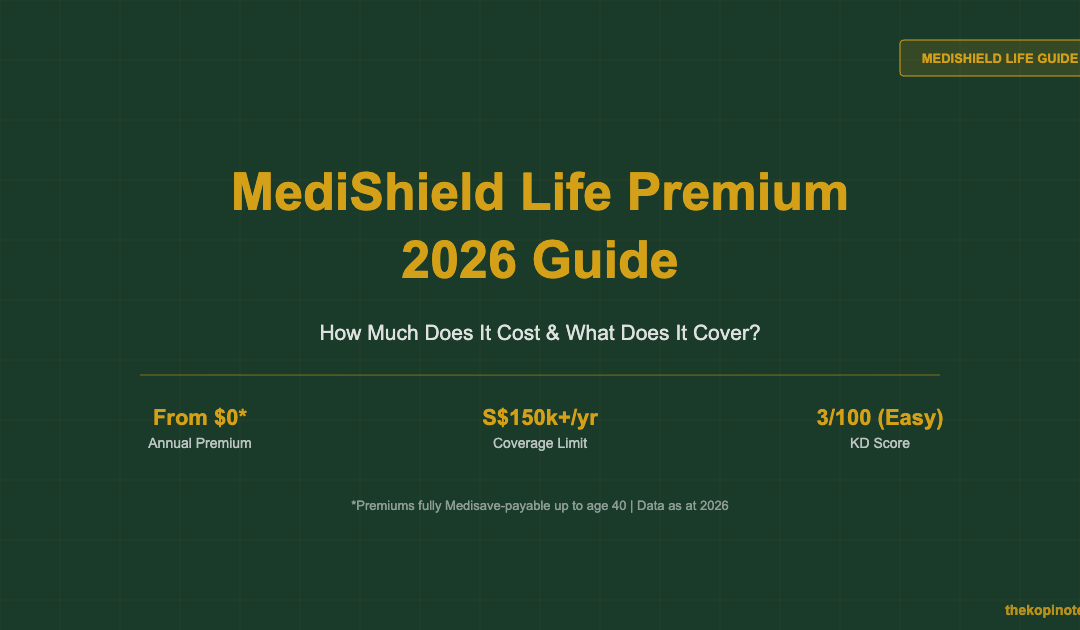
MediShield Life Premium 2026: How Much Does It Cost & What Does It Cover?
Your complete guide to MediShield Life premiums — the annual cost by age, what’s covered, how to pay using Medisave, and whether upgrading to an Integrated Shield Plan makes sense for you.
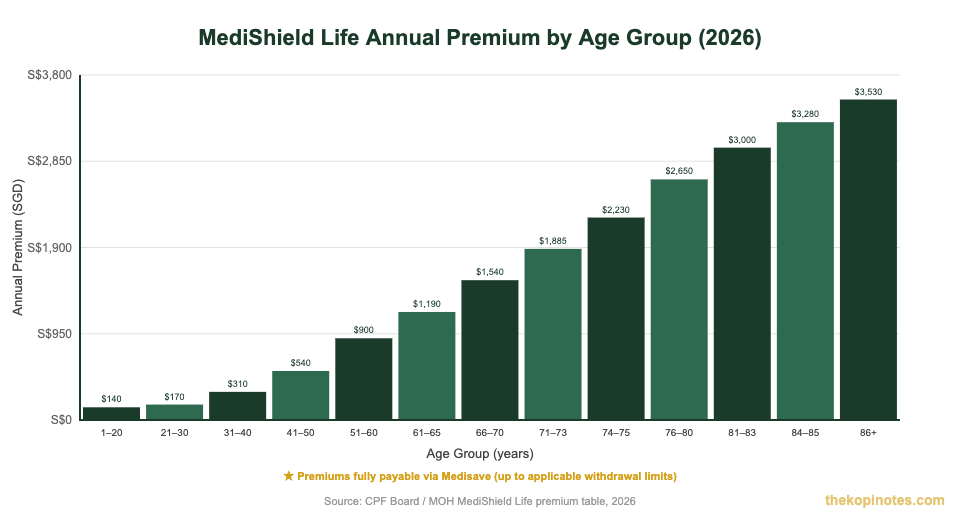
MediShield Life is Singapore’s compulsory national health insurance scheme administered by the CPF Board, providing lifetime coverage against large hospital bills. Annual premiums range from S$140 for those aged 1–20 to over S$3,500 for those aged 86 and above, and are fully payable via Medisave up to applicable withdrawal limits. Most working Singaporeans pay zero out-of-pocket for MediShield Life premiums. Upgrading to an Integrated Shield Plan (ISP) extends coverage to private hospitals and Class A/B1 wards for an additional premium.
Not financial advice. All figures are for educational reference only. Data as at June 2026 unless noted.
Table of Contents
Contents — Click to expand
- What Is MediShield Life?
- MediShield Life Premium Table 2026
- How to Pay MediShield Life Premiums (Medisave)
- What Does MediShield Life Cover?
- Deductible, Co-insurance & Claim Limits
- Should You Upgrade to an Integrated Shield Plan?
- MediShield Life vs Integrated Shield Plans: Side-by-Side
- Frequently Asked Questions
What Is MediShield Life?
MediShield Life is Singapore’s mandatory national health insurance scheme, introduced in November 2015 to replace the original MediShield plan. Administered by the CPF Board and overseen by the Ministry of Health (MOH), it covers all Singapore Citizens and Permanent Residents for life — regardless of age or pre-existing medical conditions.
The scheme is designed to help defray the cost of large hospital bills and certain outpatient treatments, primarily at Class B2 and C wards in public hospitals. Premiums are risk-pooled across all Singaporeans, with older and lower-income individuals receiving subsidies to keep the scheme affordable.
Key characteristics of MediShield Life include: lifetime coverage with no expiry, coverage that includes pre-existing conditions (though with a waiting period for new enrollees who previously had no coverage), and premiums that are fully payable via Medisave — meaning most working-age Singaporeans pay nothing out of pocket.
For those who want coverage at private hospitals or Class A/B1 wards in public hospitals, MediShield Life can be upgraded with an Integrated Shield Plan (ISP) offered by one of five approved private insurers: AIA, Great Eastern, Income Insurance, NTUC Income, and Prudential.
MediShield Life Premium Table 2026
MediShield Life premiums are age-banded — they increase as you get older, reflecting the higher healthcare utilisation at older ages. The following table shows the annual premium for each age group as at 2026. These premiums are before any government subsidies (Additional Premium Support and Transitional Subsidies), which reduce the net amount payable for lower-income Singaporeans.
| Age Group (years) | Annual Premium (SGD) | Monthly Equivalent | Medisave Payable? |
|---|---|---|---|
| 1 – 20 | S$140 | ~S$12 | Yes (parent’s Medisave) |
| 21 – 30 | S$170 | ~S$14 | Yes (own Medisave) |
| 31 – 40 | S$310 | ~S$26 | Yes (own Medisave) |
| 41 – 50 | S$540 | ~S$45 | Yes (own Medisave) |
| 51 – 60 | S$900 | ~S$75 | Yes (own Medisave) |
| 61 – 65 | S$1,190 | ~S$99 | Yes (own Medisave) |
| 66 – 70 | S$1,540 | ~S$128 | Yes (own Medisave) |
| 71 – 73 | S$1,885 | ~S$157 | Yes (own Medisave) |
| 74 – 75 | S$2,230 | ~S$186 | Yes (own Medisave) |
| 76 – 80 | S$2,650 | ~S$221 | Yes (own Medisave) |
| 81 – 83 | S$3,000 | ~S$250 | Yes (own Medisave) |
| 84 – 85 | S$3,280 | ~S$273 | Yes (own Medisave) |
| 86 and above | S$3,530 | ~S$294 | Yes (own Medisave) |
Source: CPF Board MediShield Life premium table, June 2026. Figures are before government subsidies.
For a 35-year-old Singaporean, MediShield Life costs just S$310 per year — or about 26 cents per day — fully deducted from Medisave automatically. At age 50, the annual premium rises to S$900, which for most working professionals is still entirely covered by their Medisave contributions (employees contribute 8–10.5% of their monthly salary to Medisave depending on age).
Government subsidies reduce premiums further for lower-income Singaporeans earning below S$28,000 per year, as well as for those transitioning off the old MediShield scheme. If you receive Pioneer Generation or Merdeka Generation benefits, additional rebates apply throughout your lifetime.
How to Pay MediShield Life Premiums (Medisave)
One of MediShield Life’s most practical features is that premiums are automatically deducted from your Medisave account — the healthcare sub-account within your CPF. You do not need to pay anything out of pocket as long as your Medisave balance is sufficient.
The premium deduction happens annually, typically around your birthday month. The CPF Board will notify you by letter or via CPF Online Services when the deduction takes place. There is no need to submit forms or manually initiate payment.
Who pays using Medisave:
- Employed Singaporeans: Monthly CPF contributions automatically grow your Medisave. For most working adults under age 55, Medisave receives 8–10.5% of monthly wages, more than enough to cover MediShield Life premiums.
- Self-employed persons (SEPs): If you earn more than S$6,000 per year, you are required to make Medisave contributions and your MediShield Life premium is similarly auto-deducted.
- Retirees and those not working: If your Medisave account still has a balance, premiums are deducted from it. If Medisave is exhausted, you can pay via cash, a family member’s Medisave, or apply for the Additional Premium Support scheme.
- Children aged 1–20: Parents can use their own Medisave to pay for their children’s MediShield Life premiums.
From age 40 onwards, there is a Medisave Withdrawal Limit for MediShield Life — meaning if your MediShield Life premium (or the combined MediShield Life + ISP premium) exceeds the limit, the excess must be paid in cash. This typically affects those who hold ISP plans at higher tiers (e.g., private hospital coverage). For MediShield Life alone, the Medisave withdrawal limit is sufficient to cover premiums at all age bands.
Keeping your CPF investment strategy on track ensures your Medisave and Ordinary Account balances grow sufficiently to cover rising healthcare costs in retirement. Separately, the Singapore retirement calculator can help you model how healthcare costs factor into your retirement income needs.
What Does MediShield Life Cover?
MediShield Life is a hospitalisation and surgical insurance scheme. It is designed to pay for the bulk of large bills arising from Class B2 and C ward stays in public hospitals — the subsidised wards where most Singaporeans receive treatment. It also covers certain outpatient treatments that are expensive and recurring.
| Coverage Category | What Is Covered | Benefit Limit (per policy year) |
|---|---|---|
| Inpatient hospitalisation | Daily ward & treatment charges | Up to S$1,200/day (Class C ward equivalent) |
| Surgical procedures | Surgeon’s fees, anaesthetist fees | Up to S$300–S$2,000 per table |
| Intensive Care Unit (ICU) | ICU stay charges | Up to S$2,500/day |
| Outpatient dialysis | Kidney dialysis treatment | Up to S$1,100 per month |
| Outpatient cancer treatment | Chemotherapy, radiotherapy, immunotherapy | Up to S$3,000 per month |
| Annual policy limit | Total claimable per year | S$150,000 |
| Lifetime limit | Total claimable over lifetime | Unlimited (from April 2021) |
Source: MOH MediShield Life benefit schedule, 2026
An important point: MediShield Life pays based on the subsidised bill amount in Class B2/C wards at public hospitals. If you choose a Class B1 or Class A ward, or go to a private hospital, MediShield Life will only reimburse up to what the equivalent Class B2/C charge would have been — and you pay the rest out of pocket (or via your ISP, if you have one).
This design encourages use of the subsidised public healthcare system while providing catastrophic protection for large bills. In practice, MediShield Life has an annual claim limit of S$150,000 per policy year — sufficient for most hospitalisation episodes but potentially insufficient for very prolonged ICU stays or complex cancer treatments running over multiple years. This is one reason many Singaporeans add an ISP on top.
Deductible, Co-insurance & Claim Limits
MediShield Life does not cover 100% of your hospital bill. It uses a cost-sharing structure consisting of three components: a deductible, co-insurance, and claim limits per treatment type. Understanding these prevents surprises at discharge.
Deductible: This is the portion you pay before MediShield Life kicks in. The deductible applies per policy year (not per admission). For 2026:
- Class C ward: S$1,500 per policy year
- Class B2 ward: S$2,000 per policy year
- Class B1/A/private hospital: S$3,000 per policy year
Once the deductible is met for the year, MediShield Life begins paying — but only up to the claim limits for each procedure type.
Co-insurance: After the deductible, MediShield Life pays 90% of eligible charges (up to claim limits), and you pay the remaining 10%. This co-insurance portion can be paid using Medisave.
Worked example — Class B2 ward, total bill S$20,000:
| Component | Amount (SGD) |
|---|---|
| Total hospital bill | S$20,000 |
| MediShield Life deductible (B2) | – S$2,000 |
| Eligible for MediShield Life claim | S$18,000 |
| MediShield Life pays (90%) | S$16,200 |
| Your co-insurance (10%) | S$1,800 |
| Out-of-pocket (deductible + co-ins) | S$3,800 (payable via Medisave) |
Source: MOH MediShield Life benefit structure, 2026. Illustration assumes bill falls within claim limits.
This means for a S$20,000 hospital bill in a Class B2 ward, MediShield Life pays S$16,200 and you owe S$3,800 — all of which can typically be settled from Medisave. Without MediShield Life, you would owe the full S$20,000.
Should You Upgrade to an Integrated Shield Plan?
MediShield Life covers Class B2 and C wards at public hospitals. If you want to be treated in a Class B1 or Class A ward at a public hospital, or at a private hospital, you need an Integrated Shield Plan (ISP). ISPs are sold by five private insurers — AIA, Great Eastern, Income Insurance, NTUC Income, and Prudential — and include the MediShield Life component as their base layer.
When an ISP makes sense:
- You prefer private hospital care or Class A/B1 rooms and want to avoid large out-of-pocket bills
- You have a family history of complex illnesses and want access to specialist care at private hospitals
- Your employer provides a healthcare benefit allowance that can offset the additional ISP premium
- You are willing to pay cash premiums (the ISP add-on component above MediShield Life cannot be paid via Medisave for rider premiums under the rider rules effective 2019)
When MediShield Life alone may be sufficient:
- You are young, healthy, and have no strong preference for private hospital care
- You are comfortable with public hospital Class B2/C wards and the quality of care there
- Your Medisave balance is already stretched or you prefer to minimise insurance spending
- You are a permanent resident considering moving overseas in the near future
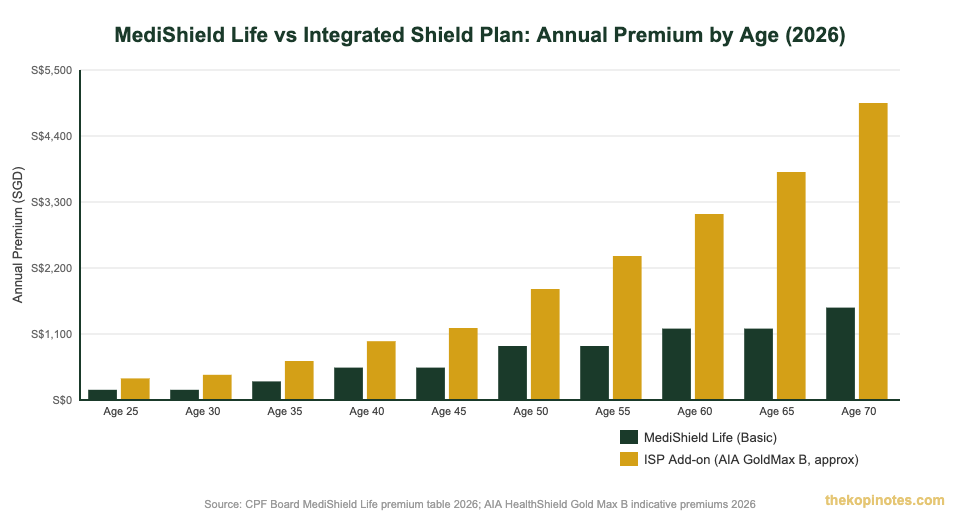
For context, a 35-year-old adding AIA HealthShield Gold Max B (covering Class B1 wards) would pay roughly S$340 per year in additional ISP premium on top of MediShield Life’s S$310 — totalling around S$650 per year. By age 50, the combined premium for a similar plan reaches approximately S$1,850 per year.
If you are comparing ISP options, our detailed Integrated Shield Plan Singapore guide covers all five insurers with a full premium and benefit comparison. You can also use the Singapore retirement calculator to model how healthcare premiums affect your long-term financial plan.
MediShield Life vs Integrated Shield Plans: Side-by-Side
The table below compares MediShield Life (base plan) against a typical ISP at the B1 and private hospital tier. All premium figures are indicative and based on 2026 published rates for a 40-year-old non-smoker.
| Feature | MediShield Life | ISP (B1 Ward) | ISP (Private Hospital) |
|---|---|---|---|
| Annual premium at age 40 | S$540 | ~S$800–S$1,100 | ~S$1,400–S$1,900 |
| Annual premium at age 60 | S$1,190 | ~S$2,600–S$3,500 | ~S$4,500–S$6,000 |
| Hospital coverage | Class B2 / C (public) | Up to Class B1 (public) | Private hospitals |
| Annual claim limit | S$150,000 | S$600,000–S$1M | S$1M+ |
| Deductible | S$1,500–S$3,000 | S$1,500–S$3,500 | S$3,500–S$5,000 |
| Co-insurance | 10% | 10% (with rider: 5–10%) | 10% (with rider: 5–10%) |
| Payable via Medisave? | 100% yes | Base layer only; rider in cash | Base layer only; rider in cash |
| Pre-existing conditions | Covered (with loading for some) | May be excluded or loaded | May be excluded or loaded |
Source: CPF Board; MOH ISP comparison data; indicative insurer premiums, June 2026.
The decision to upgrade hinges on how much value you place on flexibility of hospital choice. Public hospitals in Singapore deliver world-class care at Class B2/C wards; the main difference between wards is room sharing (6-bedded vs 1-bedded), waiting times for elective procedures, and direct specialist access. If these factors matter to you and you can afford the additional cash premium, an ISP is a worthwhile upgrade.
If you have specific insurers in mind, see our detailed breakdown of Integrated Shield Plan comparisons in Singapore, where we analyse all five insurers’ plans side-by-side. For general financial planning support, Syfe offers robo-advisory services that can help you build a long-term healthcare savings buffer alongside your investment portfolio.
Disclaimer: Insurance plan features and premium rates are subject to change. Always refer to the insurer’s latest product summary and the CPF Board’s official MediShield Life premium table for current figures before making any coverage decisions. This article does not constitute financial or insurance advice.
Frequently Asked Questions
How much is the MediShield Life premium in 2026?
MediShield Life annual premiums in 2026 range from S$140 for those aged 1–20 to S$3,530 for those aged 86 and above. For working adults in their 30s and 40s — the largest group — premiums are S$310 to S$540 per year. All premiums are fully payable via Medisave, so most working Singaporeans pay zero out of pocket. Government subsidies (Additional Premium Support) further reduce the net premium for lower-income residents.
Is the MediShield Life premium compulsory?
Yes — MediShield Life is a mandatory national insurance scheme. All Singapore Citizens and Permanent Residents are automatically enrolled and required to pay premiums. There is no opt-out option. The scheme ensures universal basic hospitalisation coverage for all Singaporeans regardless of age or health status, including those with pre-existing conditions.
Can I use Medisave to pay for MediShield Life premiums?
Yes. MediShield Life premiums are fully payable via Medisave for all age bands. The CPF Board automatically deducts the premium from your Medisave account annually — you do not need to take any action. For Integrated Shield Plan premiums (the add-on above MediShield Life), the base layer is Medisave-payable, but riders (which reduce your co-insurance and deductible) must be paid in cash.
What is the difference between MediShield Life and an Integrated Shield Plan?
MediShield Life is the basic government-mandated scheme covering Class B2 and C ward hospitalisation at public hospitals, with an annual claim limit of S$150,000. An Integrated Shield Plan (ISP) builds on top of MediShield Life to extend coverage to Class B1 or Class A wards in public hospitals, or to private hospitals altogether. ISPs have higher annual claim limits (S$600,000 to S$1M+) and lower out-of-pocket costs with a rider, but cost more in additional premiums that must partly be paid in cash.
Does MediShield Life cover pre-existing conditions?
Yes. Unlike most private insurance, MediShield Life covers pre-existing conditions for all Singaporeans. However, for some individuals who were not previously insured under MediShield (the predecessor scheme), a loading of up to 30% may apply on top of the standard premium for an initial period. After this period, the loading is removed. Integrated Shield Plans may impose exclusions or loadings for specific pre-existing conditions as part of their private insurer underwriting.
How do I check my current MediShield Life coverage and premium?
Log in to the CPF Online Services portal at cpf.gov.sg and navigate to “Healthcare” under the “My Requests” section. You can view your current MediShield Life coverage status, the last premium paid, and any outstanding amounts. If you have an Integrated Shield Plan on top, your insurer will also send you an annual statement. Your annual MediShield Life deduction notice is also mailed to your registered address each year.
Get the Most from Your Healthcare Coverage
Compare Integrated Shield Plans and start building your healthcare safety net alongside your investment portfolio.
Get Free Insurance Advice
Speak with a licensed insurance advisor. No obligation, no cost.
By submitting this form, you agree to our Privacy Policy.
This article was researched with the help of AI. While we strive to keep all information accurate and up to date, there may be errors. If you notice any discrepancies, please contact us.