MediSave Limit 2026: Shoulder Surgery in Singapore — What ISP and MediSave Actually Cover
Bills from $5,048 to $38,521 depending on ward class and procedure · Updated November 2026
Shoulder surgery in Singapore — including rotator cuff repair (TOSP code SB710S, Table 5B) and combined cuff repair with excision of distal clavicle (SB711S, Table 5C) — costs between $5,048 and $38,521 depending on the procedure and ward class. MediSave covers $2,660 for a rotator cuff repair (Table 5B) and $2,770 for the combined procedure (Table 5C), plus up to $1,130 per day for the first two days of hospitalisation. Without an Integrated Shield Plan (ISP), a private hospital shoulder surgery can leave you with over $33,000 out-of-pocket.
Not financial advice. All figures are for educational reference only. MOH bill benchmarks updated 25 November 2026. CPF MediSave withdrawal limits effective 1 April 2025. Always verify current limits with CPF Board and MOH before making decisions.
Table of Contents
Types of Shoulder Surgery in Singapore
Shoulder surgery in Singapore covers several procedures, but the two most commonly claimed through MediSave and ISPs are rotator cuff repairs. The rotator cuff is the group of four muscles and tendons that stabilise the shoulder joint. Tears can result from acute trauma (a fall, sudden wrenching motion) or degenerative wear over time. When conservative treatment fails, surgery is required.
MOH’s Table of Surgical Procedures (TOSP) classifies shoulder surgeries with specific codes that determine your MediSave withdrawal limit:
| TOSP Code | Procedure | TOSP Table | MediSave Surgery Limit |
|---|---|---|---|
| SB710S | MIS or Open Decompression with Rotator Cuff Repair | 5B | $2,660 |
| SB711S | Decompression with Cuff Repair & Excision of Distal Clavicle | 5C | $2,770 |
Source: MOH Table of Surgical Procedures (TOSP) and CPF MediSave Withdrawal Limits, effective 1 April 2025. The exact TOSP classification of your procedure is determined by your surgeon’s coding — confirm with your hospital before surgery.
The difference between SB710S and SB711S is the additional excision (removal) of the distal end of the clavicle (collarbone), which is sometimes required when acromioclavicular joint arthritis accompanies the rotator cuff tear. SB711S is classified as Table 5C because of the additional complexity.
Shoulder surgeries can be performed as day surgery (discharged same day) or as inpatient procedures with an overnight stay. Day surgery is increasingly common for straightforward rotator cuff repairs under minimally invasive (MIS / arthroscopic) technique.
How Much Does Shoulder Surgery Cost in Singapore?
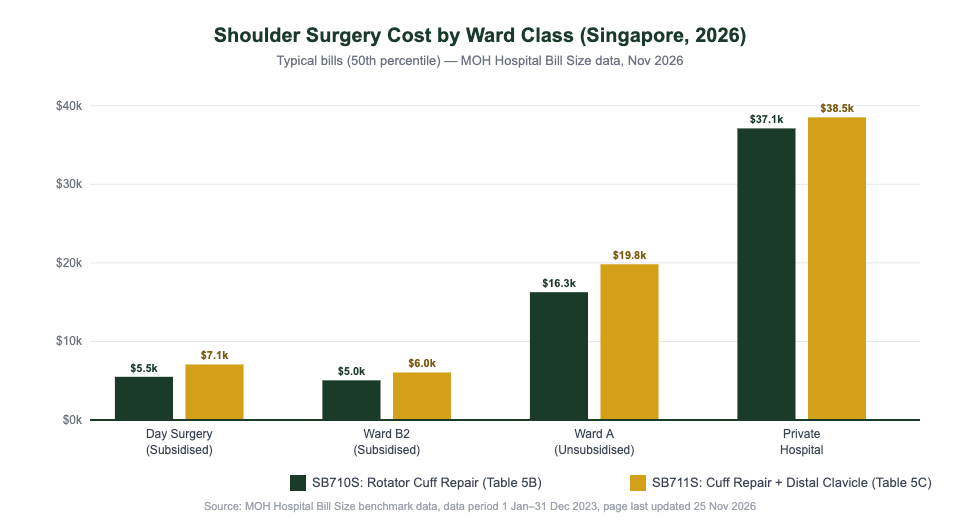
MOH publishes Hospital Bill Size benchmarks for all TOSP-coded procedures, updated periodically. The figures below are typical bills (50th percentile) for the relevant surgical episode, based on the 2023 data period (last updated 25 November 2026). Bills vary based on length of stay, implants used, anaesthesia and professional fees.
SB710S: Rotator Cuff Repair (TOSP Table 5B)
| Ward Class / Setting | Typical Bill | Range (25th–75th percentile) |
|---|---|---|
| Day Surgery (Subsidised) | $5,498 | $3,741 – $7,088 |
| Inpatient Ward B2 (Subsidised) | $5,048 | $3,969 – $6,845 |
| Inpatient Ward A (Unsubsidised) | $16,268 | $13,071 – $21,213 |
| Private Hospital (Inpatient) | $37,112 | $34,030 – $41,632 |
SB711S: Rotator Cuff Repair + Excision of Distal Clavicle (TOSP Table 5C)
| Ward Class / Setting | Typical Bill | Range (25th–75th percentile) |
|---|---|---|
| Day Surgery (Subsidised) | $7,065 | $5,760 – $8,281 |
| Inpatient Ward B2 (Subsidised) | $6,047 | $4,225 – $8,638 |
| Inpatient Ward A (Unsubsidised) | $19,822 | $16,552 – $21,404 |
| Private Hospital (Inpatient) | $38,521 | $34,553 – $43,274 |
Source: MOH Hospital Bill Size benchmark data, data period 1 Jan 2023 – 31 Dec 2023, page last updated 25 November 2026. These are typical total bills inclusive of surgeon’s fee, anaesthesia, ward charges and implants where applicable. Individual bills may vary.
Surgeon fees are listed separately on MOH’s fee benchmark tool. For SB710S, MOH’s recommended surgeon fee range (with 9% GST) is approximately $10,573 – $14,715. These fees may or may not be included in the hospital bill figures above — check with your hospital admissions team whether fees are bundled or billed separately.
The key takeaway: at a subsidised public B2 ward, shoulder surgery costs $5,048–$6,047, which is manageable with MediSave and MediShield Life. At a private hospital, the typical bill of $37,000–$39,000 requires ISP coverage to avoid a large out-of-pocket payment.
MediSave Withdrawal Limits for Shoulder Surgery in 2026
MediSave is your CPF healthcare savings account. For surgical procedures, the maximum you can withdraw per surgical episode depends on the TOSP table of your specific procedure.
For shoulder surgery, the MediSave limits (effective 1 April 2025, from CPF Board) are:
| Claim Type | TOSP Table | MediSave Limit |
|---|---|---|
| Rotator cuff repair surgery (SB710S) | 5B | $2,660 |
| Cuff repair + excision of distal clavicle (SB711S) | 5C | $2,770 |
| Hospitalisation — Days 1 & 2 | — | $1,130 per day |
| Hospitalisation — Day 3 onwards | — | $400 per day |
Source: CPF Board MediSave Withdrawal Limits, effective 1 April 2025. Hospitalisation limits apply to inpatient stays of at least 8 hours in an approved acute hospital. Data verified as at 27 November 2026.
Worked Example: MediSave for a 3-Day Rotator Cuff Repair
Using the 2026 MediSave limits, here is what you can claim from MediSave for a 3-day inpatient rotator cuff repair (SB710S):
| Claim Component | Calculation | Amount |
|---|---|---|
| Surgery (Table 5B) | Flat limit | $2,660 |
| Hospitalisation Days 1–2 | $1,130 × 2 | $2,260 |
| Hospitalisation Day 3 | $400 × 1 | $400 |
| Total MediSave (max) | $5,320 |
Key point: Even at the maximum withdrawal, MediSave covers only about 14% of a typical $37,112 private hospital rotator cuff repair bill. MediShield Life and an ISP are needed to avoid a large out-of-pocket payment.
For day surgery (same-day discharge, no inpatient ward stay), only the surgery limit applies — the hospitalisation daily rates do not apply. For a day surgery rotator cuff repair (SB710S), your MediSave can cover up to $2,660 of the surgery cost, plus a day surgery ward charge limit of up to $830 per day.
Compare how MediSave works for other procedures: see our MediSave limit guide for kidney stone surgery and the MediSave limit guide for spine surgery.
What MediShield Life Covers for Shoulder Surgery
MediShield Life is the basic national health insurance that all Singapore Citizens and Permanent Residents are enrolled in. It pays out a portion of hospitalisation bills — but it has claim limits set based on TOSP tables and ward class benchmarks.
At public hospitals (B2 and B1 wards): MediShield Life claim limits are calibrated to public B2 ward rates. After government subsidies (for citizens and PRs) and MediSave contributions, the residual bill at a B2 public hospital is typically very low — often a few hundred dollars or less. MediShield Life bridges a significant part of this remaining gap for heavily subsidised patients.
At private hospitals or public A wards: MediShield Life pays the same claim amounts it would for a public B2 ward — not the full private bill. The gap between what MediShield Life pays and the actual private hospital bill is known as the shield plan gap. For shoulder surgery, this gap can exceed $33,000 at a private hospital.
MediShield Life provides a foundation, but it was never designed to cover private hospital bills in full. That is the role of an Integrated Shield Plan (ISP).
For sports-related shoulder injuries, most are not classified as pre-existing conditions unless you had prior documented symptoms. MediShield Life covers medically necessary surgery regardless of how the injury occurred — sports or otherwise — as long as the admission and procedure meet clinical criteria.
How Your ISP Fills the Gap for Shoulder Surgery
An Integrated Shield Plan (ISP) is sold by private insurers (AIA, Income, Great Eastern, Prudential, NTUC Income) on top of MediShield Life. It raises the coverage ceiling to private hospital or public A ward bills, depending on the plan tier you choose.
ISP Plan Tiers and What They Cover
ISPs typically come in three tiers:
- Standard Plan (B1-equivalent): Covers up to public B1 ward bills. At typical B1 ward rates for shoulder surgery ($12,000–$16,000 for Ward A range), the Standard Plan pays most of the residual after MediSave and MediShield Life. At private hospitals, the gap is very large and mostly uncovered.
- Enhanced / Preferred Plan (A-ward): Covers up to public A ward bills (~$16,268 for SB710S). Still leaves a significant gap at private hospitals ($37,112 typical).
- Private Hospital Plan: Covers bills at private hospitals including Mount Elizabeth, Gleneagles, Parkway East and others. With a private plan, the $37,000–$39,000 shoulder surgery bill is largely covered — subject to co-payment.
Co-Payment Rules (From April 2021)
MOH mandated that all ISP riders must include a minimum co-payment element of 5% per policy year, with an annual co-payment cap (the cap amount varies by insurer — check your policy documents for the exact cap). This applies to all ISP riders sold or renewed from March 2018, with existing riders transitioning by April 2021.
What this means in practice:
- Even with the most comprehensive ISP + rider, you will pay at least 5% of the remaining bill (after MediSave and MediShield Life)
- For a $37,112 rotator cuff repair at a private hospital, the 5% co-payment on the residual amount typically works out to approximately $1,500–$3,500 out-of-pocket
- Without a rider (ISP base plan only), you face the full deductible plus a co-insurance percentage — typically much higher out-of-pocket costs
The complete ISP Singapore 2026 guide covers how to compare plans from AIA, Income, Great Eastern, Prudential, and NTUC across all procedures, including shoulder surgery.
Pre-Authorisation for Shoulder Surgery
Most ISP insurers require pre-authorisation for planned shoulder surgery, especially at private hospitals. Submit your surgeon’s referral and estimated bill to your insurer before admission. This confirms your coverage tier and avoids claim disputes after the surgery.
Out-of-Pocket Comparison for Shoulder Surgery: By Insurance Scenario
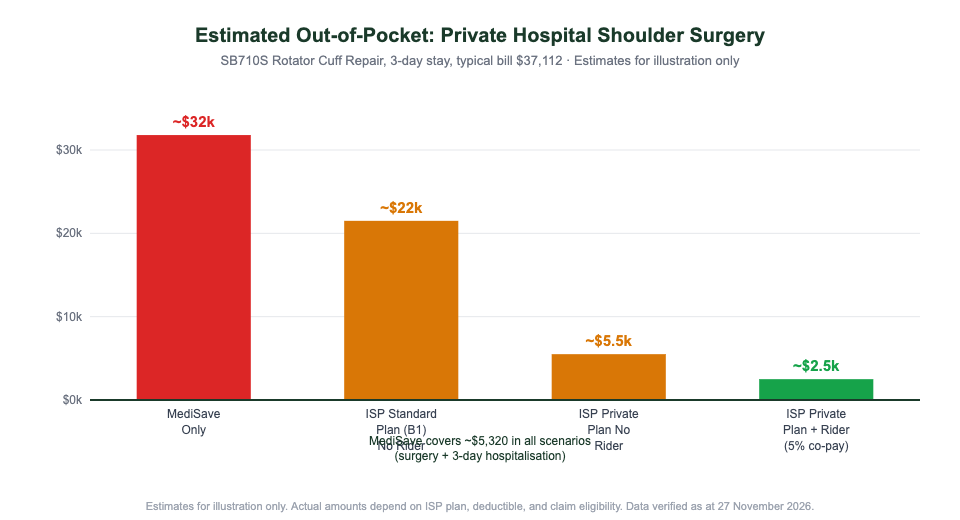
The table below illustrates how your out-of-pocket changes depending on your insurance coverage, using the typical SB710S rotator cuff repair bill at a private hospital ($37,112, 3-day stay).
| Scenario | MediSave Covers | ISP Covers (est.) | Out-of-Pocket (est.) |
|---|---|---|---|
| No insurance (MediSave only) | ~$5,320 | — | ~$31,792 |
| ISP Standard Plan (B1), no rider | ~$5,320 | Up to B1 limits | ~$18,000–$25,000 |
| ISP Private Plan, no rider | ~$5,320 | Most of residual | ~$3,000–$8,000 |
| ISP Private Plan + rider (5% co-pay) | ~$5,320 | Majority | ~$1,500–$3,500 |
Estimates for illustration only. Actual amounts depend on your ISP plan, deductible, specific insurer, and claim eligibility. MediShield Life payouts (not shown) also contribute additional coverage especially at public hospitals. Consult your insurer for exact figures.
At a subsidised public B2 ward, the picture is very different. After government subsidies, MediSave, and MediShield Life, the out-of-pocket for a typical $5,048 rotator cuff repair at B2 can be very low — sometimes near zero for heavily subsidised Singapore citizens.
Use our retirement planning calculator to factor in potential healthcare costs — including a major surgery like shoulder surgery — when planning your long-term finances.
ISP, Shoulder Injuries, and Waiting Periods
Shoulder injuries are common in Singapore — from sports (badminton, golf, swimming), workplace accidents, and age-related degeneration. If you are considering buying or upgrading an ISP specifically because you have shoulder pain or a known rotator cuff issue, there are two key limitations to understand:
1. Waiting Periods for New ISP Policyholders
Most ISPs have a waiting period of 90 days from the policy start date for non-accidental conditions. If you undergo shoulder surgery within 90 days of taking out a new ISP, the claim may be rejected. Accidental injuries (a sudden fall or trauma) may be exempt from this waiting period — check your policy wording.
2. Pre-Existing Conditions and Exclusions
If you have a known history of shoulder problems, rotator cuff tears, or prior shoulder surgery, insurers may:
- Exclude shoulder-related claims permanently
- Accept you with a loading (higher premium)
- Accept you on standard terms after a medical assessment
The key takeaway: buy your ISP before you develop shoulder problems. Waiting until you are diagnosed or in pain makes it difficult — and sometimes impossible — to get coverage for the condition you need most.
If you are already insured and have been told you need shoulder surgery, check whether your policy covers the procedure under its surgical benefits and get pre-authorisation before admission. See our complete ISP Singapore 2026 guide for more on how to compare ISP plans before you need them.
Frequently Asked Questions
What is the MediSave limit for shoulder surgery in Singapore 2026?
How much does shoulder surgery (rotator cuff repair) cost in Singapore?
Does ISP cover rotator cuff surgery?
Can I use MediSave for shoulder surgery?
What is the difference between TOSP Table 5B and 5C for shoulder surgery?
Is arthroscopic (keyhole) shoulder surgery covered by MediSave?
What happens if I stay in a higher ward than my ISP covers?
Plan Ahead Before You Need Surgery
Shoulder surgery — especially for degenerative rotator cuff tears — often develops gradually. The best time to compare ISPs and understand your MediSave limit for 2026 is before you need them.
- Complete ISP Singapore 2026 Guide — compare all five ISP providers
- MediSave Limit for Spine Surgery — another common musculoskeletal procedure
- MediSave for Kidney Stone Surgery — another common elective procedure
- Retirement Planning Calculator — factor in healthcare costs in your long-term plan
Disclaimer: This article is for educational reference only and does not constitute financial, medical, or insurance advice. MediSave limits and ISP terms change periodically — always verify with CPF Board, MOH, and your insurer before making decisions. Data sourced from MOH Hospital Bill Size (25 Nov 2026) and CPF MediSave Withdrawal Limits (1 Apr 2025).
Get Free Insurance Advice
Speak with a licensed insurance advisor. No obligation, no cost.
By submitting this form, you agree to our Privacy Policy.
This article was researched with the help of AI. While we strive to keep all information accurate and up to date, there may be errors. If you notice any discrepancies, please contact us.