Data verified as at 2026-11-18. This article is for informational purposes only and does not constitute financial advice.
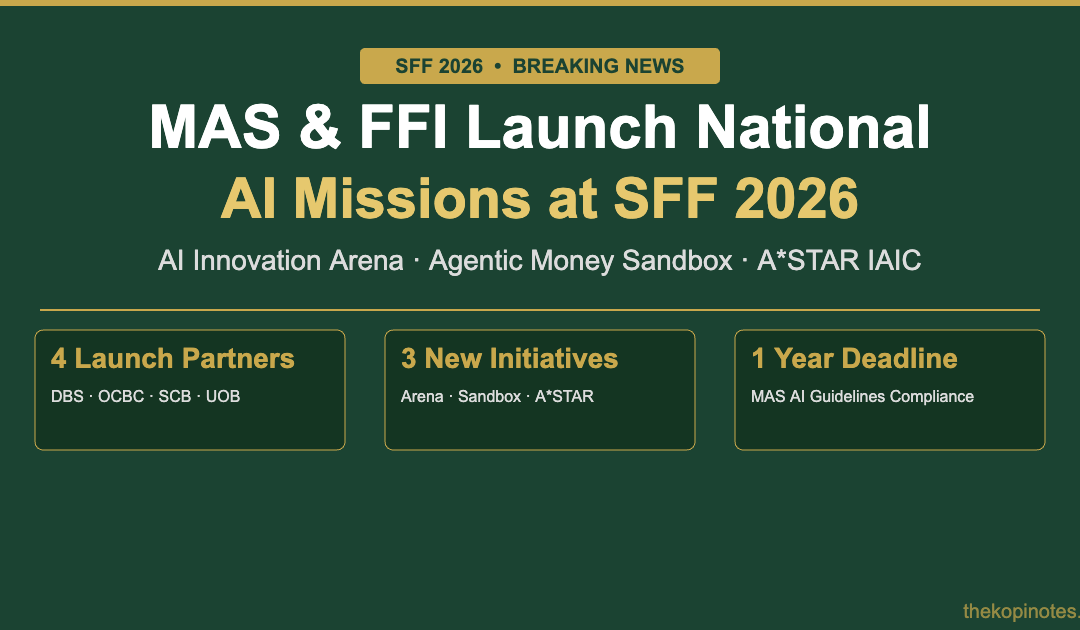
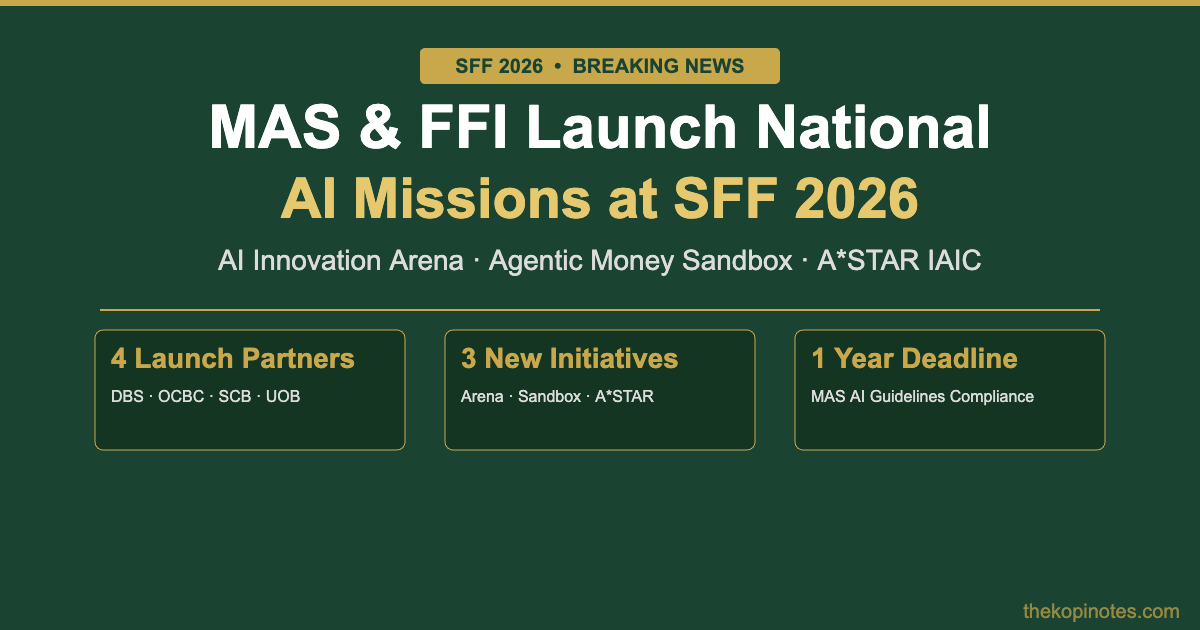
The Singapore FinTech Festival (SFF) 2026 kicked off on 18 November at Singapore EXPO, and the opening-day headline wasn’t a startup pitch or a tokenisation announcement — it was the Monetary Authority of Singapore (MAS) going all-in on artificial intelligence. At a packed keynote, MAS Deputy Managing Director Leong Sing Chiong unveiled three National AI Missions under the newly operational Future of Finance Institute (FFI), with four of Singapore’s largest banks signing on as launch partners on day one.
For retail investors watching Singapore’s banking, fintech and digital-asset landscape, this is more than a government technology initiative. It signals where MAS expects financial institutions to allocate AI investment over the next 12–24 months — and where the operational risks, and opportunities, will concentrate.
What Are the Three National AI Missions?
The FFI — which formally began operations on 3 November 2026 — was set up to coordinate Singapore’s financial-sector AI strategy across three pillars: PathFin.ai (workforce and talent), BuildFin.ai (industry-wide AI infrastructure), and SafeFin.ai (governance and risk). The three National AI Missions announced at SFF 2026 each correspond to a distinct operational frontier.
Mission 1: AI Innovation Arena — Financial Crime Prevention
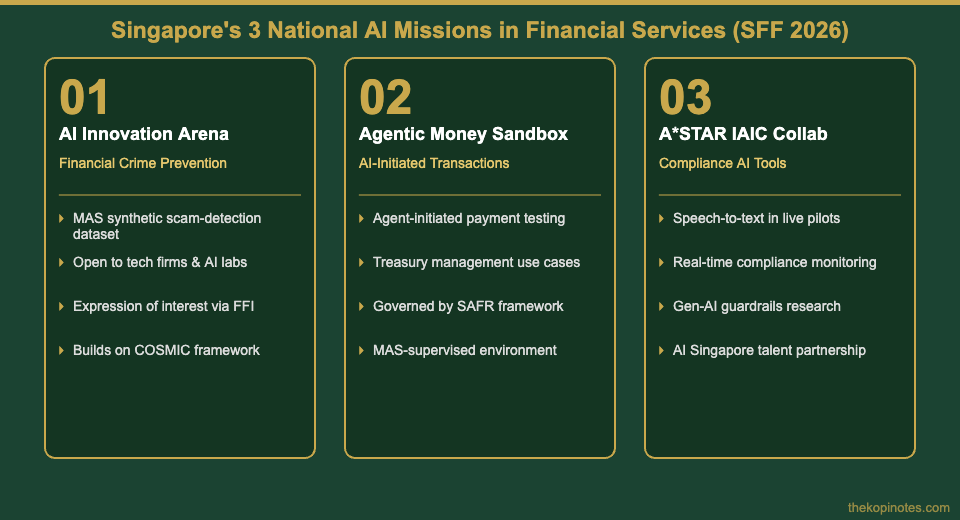
MAS will release a synthetic dataset modelled on real transaction patterns for training AI scam-detection and financial-crime-prevention models. Technology firms, AI research labs and academic institutions may access the dataset and submit solutions via the FFI portal — building directly on Singapore’s existing COSMIC (Collaborative Sharing of Money Laundering/Terrorism Financing Information and Cases) framework. DBS and OCBC are among the launch partners committing resources to this mission.
Mission 2: Agentic Money Sandbox — AI-Initiated Transactions
Perhaps the most forward-looking of the three, this initiative creates a MAS-supervised controlled environment for testing AI-initiated payment and treasury-management transactions — what the industry calls “agentic finance.” An AI agent that can autonomously move funds across accounts, execute FX trades or manage liquidity within pre-set parameters represents a step beyond today’s robo-advisers. The sandbox operates under MAS’s SAFR (Systematic Approach to Fair and Responsible AI) framework, finalised in July 2026 to govern agentic AI risks such as hallucinated transactions and goal misalignment. Standard Chartered and UOB are the confirmed launch partners for this mission.
Mission 3: A*STAR IAIC Collaboration — AI Compliance Tools
MAS has partnered with A*STAR’s Institute for AI Compliance and Inspection (IAIC) to develop compliance-monitoring AI tools for financial institutions. Focus areas include speech-to-text technology for supervisory applications, real-time compliance-monitoring pipelines and generative AI guardrails research. AI Singapore is named as a talent-development partner, reinforcing the PathFin.ai pillar’s workforce goals.
Four Launch Partners — Why Their Involvement Matters
The involvement of DBS, OCBC, Standard Chartered and UOB as day-one launch partners is not incidental. These four institutions collectively represent the backbone of Singapore’s retail banking, wealth management and SME financing ecosystem. As Singapore bank stock investors know well, any operational cost shift at these institutions feeds through into credit conditions, property valuations and dividend sustainability for leveraged landlords.
Their day-one commitment signals three things. First, that AI investment at Singapore’s major banks will accelerate beyond the R&D phase into production pilots in 2027. Second, that MAS is comfortable co-developing the governance framework alongside the very institutions it supervises — a consultative posture consistent with how the Payment Services Act and Variable Capital Company framework were rolled out. Third, that institutions which sit out the sandbox and mission phases may face a competitive disadvantage when MAS eventually scales these frameworks to industry-wide mandates.
For investors holding Singapore bank stocks or financial-sector S-REITs, the near-term read is neutral-to-positive: compliance costs will rise modestly, but the productivity uplift from AI-assisted compliance and treasury management should offset them over a 2–3 year horizon.
MAS AI Governance Timeline: Where This Fits
The National AI Missions announcement does not exist in isolation. It is the operational layer on top of a governance architecture MAS has been building methodically since early 2026.
| Date | Milestone | Implication for Financial Institutions |
|---|---|---|
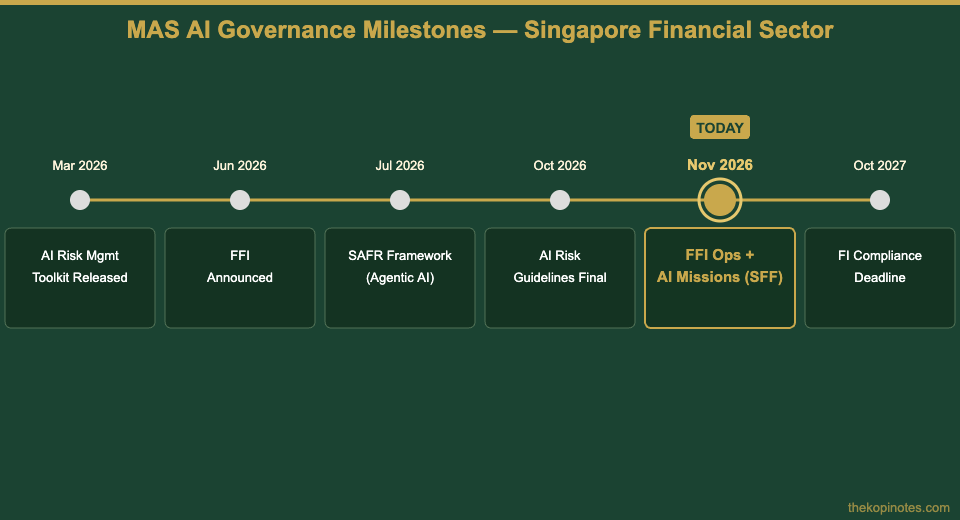
| Mar 2026 | MAS AI Risk Management Toolkit released | Voluntary adoption; sets baseline for future audits |
| Jun 2026 | Future of Finance Institute announced | Signals coordinated national AI strategy |
| Jul 2026 | SAFR framework published | Governance rules for agentic AI established |
| Oct 7, 2026 | MAS AI Risk Management Guidelines finalised | 1-year compliance window begins |
| Nov 3, 2026 | FFI begins operations | Central AI coordination hub active |
| Nov 18, 2026 ★ | SFF 2026: Three National AI Missions launched | Pilots begin; sandbox open for applications |
| Oct 2027 | MAS AI Risk Guidelines compliance deadline | All MAS-regulated FIs must comply |
The October 2027 compliance deadline is the most important date for investors to note. All MAS-regulated financial institutions — banks, insurers, capital markets intermediaries and payment service providers — must demonstrate compliance with the AI Risk Management Guidelines by that date. Institutions participating in FFI missions from late 2026 will have a structural head start in building compliant AI infrastructure.
For a full breakdown of the FFI’s structure, mandate and three pillars, see our earlier coverage: MAS Future of Finance Institute: What Singapore Investors Need to Know.
Implications for Digital Banks and Fintechs
Singapore’s digital banks — GXS (backed by Grab and Singtel), MariBank (Sea Group) and ANEXT Bank (Ant Group) — are not named in the launch partner list, but the AI Innovation Arena and Agentic Money Sandbox are explicitly open to technology firms and AI labs beyond traditional FIs. This creates a potential competitive leveller: a fintech that builds superior scam-detection models using the MAS synthetic dataset could licence those capabilities back to incumbents, or use the credential to attract institutional clients.
The Agentic Money Sandbox also carries implications for Singapore’s growing ETF and unit trust platforms. Automated rebalancing, liquidity management and cross-currency treasury operations are natural agentic finance use cases that benefit robo-advisory and digital wealth platforms as much as corporate treasuries.
The cross-border payment angle is also worth monitoring. MAS has been building bilateral digital payment corridors across Southeast Asia, and the BLOOM infrastructure linking Singapore, Malaysia and Thailand provides a live testbed for agentic cross-border transactions under the new sandbox framework.
Bottom Line for SG Investors
The three National AI Missions announced at SFF 2026 are not abstract policy — they are funded, structured programmes with named corporate partners and a hard compliance deadline of October 2027. Here is the practical investor read:
- Bank stocks (DBS, OCBC, UOB, StanChart): Short-term compliance costs are manageable. The productivity dividend from AI-assisted compliance and treasury management is a medium-term positive. Watch for AI capex guidance in 2027 earnings calls.
- S-REITs: Indirect impact via credit conditions. AI-driven improvements in bank credit risk assessment could ease SME lending, which feeds through to commercial and industrial REIT tenant health. Dividend investors should monitor debt refinancing conditions through 2027.
- Digital banks and fintechs: The sandbox and innovation arena create monetisable IP opportunities for tech-led FIs. Watch GXS and MariBank for AI partnership announcements in Q1 2027.
- Compliance risk: FIs that miss the October 2027 deadline face regulatory censure. Investors in smaller fund managers and payment service providers should ask management about AI governance readiness at upcoming AGMs.
SFF 2026 runs until 20 November 2026. TKN will continue to cover key announcements across all three days.
Frequently Asked Questions
What is the Singapore FinTech Festival 2026?
The Singapore FinTech Festival (SFF) 2026 runs from 18–20 November 2026 at Singapore EXPO. It is the world’s largest fintech event by attendance, organised by the Monetary Authority of Singapore and Elevandi. The 2026 edition centres on artificial intelligence, digital assets and cross-border financial infrastructure.
What is the MAS Future of Finance Institute (FFI)?
The FFI is a MAS-established institute that began operations on 3 November 2026. It coordinates Singapore’s financial-sector AI strategy across three pillars: PathFin.ai (talent development), BuildFin.ai (AI infrastructure) and SafeFin.ai (governance). It acts as the central coordination hub for the National AI Missions announced at SFF 2026.
What are the three National AI Missions announced at SFF 2026?
The three missions are: (1) AI Innovation Arena — using a MAS synthetic dataset to train financial-crime detection AI, open to tech firms and research institutions; (2) Agentic Money Sandbox — a supervised environment for testing AI-initiated payment and treasury transactions under the SAFR framework; and (3) A*STAR IAIC Collaboration — developing compliance-monitoring AI tools with A*STAR’s IAIC and AI Singapore.
Which banks are involved in the National AI Missions?
DBS, OCBC, Standard Chartered (Singapore) and UOB are the four launch partners. DBS and OCBC are aligned with the AI Innovation Arena; Standard Chartered and UOB with the Agentic Money Sandbox.
What is the MAS AI Risk Management Guidelines compliance deadline?
MAS finalised its AI Risk Management Guidelines on 7 October 2026. All MAS-regulated financial institutions must demonstrate compliance by October 2027 — a one-year window from finalisation. This covers banks, insurers, capital markets intermediaries and payment service providers operating in Singapore.
What is the SAFR framework?
SAFR stands for Systematic Approach to Fair and Responsible AI. MAS published the SAFR framework in July 2026 specifically to govern the risks of agentic AI — AI systems that can take autonomous actions such as initiating financial transactions. The Agentic Money Sandbox operates under SAFR rules, requiring all tested systems to meet explainability, fairness and accountability standards.
How does SFF 2026’s AI focus affect Singapore retail investors?
Directly, it signals increased AI compliance and infrastructure investment by Singapore’s major banks over the next 12–24 months. For bank stock and S-REIT investors, the medium-term read is modestly positive: productivity gains from AI-assisted compliance and treasury operations should outweigh near-term costs, while AI improvements in credit risk assessment could support commercial property tenant health over time.
Can non-banks participate in the National AI Missions?
Yes. The AI Innovation Arena is explicitly open to technology companies, AI research labs and academic institutions that wish to access the MAS synthetic dataset and develop financial-crime detection solutions. Expressions of interest can be submitted via the FFI portal.
This article was researched with the help of AI. While we strive to keep all information accurate and up to date, there may be errors. If you notice any discrepancies, please contact us.