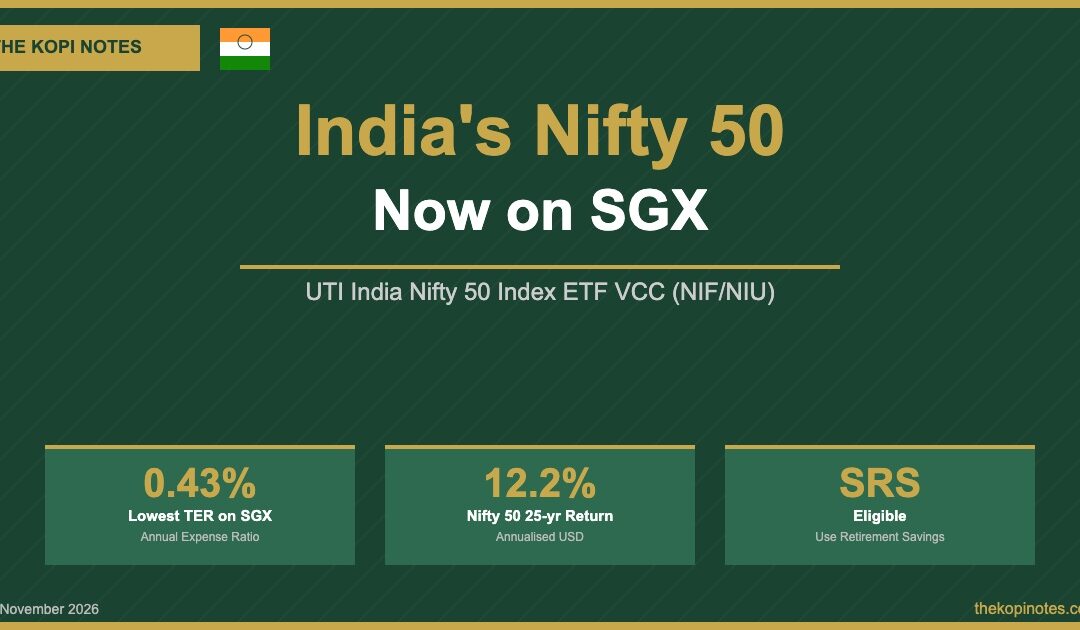
India’s first Nifty 50 ETF launched on Singapore Exchange on 12 November 2026, giving Singapore retail investors a direct, SRS-eligible gateway into India’s 50 largest companies. With the Nifty 50 down roughly 18% year-to-date in USD terms and trading below its 10-year average valuation, this new ETF arrives at a potentially pivotal moment for investors considering India exposure.
This is an editorial analysis. Not financial advice. Data verified as at 15 November 2026.
What Is the UTI India Nifty 50 Index ETF VCC?
The UTI India Nifty 50 Index ETF VCC (tickers: NIF in SGD and NIU in USD) is a Singapore-domiciled feeder fund managed by UTI International (Singapore) Pte Ltd — the Singapore arm of UTI AMC, one of India’s oldest fund houses with approximately US$170 billion in assets under management as of 30 September 2026.
As a Variable Capital Company (VCC) feeder fund regulated by MAS under the Code on Collective Investment Schemes, it invests substantially all its assets into the underlying UTI Nifty 50 ETF listed on the Indian market. That underlying Indian fund has been running since 2015 and had approximately US$7.5 billion in assets as of 31 October 2026. This makes it the first MAS-regulated scheme to feed directly into an India-domiciled ETF.
The Nifty 50 index tracks the 50 largest and most liquid companies listed on India’s National Stock Exchange (NSE) — the Indian equivalent of Singapore’s Straits Times Index (STI) or the US S&P 500.
Key Fund Specifications:
- Tickers: NIF (SGD counter), NIU (USD counter)
- Exchange: Singapore Exchange (SGX)
- Total Expense Ratio (TER): Capped at 0.43% p.a.
- Board Lot: 1 share
- SRS Eligible: Yes
- Listing Date: 12 November 2026
- Base Currency: USD
- Underlying Fund AUM: ~US$7.5 billion
Why India? The Long-Term Growth Case
The bull case for India rests on three structural pillars: demographics, GDP growth, and corporate earnings trajectory.
Demographics: India overtook China as the world’s most populous country in 2023 and has a median age of approximately 29 years. This young, growing workforce is entering peak consumption and productivity years, potentially driving domestic demand for decades.
GDP Growth: The World Bank projects India’s GDP growth for FY2026/27 at 7.1%, making it the fastest-growing major economy in the world. That compares to China at approximately 4.5% and Singapore at around 2.5%. India’s GDP is on track to become the world’s third-largest economy within this decade.
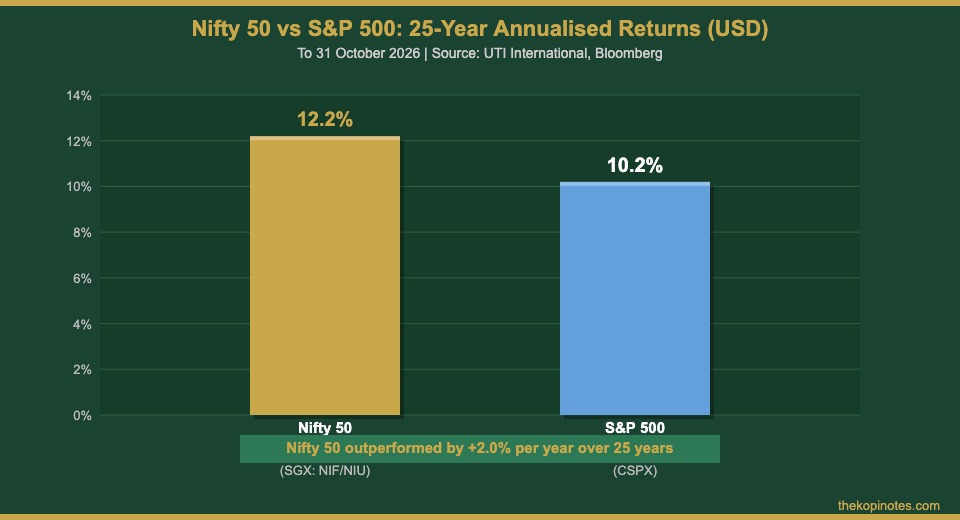
Long-Term Market Performance: The Nifty 50 has delivered annualised returns of 12.2% in USD over the past 25 years (to 31 October 2026), compared to 10.2% for the S&P 500 over the same period — a consistent outperformance of approximately 2 percentage points per year compounded over a generation (source: UTI International, Bloomberg).
For Singapore investors already holding global ETFs like VWRA (Vanguard All World) or IWDA (iShares MSCI World), India represents only about 2% of those portfolios. A dedicated India allocation via NIF/NIU significantly increases that exposure.
A Potential Dip-Buying Opportunity?
Here is what makes this ETF’s timing notable for TKN readers: the Nifty 50 has fallen approximately 18% in USD terms year-to-date as of 30 September 2026. Indian markets have been weighed down by foreign institutional outflows, rupee weakness, and global risk-off sentiment driven by US interest rate uncertainty.
As a result, Indian equity valuations have pulled back meaningfully below their long-term averages:
- Current Nifty 50 Trailing P/E: 20.38x (as at 30 September 2026)
- 10-Year Average Nifty 50 P/E: 23.49x
- Discount to long-term average: approximately 13%
A P/E around 13% below the decade average represents a potential value entry point for long-term investors — though markets can remain depressed for extended periods, and valuations are not a precise short-term timing tool. This is not a guarantee of near-term returns.
TKN’s view: for investors with a 10-year-plus horizon seeking to build a diversified Asia portfolio, the current drawdown may represent a more attractive entry than buying at peak valuations. As always, dollar-cost averaging (DCA) over multiple months is a prudent approach rather than committing all capital at once.
How the ETF Is Structured: Fees and Two-Layer Cost
The UTI India Nifty 50 Index ETF VCC uses a two-layer feeder fund structure:
- Layer 1 (Singapore VCC): You buy NIF or NIU on SGX through your brokerage. The Singapore feeder fund pools investor capital and deploys it into the Indian ETF.
- Layer 2 (Indian ETF on NSE): The underlying UTI Nifty 50 ETF on India’s NSE directly tracks the Nifty 50 Total Return Index.
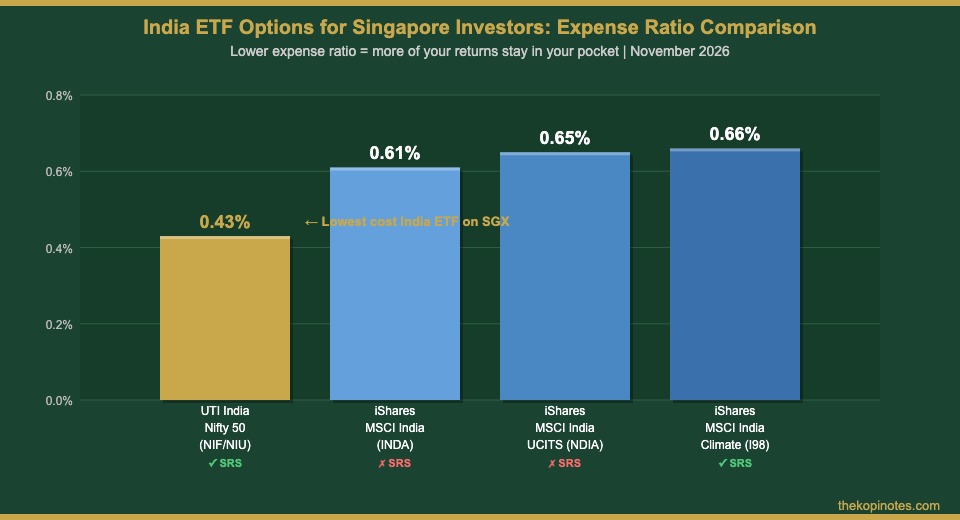
The total expense ratio is capped at 0.43% p.a., which covers costs at both levels — the Singapore feeder’s management and administrative costs, plus the underlying Indian ETF’s expenses (reflected in NAV). For context, this is cheaper than every comparable India ETF option available to Singapore investors.
India ETF Comparison for Singapore Investors
| ETF | Ticker | Exchange | TER (p.a.) | SRS Eligible | Tracks |
|---|---|---|---|---|---|
| UTI India Nifty 50 | NIF (SGD) / NIU (USD) | SGX | 0.43% | ✅ Yes | Nifty 50 |
| iShares MSCI India | INDA | US (NYSE) | 0.61% | ❌ No | MSCI India |
| iShares MSCI India UCITS | NDIA / IIND | LSE / Ireland | 0.65% | ❌ No | MSCI India |
| iShares MSCI India Climate | I98 / QK9 | SGX | 0.66% | ✅ Yes | MSCI India Climate |
Note: TER figures sourced from respective fund documents. Comparisons are approximate; methodologies may differ. Data as at November 2026.
The UTI ETF’s 0.43% TER is the lowest on this list — and unlike the MSCI India trackers (which cover ~100–165 companies), it tracks only the 50 largest Indian blue chips, giving more concentrated exposure to India’s most established names.
The India-Singapore Tax Treaty Advantage
One of the most structurally significant features of the UTI India Nifty 50 ETF VCC is its potential benefit under the India-Singapore Double Tax Avoidance Agreement (DTAA).
Under Indian tax law, capital gains on equity-oriented funds are taxed at 12.5% for long-term holdings (over 12 months) and 20% for short-term holdings. Without a tax treaty, foreign investors would bear these costs through the fund’s NAV.
The Singapore-domiciled VCC structure may allow it to claim reduced or exempt capital gains tax treatment under the DTAA when it disposes of units in the underlying Indian ETF. Bloomberg reported in October 2026 that this structure “could help foreign investors on taxes” in Indian equities.
What this means for Singapore investors: If the DTAA benefit applies, it flows through the fund’s NAV — meaning Singapore retail investors benefit without needing to file Indian tax returns or manage Indian tax compliance. For Singapore tax residents, Singapore currently has no capital gains tax, so the main tax consideration is at the fund level (Indian side).
Important caveat: UTI International itself cautions that this treaty benefit is not guaranteed, and Indian tax authorities may challenge the treatment. This is an evolving area of tax law, and investors should not rely solely on the DTAA benefit as an investment rationale. Always seek professional tax advice.
How Singapore Investors Can Buy NIF and NIU
The UTI India Nifty 50 ETF is now live on SGX and available through any SGX-enabled brokerage account. No Indian brokerage account is required.
Supported brokerages include:
- DBS Vickers Securities
- Moomoo Financial Singapore
- Phillip Securities (POEMS)
- Tiger Brokers (Singapore)
- FSMOne (IFast Financial)
SGD vs USD counter: NIF trades in Singapore dollars while NIU trades in US dollars. Both represent the same underlying USD share class. Crucially, buying the SGD counter does not hedge your currency exposure — the underlying assets are denominated in Indian rupees and USD. You retain full INR/SGD currency risk either way.
SRS account: This ETF is eligible for purchase using Supplementary Retirement Scheme (SRS) monies. This is a valuable feature: rather than leaving SRS funds in the bank earning minimal interest, Singapore investors can deploy SRS capital into this India growth ETF for long-term wealth building. For context on maximising SRS returns, see our guide to the CPF and retirement account strategies in 2026/2027.
Minimum purchase: Just 1 share — making this accessible for retail investors at all portfolio sizes.
For a broader view of your Singapore cash deployment options, check our updated comparison of Singapore T-bill yields and cash management strategies.
What Does the Nifty 50 Hold?
The Nifty 50 is a market-cap-weighted index of the 50 largest, most liquid companies on India’s NSE. Its sector exposure reflects India’s current economic engine:
- Financial Services (~37.5%): Dominated by HDFC Bank (India’s largest private bank), ICICI Bank, and Kotak Mahindra Bank. This high financial services weighting gives the index meaningful exposure to India’s credit growth story.
- Energy & Oil (~12%): Includes Reliance Industries, the conglomerate headed by Mukesh Ambani — Asia’s richest person — with businesses spanning petrochemicals, telecom, and retail.
- Information Technology (~7.5%): Infosys, TCS (Tata Consultancy Services), and Wipro — global IT services giants that earn in USD but are domiciled in India.
- Consumer & FMCG: Hindustan Unilever (HUL), ITC, Nestle India.
- Telecoms: Bharti Airtel, India’s leading mobile carrier.
The top 10 holdings account for approximately 52.3% of the index, meaning the Nifty 50 is relatively concentrated at the top. This is typical of emerging market indices and is both its attraction (exposure to India’s leading businesses) and a risk factor.
This index composition differs meaningfully from Singapore’s STI blue chips like DBS, OCBC, and UOB, and from US-focused ETFs like CSPX. For Singapore investors already holding global equities, NIF/NIU adds a growth dimension — particularly India’s fintech banks, domestic consumption plays, and IT services — not fully captured by VWRA or IWDA.
Singapore Bank Stocks vs India ETF: A Quick Comparison
Singapore investors often compare local blue chips to overseas ETFs when evaluating their portfolio composition. Here’s a quick framing:
DBS, OCBC, and UOB recently delivered strong Q3 2026 results. OCBC posted Q3 2026 net profit of S$2.04 billion and raised its full-year guidance. Singapore banks offer known dividends (typically 5–7% gross yield), SGD-denominated income, and meaningful Asia exposure through their regional operations.
UTI India Nifty 50 ETF, by contrast, offers pure India growth exposure — higher potential growth but with more currency risk, single-country concentration, and a less predictable income stream (the ETF currently has no regular distribution policy).
In a balanced Singapore investor’s portfolio, these are complementary, not competing, positions. Singapore bank stocks can serve as the income core; India ETF as a growth satellite.
Key Risks Singapore Investors Must Know
TKN presents both sides. Here are the genuine risks of investing in the UTI India Nifty 50 ETF:
- Single-country concentration: 100% India exposure means political, regulatory, economic, and corporate governance risks specific to India.
- Currency risk: You bear both SGD/INR and USD/INR exposure. The Indian rupee has historically depreciated vs the SGD over long periods, which can erode USD-denominated returns for SGD-based investors.
- Sector concentration: Financial services at ~37% creates significant sensitivity to India’s banking and lending cycle.
- Tax treaty uncertainty: The DTAA capital gains treatment is not formally guaranteed, and Indian tax authorities may challenge it. If disallowed, fund returns would be reduced by Indian capital gains tax.
- Liquidity risk: As a new SGX listing, bid-ask spreads may be wider and trading volumes lower than more established ETFs.
- NAV premium/discount: The SGX-traded price can diverge from the fund’s NAV, particularly when Indian markets are closed.
- Tracking error: The two-layer feeder structure introduces additional tracking difference vs the Nifty 50 index itself.
For investors already managing S-REIT exposure and Singapore bank deposits, adding an India ETF increases overall portfolio complexity and should be sized accordingly.
Bottom Line for SG Investors
The UTI India Nifty 50 Index ETF VCC (NIF/NIU) is a genuinely interesting new option for Singapore retail investors seeking India exposure through their existing SGX brokerage accounts.
What makes it compelling:
- Lowest-cost India ETF on SGX at 0.43% TER — cheaper than all comparable alternatives
- SRS eligible — use retirement savings for India’s growth story
- No Indian brokerage account needed — buy it like any SGX stock
- Potential DTAA tax efficiency (not guaranteed, but structurally designed for it)
- India’s long-term market record: 12.2% annualised vs 10.2% for S&P 500 over 25 years
- Current valuation: Nifty 50 P/E at 20.38x, 13% below the 10-year average of 23.49x
What to watch out for:
- The 18% YTD drawdown is a dip opportunity, but India-specific headwinds (rupee weakness, foreign outflows) may persist
- Tax treaty benefit not guaranteed — remain cautious on this angle
- Size it as a satellite position (5–10% of equities), not a core holding
For long-horizon Singapore investors seeking Asia ex-Singapore growth exposure beyond what VWRA or IWDA already provides, NIF/NIU is worth evaluating. As with any new listing, monitor liquidity and bid-ask spreads in the early weeks before committing significant capital.
Sources:
- UTI International Product Highlights Sheet, 8 October 2026, via POEMS
- Growbeansprout, “Should India be in your portfolio? How investors can access the Nifty 50 through SGX”, 30 October 2026
- PR Newswire via Yahoo Finance, “India’s 50 leading companies arrive on SGX”, 12 November 2026
- Bloomberg, “Singapore-Listed India ETF May Help Foreign Investors on Taxes”, 27 October 2026
- CaproAsia, UTI AMC ETF listing announcement, 12 November 2026
What is the ticker symbol for the UTI India Nifty 50 ETF on SGX?
The ETF trades under two counters on SGX: NIF for the SGD counter and NIU for the USD counter. Both represent the same underlying USD share class of the same VCC fund. You can buy either counter through any SGX-enabled brokerage account.
Is the UTI India Nifty 50 ETF SRS eligible in Singapore?
Yes. The UTI India Nifty 50 Index ETF VCC is classified as an Excluded Investment Product (EIP) and is eligible for purchase using Supplementary Retirement Scheme (SRS) funds. Confirm trading arrangements with your SRS operator and brokerage before transacting.
What is the expense ratio (TER) of the UTI India Nifty 50 ETF?
The total expense ratio is capped at 0.43% per annum, as per the Product Highlights Sheet dated 8 October 2026. This all-in fee covers costs at both the Singapore feeder level and the underlying Indian ETF level, making it the most cost-efficient India ETF option currently available to Singapore investors on SGX.
How is this ETF different from CSPX (S&P 500) or VWRA (global)?
CSPX tracks 500 large US companies; VWRA tracks ~3,700 companies across developed and emerging markets globally. The UTI India Nifty 50 ETF gives pure-play exposure to the 50 largest Indian companies on the NSE. India represents only about 2% of VWRA, so this ETF provides a dedicated India tilt that those global funds cannot.
What is the tax treatment for Singapore investors in the UTI Nifty 50 ETF?
Singapore currently has no capital gains tax, so there is no Singapore-level capital gains liability for most retail investors. At the fund level, the Singapore VCC structure may benefit from the India-Singapore DTAA for reduced Indian-level capital gains tax on the fund’s disposals. However, this is not guaranteed. Consult a qualified tax professional for personalised advice.
What are the main risks of investing in the Nifty 50 ETF via SGX?
Key risks include: (1) single-country concentration — 100% India exposure; (2) currency risk — SGD/INR exchange rate; (3) sector concentration — financial services is ~37% of the index; (4) tax treaty uncertainty — DTAA benefit is not guaranteed; (5) liquidity risk as a new SGX listing; (6) potential NAV premium/discount; and (7) tracking difference from the two-layer feeder structure. Size this as a satellite position in a diversified portfolio.
Where can I buy NIF or NIU in Singapore?
Through any SGX-enabled brokerage account: DBS Vickers, Moomoo Financial Singapore, Phillip Securities (POEMS), Tiger Brokers, or FSMOne (IFast Financial). The minimum purchase is 1 share. No Indian brokerage account is needed. For SRS purchases, check with your SRS operator first.
When did the UTI India Nifty 50 ETF start trading on SGX?
The ETF began trading on the Singapore Exchange on 12 November 2026. The initial public offering (IPO) subscription period ran from 19 October to 6 November 2026. It is available on the secondary market through any SGX brokerage from 12 November 2026 onwards.
This article was researched with the help of AI. While we strive to keep all information accurate and up to date, there may be errors. If you notice any discrepancies, please contact us.