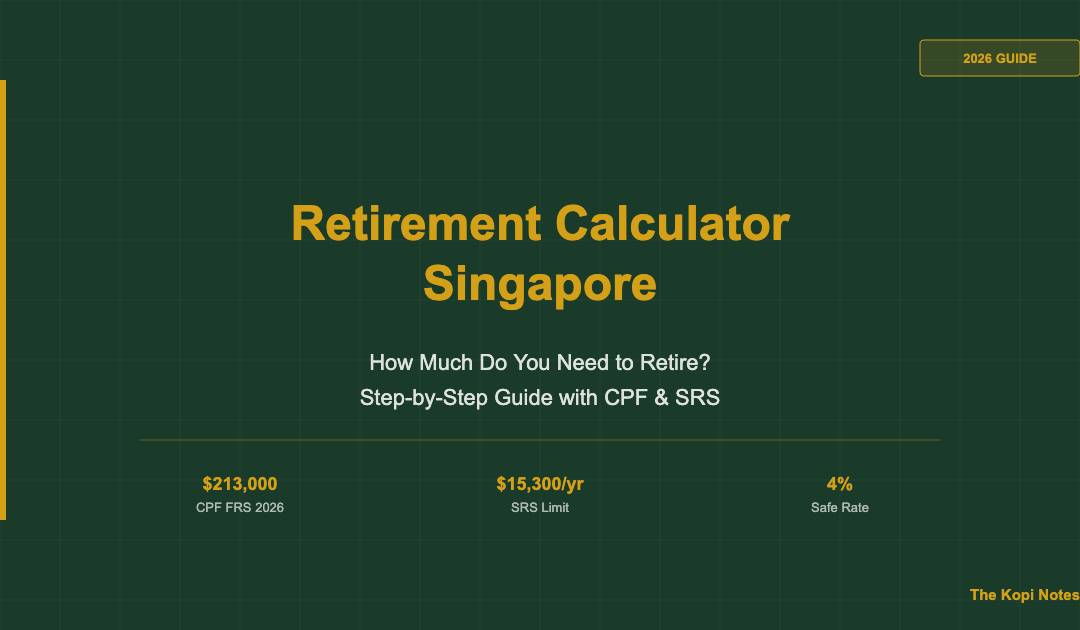
Retirement Calculator Singapore: How to Calculate Your Retirement Needs (2026 Guide)
A retirement calculator Singapore helps you work out exactly how much you need to save to retire comfortably. The key inputs are your desired monthly income in retirement, your expected retirement age, CPF retirement sum projections, SRS contributions, and investment returns. Most Singapore residents need between $1,500 and $5,000 per month in retirement income, requiring a nest egg of roughly $450,000 to $1.5 million.
Not financial advice. All figures are for educational reference only. Data as at November 2026 unless noted.
Why You Need a Retirement Calculator in Singapore
Retirement planning in Singapore is more complex than in most countries. You have CPF (Central Provident Fund) payouts, potential SRS (Supplementary Retirement Scheme) withdrawals, investment income, and possibly property rental income — all working together.
A retirement calculator Singapore lets you model all these income streams and check whether your savings are on track. Without one, most people either over-save (sacrificing quality of life now) or under-save (risking financial hardship later).
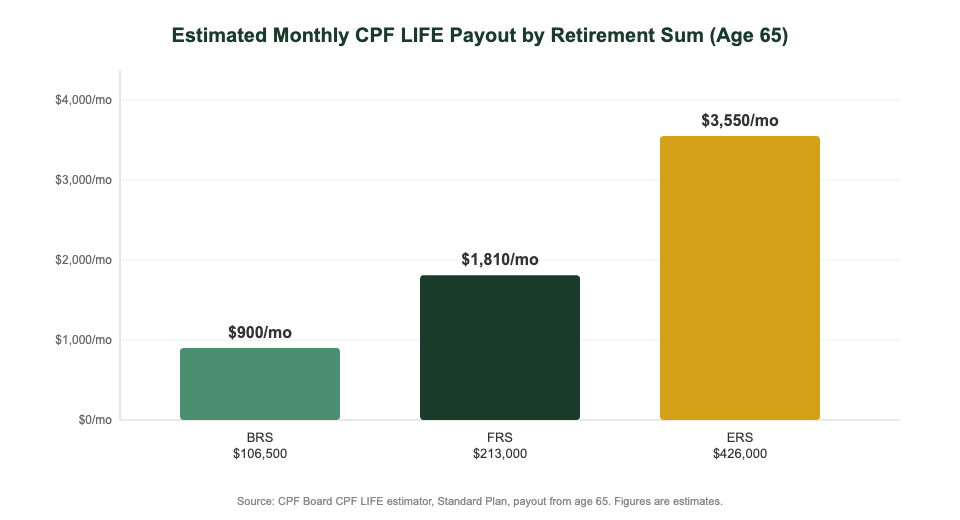
The good news: Singapore’s CPF system does much of the heavy lifting. If you hit the Full Retirement Sum (FRS) of $213,000 by age 55 in 2026, CPF LIFE provides roughly $1,810 per month from age 65 onwards — a guaranteed lifelong income stream.
The challenge: $1,810 per month may not be enough. The average Singaporean household spends around $4,500 per month. That gap needs to be filled by your personal savings, SRS, and investment portfolio.
How Much Do You Need to Retire in Singapore?
Your retirement income need depends on your lifestyle. Use the table below as a starting point, then adjust for your circumstances — whether you own your HDB flat outright, have dependants, or plan to travel extensively.
| Lifestyle | Monthly Expenses (SGD) | Annual Expenses | Nest Egg Needed (4% Rule) |
|---|---|---|---|
| Basic (HDB, hawker, local travel) | $1,500 – $2,000 | $18,000 – $24,000 | $450,000 – $600,000 |
| Comfortable (condo or HDB, dining out, overseas trips) | $3,000 – $4,500 | $36,000 – $54,000 | $900,000 – $1.35M |
| Affluent (condo, frequent travel, dining, hobbies) | $5,000 – $8,000 | $60,000 – $96,000 | $1.5M – $2.4M |
Source: CPF Board, MOM Household Expenditure Survey 2024, The Kopi Notes calculations. The 4% rule assumes a 25-year retirement from age 65.
The 4% rule is a useful rule of thumb: multiply your annual retirement expenses by 25 to get the total nest egg you need. This assumes your portfolio grows at around 4% per year (net of inflation), giving you a sustainable drawdown over 25–30 years.
However, Singapore retirees have an advantage the 4% rule doesn’t capture: CPF LIFE provides a lifelong payout regardless of market conditions. You should subtract your expected CPF LIFE income from your monthly income need before calculating how much of your own savings you need to draw down.
CPF Retirement Sums: BRS, FRS and ERS (2026)
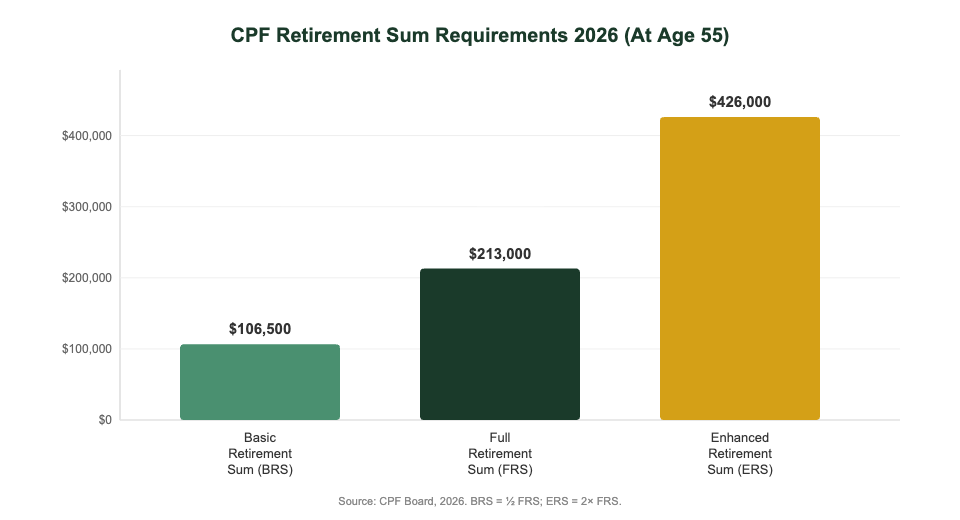
At age 55, your CPF savings are assessed against three retirement sum thresholds. The amount you have in your CPF Retirement Account (RA) determines your CPF LIFE payout from age 65.
| Retirement Sum | 2026 Amount | Est. Monthly Payout (Age 65, Standard Plan) | What It Covers |
|---|---|---|---|
| Basic Retirement Sum (BRS) | $106,500 | ~$900/month | Basic needs only; requires pledging property |
| Full Retirement Sum (FRS) | $213,000 | ~$1,810/month | Comfortable basic retirement; most common target |
| Enhanced Retirement Sum (ERS) | $426,000 | ~$3,550/month | Higher payout for more comfortable retirement |
Source: CPF Board, November 2026. ERS = 2× FRS from 2024 onwards. BRS = ½ FRS. Payout estimates are for the CPF LIFE Standard Plan starting at age 65.
The CPF Board increases the FRS by approximately 3.5% each year to keep pace with inflation. This means if you are 40 today, your FRS at age 55 will be higher — it’s important to model future FRS projections in your retirement calculator, not just today’s figures.
How to Use Our Retirement Calculator Singapore
Rather than doing these calculations manually, use TKN’s free Singapore retirement planning calculator to get a personalised estimate in minutes. Simply enter your age, current savings, expected CPF LIFE payout, and desired monthly retirement income, and the calculator tells you exactly how much more you need to save each month.
The calculator accounts for:
- CPF LIFE payouts — based on your projected retirement sum at 55
- SRS withdrawals — tax-advantaged drawdown from age 62
- Investment portfolio returns — using realistic Singapore market assumptions
- Inflation adjustment — Singapore’s long-run CPI is around 2–2.5% annually
- Years in retirement — based on Singapore’s life expectancy of 83–85 years
Beyond CPF: SRS and Investment Returns
For most Singaporeans, CPF LIFE alone will not fully fund retirement. The gap needs to be filled by the SRS, personal investments, and potentially property rental income.
Supplementary Retirement Scheme (SRS)
The SRS is a voluntary savings scheme that lets you contribute up to $15,300 per year (Singaporeans and PRs) for a tax deduction at your marginal rate. If you are in the 11.5% or higher tax bracket, SRS contributions pay for themselves — the tax savings alone justify the contribution.
SRS funds can be invested in stocks, ETFs, insurance products, or unit trusts. For passive investors, platforms like Endowus (use referral code 2V343) offer low-cost SRS portfolio management, while Syfe (use referral code SRPRFFFCD) provides robo-advisory SRS portfolios with automatic rebalancing.
Building a Passive Income Stream
Many Singapore retirees supplement CPF and SRS with dividend income from S-REITs and dividend stocks. A well-diversified passive income portfolio in Singapore can generate 5–7% annual yields, providing a third income pillar alongside CPF LIFE and SRS withdrawals.
For example, a $300,000 investment in top S-REITs at an average 6% yield generates $18,000 per year, or $1,500 per month — enough to meaningfully close the retirement gap.
The table below shows how combining CPF LIFE (FRS), SRS, and investment income can build toward a comfortable retirement at different portfolio sizes:
| Income Source | Example Amount | Monthly Income | Notes |
|---|---|---|---|
| CPF LIFE (FRS) | $213,000 RA at 55 | ~$1,810 | Lifelong, guaranteed, starts age 65 |
| SRS Withdrawals | $200,000 at drawdown | ~$700–$1,000 | 10-year withdrawal period from age 62 |
| Investment Portfolio (S-REITs/ETFs) | $300,000 at 6% yield | ~$1,500 | Dividend/distribution income, market-dependent |
| Total Combined | ~$713,000 saved | ~$4,010–$4,310 | Comfortable retirement in Singapore |
Source: CPF Board, MAS, The Kopi Notes estimates. Investment income is not guaranteed and depends on market conditions.
Worked Example: Calculating Retirement Needs
Let’s walk through a realistic example using our retirement calculator Singapore methodology.
Profile: Alex, age 40, planning to retire at 65. Current CPF OA + SA balance: $150,000. Monthly salary: $6,000. Desired retirement income: $4,000/month (today’s dollars, inflation-adjusted to age 65).
| Step | Calculation | Result |
|---|---|---|
| 1. Inflation-adjusted monthly need at 65 | $4,000 × (1.025)^25 | ~$7,375/month |
| 2. Expected CPF LIFE payout (ERS target) | FRS grows ~3.5%/yr; aim for ERS at 55 | ~$3,550–$4,500/month (est. 2041) |
| 3. Remaining gap to fill | $7,375 – $4,000 (CPF LIFE mid-est.) | ~$3,375/month from personal savings |
| 4. Total nest egg needed (4% rule) | $3,375 × 12 ÷ 0.04 | ~$1.01M in personal savings |
| 5. Monthly savings required | Calculator: $1.01M over 25 years at 5% return | ~$1,900/month additional savings |
Source: The Kopi Notes calculations. 2.5% annual inflation, 5% portfolio return assumption. CPF LIFE FRS indexed at 3.5% annually. For personalised results, use the TKN retirement calculator.
For Alex to retire comfortably, the combination strategy would be: maximise CPF (top up Retirement Account to ERS if possible), contribute $15,300/year to SRS, and invest the remaining monthly surplus in a diversified CPF investment strategy and brokerage portfolio.
Frequently Asked Questions
How much CPF do I need to retire in Singapore?
The minimum target is the Full Retirement Sum (FRS) of $213,000 in your CPF Retirement Account by age 55 in 2026. This gives you approximately $1,810 per month from CPF LIFE from age 65. If your desired retirement income is higher than $1,810/month, you will need personal savings or SRS to make up the difference. The Enhanced Retirement Sum (ERS) of $426,000 provides around $3,550/month.
What is the 4% rule and does it apply in Singapore?
The 4% rule states that you can withdraw 4% of your portfolio annually without depleting it over a 30-year retirement. For Singapore, it’s a useful starting point but needs adjustment: (1) subtract your guaranteed CPF LIFE income from your monthly need before applying the rule; (2) Singapore has lower stock market returns historically than the US market the rule was designed for; (3) consider a 3.5% withdrawal rate for safety given longer Singaporean life expectancy. Use our retirement calculator for a Singapore-specific projection.
At what age should I start planning for retirement in Singapore?
The ideal time to start is in your 20s, but it’s never too late. If you are in your 20s–30s, focus on maximising CPF SA (Ordinary Account transfers to Special Account) and starting a disciplined investment habit. In your 40s, review your CPF trajectory against the FRS/ERS targets and maximise SRS contributions. In your 50s, review your CPF LIFE options (Standard vs Basic vs Escalating Plan) and begin drawing down SRS from age 62 to minimise taxes. Our retirement calculator Singapore tool models all these stages.
Is $1 million enough to retire in Singapore?
$1 million in personal savings, combined with CPF LIFE, is enough for a comfortable retirement for most Singaporeans. At a 4% withdrawal rate, $1 million generates $40,000 per year ($3,333/month). Add CPF LIFE FRS of ~$1,810/month and you have ~$5,143/month total — enough for a comfortable HDB lifestyle. If you live in a condo and travel frequently, you would need $1.5M–$2M or CPF LIFE at ERS level. Run your numbers in the retirement calculator for a personalised result.
How does SRS help with retirement in Singapore?
The SRS (Supplementary Retirement Scheme) lets Singaporeans and PRs contribute up to $15,300 per year and deduct it from taxable income. In retirement from age 62, only 50% of SRS withdrawals are taxable, and spreading withdrawals over 10 years often means you pay very little or zero tax. This makes SRS highly tax-efficient. SRS funds must be invested to grow — leaving them in cash earns only 0.05% interest. Good options include ETF portfolios via Endowus or Syfe, or Singapore Savings Bonds via FSMOne.
What is a realistic retirement portfolio return assumption for Singapore?
For a balanced Singapore portfolio (60% equities, 40% fixed income), a realistic long-run return assumption is 4–6% per year. CPF SA interest of 4% per year is essentially risk-free. A diversified ETF portfolio (e.g. VWRA or CSPX) has historically returned 7–10% over the long term globally, but expect higher volatility. For conservative planning in a retirement calculator, use 4–5% for a balanced portfolio. This is after fees but before inflation — subtract 2–2.5% for the inflation-adjusted real return of 2–3%.
Start Planning Your Retirement Today
Planning your retirement in Singapore starts with knowing your numbers. Use CPF’s retirement sum targets as your foundation, fill the gap with SRS and disciplined investing, and check your progress annually with a retirement calculator.
Key takeaways from this guide: (1) Target CPF FRS of $213,000 as your baseline; (2) contribute to SRS annually for tax deductions and tax-free growth; (3) build a passive income stream through S-REITs or ETFs; (4) run your numbers in a retirement calculator every year to stay on track.
This article was researched with the help of AI. While we strive to keep all information accurate and up to date, there may be errors. If you notice any discrepancies, please contact us.