CPF Contribution Rate 2026 for Age 55 and Above: Rates, OA/SA/MA Allocation & Planning Guide
CPF | 7 November 2026 | 7 min read
When you turn 55 in Singapore, your CPF contribution rate changes significantly. For private-sector employees aged 55–60, total CPF contributions drop from 37% to 29.5% of wages — with your employee share falling from 20% to 15% and your employer’s share from 17% to 14.5%. This reduction continues with age, reaching just 10% total above 70. The ordinary wage (OW) ceiling is S$7,400/month in 2026. Here is exactly what changes, where your money goes, and how to plan ahead.
Not financial advice. All figures are for educational reference only. Data as at November 2026 unless noted. Always verify current rates at cpf.gov.sg.
CPF Contribution Rates for Age 55 and Above (2026)
Singapore’s CPF contribution rates are tiered by age. The rates below apply to private-sector employees and are effective as at January 2026. The CPF ordinary wage (OW) ceiling is S$7,400 per month, and the annual wage (AW) ceiling is S$102,000 minus the OW contributed that calendar year.
| Age Group | Employee | Employer | Total |
|---|---|---|---|
| 55 and below | 20% | 17% | 37% |
| >55 to 60 | 15% | 14.5% | 29.5% |
| >60 to 65 | 9.5% | 11% | 20.5% |
| >65 to 70 | 7.5% | 7.5% | 15% |
| Above 70 | 5% | 5% | 10% |
Source: CPF Board, cpf.gov.sg — Private sector employees; OW ceiling S$7,400/month as at Jan 2026
At the OW ceiling of S$7,400, an employee aged 55–60 contributes S$1,110/month (15%), while their employer contributes S$1,073/month (14.5%) — a combined S$2,183/month flowing into CPF. Compare that to the under-55 rate where the same employee would see S$1,480 employee + S$1,258 employer = S$2,738 total.
The stepdown in contributions is deliberate policy: it increases take-home pay at the point in life when many Singaporeans are approaching retirement and may need more liquidity.
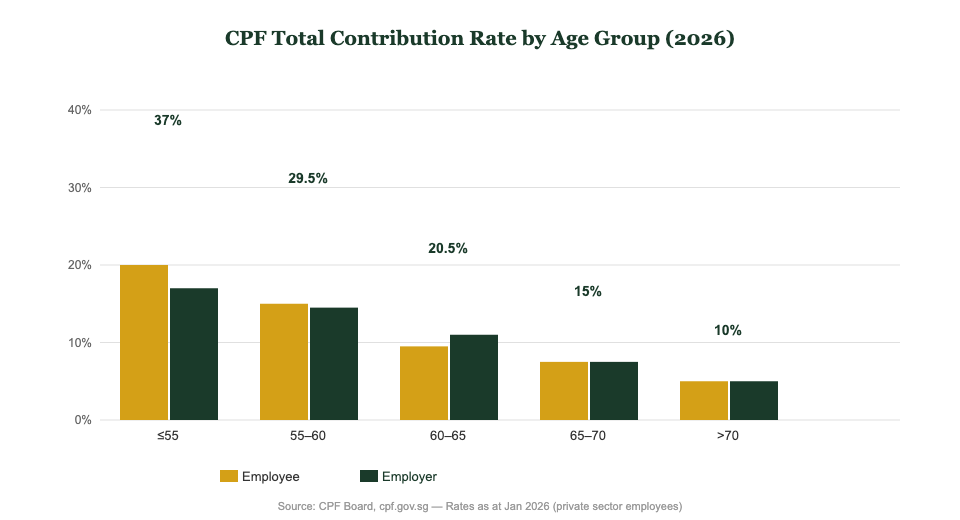
CPF total contribution rate by age group 2026, broken down by employee and employer share. Source: CPF Board.
Important: Ordinary Wage vs Additional Wage
The Ordinary Wage (OW) ceiling of S$7,400 applies to your monthly salary. For bonus, overtime, and other variable pay (Additional Wage or AW), the ceiling is S$102,000 minus the total OW for the year. If you earn S$7,400/month, your OW for the year is S$88,800 — meaning AW up to S$13,200 is also CPF-applicable. Everything above that is CPF-exempt.
What Happens to Your CPF at Age 55?
Turning 55 is a major milestone in your CPF journey. Several structural changes occur automatically:
1. A Retirement Account (RA) Is Created
CPF automatically creates a Retirement Account (RA) for you on your 55th birthday. CPF will set aside funds from your Special Account (SA) first, then your Ordinary Account (OA) if needed, to meet the Full Retirement Sum (FRS).
The FRS for 2026 is S$213,000. Any SA and OA balances above the FRS remain in those accounts for your use.
There are three tiers to choose from:
- Basic Retirement Sum (BRS): S$106,500 — if you pledge your property, you can opt for BRS and keep more in OA
- Full Retirement Sum (FRS): S$213,000 — the default; provides a standard CPF LIFE monthly payout from age 65
- Enhanced Retirement Sum (ERS): S$319,500 — top up beyond FRS for higher lifetime payouts
These sums increase by approximately 3.5% each year. For the definitive figures, see our guide on CPF FRS, BRS and ERS 2026.
2. CPF LIFE Enrolment
If your RA balance is at least S$60,000 when you reach 65, you will be automatically enrolled in CPF LIFE — a lifelong annuity scheme that pays monthly from age 65 onwards for as long as you live. You can defer payouts up to age 70, increasing your monthly amount by roughly 7% per year of deferral.
3. Withdrawal Rights
From age 55, you can withdraw a lump sum from CPF — typically S$5,000, or any savings above the FRS if your RA is fully funded. After 55, your OA can also be used to service an existing HDB mortgage.
For a comprehensive breakdown of the full retirement planning framework, see our retirement planning Singapore 2026 guide.
OA, SA and MA Allocation Rates Explained
Once you are past 55, your CPF contributions are allocated differently across the three accounts. The allocations below are expressed as a percentage of your total wage (not percentage of contributions).
| Age Group | OA | SA / RA | MA (MediSave) | Total |
|---|---|---|---|---|
| 55 and below | 23% | 8% | 6% | 37% |
| >55 to 60 | 11.5% | 7% | 11% | 29.5% |
| >60 to 65 | 3.5% | 7% | 10% | 20.5% |
| >65 to 70 | 1% | 7% | 7% | 15% |
| Above 70 | 1% | 7% | 2% | 10% |
Source: CPF Board — Allocation as a % of total wage. After age 55, SA contributions flow to Retirement Account (RA).
Notice two key shifts after 55:
- OA allocation drops sharply — from 23% (under 55) to just 11.5% at ages 55–60, and to 1% above 60. You accumulate far less in OA after 55.
- MA allocation rises temporarily — MediSave gets 11% of your wages at 55–60, reflecting the policy priority of funding healthcare in later life. The CPF Basic Healthcare Sum (BHS) caps how much can sit in MediSave — once you hit the BHS (S$75,500 in 2026), excess MA flows to your RA instead.
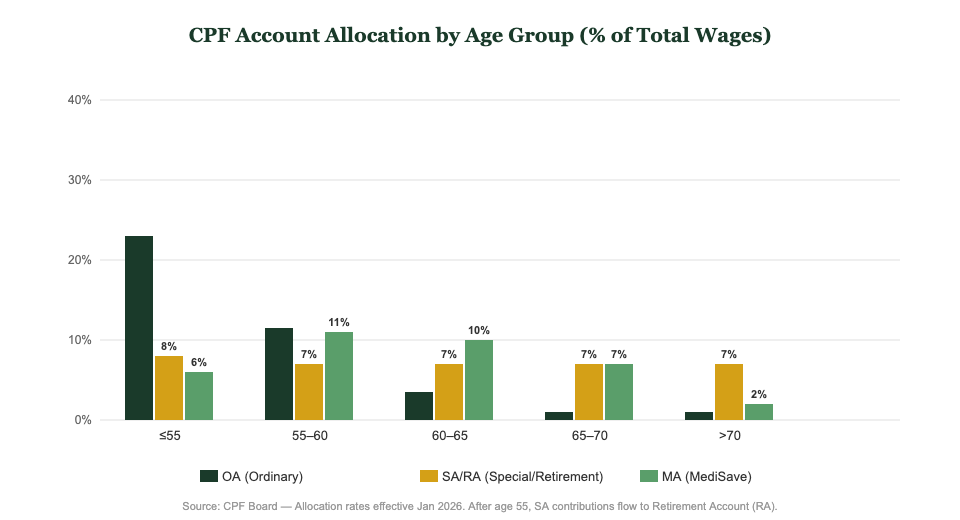
CPF OA, SA/RA and MediSave (MA) allocation rates by age group 2026. Source: CPF Board.
For employees still working past 65, the OA allocation drops to just 1% — essentially all your CPF contributions are going to your Retirement Account and MediSave. This is intentional: by this stage, the OA’s primary purpose (housing) has typically been fulfilled.
CPF Planning Tips for Age 55 and Above
Lower contribution rates in your 50s and 60s mean less automatic CPF savings — which makes deliberate planning even more important. Here are five strategies Singapore investors use to close the gap:
1. Top Up Your Retirement Account
You can voluntarily top up your RA (or a loved one’s RA) up to the Enhanced Retirement Sum (S$319,500 in 2026) under the Retirement Sum Topping-Up (RSTU) scheme. Top-ups to your own RA qualify for up to S$8,000 in tax relief per year, and top-ups to a family member’s RA qualify for another S$8,000. The 4% SA interest rate on RA balances makes this one of the most efficient uses of spare cash in retirement planning.
2. Maximise Your SRS Contributions
The Supplementary Retirement Scheme (SRS) lets you contribute up to S$15,300 per year (Singaporeans/PRs) or S$35,700 (foreigners) and get a full tax deduction. SRS funds can be invested in ETFs, stocks, unit trusts, or fixed deposits. At retirement, only 50% of SRS withdrawals are taxable. If you have a DBS, OCBC, or UOB SRS account, you can invest it immediately — see our DBS SRS account investing guide for the step-by-step.
3. Use CPF OA for Top-Up Before Withdrawing
At 55, before making any lump-sum withdrawal, consider whether topping up to ERS (S$319,500) first makes sense. Every dollar in your RA earns 4–5% per annum in guaranteed interest from CPF — better than most fixed deposits. Funds that stay in RA eventually fund your CPF LIFE payouts from 65 onwards.
4. Consider Deferring CPF LIFE Payouts
CPF LIFE payouts can begin anytime from age 65 to 70. Each year you defer increases your monthly payout by roughly 6–7%. If you have alternative income sources (SRS, dividends, rental), deferring to 70 can significantly boost lifetime income. Use the CPF LIFE estimator at cpf.gov.sg for a personalised projection.
5. Invest Your Remaining OA Balance via CPFIS
Your OA balance — which will grow more slowly after 55 — can be invested via the CPF Investment Scheme (CPFIS). Eligible products include ETFs, unit trusts, and Singapore Government Bonds. Only the first S$20,000 must remain uninvested. For a framework on CPF investing, see our article on CPF investment strategy.
For the broader retirement planning picture — including how to combine CPF, SRS, S-REITs, and dividend stocks — the Singapore retirement calculator on TKN lets you model different scenarios across your 55–65 window.
Worked Example: CPF Deductions at 55 vs Before 55
Let us look at a concrete example. Suppose Ahmad earns S$6,500/month and turns 55 this year.
| Item | Age <55 | Age 55–60 | Change |
|---|---|---|---|
| Gross salary | S$6,500 | S$6,500 | — |
| Employee CPF (% / $) | 20% / S$1,300 | 15% / S$975 | +S$325 take-home |
| Employer CPF (% / $) | 17% / S$1,105 | 14.5% / S$942.50 | S$162.50 less ER contribution |
| Take-home pay | S$5,200 | S$5,525 | +S$325/month |
| Total CPF inflow | S$2,405 | S$1,917.50 | −S$487.50/month |
Note: Figures are illustrative. Ahmad earns S$6,500/month. Take-home rises by S$325 at 55–60; total CPF inflow drops by S$487.50/month vs the under-55 rate.
Over the 55–60 window (5 years), Ahmad accumulates roughly S$29,250 less in CPF compared to staying at the under-55 rate — highlighting the importance of voluntary top-ups or SRS contributions if you want to maintain the same trajectory toward your retirement target.
Frequently Asked Questions
What is the CPF contribution rate for a 55-year-old in Singapore in 2026?
For employees aged above 55 up to 60, the total CPF contribution rate is 29.5% of wages — 15% from the employee and 14.5% from the employer. This applies to the first S$7,400 of monthly ordinary wages. This rate is effective from January 2025 and continues through 2026.
Does my CPF contribution rate change the day I turn 55?
Yes. CPF contribution rates change from the first day of the month after your 55th birthday. For example, if you turn 55 on 15 March, the new 29.5% rate applies from 1 April. Your employer updates payroll accordingly. No action is required from you.
Where does my CPF go after I turn 55 — OA, SA or MA?
After 55, the allocation for employees aged 55–60 is approximately: OA 11.5%, SA/Retirement Account 7%, and MediSave 11% of wages. Note that after age 55, contributions previously going to the SA actually flow into your Retirement Account (RA), which funds CPF LIFE.
Can I still top up my CPF after 55?
Yes. You can make voluntary cash top-ups to your Retirement Account (RA) up to the Enhanced Retirement Sum (S$319,500 in 2026) under the Retirement Sum Topping-Up (RSTU) scheme. Top-ups to your own RA qualify for up to S$8,000 in tax relief per year, and top-ups to a family member’s RA qualify for another S$8,000. The 4% SA interest rate on RA balances makes this one of the most efficient uses of spare cash in retirement planning.
What happens to my CPF OA savings at 55?
At 55, CPF will transfer funds from your SA and OA into a new Retirement Account (RA) to meet your chosen retirement sum (BRS, FRS, or ERS). Your SA is depleted first; then OA if necessary. Any OA balance above what is needed stays in your OA, earning 2.5% interest, and can be used for housing loans, CPFIS investing, or withdrawn in cash above the FRS.
How much will I get from CPF LIFE monthly if I meet the FRS?
As of 2026, meeting the FRS of S$213,000 and starting CPF LIFE payouts at 65 (Standard Plan) provides approximately S$1,500–S$1,700 per month for life. Meeting the ERS of S$319,500 provides roughly S$2,200–S$2,400/month. Deferring to 70 increases the monthly amount by 6–7% per year. Use the official CPF LIFE estimator at cpf.gov.sg for a personalised projection.
Is the CPF contribution rate the same for self-employed people?
No. Self-employed persons (SEPs) in Singapore are not required to contribute to CPF OA or SA, but they must make MediSave contributions if their annual net trade income exceeds S$6,000. The MediSave contribution rate for SEPs above 55 is lower than for employees. SEPs can make voluntary CPF contributions to any account under the Voluntary CPF scheme to build retirement savings.
Plan Your Retirement With the Right Tools
Use TKN’s calculator, then grow your savings with these Singapore-approved platforms.
| Retirement Calculator Plan your CPF + SRS + investment income → |
Endowus — CPF + SRS Investing Use code 2V343 for fee rebate → |
| Syfe — SRS & Cash Portfolios Use code SRPRFFFCD → |
FSMOne — Funds & ETFs Use code P0544985 → |
TKN may earn a referral fee. This is not financial advice. Verify all CPF figures at cpf.gov.sg.
This article was researched with the help of AI. While we strive to keep all information accurate and up to date, there may be errors. If you notice any discrepancies, please contact us.