FSMOne vs GXS Savings Account (2026): Investing Platform vs Digital Bank Compared
They are not competing for the same dollar. Here’s how to tell which one your cash actually needs.
FSMOne is a CPFIS-approved investment platform for unit trusts, ETFs and stocks with a 0% sales charge, while GXS Savings Account is an SDIC-insured digital bank account paying a fixed daily interest rate of up to 2% p.a. on its Boost Pocket. They solve different problems: FSMOne grows CPF, SRS and cash money over the long term with market risk, while GXS protects and parks idle cash with a guaranteed, capital-safe rate. Most Singapore investors end up using both, not choosing one.
Not financial advice. All figures are for educational reference only. Data as at November 2026 unless noted.
Quick Answer: Which Should You Use?
If you’re asking “FSMOne or GXS”, you’re really asking two different questions at once. For money you want to grow over years — CPF Ordinary Account savings, SRS contributions, or cash you don’t need for a while — FSMOne gives you a CPFIS-approved, 0%-sales-charge way to buy unit trusts, ETFs and stocks. For money you want to keep safe and liquid — an emergency fund, next month’s rent, savings you can’t afford to see drop in value — GXS Savings Account gives you a flat, SDIC-insured daily interest rate with zero market risk. Neither is “better” in isolation; they sit at opposite ends of the risk spectrum, and most Singapore investors use both at the same time.
What FSMOne and GXS Actually Are
FSMOne (now branded FSM Global, part of iFAST Corporation, listed on the SGX) is an online investment platform. Singapore investors use it to buy unit trusts with a permanent 0% sales charge, trade SGX and global stocks and ETFs, and — critically — invest their CPF Ordinary Account and Special Account savings through the CPF Investment Scheme (CPFIS), as well as Supplementary Retirement Scheme (SRS) funds. Money placed on FSMOne is not a deposit; it buys units in funds or shares in companies, which can rise or fall in value. Holdings are held in custody (CDP for SGX-listed securities), and FSMOne is not SDIC-insured because it isn’t a bank.
GXS Savings Account is a deposit account offered by GXS Bank, a digital full bank licensed and regulated by the Monetary Authority of Singapore (MAS). Every dollar you put into a GXS Main Account, Saving Pocket or Boost Pocket is a bank deposit, insured by the Singapore Deposit Insurance Corporation (SDIC) up to S$100,000 per depositor. There is no CPF or SRS access on GXS — it only accepts cash. In exchange for giving up any upside, your principal does not move: you earn a fixed, published interest rate and nothing else.
Key Differences at a Glance
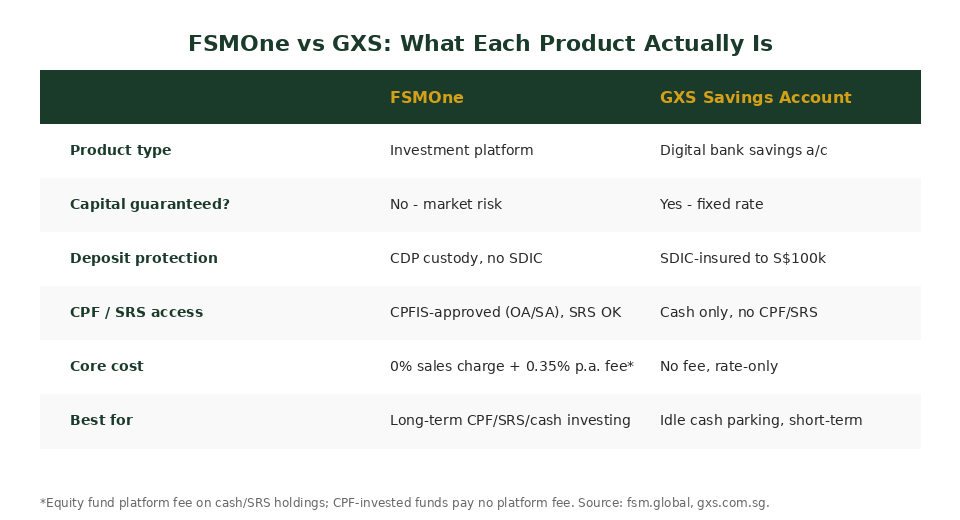
| Feature | FSMOne | GXS Savings Account |
|---|---|---|
| Entity type | Investment platform (iFAST) | MAS-licensed digital full bank |
| What you hold | Unit trusts, ETFs, stocks | Cash bank deposit |
| Capital guaranteed? | No — subject to market risk | Yes — fixed rate |
| Deposit protection | CDP custody, no SDIC cover | SDIC-insured to S$100,000 |
| CPF OA/SA access | Yes — CPFIS-approved | No |
| SRS access | Yes | No |
| Core cost | 0% sales charge + ~0.35% p.a. platform fee on cash/SRS equity holdings | None — rate is net |
| Typical use | Long-term CPF/SRS/cash investing | Idle cash, emergency fund, short-term savings |
Source: fsm.global pricing structure; gxs.com.sg/savings-account. Figures as at November 2026.
Rates & Fees Compared
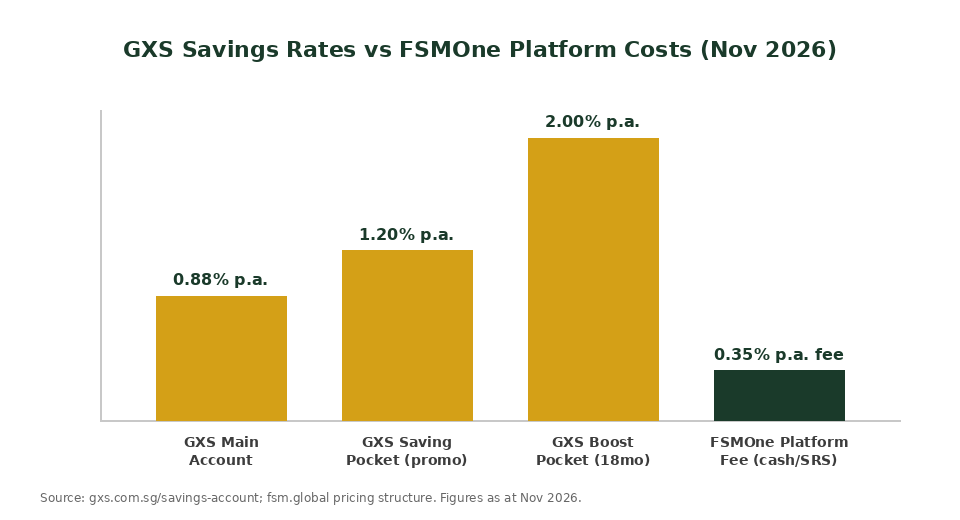
GXS pays three different rates depending on which “pocket” you use. The Main Account — the one your debit card draws from — pays a flat 0.88% p.a., credited daily, with no conditions. Saving Pockets currently carry a limited-time promotional rate of 1.2% p.a., also with no lock-in and no minimum balance. The Boost Pocket pays a base rate of 0.88% p.a. plus a maturity bonus that scales with how long you lock the money away — 0.13% p.a. for 1 month, up to 0.87% p.a. for 12 months, and 1.12% p.a. for 18 months, for a headline rate of up to 2.0% p.a. on the longest tenure. None of these rates require salary crediting, card spend, or a minimum balance — GXS’s entire pitch is “no hoops.”
FSMOne doesn’t pay you a rate at all — it charges you one. Unit trust purchases carry a permanent 0% sales charge across cash, CPF and SRS. On top of that, cash and SRS holdings in equity unit trusts carry a platform fee of roughly 0.35% p.a. (quoted as 0.0875% per quarter), while fixed income unit trusts are cheaper. Crucially, CPF-invested funds pay no platform fee at all — only cash and SRS holdings do. Buying SGX stocks or ETFs on FSMOne costs around 0.08% commission with a minimum of roughly S$8.80 per trade. For a Singapore investor parking SGD 20,000 in a cash equity unit trust on FSMOne for a year, that 0.35% platform fee works out to about SGD 70 — a cost you pay regardless of whether the fund goes up or down. On GXS, the same SGD 20,000 in a Saving Pocket earns roughly SGD 240 a year in interest at the 1.2% promo rate — guaranteed, not a cost.
CPF, SRS and Capital Guarantee
This is the dividing line that actually separates the two products. GXS cannot touch your CPF or SRS money under any circumstance — it is a cash-only consumer bank account, and CPF funds legally cannot sit in a commercial digital bank savings account outside the CPF Board’s own OA/SA interest (2.5%/4% p.a. respectively as unchanged through Q3 2026). FSMOne, by contrast, is one of a small number of CPFIS-approved platforms, meaning your CPF Ordinary Account or Special Account savings above the required minimum sums can be invested in approved unit trusts, ETFs and selected stocks through FSMOne — and the fund choices there are not available through GXS at all, insured or not.
The flip side is capital guarantee. A GXS deposit cannot lose nominal value; the only “risk” is inflation eroding real purchasing power over time, and SDIC insurance covers up to S$100,000 if GXS Bank itself were to fail. A unit trust or ETF bought through FSMOne can fall in value — sometimes sharply — and there is no insurance scheme that protects you against market losses. If capital preservation is your primary goal, GXS’s structure is the safer one by design. If long-term real returns above inflation are the goal, FSMOne’s market exposure is the tool built for that job, not GXS’s.
Who Should Pick Which?
FSMOne is the better fit if: you want to invest your CPF OA/SA savings above the CPF Board’s own rate, you’re funding SRS contributions for tax relief and want to put that money to work instead of leaving it idle, you want 0%-sales-charge access to unit trusts and ETFs, or you’re comfortable with market risk in exchange for the chance of higher long-term returns.
GXS is the better fit if: you need an emergency fund that cannot lose value, you’re parking cash you’ll need within the next few months, you want SDIC-insured protection on every dollar, or you simply want a no-conditions savings account that beats a traditional bank’s savings rate without any investment decision-making.
Using Both Together
In practice, most Singapore investors who use one of these products end up using the other too, because they’re solving different problems in the same financial plan. A common structure: keep 3–6 months of expenses in a GXS Saving Pocket or Boost Pocket for guaranteed, insured liquidity, then direct CPF OA savings above the Board’s floor rate and SRS contributions into FSMOne for long-term growth. For readers building a broader cash-and-investment strategy, our passive income Singapore guide and CPF investment strategy breakdown both cover how to size each bucket. If you’re also comparing SDIC-insured options against Syfe’s cash management products, our Syfe referral code page breaks down Syfe Cash+ alongside its referral bonus, and our Singapore T-bills 2026 guide is a useful benchmark for comparing GXS’s rate against the latest T-bill cut-off yield.
For SRS specifically, FSMOne’s zero sales charge on unit trusts makes it one of the more cost-efficient ways to put SRS contributions to work rather than letting them sit earning the SRS operator bank’s low default rate — our CPF investment strategy article has a worked SRS funding example. If you’re weighing a FSMOne account against a robo-advisor instead, our Endowus referral code page and our best S-REITs in Singapore 2026 roundup are good next reads for the investing side, while the Singapore retirement calculator helps size how much of your CPF/SRS allocation should go toward growth assets versus guaranteed instruments at your stage of life.
Frequently Asked Questions
Is FSMOne the same type of product as GXS Savings Account?
No. FSMOne is an investment platform where you buy unit trusts, ETFs and stocks, and your capital can rise or fall in value. GXS Savings Account is a bank deposit account that pays a fixed, SDIC-insured interest rate and cannot lose nominal value. They serve different purposes rather than competing head-to-head.
Can I invest my CPF savings through GXS Savings Account?
No. GXS Savings Account only accepts cash deposits and has no CPF Investment Scheme approval. To invest CPF Ordinary Account or Special Account savings above the CPF Board’s own interest rate, you would need a CPFIS-approved platform like FSMOne instead.
Is my money safe on FSMOne if the platform fails?
Your unit trusts, ETFs and stocks are held in custody separately from FSMOne’s own balance sheet (via CDP for SGX-listed securities and trustees for unit trusts), so they are generally protected from FSMOne’s own insolvency. However, this is not the same as SDIC deposit insurance — your investments can still lose value due to normal market risk, which no insurance scheme covers.
Which pays a higher return, FSMOne or GXS?
GXS’s rates are fixed and currently top out at around 2% p.a. on its longest Boost Pocket tenure. FSMOne’s unit trusts and ETFs have no fixed return — they can outperform GXS’s rate significantly over the long run, or underperform it and lose money in a given year, because returns depend entirely on market performance rather than a published rate.
Should I use FSMOne and GXS at the same time?
Many Singapore investors do. A common approach is to keep an emergency fund and near-term cash in GXS for guaranteed liquidity, while directing CPF OA/SA savings and SRS contributions into FSMOne for long-term, tax-advantaged growth. The two products are not substitutes for each other in a well-structured plan.
Does FSMOne charge a platform fee on CPF investments?
No. FSMOne’s platform fee on equity unit trusts applies only to cash and SRS holdings, at roughly 0.35% p.a. CPF-invested funds on FSMOne are exempt from this platform fee, which is one reason it is widely used for CPFIS investing.
Ready to Put Your Cash and Your CPF to Work?
Open an account and start earning on idle cash or invest your CPF/SRS savings — use our referral links for sign-up bonuses.
This article was researched with the help of AI. While we strive to keep all information accurate and up to date, there may be errors. If you notice any discrepancies, please contact us.