DIGITAL BANKS & BROKERS
Endowus + IBKR: The Two-Platform Dividend Strategy for Singapore Investors (2026)
Endowus and Interactive Brokers (IBKR) solve different problems. Endowus gives you low-cost access to CPF, SRS, and cash unit trusts through a robo-advisor wrapper. IBKR gives you direct, low-cost access to SG and global stocks, REITs, and ETFs. Singapore dividend investors increasingly use both: Endowus for retirement-linked money, IBKR for hands-on dividend picking.
Not financial advice. All figures are for educational reference only. Data as at July 2026 unless noted.
- Endowus charges an ongoing 0.25%–0.60% p.a. access fee but gives you CPF and SRS access to institutional-class funds. IBKR charges a one-time per-trade commission (often $0 on US stocks) but you pick and manage everything yourself.
- For dividend income, direct US stocks lose 30% to withholding tax with no relief for Singaporeans — SG stocks and Ireland-domiciled ETFs are usually the smarter dividend building blocks on IBKR.
- A common split: CPF/SRS retirement money stays in Endowus funds, while cash dividend picking (S-REITs, SG blue chips, global ETFs) moves to IBKR for lower long-run cost.
Why Combine Two Platforms?
Most Singapore investors start with one platform and stop there. That works fine for a while. But Endowus and IBKR are built for different jobs, and using only one means leaving money on the table somewhere.
Endowus is a robo-advisor. It builds and rebalances a portfolio of unit trusts and ETFs for you, and it is one of the few platforms that lets you invest your CPF Ordinary Account and SRS funds this way. You do not pick individual stocks. You pick a portfolio, and Endowus does the rest.
IBKR is a brokerage. There is no advisory layer. You choose exactly which stocks, REITs, or ETFs to buy, in SGD, USD, or another currency, at some of the lowest commissions available to retail investors in Singapore.
For example, a Singapore investor with S$80,000 to invest might keep S$40,000 of CPF and SRS money in an Endowus Flagship portfolio for long-term, hands-off growth, while running a separate S$40,000 cash portfolio of S-REITs and dividend blue chips on IBKR. That split uses each platform for what it is actually good at.
What Endowus Does Best
Endowus’ biggest edge is access. It is one of a small number of platforms that lets you invest your CPF Ordinary Account (OA) and SRS funds into a professionally managed, globally diversified portfolio — something you cannot do directly on IBKR.
Here’s why that matters. CPF OA money sitting untouched earns 2.5% a year. Endowus’ CPF portfolios are built to target a higher long-run return, using the same institutional-class funds that private bank clients get, at a much lower entry point.
The fee tiers step down as your invested balance grows — you pay less, percentage-wise, the more you have invested, per the official Endowus fee schedule. This is fully explained with worked examples in our Endowus review covering fees, CPF and SRS.
Endowus also rebates 100% of trailer fees back to you, and there are no sales charges or lock-in periods. That’s genuinely unusual — most CPF-linked investment products still carry upfront sales charges.
Where Endowus falls short: you can’t buy individual stocks or REITs, and the ongoing access fee compounds against you over decades even though the percentage looks small in any single year.
What IBKR Does Best
IBKR is a direct-access broker, not a robo-advisor. That trade-off is exactly why dividend investors like it: you choose exactly which S-REIT, SG blue chip, or global ETF you own, and you pay per trade instead of an ongoing percentage fee.
Two 2026 changes make IBKR more attractive than before. First, IBKR Lite now offers commission-free trading on US-listed stocks and ETFs for eligible Singapore residents. Second, per the official IBKR Singapore commission schedule, SGX stock commissions under the Fixed pricing tier run as low as 0.08% of trade value (minimum S$2.50), with the rate falling further at higher monthly volumes.
There is no ongoing account or custody fee on stock holdings. Once you own the shares, holding them costs nothing extra — unlike Endowus, where the access fee applies every year regardless of whether you buy or sell.
The catch: IBKR cannot touch your CPF OA or CPF SA money at all, and SRS support depends on your SRS bank’s linkage process. You also do all the picking, sizing, and rebalancing yourself, with no advisory guardrails. For a broader broker shortlist, see our comparison of IBKR vs Saxo vs MooMoo vs Syfe for ETF investing.
Cost Comparison: Fees vs Commissions
This is the part people get wrong. They compare a single Endowus fee percentage against a single IBKR commission percentage, as if the two work the same way. They don’t.
Endowus’ access fee is an ongoing, recurring charge on your total invested balance, billed quarterly, every year you hold the portfolio. IBKR’s commission is a one-time charge, paid only when you buy or sell. If you buy and hold for years, the IBKR cost stays flat while the Endowus cost keeps accumulating.
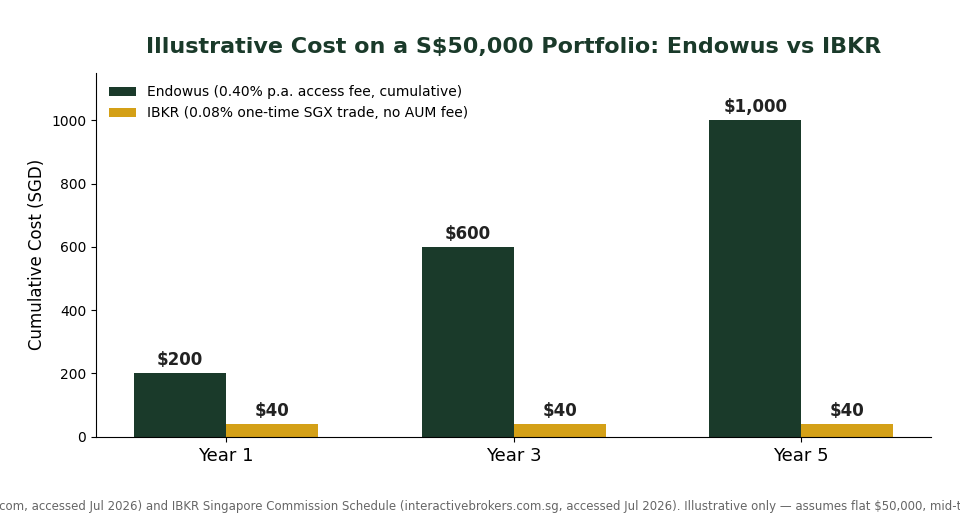
On a flat S$50,000 lump sum, held for five years with no further trading, Endowus’ 0.40% mid-tier access fee costs roughly S$1,000 in cumulative fees. The same S$50,000 traded once on IBKR at the SGX Fixed rate (0.08%) costs about S$40, one-time, then nothing more to hold.
Here’s why that gap exists: Endowus is charging you for ongoing portfolio construction, rebalancing, and CPF/SRS access — a service. IBKR is charging you for order execution — a transaction. If you’re buying and holding a small number of dividend stocks for years, the transaction model is structurally cheaper. If you want someone else managing rebalancing across dozens of funds inside your CPF, the service model earns its fee.
| Feature | Endowus | IBKR |
|---|---|---|
| Fee structure | 0.25%–0.60% p.a. on AUA | Per-trade commission, one-time |
| CPF OA / SA access | Yes | No |
| SRS access | Yes, no agent bank charge | Depends on SRS bank linkage |
| Individual stock/REIT picking | No | Yes |
| US stock commission (eligible SG residents) | N/A | S$0 (IBKR Lite) |
| Ongoing custody fee | Included in access fee | None |
Source: Endowus Fee Schedule (help.endowus.com, accessed Jul 2026); IBKR Singapore Commission Schedule (interactivebrokers.com.sg, accessed Jul 2026).
A Sample Two-Platform Portfolio
Say you’re 35, earning a steady income, and want both retirement growth and cash dividend income. Here’s one way to split S$100,000 across the two platforms.
| Bucket | Platform | Amount | Purpose |
|---|---|---|---|
| CPF OA | Endowus | S$40,000 | Long-term growth above the 2.5% CPF OA floor |
| SRS | Endowus | S$20,000 | Tax-relieved retirement investing, hands-off |
| Cash – S-REITs & SG dividend stocks | IBKR | S$25,000 | Direct dividend income, 0% local withholding tax |
| Cash – global ETFs (e.g. Ireland-domiciled) | IBKR | S$15,000 | Global diversification at low, one-time cost |
This isn’t a recommendation for your specific situation — it’s an illustration of the logic: retirement-linked money that benefits from professional management and CPF/SRS access sits in Endowus, while self-directed dividend picking with SGD or USD cash sits in IBKR. You can weight the split however fits your own risk appetite and how hands-on you want to be.
For readers building the dividend side of this split, our guide to the best S-REITs in Singapore and our Singapore REIT ETF guide are both good starting points for the IBKR side of the portfolio.
Withholding Tax: The Hidden Dividend Cost
This is the part most dividend investors miss when they open an IBKR account. Withholding tax (WHT) is the tax a foreign government deducts from your dividend before it even reaches you — and it varies enormously depending on what you buy.
Singapore has no tax treaty with the United States. That means dividends from directly-held US stocks are withheld at the full 30% rate before you receive a cent. A US stock paying a 4% headline dividend yield actually delivers you about 2.8% after withholding.
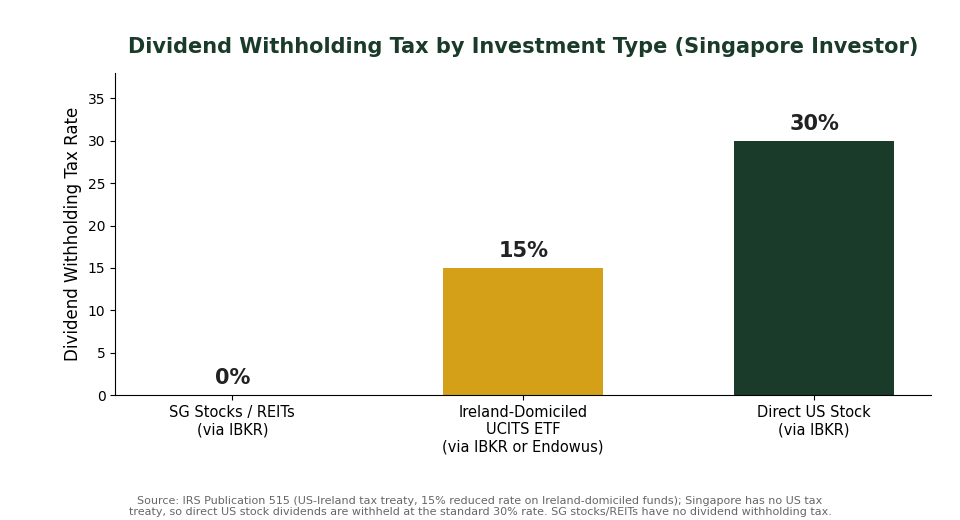
SG stocks and REITs, in contrast, have no dividend withholding tax for individual investors — the full DPU or dividend reaches you. That’s a big reason IBKR is a natural home for S-REIT dividend investing, and why we keep coming back to passive income strategies built on S-REITs for Singapore investors.
Ireland-domiciled UCITS ETFs sit in between. Under the US-Ireland tax treaty, US-sourced dividends flowing into these funds are withheld at a reduced 15% rate, not 30%. Many of the global equity ETFs available on both IBKR and inside Endowus’ fund menu are Ireland-domiciled for exactly this reason.
The practical takeaway: if you want direct US dividend exposure, buying it through an Ireland-domiciled ETF on IBKR usually beats buying individual US stocks directly — you keep 85% of the dividend instead of 70%.
How to Set Up the Two-Platform Strategy
You don’t need to open both accounts on day one. Here’s a practical order to do it in.
Step 1: Open Endowus first if you have CPF OA or SRS money you want invested. Sign-up is done fully online with Singpass, and CPF/SRS investment requires linking your CPF Investment Account or SRS account — this can take a few working days to process.
Step 2: Decide your Endowus portfolio. Flagship Core is the default balanced option; Endowus also offers Income, Satellite, and Fund Smart portfolios for more specific goals.
Step 3: Open IBKR for your cash dividend investing. Account opening is online, but funding requires a bank transfer or FAST transfer into your IBKR account, and full trading access is usually active within a few working days after funding.
Step 4: Build your IBKR dividend watchlist. Decide upfront whether you’re buying SG stocks/REITs (0% WHT), Ireland-domiciled ETFs (15% WHT), or accept the 30% WHT trade-off for specific US stocks you have strong conviction on.
Step 5: Set a rebalancing cadence for each platform separately. Endowus rebalances your funds automatically. On IBKR, you’re responsible for reviewing your dividend positions yourself — quarterly or half-yearly is a reasonable habit.
Pros and Cons at a Glance
| Endowus | IBKR | |
|---|---|---|
| Pros | CPF/SRS access, professional rebalancing, no sales charge, 100% trailer fee rebate | Low one-time cost, full control, S$0 US stock commission, no custody fee |
| Cons | Ongoing % fee compounds over time, no individual stock picking | No CPF access, no advisory guidance, you own every decision |
Neither platform is “better” in the abstract — they’re built for different money and different investor behaviour. Most serious Singapore dividend investors we hear from end up using both, in the split that matches how hands-on they want to be with each pot of money.
Ready to Set Up Your Two-Platform Strategy?
Use our referral codes below to get started — both come with sign-up bonuses, and using them costs you nothing extra.
Frequently Asked Questions
Can I use both Endowus and IBKR at the same time?
Can I invest my CPF money through IBKR?
Is Endowus cheaper than IBKR?
Why does withholding tax matter for dividend investors?
Is IBKR safe for Singapore investors?
Can I invest my SRS funds through IBKR?
What's a reasonable starting split between the two platforms?
Do I pay GST on Endowus fees?
Does IBKR really charge $0 commission on US stocks?
This article was researched with the help of AI. While we strive to keep all information accurate and up to date, there may be errors. If you notice any discrepancies, please contact us.