How to Invest in Singapore: Your 2026 Year-End Checklist (SRS, CPF & Portfolio)
Singapore’s most valuable investing windows close on 31 December every year — and most investors realise too late. By acting before year-end, you can contribute up to S$15,300 to your SRS account for immediate income tax relief, top up your CPF for the extra 1% interest, lock in T-bill yields near 1.9% p.a., and rebalance your portfolio without capital gains tax. This checklist tells you exactly what to do and in which order.
Not financial advice. All figures are for educational reference only. Data verified as at 3 November 2026 unless noted.
Why Year-End Deadlines Cost Investors Thousands
Most Singaporeans know, in theory, that the SRS contribution deadline is 31 December. But year after year, two things get in the way: not knowing exactly how much to contribute, and not knowing which action to prioritise when cash is limited.
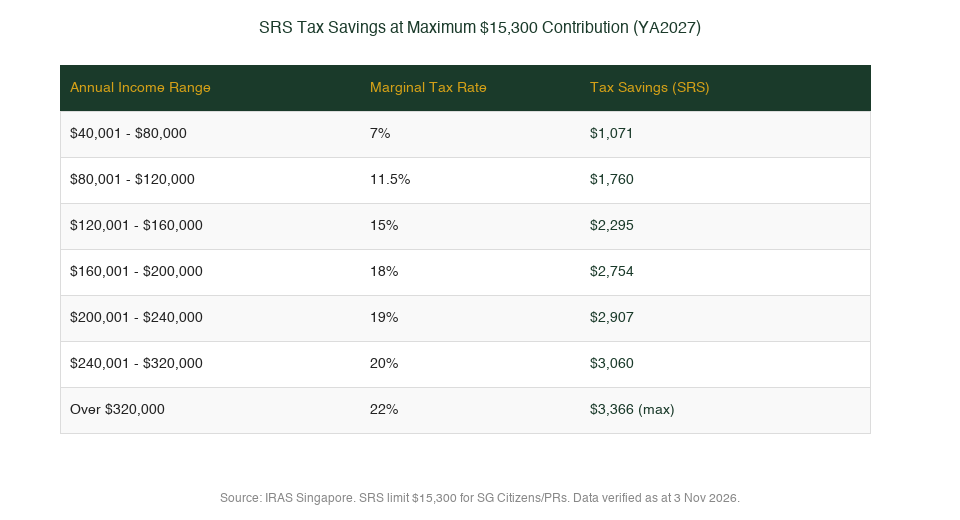
The cost of doing nothing is real. Consider an investor on a S$120,000 annual income who fails to max their SRS in 2026. They forfeit S$15,300 × 15% = S$2,295 in tax savings — money that could have been invested or spent — simply because they ran out of time. If this repeats for 10 years, that’s S$22,950 in forgone tax relief, plus the investment returns that money would have generated had it been inside the SRS wrapper.
The same applies to CPF voluntary top-ups, T-bill reinvestment decisions, and portfolio rebalancing. Each action has a window. Singapore’s tax system rewards those who act before December ends — and punishes those who plan to “do it in January.”
The Four Year-End Investment Levers
Singapore investors have four distinct year-end actions, each unlocking a different kind of benefit:
Lever 1: SRS Contribution
Putting money into your Supplementary Retirement Scheme (SRS) account gives you a dollar-for-dollar income tax deduction. For every S$15,300 you contribute, you reduce your chargeable income by S$15,300. At the 15% marginal rate, that’s S$2,295 saved on your 2026 tax bill (payable in 2027). Crucially, the money isn’t wasted — it stays invested inside your SRS account in ETFs, REITs, Singapore Savings Bonds, or T-bills, earning market returns on top of the tax relief.
Lever 2: CPF Voluntary Top-Up (RSTU)
Topping up your CPF Special Account (SA) or Retirement Account (RA) under the Retirement Sum Topping-Up scheme gives you up to S$8,000 in additional tax relief — completely separate from and on top of the SRS relief. This money earns 4% per year in CPF, guaranteed by the Singapore government. You can claim another S$8,000 relief for topping up eligible family members’ CPF accounts, bringing the combined maximum to S$16,000 in annual tax relief from CPF top-ups alone.
Lever 3: T-Bill and SSB Management
If you hold Singapore T-bills or Singapore Savings Bonds maturing in December, your year-end decision affects your January liquidity. T-bills maturing in November or December can be reinvested at current rates (approximately 1.9% p.a. for 6-month as at November 2026). SSBs can be redeemed at any month-end with no penalty and no loss of accrued interest.
Lever 4: Portfolio Rebalancing
Singapore has zero capital gains tax. This means you can sell ETFs or REITs that have drifted above your target allocation, lock in profits, and reinvest without any tax consequence. Year-end is an ideal time to review and rebalance — not for tax reasons (unlike the US), but because it aligns with your annual financial review and reinforces the discipline of selling high and buying low. No tax friction means no reason to delay.
Exact Figures and Deadlines for 2026
Here are the specific numbers for each year-end action:
| Action | 2026 Limit | Deadline | Key Benefit |
|---|---|---|---|
| SRS contribution (SC/PR) | S$15,300 | 31 Dec 2026 | 7–22% income tax relief |
| SRS contribution (Foreigner) | S$35,700 | 31 Dec 2026 | Based on SG tax residency |
| CPF RSTU top-up (self) | S$8,000 | 31 Dec 2026 | S$8,000 income tax relief + 4% p.a. |
| CPF RSTU top-up (family) | S$8,000 | 31 Dec 2026 | Additional S$8,000 income tax relief |
| 6-month T-bill (current yield) | No limit | Rolling bi-weekly auctions | ~1.9% p.a. risk-free return |
| Singapore Savings Bonds | S$200,000 max holding | Last business day monthly | ~2.3% p.a. 10Y avg, fully flexible |
Source: IRAS Singapore, CPF Board, MAS. T-bill yield based on latest MAS auction as at November 2026. Data verified as at 3 November 2026.
One important note: the personal income tax relief cap is S$80,000 per year. If you are already claiming other reliefs (NS man, spouse, parent, Parenthood Tax Rebate), factor these in before calculating how much SRS and CPF top-up relief you can still use. IRAS automatically applies the cap — you cannot claim more than S$80,000 in total reliefs regardless of contributions.
Which Action Gives the Best Return on Your Year-End Dollars?
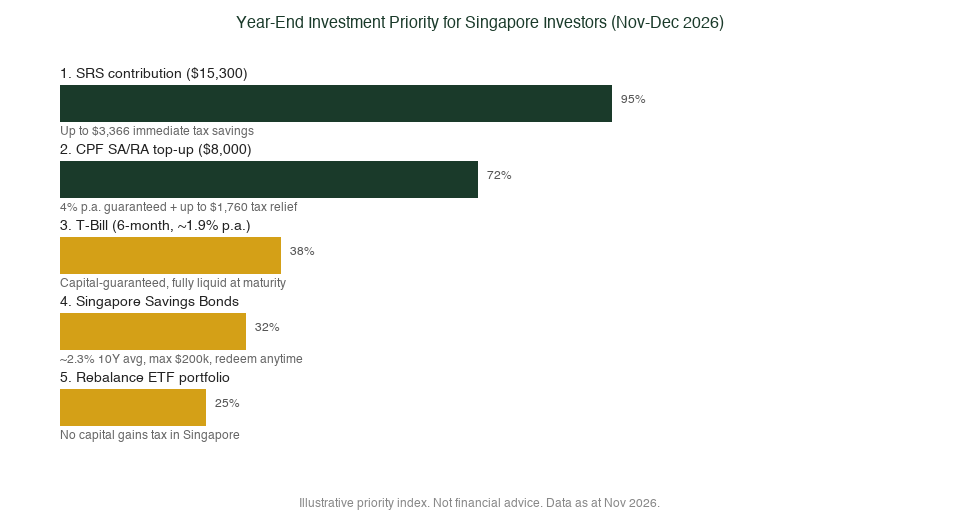
When cash is limited, the order of operations matters. Here is how to prioritise, starting with the highest effective return per dollar deployed:
| Priority | Action | Effective Return | Liquidity |
|---|---|---|---|
| #1 | Max SRS ($15,300) | 7–22% immediate + investment return | Restricted (penalty before age 63) |
| #2 | CPF RSTU top-up ($8,000) | 4% guaranteed + 7–22% tax relief | Locked until 55 (SA) or retirement (RA) |
| #3 | T-bills (6-month) | ~1.9% p.a. risk-free | 6 months (non-redeemable before maturity) |
| #4 | Singapore Savings Bonds | ~2.3% p.a. (10Y avg) | Flexible — redeem any month-end |
| #5 | ETF portfolio rebalance | Market returns minus TER | High — sell T+2 settlement |
Effective return for SRS and CPF assumes tax savings are realised in full. Personal circumstances vary — consult a qualified financial advisor or tax professional for personalised advice.
One important nuance: SRS contributions are not lost money. The S$15,300 stays invested inside your SRS account where you can invest it in ETFs, REITs, and Singapore bonds. The tax savings are therefore a bonus return on top of whatever your SRS investments earn. At the 15% bracket and a 7% annual investment return, the effective first-year return on SRS contributions is approximately 22% — making it one of the highest-returning, lowest-risk moves available to any Singapore investor.
Use our Singapore retirement calculator to model how SRS contributions compound over time alongside CPF and your brokerage portfolio.
Your 6-Step Year-End Investment Checklist
Work through these steps in order. Each one takes under an hour to complete.
Step 1 — Check your remaining SRS allowance
Log in to your SRS bank account (DBS, OCBC, or UOB) and check how much you have already contributed in 2026. The annual limit is S$15,300 for Singapore citizens and PRs, and S$35,700 for foreigners. If you have contributed nothing, you can still top up the full S$15,300 before 31 December. Funds transferred by midnight on 31 December count for YA2027 tax relief — but to be safe, make your transfer before 28 December in case of system delays or weekends.
Step 2 — Calculate your effective tax savings
Your marginal income tax rate determines how much SRS saves you. Add up all your income for 2026 (employment, rental, freelance), subtract your existing reliefs (CPF relief, earned income relief, NSman, etc.), and find where your chargeable income falls. The chart above shows the savings at each bracket. For most PMEs earning between S$80,000 and S$160,000, a full S$15,300 SRS contribution saves between S$1,760 and S$2,295 in taxes — received as a lower tax bill when you file in April 2027.
Step 3 — Invest your SRS funds immediately (do not leave them idle)
SRS money sitting uninvested earns only 0.05% — essentially nothing. As soon as funds hit your SRS account, invest them. The best options within SRS for most investors are: (a) Singapore Savings Bonds via your SRS bank for safe, flexible returns; (b) T-bills via your SRS bank for 6-month capital-guaranteed returns at ~1.9% p.a.; or (c) ETFs through platforms like Endowus (referral code 2V343 for cash credit), which offers low-cost access to global ETFs using SRS funds. See our guide on CPF and SRS investment strategy for a fuller framework.
Step 4 — Top up CPF under RSTU if you have spare cash
If you have already maxed your SRS and still have available cash, the CPF RSTU top-up is the next priority. You receive S$8,000 in tax relief for topping up your own SA or RA, and another S$8,000 for topping up an eligible family member’s CPF. The money earns 4% p.a. guaranteed. The critical constraint: this cash cannot be withdrawn until age 55 (SA) or at retirement (RA). Do not top up CPF if you need the funds within the next five years.
Step 5 — Review your T-bills and SSBs for December maturity
If you hold 6-month T-bills maturing in November or December, decide before the cutoff whether to reinvest or redeem. Current 6-month T-bill yields are approximately 1.9% p.a. (as at November 2026). T-bill rates have trended down from the 4%+ peak in 2023, but still offer capital-guaranteed returns above most savings accounts and fixed deposits. Apply for the next auction via your bank, CPF OA, or SRS account as appropriate. For the full application guide, see our Singapore T-bills 2026 guide and Singapore Savings Bonds guide.
Step 6 — Rebalance your ETF and REIT portfolio
Singapore has no capital gains tax, so there is zero friction when selling assets that have outperformed their target allocation. If your global equities ETF has grown to 75% of your portfolio when your target is 65%, now is the time to trim and redeploy into underweight assets. Platforms like Syfe (referral code SRPRFFFCD) offer automatic rebalancing within managed portfolios. For direct ETF investors using IBKR (referral code jianxiong368), review your allocation manually and place rebalancing trades before year-end when you are doing your annual financial review anyway.
Frequently Asked Questions
When exactly is the SRS contribution deadline for 2026?
Can I contribute to SRS if I already have an investment portfolio outside SRS?
Is there any point topping up SRS if I am only in the 7% tax bracket?
Can I apply for Singapore T-bills using my SRS funds?
What happens if I miss the 31 December SRS deadline?
Ready to Invest Smarter Before Year-End?
The two most impactful steps are maxing your SRS and investing those funds in low-cost ETFs or Singapore bonds. Here are TKN-recommended platforms that accept SRS funds:
TKN may earn referral fees when you sign up using the codes above. This does not affect our editorial opinions. All investment products carry risk. This is not financial advice.
This article was researched with the help of AI. While we strive to keep all information accurate and up to date, there may be errors. If you notice any discrepancies, please contact us.