VWRA Securities Lending Explained: How Vanguard Lends Your FTSE All-World Shares (2026 Guide)
What happens behind the scenes of your VWRA units — Vanguard’s lending programme, how it compares to iShares, and the real counterparty risk for Singapore investors.
VWRA (Vanguard FTSE All-World UCITS ETF) participates in Vanguard’s securities lending programme, temporarily lending its underlying shares to approved borrowers against collateral. Unlike most fund managers, Vanguard’s stated policy is to pass back nearly all net lending revenue — historically around 98% — to the fund itself, rather than keeping a large manager’s cut. This makes VWRA’s lending structure one of the more investor-friendly in the UCITS ETF world, and it can quietly help offset part of VWRA’s 0.14% TER.
Not financial advice. All figures are for educational reference only. Data verified as at November 2026 unless noted.
Table of Contents
Contents — Click to expand
What Is Securities Lending, and Why Does VWRA Do It?
When you buy VWRA, you’re not just buying a passive basket of roughly 3,800 stocks that sits untouched in a vault. Like almost every large physically-replicated index fund, VWRA participates in a securities lending programme. The fund temporarily lends some of its underlying shares — think Apple, Microsoft, Nvidia, Taiwan Semiconductor — to borrowers such as hedge funds and market makers, who typically need them to cover short positions, settle trades, or support other market activities.
In exchange, the borrower posts collateral worth more than the value of the loan, and pays a lending fee. That fee becomes extra revenue for the fund (or the fund manager, depending on the split), which can help offset the ETF’s running costs. This happens automatically inside the fund structure — a Singapore investor holding VWRA through Syfe, Endowus, or a direct brokerage account doesn’t opt in or out; it’s part of how the fund is run by Vanguard Asset Management (Vanguard Funds plc, the Irish UCITS umbrella that issues VWRA).
The practice is common, regulated, and — done properly — low-risk. But the terms vary significantly between fund managers, and those differences matter more than most investors realise.
Vanguard’s Securities Lending Policy for VWRA
Vanguard’s publicly stated approach to securities lending is unusually investor-friendly compared to the rest of the industry. According to Vanguard’s own disclosures, its policy is to return all securities lending revenue, net of program costs, to the fund and its shareholders — rather than keeping a fixed percentage as the manager’s fee, which is the more common industry structure (a “fee split” model).
A Morningstar study cited by Vanguard ranked it first among ten major fund sponsors for the share of gross lending revenue passed through to shareholders, putting Vanguard’s historical pass-through rate at roughly 98%, with program costs amounting to around 5% of gross revenue in the measurement year. Vanguard states that, across its broader fund and ETF range, securities lending income has on average offset somewhere between 23% and 90% of fund expense ratios — though this is a fund-range average, not a VWRA-specific disclosed figure, and the actual benefit to any single ETF (including VWRA) will vary year to year and isn’t separately broken out in retail-facing factsheets.
This matters because VWRA already runs a lean 0.14% TER (cut from 0.19% in July 2026 — see our VWRA expense ratio guide for the full breakdown). Whatever lending income the fund earns is a quiet tailwind on top of that already-low fee, rather than a headline number Vanguard markets loudly.
| Policy detail | VWRA (Vanguard) |
| Lending agent / structure | Vanguard Asset Management, via Vanguard Funds plc (Irish UCITS) |
| Revenue pass-through to fund | ~98% (net of program costs), per Vanguard/Morningstar research |
| Manager’s retained share | ~2% (covers program administration costs) |
| Fund-range TER offset (average) | 23%-90% historically, across Vanguard’s index range |
Source: Vanguard’s Approach to Securities Lending (Vanguard professional insights); Morningstar fund sponsor study as cited by Vanguard. Fund-specific VWRA lending revenue is not separately disclosed in retail factsheets — check the Vanguard Funds plc annual report for exact figures.
VWRA vs CSPX: How the Two Programs Differ
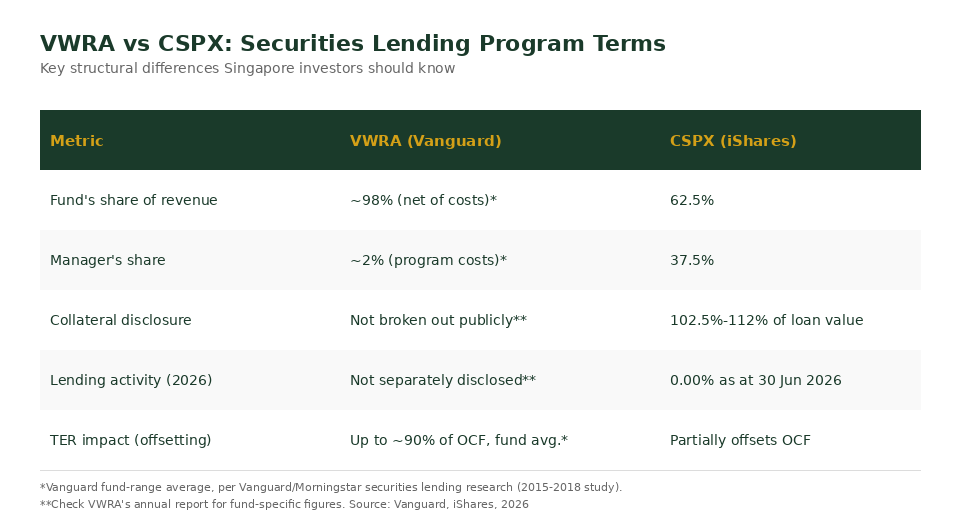
Singapore investors often hold both VWRA and CSPX (iShares Core S&P 500 UCITS ETF) side by side — one for global diversification, one for a concentrated US bet. Their securities lending structures, however, are built quite differently. As we covered in our CSPX securities lending guide, iShares runs a more conventional fee-split model: the fund keeps 62.5% of lending revenue while BlackRock, as lending agent, retains 37.5%. Collateral requirements for CSPX sit at 102.5%-112% of loan value, and iShares publishes a specific lending return figure per fund (0.00% for CSPX as at 30 June 2026, per iShares’ own disclosure).
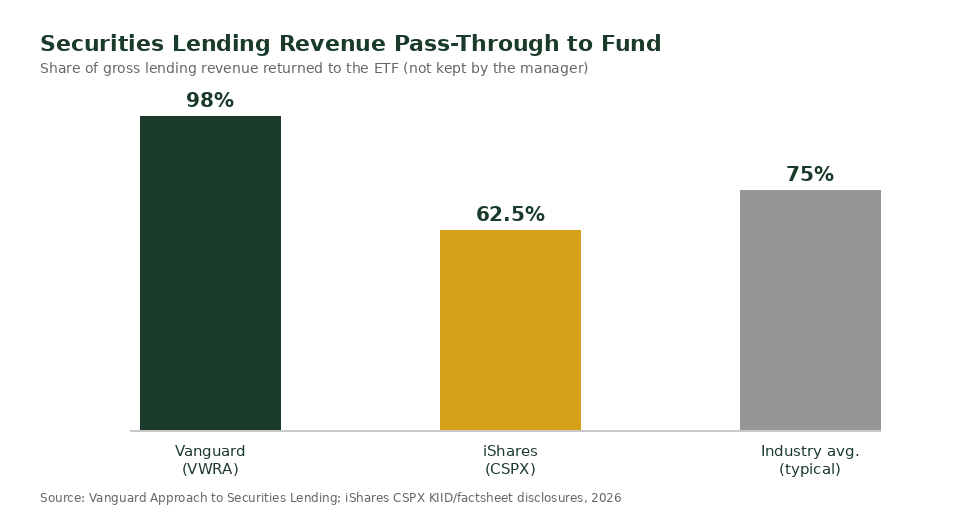
Vanguard’s structure, by contrast, keeps almost all of the revenue inside the fund rather than splitting it meaningfully with the manager. Neither approach is “wrong” — both sit within EU UCITS rules, which cap how much of a fund’s assets can be on loan at once and require over-collateralisation. But the economics clearly favour the end investor more under Vanguard’s model, at least on the revenue-split dimension. The trade-off is transparency: iShares discloses a specific per-fund lending return figure, while Vanguard reports its pass-through policy at a program level rather than breaking out a VWRA-specific number in its retail factsheet.
| Dimension | VWRA (Vanguard) | CSPX (iShares) |
| Fund’s share of revenue | ~98% (net of costs) | 62.5% |
| Manager’s retained share | ~2% (program costs) | 37.5% |
| Collateral disclosure | Not broken out publicly by fund | 102.5%-112% of loan value |
| Per-fund lending return disclosed | No (program-level policy only) | Yes — 0.00% (12mo to 30 Jun 2026) |
Source: Vanguard’s Approach to Securities Lending; iShares UK product disclosures for CSPX, as at 2026.
How Lending Revenue Offsets Your Costs
Here’s a worked example to make this concrete. A Singapore investor holding SGD 50,000 in VWRA pays roughly SGD 70 a year in TER at the current 0.14% rate. If Vanguard’s fund-range average lending offset (23%-90% of OCF) applied proportionally to VWRA — which it may not, since this is a range average rather than a VWRA-specific figure — the effective net cost to the investor after lending income could sit meaningfully below the headline 0.14%, though Vanguard does not publish a VWRA-specific “net of lending” TER for retail investors to quote precisely.
Compare this to CSPX: on a SGD 50,000 holding at CSPX’s 0.07% TER, the investor pays about SGD 35 a year, and iShares’ own 0.00% lending-return disclosure for the 12 months to 30 June 2026 suggests no measurable offset in that specific period. The honest takeaway is that lending income is a real but unpredictable tailwind — it isn’t a guaranteed annual discount, and Singapore investors shouldn’t factor it into their cost comparisons as if it were. Our VWRA expense ratio guide covers the headline TER numbers in detail if you want the base-case cost comparison without the lending variable.
Counterparty Risk: What Could Actually Go Wrong
The main risk in any securities lending programme is counterparty default combined with a collateral shortfall: if a borrower fails to return the lent shares and the posted collateral has lost value relative to the loan (due to a market move between collateral marks), the fund could, in theory, realise a loss. This is why UCITS rules mandate over-collateralisation and daily mark-to-market of collateral value, and why reputable lending agents use strict borrower credit criteria and indemnification arrangements in many cases.
For a Singapore investor, this risk sits several layers removed from your own account: you hold units of VWRA, not the underlying lent shares directly, and any shortfall would need to be large enough to materially impact the fund’s NAV — something that has essentially never happened at scale in a major UCITS index fund’s lending programme in recent history. It’s a real, disclosed risk factor (you’ll find it in VWRA’s prospectus), but it’s a small one relative to market risk, currency risk, or VWRA’s USD currency exposure, which are far more likely to move your actual returns.
Should Singapore Investors Worry About This?
No — and that’s really the point of this article. VWRA’s securities lending programme is a background mechanic that, if anything, tilts slightly in your favour relative to how most other large ETF providers structure their lending economics. Vanguard’s near-full pass-through of lending revenue is consistent with its broader low-cost, investor-first positioning (the same philosophy behind cutting VWRA’s TER to 0.14%). It doesn’t change your asset allocation decision between VWRA, a robo-advisor like Syfe Core or Endowus, or CSPX — but it’s a reasonable data point in VWRA’s favour if you’re comparing the fine print between fund providers rather than just headline TERs.
If you’re building a long-term core-satellite portfolio, resources like our passive income Singapore guide and retirement planning calculator can help you figure out how VWRA fits into your broader plan, with or without factoring in a securities lending tailwind you can’t fully quantify in advance.
Frequently Asked Questions
Does VWRA lend out the shares I own through my broker?
Yes, indirectly. You own units of the VWRA fund, not the individual underlying shares directly. Vanguard Funds plc, as the fund operator, may lend a portion of the fund’s underlying holdings to approved borrowers as part of its securities lending programme. This happens inside the fund structure automatically — you don’t opt in or out as a unitholder.
Does Vanguard keep a cut of VWRA's lending revenue like iShares does?
Much less so. Vanguard’s stated policy is to pass back almost all net lending revenue to the fund — historically around 98%, per Morningstar research cited by Vanguard — keeping only enough to cover program administration costs. iShares, by comparison, retains 37.5% of CSPX’s lending revenue as the manager’s share under its fee-split model.
Is VWRA's securities lending programme safe for Singapore investors?
It operates under EU UCITS rules, which require over-collateralisation and daily mark-to-market, and limit how much of a fund’s assets can be on loan at once. This is a conservative regulatory framework. There is a small residual counterparty risk in the event of a borrower default combined with a collateral shortfall, but this risk sits several layers removed from your own holdings and is disclosed in VWRA’s prospectus.
Does securities lending reduce VWRA's 0.14% TER in practice?
It can, in principle — lending income is folded into the fund’s performance and can partially offset running costs. Vanguard states that lending income has offset between 23% and 90% of expense ratios on average across its fund range historically, but this isn’t a VWRA-specific disclosed number, so investors shouldn’t assume a precise annual discount. Treat VWRA’s 0.14% TER as the number to plan around, with lending income as an unquantified bonus.
Can I buy VWRA using my CPF or SRS funds?
VWRA is listed on the London Stock Exchange and is not on the CPFIS-approved list, so it cannot be bought with CPF Ordinary Account funds. It can be bought with SRS funds through brokers that support LSE-listed securities and SRS settlement, such as FSMOne. Check our VWRA ETF Singapore guide for the full breakdown of funding routes.
Where can I find the official securities lending disclosures for VWRA?
Vanguard’s general policy is described on its professional investor insights pages, while fund-specific lending activity (if disclosed) would appear in the Vanguard Funds plc annual report, available on Vanguard’s UK site. Always check the latest annual report for the exact figures rather than relying on general policy statements alone.
Sources & Further Reading
- Vanguard’s Approach to Securities Lending — Vanguard professional insights
- VWRA / FTSE All-World UCITS ETF factsheet — Vanguard
- CSPX product disclosures — iShares/BlackRock
- MAS regulations on collective investment schemes — Monetary Authority of Singapore
Want to put VWRA to work in a broader passive income strategy? Read our passive income Singapore guide, run the numbers with our retirement planning calculator, or compare brokers via our Syfe referral code and sign-up bonus page.
Not financial advice. All figures are for educational reference only and may change. Data verified as at November 2026 against Vanguard and iShares public disclosures where available; fund-specific securities lending revenue for VWRA is not separately broken out in retail factsheets. The Kopi Notes may earn a referral fee from some of the links on this page.
This article was researched with the help of AI. While we strive to keep all information accurate and up to date, there may be errors. If you notice any discrepancies, please contact us.