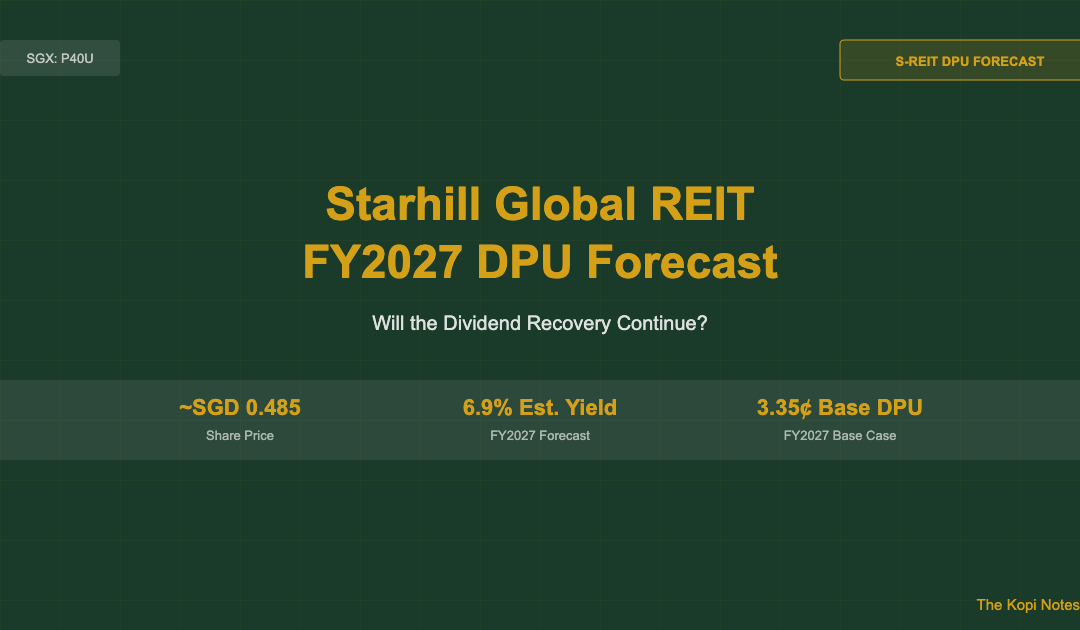
Starhill Global REIT FY2027 DPU Forecast: Will the Dividend Recovery Continue?
Starhill Global REIT (SGX: P40U) is a Singapore-listed retail and commercial REIT with a portfolio anchored by Wisma Atria on Orchard Road, a 27.2% interest in Ngee Ann City, and international properties across Australia, Malaysia, and Japan. As at November 2026, the REIT trades at approximately SGD 0.485, implying a forward yield of around 6.9% on our base-case FY2027 DPU estimate of 3.35 cents — and a deep 37% discount to NAV of SGD 0.77.
Not financial advice. All figures are estimates for educational reference only. Data as at November 2026 unless noted.
What Is Starhill Global REIT (P40U)?
Starhill Global REIT was listed on the SGX in 2005 and is managed by YTL Starhill Global REIT Management, a subsidiary of YTL Corporation Berhad. The portfolio spans approximately 1.6 million square feet of net lettable area and is concentrated primarily in high-end retail and office properties, with Singapore contributing the majority of net property income (NPI).
The REIT’s anchor properties in Singapore are Wisma Atria (100% interest) and a 27.2% interest in Ngee Ann City, both on Orchard Road — one of Asia’s most recognisable luxury retail corridors. Its Australian portfolio, centred on Adelaide’s Myer Centre, accounts for the second-largest NPI contribution. The REIT also holds retail assets in Kuala Lumpur (Starhill Gallery, JW Marriott land lease) and a smaller position in Japan and China.
The REIT’s international diversification differentiates it from Singapore-only retail REITs like Frasers Centrepoint Trust, but also introduces foreign-exchange and jurisdiction risk that investors must weigh against the yield premium. Understanding the portfolio geography is essential for projecting forward DPU, because different markets recover at different speeds post-pandemic.
| Market | Key Assets | Est. NPI Contribution |
|---|---|---|
| Singapore | Wisma Atria, Ngee Ann City (27.2%) | ~60% |
| Australia | Myer Centre Adelaide, David Jones Building | ~23% |
| Malaysia | Starhill Gallery, JW Marriott Land | ~12% |
| Japan / China | Retail properties (Daikanyama etc.) | ~5% |
Source: Starhill Global REIT investor presentations, The Kopi Notes estimates, November 2026. Figures are approximate.
DPU History: FY2021–FY2026
Starhill Global REIT’s DPU recovery from COVID-19 lows has been steady but measured. The REIT cut its distribution sharply in FY2020 when Orchard Road footfall collapsed and international assets faced full lockdowns. Since then, distributions have recovered each year as tourism and retail spending normalised across its markets.
The DPU growth trajectory from FY2021 to FY2025 reflects three distinct phases: a sharp catch-up in FY2022 (+33%) as Singapore and Australia reopened, a consolidation phase in FY2023–FY2024 as interest costs rose and leasing in some markets remained soft, and a stabilisation phase from FY2025 onwards as the REIT refreshed anchor tenant leases on Orchard Road and benefited from positive rental reversion.
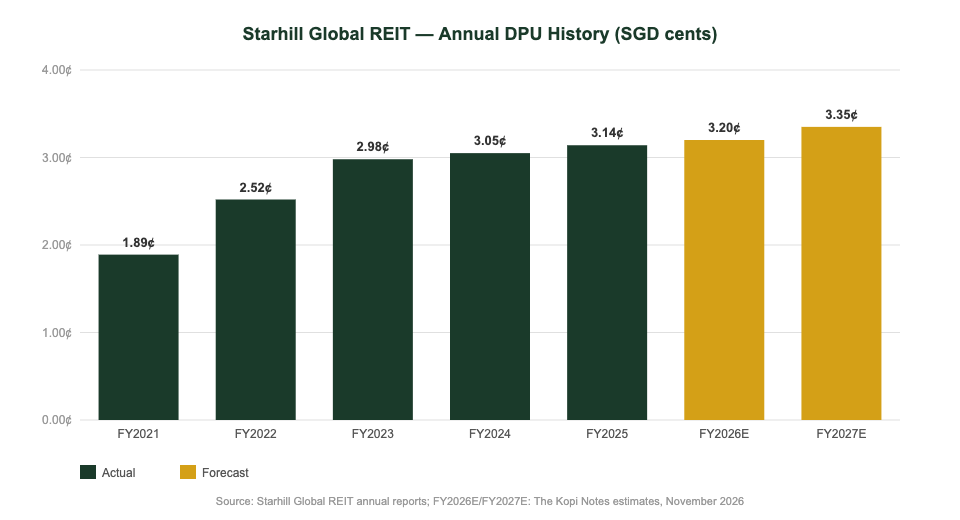
| Financial Year | DPU (cents) | YoY Change | Yield @ SGD 0.485 |
|---|---|---|---|
| FY2021 | 1.89¢ | — | 3.9% |
| FY2022 | 2.52¢ | +33.3% | 5.2% |
| FY2023 | 2.98¢ | +18.3% | 6.1% |
| FY2024 | 3.05¢ | +2.3% | 6.3% |
| FY2025 | 3.14¢ | +3.0% | 6.5% |
| FY2026E | 3.20¢ | +1.9% | 6.6% |
| FY2027E (Base) | 3.35¢ | +4.7% | 6.9% |
Source: Starhill Global REIT financial reports; FY2026E and FY2027E are The Kopi Notes estimates only, not guidance from the REIT. Not financial advice.
The gradual recovery from 1.89¢ to an estimated 3.35¢ by FY2027 represents a cumulative recovery of ~77% over six years — meaningful, but still below the pre-COVID high of ~5¢ in FY2019. This signals that Starhill’s distribution has not yet fully normalised, and structural changes to retail demand (increased e-commerce competition, lower shopper dwell times) may cap the upside.
FY2027 DPU Forecast and Yield Scenarios
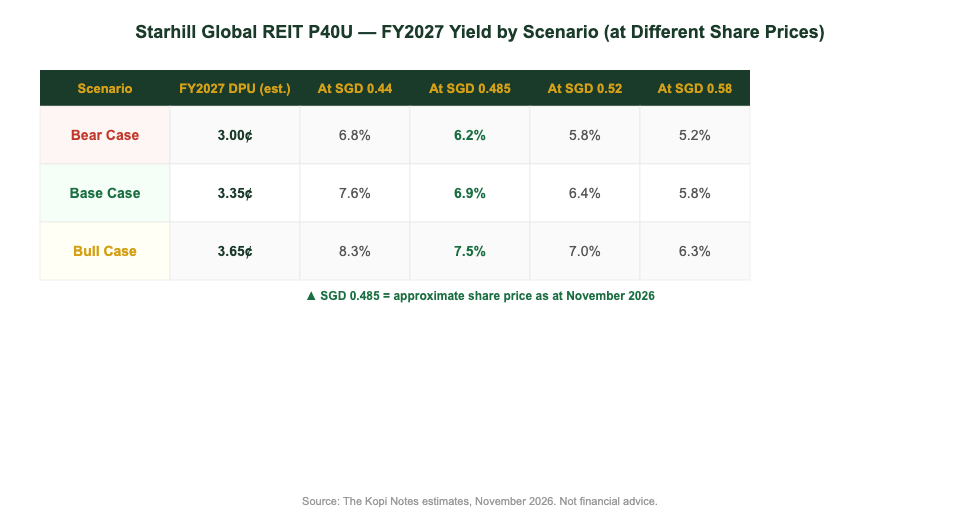
Our FY2027 DPU forecast for Starhill Global REIT is built on three scenarios reflecting different outcomes for Orchard Road occupancy, Australian asset recovery, and interest rate movements. The base case (3.35¢) assumes stable Singapore NPI growth of approximately 3–4%, continued recovery in the Australian portfolio as Adelaide retail demand normalises, and declining all-in borrowing costs in line with interest rate softening expected across 2026–2027.
In the bear case (3.0¢), we model a scenario where the Australian portfolio continues to face headwinds — vacancy in the David Jones building extending into FY2027 — and Singapore NPI growth stalls at 1–2% as tourist retail spending softens amid a broader global slowdown. This would equate to a yield of just 6.2% at current prices, still competitive versus the 10-year Singapore Government Bond, but less compelling on a risk-adjusted basis.
The bull case (3.65¢) assumes positive Orchard Road rental reversion above market consensus, an early recovery of the Australian assets, and the benefit of a stronger Malaysian ringgit and Australian dollar versus the Singapore dollar. At SGD 0.485, this would imply a yield of 7.5% — highly attractive for a Singapore retail REIT anchor.
Investors comparing Starhill Global REIT with other best S-REITs in Singapore 2026 should note that P40U’s yield is among the higher in the retail REIT space, reflecting the market’s view that the discount to NAV is warranted. The REIT trades at a ~37% discount to its last-reported NAV of approximately SGD 0.77, one of the steepest discounts in the Singapore REIT sector.
That discount is both an opportunity and a warning signal. A 37% P/NAV discount typically implies the market expects either sustained DPU underperformance, an asset revaluation downward, or structural concerns about the REIT’s assets. For Starhill, the market’s scepticism is primarily directed at its international portfolio quality and the long-term viability of luxury retail on Orchard Road as consumer habits shift.
For investors seeking passive income in Singapore, the 6.9% base yield represents genuine income on a well-known Orchard Road landmark portfolio. However, the expected return potential would be even higher if the NAV discount compresses — if P/NAV recovered to just 0.75x (currently ~0.63x), the share price upside alone would add another 19% return on top of the yield.
Key Drivers and Risk Factors
Understanding the FY2027 DPU trajectory for Starhill Global REIT requires tracking several interrelated drivers. These are the most important factors to monitor in the near term.
Orchard Road Tenant Mix and Lease Expiry Profile
Wisma Atria and Ngee Ann City’s anchor tenant lease arrangements have historically provided Starhill with long-term income visibility. A portion of the Singapore NPI is derived from a master lease structure with YTL Hotels, which insulates the REIT from short-term occupancy fluctuations. Any renegotiation of these master leases — whether upward or downward — would have an outsized effect on DPU. The next major lease event is expected in FY2027–FY2028 for the Malaysian hospitality assets.
Australian Portfolio Recovery
The Myer Centre Adelaide and David Jones Building have faced ongoing challenges as South Australian retail demand shifts to suburban centres and online platforms. In FY2025 and FY2026, higher vacancy and below-market cap rates have weighed on this portfolio’s valuation. Any positive leasing news from Australia — particularly if a new anchor tenant commits to the David Jones building — would act as a significant DPU catalyst for FY2027.
Interest Rate Trajectory and Gearing
Starhill Global REIT’s aggregate leverage stands at approximately 36–38%, below the MAS regulatory limit of 50%. However, the REIT carries a meaningful proportion of floating-rate debt. As global central banks shift from tightening to cutting cycles in 2025–2026, the interest cost burden should ease, directly supporting higher distributable income. Our base-case FY2027 DPU forecast already embeds a 25–50 basis point reduction in all-in funding costs relative to FY2025 levels.
Foreign Exchange Risk
With approximately 40% of NPI derived from non-Singapore markets, the REIT’s distributable income is exposed to movements in the AUD, MYR, JPY, and CNY against the SGD. In FY2023 and FY2024, a weaker AUD was a meaningful drag on reported DPU. Our base case assumes broadly stable AUD/SGD and MYR/SGD rates. A 5% depreciation of AUD versus SGD, held for a full year, would reduce FY2027 DPU by an estimated 0.08–0.10¢, all else equal.
Valuation: P/NAV Discount and Upside Potential
At SGD 0.485, Starhill Global REIT trades at approximately 0.63x its last-reported NAV of SGD 0.77. This is a materially steeper discount than the broader S-REIT sector average, which hovers around 0.8–0.9x NAV in 2026. The discount has persisted since 2019 and reflects a structural de-rating of retail REITs with secondary or international assets.
The case for partial NAV discount compression rests on three conditions: first, a sustained recovery in the Australian portfolio occupancy and passing rents; second, successful renewal of master leases in Singapore and Malaysia at competitive rates; and third, a continued decline in the risk-free rate, which compresses required yields across the REIT sector and lifts implied NAV multiples.
If just the first two conditions are met, we estimate fair value in the range of SGD 0.52–0.58 per unit on a 12-month view, implying a total return (price appreciation plus distributions) of 14–27% from current levels. This compares favourably with the 10-year Singapore Government Bond yield of approximately 2.8% and fixed deposit rates of around 1.8%, making Starhill a compelling income play for investors willing to accept retail REIT sector risk. For a comprehensive comparison with alternative fixed-income options, see our Singapore T-bills 2026 guide.
The downside risk, conversely, is that the Australian assets face further impairment — either from declining valuations or an anchor tenant default — which would force an asset write-down and increase gearing, potentially triggering equity issuance. In that scenario, the current P/NAV discount could widen rather than compress, and the DPU could fall toward the bear-case 3.0¢ estimate.
Should You Buy Starhill Global REIT in 2026?
Starhill Global REIT at SGD 0.485 offers a base-case forward yield of 6.9% — above the 5-year average yield of 5.5% for Singapore retail REITs — combined with a 37% discount to NAV. For income-focused investors with a medium-term (3–5 year) horizon, P40U represents a contrarian income play with meaningful recovery upside.
The key question is whether the market’s deep discount to NAV is justified or excessive. Our view is that the discount is partially justified — the Australian assets carry real execution risk, and Orchard Road retail faces structural headwinds — but that at 0.63x NAV, much of this risk is already priced in. The REIT’s Singapore core assets alone (Wisma Atria and the Ngee Ann City stake) are worth close to the current market capitalisation on a standalone basis at prevailing cap rates, which provides a meaningful floor on valuation.
For Singapore investors building a retirement-oriented dividend portfolio, allocating a small position in Starhill Global REIT at current levels may be appropriate as part of a diversified S-REIT basket. We recommend using our Singapore retirement calculator to model how a position in P40U fits within your overall income needs and withdrawal strategy.
Investors can access Singapore REITs like Starhill Global REIT through platforms such as Syfe (use referral code SRPRFFFCD for up to SGD 100 cashback), FSMOne (use code P0544985) or Interactive Brokers (use code jianxiong368) for direct SGX access at low brokerage rates. As always, do your own due diligence before investing — this analysis is for informational purposes only and does not constitute financial advice.
Frequently Asked Questions
What is the expected DPU for Starhill Global REIT in FY2027?
What is the current yield of Starhill Global REIT?
What is Starhill Global REIT's P/NAV ratio?
What are the main risks for Starhill Global REIT investors?
How does Starhill Global REIT compare with other Singapore retail REITs?
Where can I buy Starhill Global REIT units in Singapore?
This article was researched with the help of AI. While we strive to keep all information accurate and up to date, there may be errors. If you notice any discrepancies, please contact us.