Mapletree Industrial Trust Dividend: DPU History, Yield & How to Invest (2026)
Singapore’s largest industrial REIT — data centres, hi-tech buildings, flatted factories — and a 15-year track record of consistent distributions.
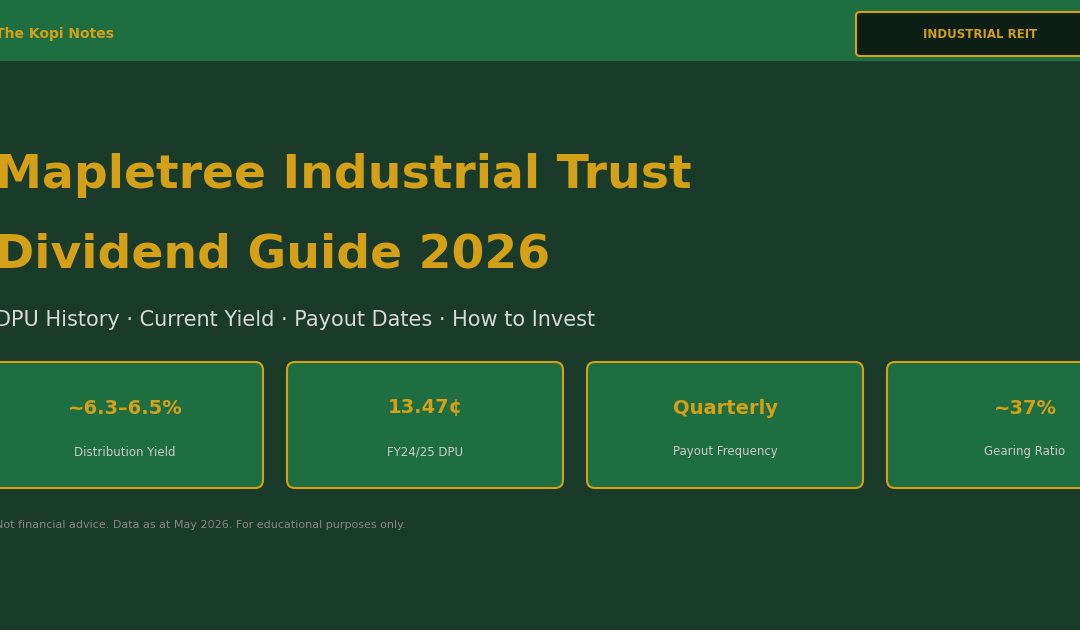
Mapletree Industrial Trust (MIT, SGX: ME8U) pays quarterly dividends — known as Distributions Per Unit (DPU) — sourced from a portfolio of Singapore and US data centres, hi-tech buildings, and flatted factories. For FY2024/25, MIT’s annualised DPU stands at 13.47 cents per unit, delivering a forward distribution yield of around 6.3–6.5% at current prices. Its quarterly payout cadence and data-centre exposure make it one of Singapore’s most-watched industrial REITs for passive income investors.
Not financial advice. All figures are for educational reference only. Data as at May 2026 unless noted.
Table of Contents
What Is Mapletree Industrial Trust?
Mapletree Industrial Trust (MIT) was listed on the Singapore Exchange (SGX) in October 2010 and is managed by Mapletree Industrial Trust Management Ltd, a subsidiary of Mapletree Investments (backed by Temasek Holdings). This institutional lineage gives MIT one of the strongest sponsor pipelines among Singapore industrial REITs.
As at Q4 FY2025/26, MIT’s portfolio comprises 168 properties across Singapore and the United States, with total assets under management (AUM) of approximately S$9.0 billion. The US portfolio (a 50% stake in 29 data centres managed with Mapletree US & EU Real Estate) adds a technology-real-estate dimension that differentiates MIT from pure-play Singapore industrial REITs.
MIT’s portfolio mix as at Q4 FY2025/26:
| Asset Type | % of Portfolio by AUM | Key Feature |
| Data Centres (US & SG) | ~57% | Long leases, mission-critical tenants |
| Hi-Tech Buildings | ~17% | R&D labs, tech firms |
| Business Park Buildings | ~10% | Office-adjacent, Mapletree Business City |
| Flatted Factories | ~8% | SME tenants, stable occupancy |
| Stack-Up / Ramp-Up | ~8% | Logistics-adjacent industrial |
Source: Mapletree Industrial Trust Q4 FY2025/26 results presentation, May 2026
MIT distributes at least 90% of its distributable income to unitholders quarterly, making it attractive for investors who want regular cash flow.
MIT DPU History (FY2019–FY2026)
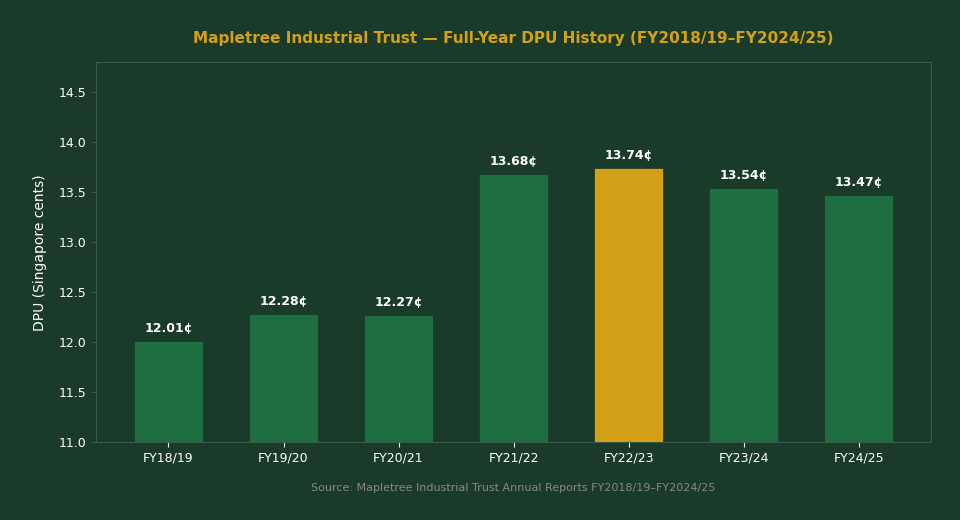
MIT has grown its DPU steadily over the past decade. The acquisition of US data centres from FY2021/22 provided a meaningful DPU uplift, lifting total DPU from ~12 cents to over 13 cents. The table below shows MIT’s full-year DPU (financial year ends 31 March):
| Financial Year | Full-Year DPU (S¢) | YoY Change | Note |
| FY2018/19 | 12.01 | +3.7% | Singapore portfolio only |
| FY2019/20 | 12.28 | +2.2% | Pre-COVID, organic growth |
| FY2020/21 | 12.27 | -0.1% | COVID rental reliefs offset by data centre acq. |
| FY2021/22 | 13.68 | +11.5% | US data centre acquisition uplift |
| FY2022/23 | 13.74 | +0.4% | Stable; higher financing costs emerging |
| FY2023/24 | 13.54 | -1.5% | Higher interest costs; USD/SGD headwind |
| FY2024/25 | 13.47 | -0.5% | Rate stabilisation; data centre demand strong |
Source: Mapletree Industrial Trust annual reports & quarterly results, FY2018/19–FY2024/25
- Consistency: MIT has never cut its dividend to zero — even during COVID-19, DPU held flat.
- Data centre uplift: The FY2021/22 DPU jump (+11.5%) illustrates how the US data centre acquisition structurally lifted distributions.
- Rate headwinds: DPU softness in FY2023/24 and FY2024/25 reflects higher borrowing costs, not operational weakness — occupancy remained above 91% throughout.
- Recovery thesis: As global interest rates ease in 2025–2026, MIT’s DPU should stabilise or recover as refinancing costs normalise.
For Singapore investors seeking passive income in Singapore, MIT’s quarterly payout cadence and institutional-grade portfolio make it a core holding consideration.
Current Dividend Yield Analysis
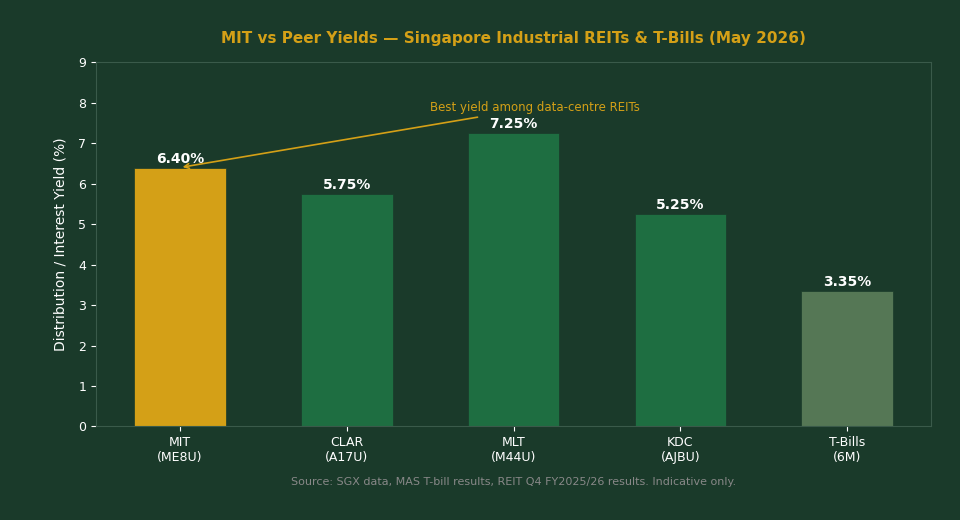
MIT’s distribution yield depends on both the DPU paid and the unit price at which you buy. As at May 2026, MIT (SGX: ME8U) trades at approximately S$2.07–S$2.15 per unit, implying a forward distribution yield of 6.3–6.5% based on the FY2024/25 DPU of 13.47 cents.
| Investment | Yield (May 2026 est.) | Frequency | Risk Level |
| MIT (ME8U) | ~6.3–6.5% | Quarterly | Medium |
| Keppel DC REIT | ~5.0–5.5% | Semi-annual | Medium |
| CapitaLand Ascendas REIT | ~5.5–6.0% | Semi-annual | Medium |
| Mapletree Logistics Trust | ~7.0–7.5% | Quarterly | Medium-High |
| Singapore T-Bills (6M) | ~3.2–3.5% | At maturity | Very Low |
| Singapore Savings Bonds | ~2.8–3.0% | Semi-annual | Risk-free |
Source: SGX data, MAS T-bill auction results, May 2026. REIT yields are indicative based on trailing DPU. Not a recommendation.
MIT’s yield premium over risk-free Singapore government instruments is approximately 300–330 basis points. Historically, when this spread is above 300bps, S-REITs have tended to be at fair-to-attractive valuations relative to risk-free rates.
Track this spread using TKN’s free S-REIT Yield vs SGS Bond Spread Calculator. For alternatives, read TKN’s Singapore T-bills 2026 guide and Singapore Savings Bonds guide.
Dividend Payout Dates & Schedule
MIT pays distributions quarterly — one of only a handful of S-REITs with this cadence. MIT’s financial year runs from 1 April to 31 March.
| Quarter | Period Covered | Typical Ex-Date | Typical Payment |
| Q1 (1Q FY) | Apr–Jun | Late July / Early Aug | Late Aug / Early Sep |
| Q2 (2Q FY) | Jul–Sep | Late Oct / Early Nov | Late Nov / Early Dec |
| Q3 (3Q FY) | Oct–Dec | Late Jan / Early Feb | Late Feb / Early Mar |
| Q4 (4Q FY) | Jan–Mar | Late Apr / Early May | Late May / Early Jun |
Source: Mapletree Industrial Trust investor relations. Check MIT investor relations for confirmed dates.
Important: You must own MIT units before the ex-dividend date to qualify for that quarter’s distribution. Singapore individual investors are not subject to withholding tax on distributions from SGX-listed S-REITs.
Model how quarterly DPU compounding affects your MIT income using TKN’s Dividend Reinvestment (DRIP) Calculator.
How to Buy Mapletree Industrial Trust (MIT) on SGX
MIT (ticker: ME8U) is listed on the Main Board of the Singapore Exchange (SGX). Singapore residents can buy it through any SGX-connected brokerage:
Step 1: Open a CDP-Linked Brokerage Account
- FSMOne — low-cost, CDP-linked. See TKN’s FSMOne referral code for sign-up promotions.
- Syfe Trade — mobile-first, CDP-linked. Check TKN’s Syfe referral code and sign-up bonus for current offers.
- moomoo Singapore — competitive commissions. Read TKN’s moomoo Singapore review for a full breakdown.
Step 2: Fund Your Account
MIT trades in 100-unit lots. At ~S$2.10 per unit, one lot costs approximately S$210 — one of the most accessible entry points among major S-REITs.
Step 3: Place a Buy Order
Search for MIT using ticker symbol ME8U on SGX. A limit order is generally safer than a market order to avoid a wide bid-ask spread.
Step 4: Hold Through the Ex-Dividend Date
Once you own MIT units, hold through the ex-date to receive the quarterly DPU deposited into your bank account approximately 6–8 weeks later.
CPF Investment Scheme (CPFIS) Eligibility
MIT is eligible under CPFIS-OA. Singapore CPF members can use their Ordinary Account savings to purchase MIT units — targeting 6%+ distributions vs. the base 2.5% OA rate. Read TKN’s CPF investment strategy guide for more.
MIT vs Peer Industrial REITs — Yield & Metrics Comparison
| REIT | Ticker | Yield (est.) | Gearing | Occupancy | AUM (S$B) | Payout Freq. |
| Mapletree Industrial Trust | ME8U | ~6.3–6.5% | ~37% | ~91.5% | ~9.0 | Quarterly |
| CapitaLand Ascendas REIT | A17U | ~5.5–6.0% | ~38% | ~93.5% | ~17.5 | Semi-annual |
| Mapletree Logistics Trust | M44U | ~7.0–7.5% | ~39% | ~96.0% | ~13.5 | Quarterly |
| Keppel DC REIT | AJBU | ~5.0–5.5% | ~36% | ~98.5% | ~4.2 | Semi-annual |
Source: Individual REIT Q4 FY2025/26 / Q1 2026 results. Yields are indicative based on trailing DPU at May 2026 prices. Not a recommendation.
- Yield vs. data-centre peers: MIT yields more than Keppel DC REIT (~5.0–5.5%) while sharing significant data-centre exposure.
- Quarterly payout: MIT and MLT are the two major industrial S-REITs paying quarterly.
- Gearing headroom: MIT’s ~37% leverage is well within MAS’s 50% cap, leaving room for future acquisitions without dilutive equity raises.
Model total return scenarios using TKN’s S-REIT Total Return Calculator. For a curated view of all top S-REITs, see TKN’s guide to the best S-REITs in Singapore 2026.
Key Risks to the MIT Dividend
No S-REIT dividend is guaranteed. MIT’s strong track record does not eliminate the following risks investors should weigh:
1. Interest Rate Risk
MIT carries approximately S$3.3 billion in total debt. While ~80% is hedged to fixed rates, rising interest rates directly increase financing costs. The post-2022 rate hike cycle is the primary reason MIT’s DPU dipped in FY2023/24 and FY2024/25.
2. USD/SGD Currency Risk
MIT’s US data centre portfolio generates USD income. A 5% USD depreciation vs. SGD could reduce overall DPU by approximately 1–2 cents. MIT partially hedges this via FX forwards.
3. Lease Renewal and Occupancy Risk
Singapore flatted factory and hi-tech building leases run 3–5 years and are repriced at market rates on renewal. MIT’s occupancy has held above 90% since listing, but this remains a metric to monitor.
4. Development Pipeline Dilution
MIT regularly redevelops ageing factories into higher-value buildings. During construction, assets earn no income, and equity fundraising can dilute existing unitholders.
5. Regulatory and Gearing Risk
MAS imposes a 50% maximum gearing limit. A sharp fall in property valuations could push gearing higher. MIT’s ~37% current gearing provides a comfortable buffer.
Despite these risks, MIT’s institutional sponsor, data-centre structural tailwind, and 15-year track record of continuous distributions place it among Singapore’s more resilient industrial REITs for income investors.
Start Investing in MIT — Compare Brokers
Open a CDP-linked brokerage account to buy Mapletree Industrial Trust and other S-REITs on SGX.
FAQ — Mapletree Industrial Trust Dividend
What is the current MIT dividend yield?
How often does MIT pay dividends?
What is MIT's DPU history?
Can I use CPF to invest in MIT?
Is MIT a good long-term dividend investment?
What is the minimum investment in MIT?
Disclaimer: This article is for informational and educational purposes only and does not constitute financial advice. Investing in REITs involves risk, including the possible loss of principal. Past DPU figures are not indicative of future distributions. Always conduct your own research or consult a MAS-licensed financial adviser before making investment decisions. Data as at May 2026.
This article was researched with the help of AI. While we strive to keep all information accurate and up to date, there may be errors. If you notice any discrepancies, please contact us.