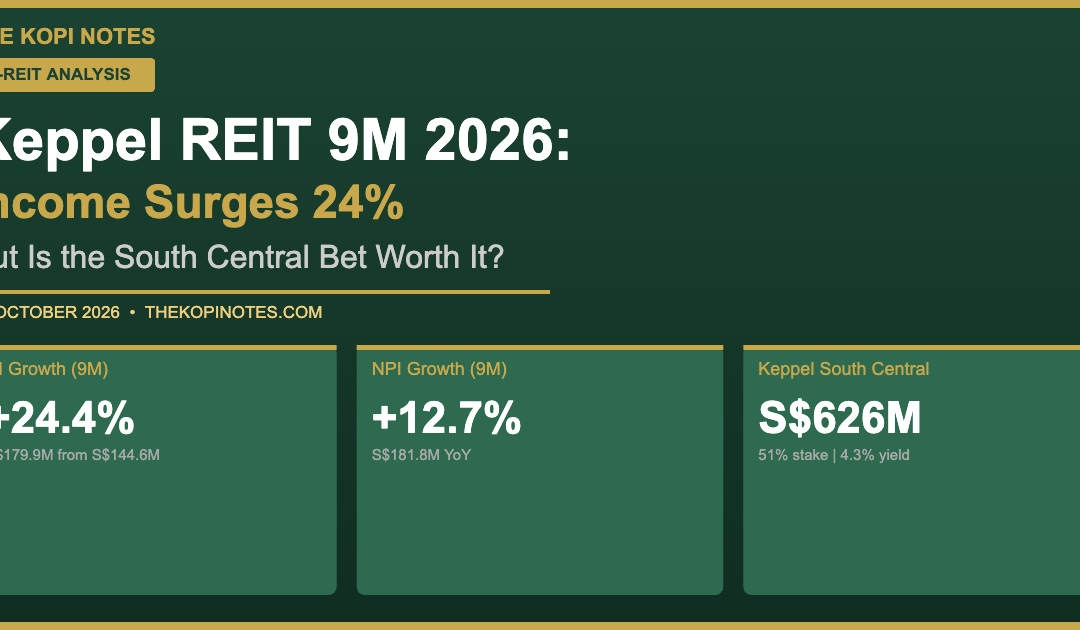
Keppel REIT’s nine-month 2026 distributable income from operations jumped 24.4% to S$179.9 million, driven by two major acquisitions — Top Ryde City Shopping Centre and a one-third stake in MBFC Tower 3. At the same time, the manager confirmed the S$626.2 million Keppel South Central deal, a bold bet on a 33-storey Grade A tower that is only 48.8% occupied. For Singapore retail investors, this creates a nuanced picture: strong numbers on paper, but a meaningful execution risk beneath.
This is an editorial analysis. Not financial advice. Data verified as at 30 October 2026.
What Just Happened: The 9M 2026 Numbers at a Glance
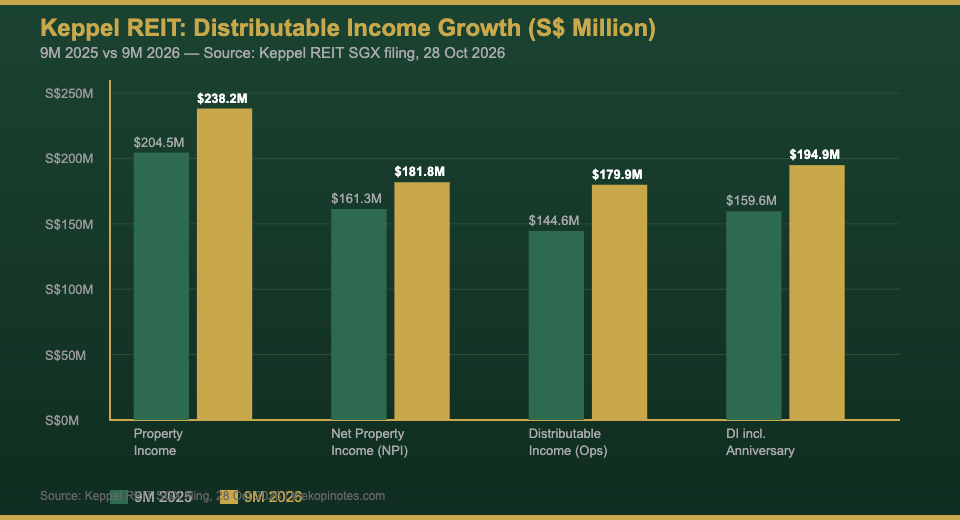
Keppel REIT (SGX: K71U) released its nine-month 2026 business update on 28 October 2026, covering the period January to September 2026. The headline number — distributable income up 24.4% to S$179.9 million — is impressive. But unpacking the details reveals a more complicated story that every Singapore investor holding or considering KREIT units should understand.
The growth was primarily acquisition-driven. Without the two major acquisitions completed in late 2025 and early 2026, organic distributable income growth would have been just 3.6%. That is still positive, but it underscores how much heavy lifting was done by buying assets rather than extracting more value from the existing portfolio.
| Metric | 9M 2025 | 9M 2026 | Change |
|---|---|---|---|
| Property Income | S$204.5M | S$238.2M | +16.6% |
| Net Property Income (NPI) | S$161.3M | S$181.8M | +12.7% |
| Distributable Income (Operations) | S$144.6M | S$179.9M | +24.4% |
| DI incl. Anniversary Distribution | S$159.6M | S$194.9M | +22.1% |
| Organic DI Growth (ex-acquisitions) | — | — | +3.6% |
Source: Keppel REIT SGX filing, 28 October 2026
The Dilution Problem: Why Your DPU Didn’t Rise as Fast as Income
Here is the part many retail investors miss. While distributable income grew by 24.4%, the number of units in issue ballooned by approximately 28% due to the January 2026 preferential offering. That offering raised about S$886.3 million and was used to fund the MBFC Tower 3 acquisition. The result: more money flowing in, but spread across far more units.
For the first half of 2026, DPU came in at 2.61 cents — a 4.0% decline from 2.72 cents in 1H 2025, despite distributable income from operations rising 25.2%. This is the textbook dilution trade-off: you buy a bigger, better portfolio, but you also issue more units to pay for it, and the per-unit payout suffers in the short term.
The manager has built in some cushion: an anniversary distribution of S$10 million per half-year, which runs until the half-year ending 30 June 2027. This adds roughly 0.20 cents per unit per half, softening the blow. After that concludes, distributions from the T Tower (South Korea) and KR Ginza II (Japan) divestments — totalling S$15 million paid in three semi-annual tranches starting 2H 2027 — will take over as a temporary income top-up.
For investors eyeing Keppel REIT for income, this is important: the DPU trajectory is a multi-year story of recovering from the dilution of the 2026 unit issuance. The underlying business is improving. The per-unit reward is lagging — and will require time and leasing success (particularly at Keppel South Central) to fully materialise.
This dynamic is well-known to REIT investors. For a deeper look at how to evaluate REIT income quality, see our Best REITs Singapore 2026 Guide.
The Keppel South Central Bet: Analysing the Risk and Reward
The most controversial element of the 9M 2026 update is the confirmation of the Keppel South Central acquisition. Announced on 20 October 2026, the deal sees Keppel REIT acquiring a 51% interest in a 33-storey, 522,500 sq ft Grade A office tower at 10 Hoe Chiang Road, Tanjong Pagar, from its sponsor Keppel Ltd at an agreed property value of S$626.2 million — or about S$2,350 per sq ft.
The deal structure is straightforward: Keppel REIT pays S$610.9 million (purchase consideration), with Keppel retaining the remaining 49% stake. Total acquisition cost comes to S$627.1 million, including stamp duty and a partially-waived acquisition fee.
At the time of signing, Keppel South Central had a committed occupancy of just 48.8% (30 September 2026). Including leases in documentation, that rises to 52.7%. By 15 October, the REIT said commitments had reached approximately 60%. A further 20% of space was reportedly under negotiation.
The building is newly completed (January 2025) and its lower-to-mid floors are the most leased. Tenants confirmed include Manulife, co-working operator Industrious, and the Competition & Consumer Commission of Singapore (CCCS). Average committed rent stands at S$11.30 psf per month — respectable for a new CBD building.
To protect investors from the income shortfall during the occupancy ramp-up, sponsor Keppel Ltd is providing an income guarantee of S$2,230,170 per month for up to five years. This is based on assumptions of 95% stabilised occupancy, average rents of S$11.15 psf per month, and a 79% operating margin. It is a meaningful protection — the annualised guarantee equates to about S$26.76 million — but it also means unitholders are effectively underwriting a leasing risk that the seller assessed as real.
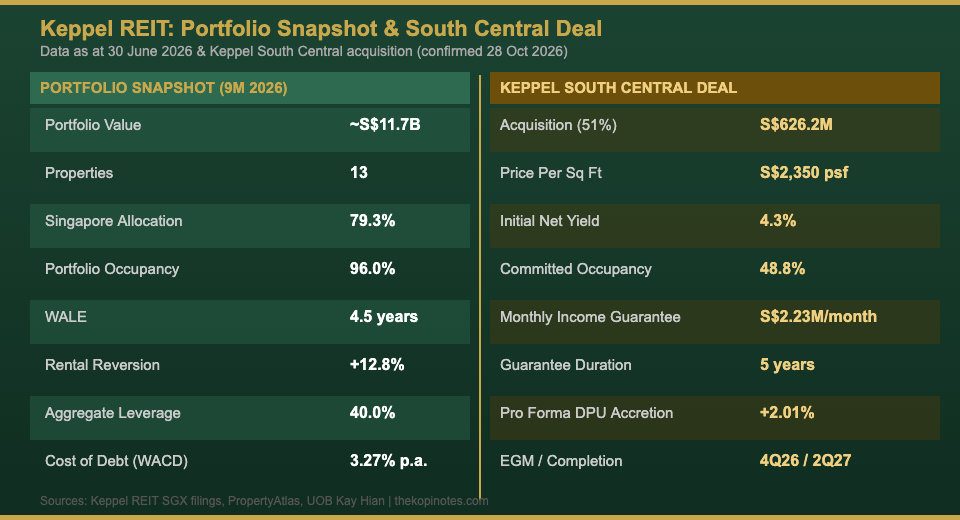
| Keppel South Central — Deal Snapshot | Details |
|---|---|
| Acquisition (51% interest) | S$626.2 million (agreed property value) |
| Price Per Sq Ft | S$2,350 psf |
| Initial Net Property Yield | 4.3% (with income support) |
| Committed Occupancy (30 Sep 2026) | 48.8% (incl. docs: 52.7%) |
| Monthly Income Guarantee | S$2.23 million/month, 5-year max |
| Key Tenants Confirmed | Manulife, Industrious, CCCS |
| EGM / Expected Completion | 4Q 2026 EGM / 2Q 2027 completion |
| Pro Forma DPU Accretion | +2.01% (on adjusted FY2025 base) |
| Post-Deal Aggregate Leverage | ~41.1% |
Source: PropertyAtlas, UOB Kay Hian, Keppel REIT SGX announcements, October 2026
The independent valuations are somewhat reassuring: Colliers valued the 51% interest at S$646.7 million (with support) and S$631.0 million (without), while CBRE came in at S$652.0 million and S$642.0 million respectively. Keppel REIT is paying 3–4% below these valuations, which suggests they are not overpaying — at least on a mark-to-model basis.
The bigger question is whether Keppel South Central can achieve 95%+ occupancy within the five-year guarantee window, and what rent it can command once the lower floors give way to harder-to-lease upper floors. If the building ramps up well, unitholders benefit. If leasing disappoints, the income support buys time but the yield will structurally underperform.
Portfolio Health Check: What Is Working Well
Away from the South Central narrative, Keppel REIT’s core Singapore portfolio continues to deliver solid results. The overall portfolio committed occupancy stood at 96.0% as of 30 June 2026, matching Singapore’s core CBD Grade A market average of 96.7% (CBRE data). Rental reversion came in at a strong +12.8%, meaning leases renewing are getting locked in at rents significantly above the expiring rates.
The weighted average lease expiry (WALE) stands at 4.5 years, with the top 10 tenants averaging 8.0 years — a stable income base. The Singapore income mix is heavily skewed toward banking, insurance and financial services (65.3% of attributable committed gross rent), with technology, media and telecommunications at 10.1%.
On the balance sheet, aggregate leverage is at 40.0%, down sharply from 47.9% at end-2025. The weighted average cost of debt is 3.27% per annum, and the interest coverage ratio is 2.7 times. The divestment of KR Ginza II (Japan) at a 28.4% premium to acquisition cost, and the planned T Tower (South Korea) divestment, underscore the manager’s strategic shift back to Singapore. Post all transactions, Singapore would represent 82% of portfolio value.
You can track how S-REIT earnings are shaping up this season in our S-REIT October 2026 Earnings Preview, which covers CICT, CapLand Ascendas REIT and Mapletree Industrial Trust.
What Analysts Are Saying
UOB Kay Hian maintained its BUY call on Keppel REIT on 21 October 2026, lifting its target price to S$1.060 from S$1.050. At the last-traded price of S$0.785, that implies approximately 35% upside. The analyst’s key thesis is the “Singapore refocus” narrative: Keppel South Central moves the portfolio further into the manager’s home market, reduces exposure to underperforming Seoul and Tokyo offices, and positions the REIT for Singapore office sector tailwinds.
The acquisition is modelled to be 2.01% DPU-accretive on an adjusted FY2025 base — modest but positive. The accretion depends critically on Keppel South Central’s leasing velocity. For context on how the broader REIT market is faring, see our Singapore Q3 2026 Market Wrap.
What Does This Mean for You as a Singapore Retail Investor?
For current KREIT unitholders, the 9M 2026 results confirm the business is growing. Income is up meaningfully, the core Singapore portfolio is performing well, and the balance sheet is in better shape than a year ago. The near-term DPU story is clouded by the unit dilution from the January 2026 offering, but the anniversary distribution provides some cushion until mid-2027.
The pivotal risk is Keppel South Central. As a retail investor, you are effectively co-underwriting a bet that a brand-new, half-empty Grade A CBD tower will fill up to 95%+ occupancy over the next few years. The EGM is expected in 4Q 2026, and completion in 2Q 2027. Given it is an interested-party transaction (Keppel Ltd holds ~33.7% of units), independent unitholders’ votes matter — and Deloitte Singapore SR&T Corporate Finance has been appointed as the independent financial adviser.
For investors considering KREIT as a new position, the 35% discount to UOB KH’s fair value is attractive if you believe in the long-term Singapore office narrative. The entry price of ~S$0.785 implies a price-to-NAV below 1x (NAV per unit: S$1.28 pre-deal, S$1.27 post-deal) — historically a reasonable entry for quality S-REITs. See our Singapore Home Prices vs S-REITs yield comparison for broader context.
Those preferring data-centre exposure within the Keppel family should read our Keppel DC REIT and the AI Boom analysis — a very different risk profile to the office REIT story here.
Bottom Line for SG Investors
Keppel REIT’s 9M 2026 results are genuinely encouraging on the income growth front. A 24.4% jump in distributable income, driven partly by smart acquisitions and partly by a healthy core portfolio posting +12.8% rental reversions, is no small feat. But the Keppel South Central deal introduces a leasing execution risk investors must not underestimate. At 48.8% occupancy, the building needs to roughly double its committed tenancy to validate the acquisition price without relying indefinitely on the sponsor’s income guarantee.
The bull case — a prime Tanjong Pagar tower, blue-chip sponsorship, 35%+ upside to fair value — is compelling. The bear case is occupancy stagnation and a DPU that continues to lag income growth due to the enlarged unit base. For long-term Singapore office bulls, Keppel REIT at current levels could be an interesting accumulation opportunity. Watch the EGM outcome in 4Q 2026 carefully. That vote, and the leasing updates that follow, will set the tone for KREIT’s distribution trajectory through 2027 and beyond.
Check back on our Singapore market watchlist for updates as the story develops.
FAQ: Keppel REIT 9M 2026 Results & Keppel South Central Deal
What were Keppel REIT’s 9M 2026 distributable income results?
Keppel REIT’s distributable income from operations for 9M 2026 rose 24.4% year on year to S$179.9 million, from S$144.6 million in 9M 2025. Including the anniversary distribution, total distributable income increased 22.1% to S$194.9 million.
Why did DPU fall even though distributable income rose significantly?
Keppel REIT completed a preferential offering in January 2026 that raised approximately S$886.3 million, issuing roughly 923 million new units. This expanded the unit base by about 28%, meaning each unit receives a smaller share of total distributable income. In 1H 2026, DPU was 2.61 cents — down 4.0% from 2.72 cents in 1H 2025 — despite distributable income growing 22.8% over the same period. The anniversary distribution of S$10 million per half-year provides a partial offset until mid-2027.
What is the Keppel South Central deal?
Keppel REIT agreed on 20 October 2026 to acquire a 51% interest in Keppel South Central — a newly completed 33-storey, 522,500 sq ft Grade A office tower at 10 Hoe Chiang Road, Tanjong Pagar — from its sponsor, Keppel Ltd, at an agreed property value of S$626.2 million. The purchase consideration is S$610.9 million. The deal requires EGM approval in 4Q 2026, with completion targeted for 2Q 2027.
Why is Keppel South Central’s occupancy so low, and what is the income guarantee?
The building was completed in January 2025 and is still in its lease-up phase. Committed occupancy stood at 48.8% (30 September 2026), rising to 52.7% including leases in documentation. By 15 October, commitments had reportedly reached ~60%. To compensate unitholders for the income shortfall, sponsor Keppel Ltd provides an income guarantee of S$2,230,170 per month for up to five years, based on 95% stabilised occupancy at S$11.15 psf per month.
Is Keppel REIT’s balance sheet healthy after the South Central acquisition?
Currently, aggregate leverage is 40.0% — significantly improved from 47.9% at end-2025. Post the Keppel South Central acquisition (and assuming both T Tower and KR Ginza II divestments complete), leverage is expected to reach approximately 39.2%. Without those divestments, post-deal leverage is modelled at ~41.1%. The weighted average cost of debt is 3.27% p.a. with interest coverage of 2.7 times.
What is the analyst consensus on Keppel REIT?
UOB Kay Hian maintained a BUY rating with a target price of S$1.060 (as of 21 October 2026), implying approximately 35% upside from S$0.785. The thesis centres on Singapore office sector tailwinds and the expected +2.01% DPU accretion from Keppel South Central once stabilised. The key risk is leasing execution at the half-empty new tower.
This article was researched with the help of AI. While we strive to keep all information accurate and up to date, there may be errors. If you notice any discrepancies, please contact us.